
AgentBooks vs SEO Content Machine: Which AI Content Platform Fits Your Workflow?
If you are comparing AI content automation platforms, you have probably noticed that AgentBooks and SEO Content Machine (SCM) both promise to reduce the manual work of planning, writing, and publishing SEO content. But they approach the problem from different angles. AgentBooks is a web-based platform built around brand intelligence and an always-on content engine, while SCM is a desktop application that has evolved into an agentic SEO workspace with deep WordPress integration and programmatic SEO features.
This comparison breaks down what each tool actually does, where they differ, and how to decide which one matches your team's needs. All product details come from the vendors' own descriptions; no rankings or traffic outcomes are guaranteed by either platform.
Quick comparison: AgentBooks vs SEO Content Machine
First viewport screenshot of Changelog | SEO Content Machine.
| Feature | AgentBooks | SEO Content Machine (SCM) |
|---|---|---|
| Platform | Web-based | Desktop app (Windows, Mac, Linux) |
| Core approach | Brand intelligence + always-on content engine | Agentic SEO workspace + programmatic SEO |
| Website crawling | Yes, builds a reusable brand dataset | Connects to your site and Google Search Console |
| Keyword planning | Categorized keyword plans | AI agent reads real search demand and plans topics |
| Content creation | Approval-first article workflows, scheduled generation | AI Writer with polish/rewrite, Page Pipeline for bulk CSV generation |
| Publishing | Multilingual publishing, custom domain, AgentBooks-hosted sites | Direct publishing to WordPress |
| Internal linking | Link management | Automated internal linking |
| AI model support | Built-in | Multiple models via OpenRouter, Gemini, Claude, local models; bring your own keys |
| API / integrations | Not specified | TAPI API, MCP server for Claude Code, N8N |
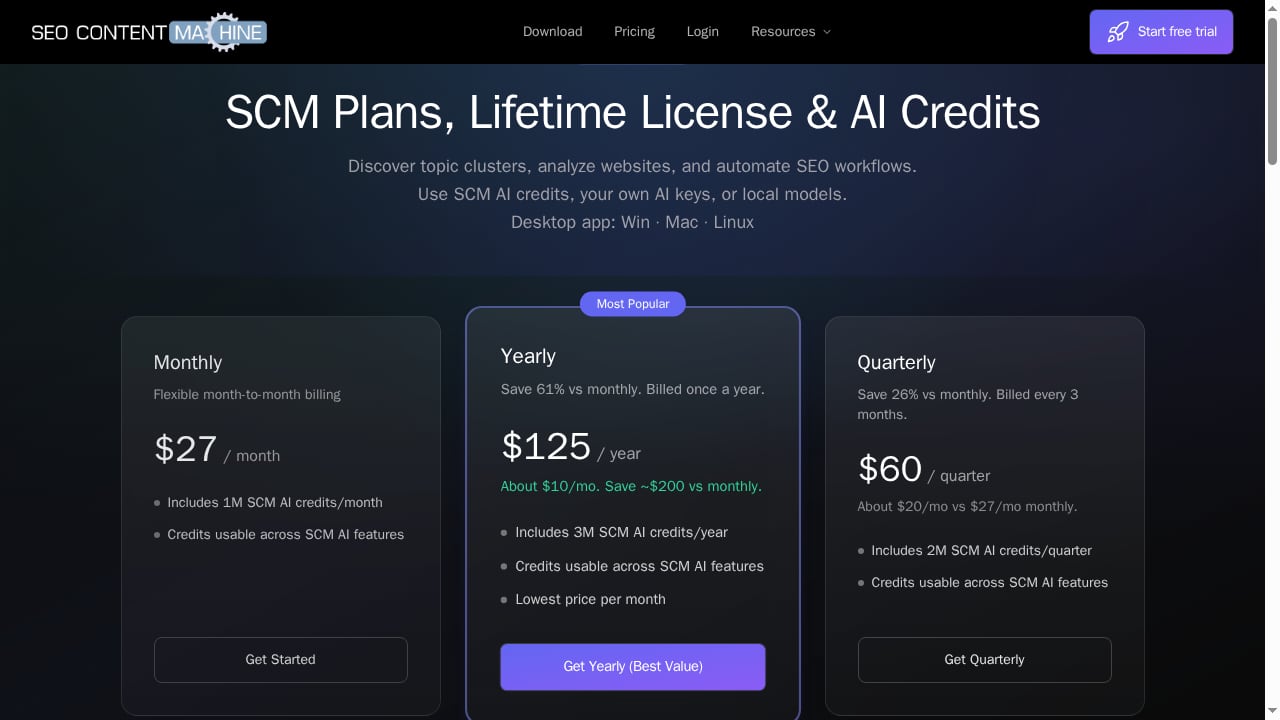
| Pricing | Free public beta (1 brand), Business $30/mo, Enterprise $100/mo | 14-day free trial (100k credits), monthly $27, quarterly $60, yearly $125, lifetime $208 |
| Best for | SaaS, e-commerce, agencies, founders wanting brand-consistent automation | Users wanting desktop control, programmatic SEO, and model flexibility |
What AgentBooks does well
AgentBooks is designed to turn a website into a self-sustaining content operation. You submit your site once, and the platform crawls it to build a reusable brand dataset. That dataset informs topic planning, market mapping, and article creation in your brand's voice. The workflow is approval-first: you review and approve articles before they go live, which keeps editorial control in human hands.
Key strengths include:
- Brand intelligence: The platform learns your product and market from your website, so content reflects your positioning rather than generic AI output.
- End-to-end pipeline: Keyword planning, organic search research (top three organic results, excluding ads), TDK optimization, image and link management, and publishing all live in one workspace.
- Scheduled content generation: The Business plan ($30/month) supports scheduled operations, making it suitable for teams that want consistent publishing without manual triggers.
- Multilingual publishing and hosted sites: You can publish in multiple languages and use AgentBooks-hosted content sites with a custom domain.
- Transparent pricing: A free public beta for one brand, a $30/month Business plan, and a $100/month Enterprise plan for multiple brand workspaces and higher capacity.
AgentBooks is particularly strong for SaaS teams, e-commerce and DTC brands, digital agencies, founders, and independent websites that want to scale organic content without multiplying editorial overhead. The platform does not guarantee rankings or traffic, which is an honest limitation to keep in mind.
What SEO Content Machine does well
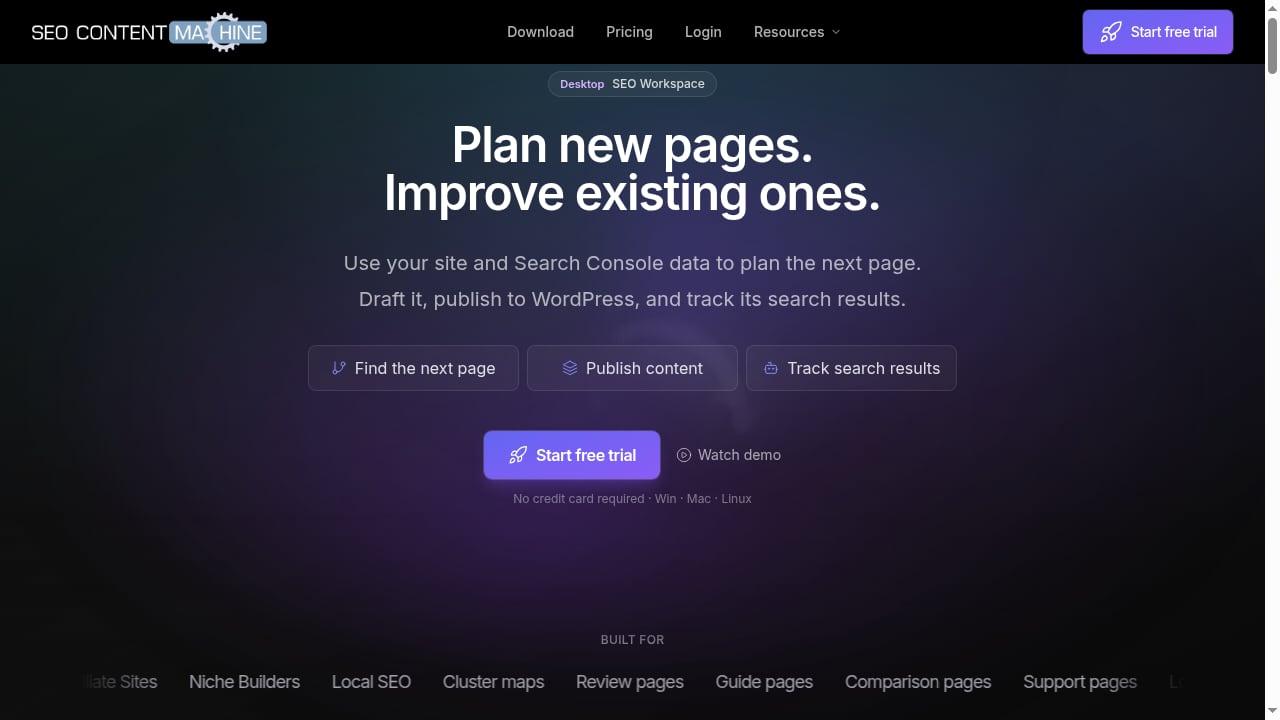
First viewport screenshot of seocontentmachine.com.
SEO Content Machine has moved beyond its roots as a content spinner into an agentic SEO workspace. It connects to your website and Google Search Console, then uses an AI agent to read your pages and real search demand to plan new content and identify existing pages to refresh. The workspace includes a site plan, link graph, document editor, and chat interface.
Key strengths include:
- Programmatic SEO: Starting from a single seed keyword, SCM can generate full topic clusters and page plans. The Page Pipeline supports bulk content generation from CSV imports, which is useful for large-scale programmatic pages.
- WordPress publishing: You can draft, edit, and publish pages directly to WordPress without leaving the tool.
- Model flexibility: SCM integrates with multiple AI models, including OpenRouter, Gemini, Claude, and local models. You can bring your own API keys or run local models, which may appeal to users with specific cost or privacy requirements.
- Automation and integrations: An API (TAPI) and MCP server enable automation and integration with external tools like Claude Code and N8N.
- Lifetime license option: A one-time lifetime license at $208 is available, alongside monthly ($27), quarterly ($60), and yearly ($125) plans. A 14-day free trial includes 100,000 AI credits.
SCM is positioned as an all-in-one SEO workspace with a focus on automation and agentic workflows. It is a strong fit for users who prefer a desktop application, want granular control over AI models, or need programmatic SEO at scale.
Where AgentBooks and SCM differ most
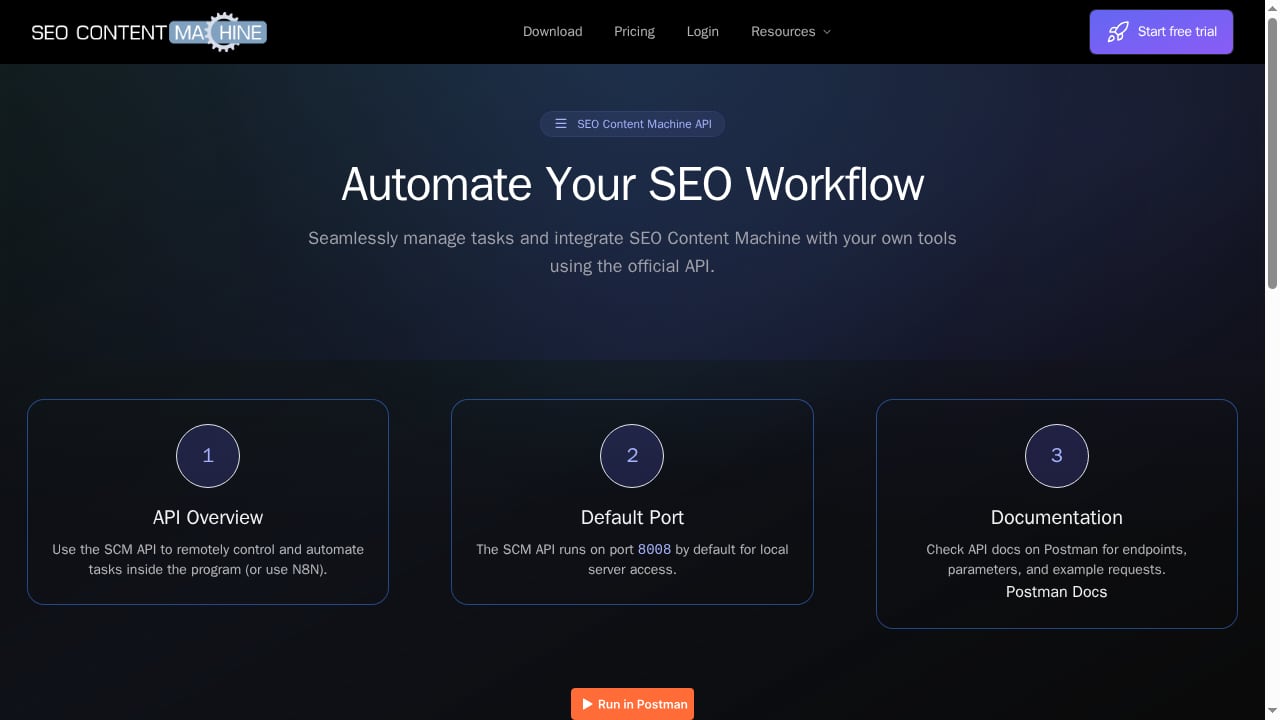
First viewport screenshot of seocontentmachine.com.
Brand voice and editorial control
AgentBooks builds a reusable brand dataset by crawling your website, then uses that dataset to generate content in your brand's voice. The approval-first workflow means every article can be reviewed before publishing. SCM offers an AI Writer with polish and rewrite tools, but its focus is more on agentic planning and bulk generation than on building a persistent brand dataset. If brand consistency across hundreds of articles is a priority, AgentBooks has a clearer mechanism for it.
Platform and workflow
AgentBooks is web-based, which means no installation and access from any device. SCM is a desktop application for Windows, Mac, and Linux. Desktop tools can offer more local control and offline capabilities, but they may also require more setup and maintenance. Web-based platforms are generally easier for teams to collaborate on, though SCM's chat interface and document editor provide a collaborative feel within the desktop app.
Programmatic SEO vs. always-on content engine
SCM shines at programmatic SEO: generating topic clusters and bulk pages from CSV imports. This is ideal for sites with large, structured datasets (e.g., directories, e-commerce filters, or location pages). AgentBooks focuses on an always-on content engine: scheduled, brand-consistent articles that build topical authority over time. If your strategy relies on hundreds of templated pages, SCM's Page Pipeline is a better fit. If you need a steady stream of researched, voice-matched articles, AgentBooks is more aligned.
Pricing and value
AgentBooks offers a free public beta for one brand, then $30/month for the Business plan and $100/month for Enterprise. SCM offers a 14-day free trial with 100,000 credits, then $27/month, $60/quarter, $125/year, or a $208 lifetime license. SCM's lifetime license can be attractive for budget-conscious users who want to avoid recurring fees. However, AgentBooks' pricing includes brand intelligence and hosted content sites, which SCM does not offer. The right choice depends on whether you value a one-time payment or an ongoing service with brand-building features.
AI model flexibility
SCM supports multiple AI models, including OpenRouter, Gemini, Claude, and local models, and allows you to bring your own keys. This is a significant advantage for users who want to optimize costs or use specific models. AgentBooks uses its own built-in AI models, which simplifies setup but offers less flexibility. If model choice is critical, SCM wins on this point.
When to choose AgentBooks
- You want a web-based platform that learns your brand from your website and generates content in your voice.
- You need an approval-first workflow with scheduled publishing.
- You value an all-in-one workspace that includes keyword planning, organic research, TDK optimization, and multilingual publishing.
- You are a SaaS team, e-commerce brand, agency, or founder looking for an always-on content engine without managing multiple tools.
- You want a free beta to test the platform before committing.
When to choose SEO Content Machine
First viewport screenshot of seocontentmachine.com.
- You prefer a desktop application with local control and the ability to use your own AI models or local models.
- You need programmatic SEO features like bulk CSV imports and topic cluster generation.
- You want direct WordPress publishing and automated internal linking.
- You need API access (TAPI) or MCP server integration for custom automation with tools like Claude Code or N8N.
- You are attracted to a one-time lifetime license at $208.
Practical examples: how each tool fits a workflow
Scenario 1: A SaaS company launching a new feature. AgentBooks would crawl the site, learn the product, plan topics around the new feature, and generate approval-ready articles in the brand's voice on a schedule. SCM could connect to Search Console, identify existing pages to refresh, and use its AI Writer to draft updates, but it would rely more on manual input for brand voice consistency.
Scenario 2: An e-commerce site with 500 product categories. SCM's Page Pipeline could ingest a CSV of categories and generate pages at scale, with automated internal linking. AgentBooks could still produce category-level content, but its strength is in researched articles rather than templated bulk pages.
Scenario 3: A digital agency managing multiple clients. AgentBooks' Enterprise plan ($100/month) supports multiple brand workspaces, making it easy to separate client sites. SCM's desktop app can handle multiple projects, but collaboration across a team may be less seamless than a web-based platform.
The broader shift: from SEO to GEO and AEO
As AI answer engines and agents become more prevalent, content strategies are evolving. According to netzstrategen's analysis of search behavior, visibility is shifting from traditional search results to AI-generated answers. The article notes that AI traffic converted 42% better than classic organic traffic in March 2026, and that structured, factual, question-answer content is more likely to be cited. Both AgentBooks and SCM can help produce structured content, but AgentBooks' focus on brand intelligence and approval workflows may better support the consistency and factual specificity that AI engines reward.
For a deeper look at how AI is reshaping commerce, McKinsey's analysis of agentic commerce explores how AI shopping agents are transforming retail. This context matters because content that is machine-readable and brand-consistent will be more valuable as agents become intermediaries.
Related reading
- auto-post.io Review 2026: Hands-Off AI Blog Automation Tested - Evidence-based auto-post.io review: AI blog automation, multi-CMS publishing, pricing, setup, strengths, limits, and who should use it in 2026.
Sources and further reading
- Machined Meaning: Definition, Synonyms, and AI Content Use - Machined means made or finished by machine, or cut and shaped with precision. Learn the definition, synonyms, and why the word now describes AI content workflows.
FAQ
Is AgentBooks better than SEO Content Machine?
Neither is universally better. AgentBooks excels at brand-consistent, always-on content generation with an approval-first workflow, while SCM excels at programmatic SEO, desktop control, and AI model flexibility. Choose based on your workflow priorities.
Can I use both AgentBooks and SEO Content Machine?
Yes. Some teams might use SCM for bulk programmatic pages and AgentBooks for brand-driven articles. However, running two platforms adds complexity and cost, so evaluate whether one tool can cover your core needs.
Does AgentBooks guarantee rankings or traffic?
No. AgentBooks explicitly does not guarantee rankings or traffic. It is a content automation platform designed to scale production, but SEO results depend on many factors including competition, site authority, and content quality.
Is SEO Content Machine only for Windows?
No. SCM is available for Windows, Mac, and Linux as a desktop application.
Which tool is more affordable?
SCM has a lower monthly entry price ($27 vs. $30) and a lifetime license option ($208). AgentBooks offers a free public beta and includes brand intelligence and hosted content sites in its plans. Consider total value, not just sticker price.
Conclusion
AgentBooks and SEO Content Machine are both capable AI content automation platforms, but they serve different needs. AgentBooks is a web-based, brand-centric platform that turns your website into an always-on content engine with approval-first workflows and multilingual publishing. SCM is a desktop-based agentic SEO workspace with strong programmatic SEO features, model flexibility, and a lifetime license option.
If you prioritize brand voice consistency, scheduled publishing, and an all-in-one web platform, AgentBooks is likely the better fit. If you need programmatic SEO at scale, desktop control, or the ability to use your own AI models, SCM may be the stronger choice. For a broader view of the market, see our Top 10 AI Content Marketing and SEO Platforms 2026 and compare AgentBooks with other tools like GravityWrite and Search Atlas. You can also explore how Ahrefs free sign-up fits into an AI content workflow.