
How to Use AgentBooks with SE Ranking: AI SEO Workflow
AgentBooks turns your website into a continuous content engine, while SE Ranking supplies the keyword data, rank tracking, and audit signals that keep that engine pointed at real demand. Used together, they close the loop between planning, publishing, and measuring organic performance.
This guide explains the combined workflow, setup steps, practical examples, and the problems the pairing solves. It is written for SaaS teams, e-commerce and DTC sites, digital agencies, founders, and independent website owners who want a repeatable content operation rather than one-off articles.
Why combine AgentBooks and SE Ranking?
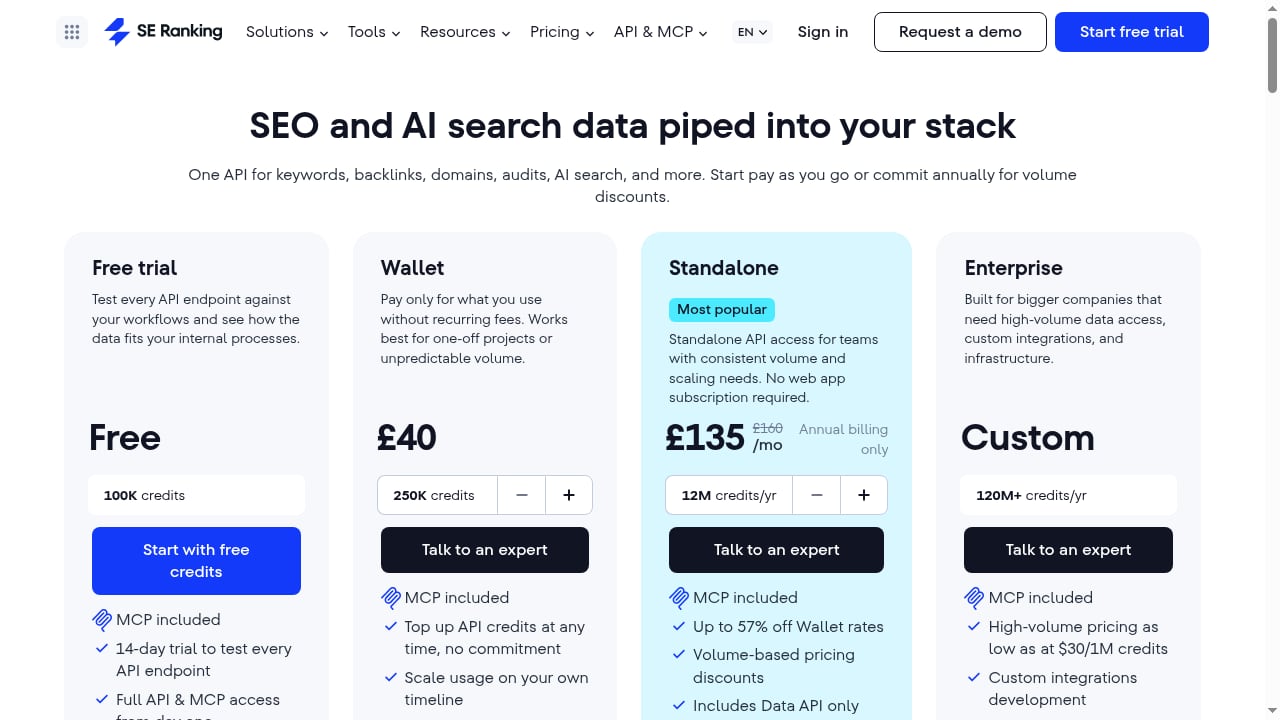
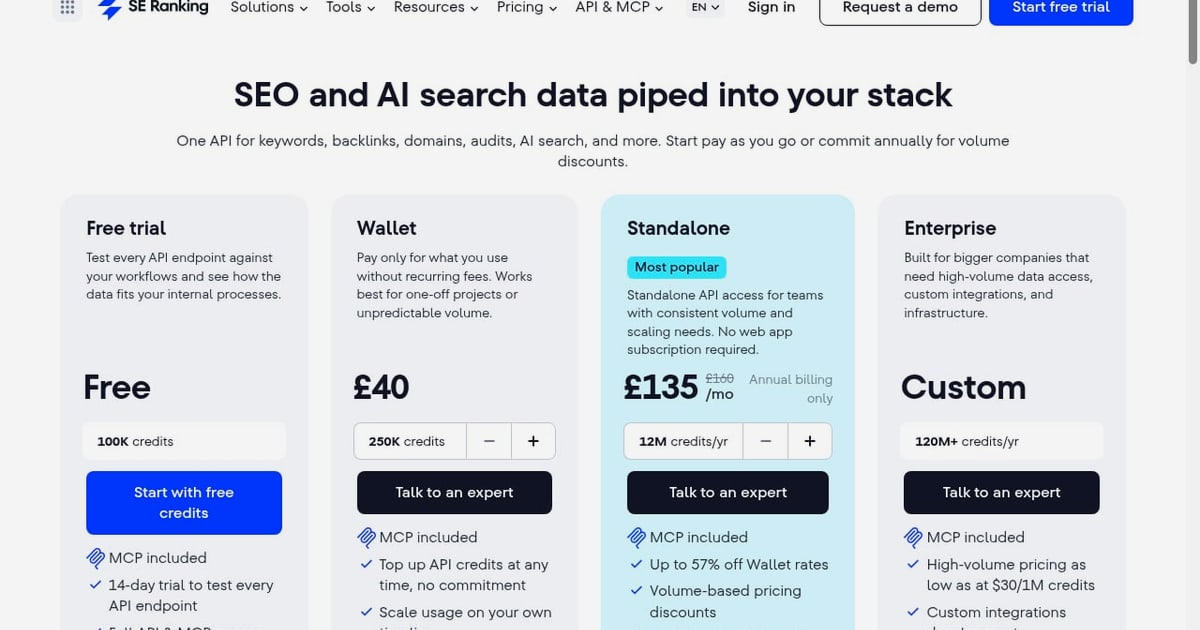
First viewport screenshot of SE Ranking API Pricing: Free Trial, Wallet, Annual Plans.
AgentBooks handles the heavy lifting of content production: it crawls your site to learn the product, maps the market, plans topics, researches top organic results, drafts articles in your brand voice, and publishes on a schedule. SE Ranking provides the external SEO intelligence layer: accurate keyword data, competitor tracking, site audits, and automated reports.
On their own, each tool leaves a gap. A content engine without reliable keyword data can publish consistently but miss demand. An SEO platform without a production workflow can surface opportunities but leave you to write and ship everything manually. Together, they cover the full path from opportunity to published asset to measured result.
If you are still evaluating the content side, the comparison of AgentBooks vs MarketMuse is useful for understanding where a planning tool ends and a full content engine begins.
What each tool does best
First viewport screenshot of SE Ranking — AI SEO Software That Gets Results.
AgentBooks: the content engine
AgentBooks starts from real product data rather than blank prompts. After you share your website once, it builds brand intelligence, creates a categorized keyword plan, and runs an approval-first article workflow. Core capabilities include:
- Brand intelligence from website crawling
- Categorized keyword planning
- Top organic-result research for each topic
- Scheduled content generation and publishing
- SEO preparation: titles, descriptions, keywords, images, tags, and links
- Custom domain and site identity
- Multilingual publishing
- Multi-brand workspaces
AgentBooks does not guarantee rankings or traffic. It optimizes the content process and the measurable inputs that feed it.
SE Ranking: the SEO data layer
SE Ranking is an AI SEO tool that pays for itself through accurate data, actionable insights, and automated reports. Its strengths sit in keyword research, rank tracking, competitor analysis, site auditing, and reporting. That data is what tells you whether the content engine is moving in the right direction.
The combined workflow: step by step
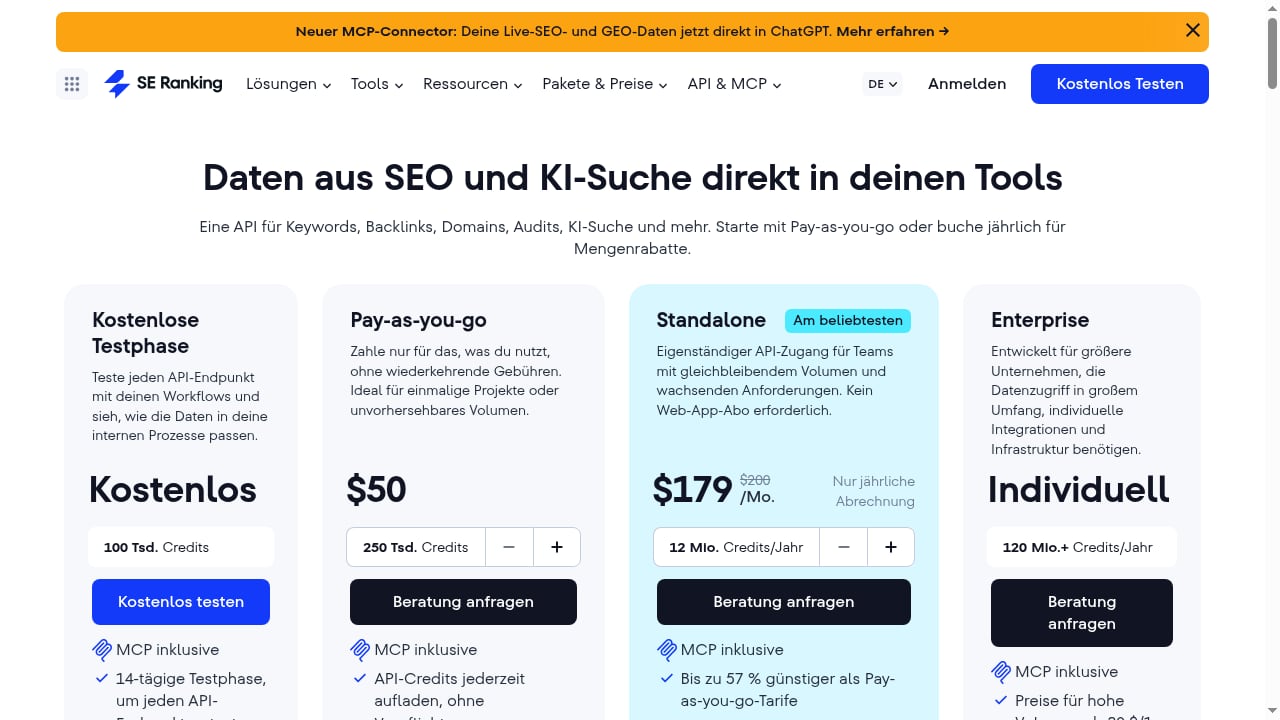
First viewport screenshot of SE Ranking API-Preise: kostenlos testen, PAYG, Jahrespläne.
Step 1: Seed AgentBooks with your website
Connect your site in AgentBooks and let it crawl. This produces the brand profile, product understanding, and initial market map. If you run multiple brands, use separate workspaces so each one keeps its own voice and keyword plan.
Step 2: Pull keyword opportunities from SE Ranking
In SE Ranking, run keyword research for your core topics. Export or note the clusters with meaningful volume and realistic difficulty. Look at competitor rankings to see which pages are earning positions you could contest.
Step 3: Feed those clusters into the AgentBooks keyword plan
AgentBooks already generates a categorized keyword plan. Use the SE Ranking data to validate and prioritize it. Promote clusters with strong intent and achievable difficulty; deprioritize vanity terms. This is where the two tools reinforce each other: AgentBooks proposes, SE Ranking validates.
Step 4: Approve topics and let AgentBooks draft
AgentBooks researches the top organic results for each approved topic and drafts an article in your brand voice. The approval-first workflow means nothing publishes without a human decision. Review for accuracy, tone, and product fit.
Step 5: Publish on a schedule
AgentBooks handles SEO preparation and publishing to your custom domain or connected site. Scheduling keeps output steady instead of bursty, which matters for both readers and search engines.
Step 6: Track results in SE Ranking
Add your published URLs to SE Ranking rank tracking. Monitor position changes, impressions, and which pages attract links or AI citations. Use the audit tool to catch technical issues that could suppress otherwise strong content.
Step 7: Feed insights back into the plan
Every reporting cycle should change the next cycle's plan. Pages that rank well get expanded or internally linked. Pages that stall get rewritten, merged, or retired. This feedback loop is what separates a content engine from a content treadmill.
Practical example: a SaaS feature cluster
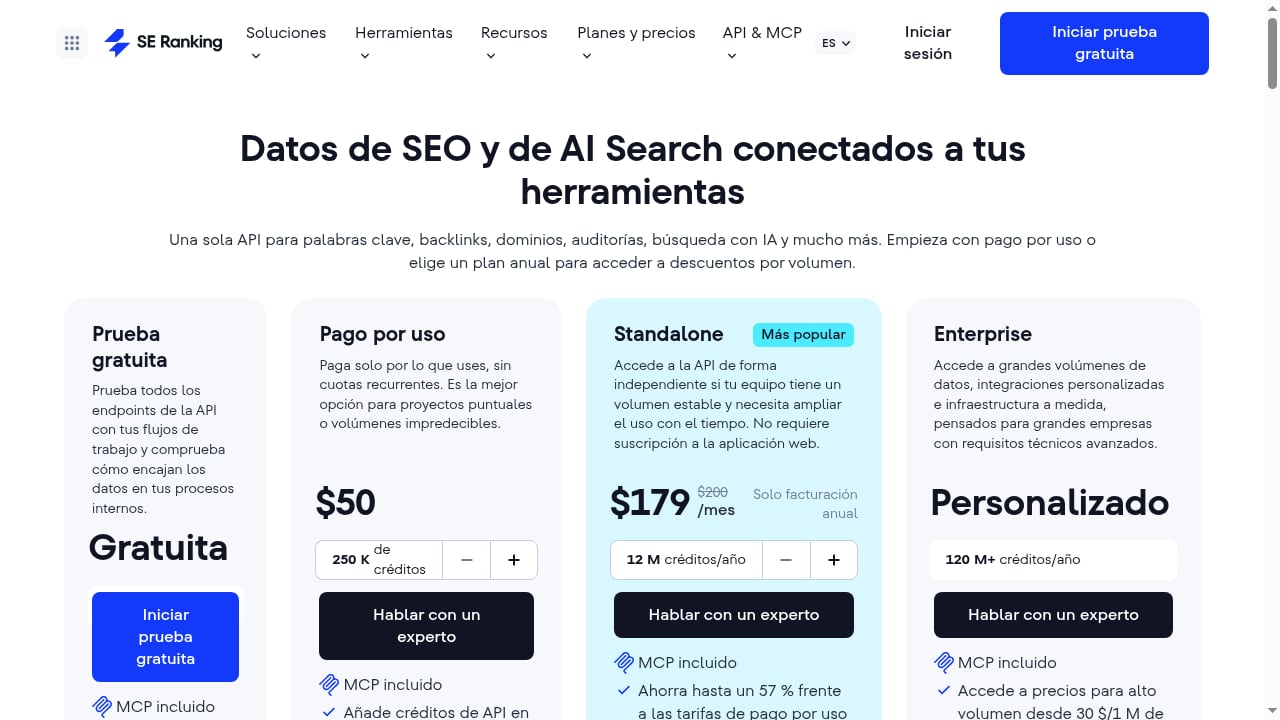
First viewport screenshot of Precios de la API de SE Ranking: prueba gratuita, pago por uso, planes anuales.
Imagine a project management SaaS. SE Ranking shows that "resource allocation template" and "capacity planning for agencies" have steady volume and moderate difficulty, while a broad term like "project management" is dominated by large brands.
You feed the two specific clusters into AgentBooks. It drafts a template-focused article and a capacity-planning guide, each researched against current top results. You approve both, schedule them a week apart, and add the URLs to SE Ranking rank tracking.
Six weeks later, the template article sits on page two and earns a few backlinks. You ask AgentBooks for a follow-up that targets a related long-tail term and links back to the template. The capacity-planning guide stalls, so you merge it into a broader operations article instead of letting it sit.
That cycle — data in, content out, results back in — is the entire point of the pairing.
Practical example: an e-commerce category push
A DTC store wants to rank category pages and supporting blog content. SE Ranking identifies which category keywords competitors own and which informational queries feed those categories. AgentBooks produces buying guides and comparison articles that link to the category pages, while the category pages themselves get optimized titles and descriptions.
Because AgentBooks supports multilingual publishing, the same workflow can extend to new markets once the primary language cluster is stable.
Where the combination solves real problems
- Inconsistent publishing: scheduling in AgentBooks keeps output steady.
- Keyword guesswork: SE Ranking replaces assumptions with data.
- Slow production: AgentBooks compresses research and drafting time.
- No measurement: SE Ranking rank tracking and reports show what actually moved.
- Multi-brand chaos: separate AgentBooks workspaces plus separate SE Ranking projects keep brands cleanly separated.
- Agency reporting: automated SE Ranking reports reduce manual client reporting work.
Decision guidance: when this pairing fits
This combination fits teams that want to publish consistently and measure honestly. It is a strong fit for lean SaaS teams, agencies managing several clients, and founders who need content output without hiring a writing team.
It is a weaker fit if you only need a one-time audit, or if you already have a mature editorial team and a separate analytics stack that covers the same ground. In those cases, evaluate whether you need the full engine or just one half of it. For a broader view of how content engines compare, see the AgentBooks vs Growth Engine Hub breakdown.
Setup checklist
- Connect your website to AgentBooks and confirm the brand profile.
- Create a matching project in SE Ranking for the same domain.
- Run keyword research in SE Ranking and shortlist clusters.
- Align the AgentBooks keyword plan with those clusters.
- Approve the first batch of topics.
- Schedule publishing and add URLs to rank tracking.
- Review performance monthly and adjust the plan.
Related reading
- AgentBooks vs QuickCreator vs GTM AI for Solo Founders - Compare AgentBooks, QuickCreator's AI content team, and GTM AI for solo founders. See which fits content automation, publishing, and go-to-market tasks.
- AgentBooks vs Growth Engine Hub: Which AI Content Engine Wins? - AgentBooks vs Growth Engine Hub compared: brand intelligence, keyword planning, publishing workflow, channels, and pricing to pick the right AI content engine.
- Averi Review 2026: Honest Look at the AI Content Engine - Averi review for founders and lean teams: how the Brand Core and Strategy Map work, real pricing, SEO/GEO scoring, limitations, and who should buy.
Sources and further reading
- ChatGPT Agent isn’t magic: Here’s what it can (and can’t) do - I tested ChatGPT Agent for digital marketing. Here's what impressed (and what didn't).
- 🦸 The Solo-Founder Playbook 📘: Zero to Hero - Part 1 🚀 - A deep, opinionated, practical guide for the human running a software business alone. Hard-won lessons, decision frameworks, and the actual mechanics of going from idea → first dollar → first $10K MRR...
- Using AI Agents to Build Real Products - Explore top LinkedIn artificial intelligence content from experienced professionals.
FAQ
Does AgentBooks replace SE Ranking?
No. AgentBooks produces and publishes content; SE Ranking provides keyword data, rank tracking, audits, and reporting. They cover different parts of the workflow.
Can I use SE Ranking data inside AgentBooks?
You use SE Ranking research to validate and prioritize the AgentBooks keyword plan. The two tools complement each other rather than sharing a direct integration.
Does AgentBooks guarantee rankings?
No. AgentBooks optimizes the content process and measurable inputs. Rankings depend on many factors outside any single tool.
How long before I see results?
Content typically needs several weeks to months to gain traction. SE Ranking rank tracking shows movement over time, which is why the feedback loop matters more than any single article.
Is this workflow suitable for agencies?
Yes. Multi-brand workspaces in AgentBooks and separate SE Ranking projects make it practical to run the same workflow across multiple clients.
What if I only have a small site?
Start with a narrow cluster, publish consistently, and measure in SE Ranking. The workflow scales down as easily as it scales up.
Conclusion
AgentBooks and SE Ranking solve different halves of the same problem. AgentBooks keeps content flowing from real product understanding; SE Ranking keeps that content accountable to actual search data. Set up both, run the seven-step loop, and let the reporting cycle steer the next batch of topics. The result is a content operation that improves with every iteration instead of restarting from scratch.
For a closer look at how AgentBooks compares with other content engines, read the AgentBooks vs AirOps vs Averi comparison.