
AgentBooks vs Brafton: AI Engine or Agency?
Choosing between an AI content automation platform and a full-service content marketing agency is a decision about how you want content to get made. AgentBooks is built to turn your website into an always-on content engine that plans, researches, drafts, and stages articles for approval. Brafton is a long-established agency that pairs human strategists and creators with an AI Studio to run campaigns for B2B and B2C brands. They can both produce content, but they solve different problems for different teams. This comparison breaks down how each works, where each is strong, and which one fits your situation.
What AgentBooks does
First viewport screenshot of $12K Worth of Traffic to 1 Stanford University Blog Post | Brafton.
AgentBooks is an AI-powered content automation platform. You share your website once, and the system learns your product, maps your market, plans topic clusters, researches organic search results, and continuously publishes useful content in your brand's voice. The workflow is approval-first: drafts are staged for review before anything goes live.
Core capabilities include:
- Brand intelligence from website crawling — the platform reads your product pages and existing content to build a factual knowledge base, rather than starting from a blank prompt.
- Categorized keyword planning — keywords are grouped into logical topic clusters with a content calendar attached.
- Top organic-result research — the system checks what already ranks for target topics before drafting.
- SEO preparation — title, description, keywords, images, tags, and links are prepared as part of each article.
- Custom domain and multilingual publishing — content can be published to your own site in multiple languages.
- Multi-brand workspaces — agencies and portfolio owners can manage several brands from one place.
Pricing is transparent and self-serve: a free plan during public beta, a Business plan at $30/month, and an Enterprise plan at $100/month. AgentBooks does not guarantee rankings or traffic; it optimizes the content process and the measurable inputs that feed it.
What Brafton does
First viewport screenshot of 1 Infographic Series, 500 Backlinks for Preply — and Counting | Brafton.
Brafton is a full-service content marketing agency that positions itself as the world's best content marketing agency. It provides creative and strategic content marketing, SEO, PPC management, and digital marketing services to businesses across industries. Its clients include B2B and B2C brands, enterprise companies, universities, and mid-sized businesses.
Brafton's core offerings include content creation, SEO campaigns, PPC management, infographic design, website design, UX redesign, and custom training summits. It also offers an AI Studio intended to strengthen AI visibility and scale content across complex topics. The agency emphasizes industry-specific content and thought-leadership positioning.
Brafton publishes case studies with specific outcomes, including:
- A 55% increase in site conversions for Rubbermaid Commercial Products Australia.
- 500+ backlinks from an infographic series for Preply.
- $30,000 in estimated traffic value from a single blog post for AppDirect.
- A 349% increase in Google AIO presence for EOS GmbH.
These are agency-delivered results that combine human strategy, creative production, and campaign execution.
How the two approaches differ
First viewport screenshot of 4 Brands, 4 Sites & Traffic Galore for Clemens Food Group | Brafton.
| Dimension | AgentBooks | Brafton |
|---|---|---|
| Model | Self-serve AI content automation software | Full-service content marketing agency |
| Starting point | Your website's product facts and market data | Human strategy, client goals, and campaign planning |
| Workflow | Approval-first drafts staged automatically | Agency-managed strategy, creation, and execution |
| Pricing | Free plan, $30/month Business, $100/month Enterprise | Service engagement; not a self-serve SaaS price |
| Scope | Content planning, research, drafting, SEO prep, publishing | Content, SEO, PPC, design, UX, email, social, and more |
| Human involvement | You review and approve | Agency team executes with your input |
| Best for | Teams that want to own and scale a content engine | Brands that want a managed, multi-channel partner |
Automation vs. managed service
The clearest difference is who does the work. AgentBooks runs a pipeline: it plans topics, researches search results, drafts articles, prepares SEO elements, and stages them for your approval. You set the cadence and review the output. Brafton assigns strategists, writers, and specialists to plan and execute campaigns on your behalf. If you want to keep content operations in-house and scale output without scaling headcount, AgentBooks is built for that. If you want an external team to own strategy and execution across channels, Brafton is built for that.
Brand voice and factual grounding
AgentBooks builds brand intelligence directly from your website, so articles reference verified product details rather than generic assumptions. Brafton's brand voice comes from human strategists and editorial oversight, which can capture nuance, positioning, and thought-leadership angles that a crawler may miss. The trade-off is speed and cost: human-led brand work is slower and more expensive per article, while automated brand intelligence is faster and cheaper but depends on the quality of your site content.
Pricing transparency
AgentBooks publishes its pricing openly: free during beta, $30/month for Business, $100/month for Enterprise. Brafton's pricing is not listed publicly; it is structured around service engagements. For a lean team that needs predictable monthly costs, AgentBooks is easier to budget. For an enterprise that wants a managed partner and is comfortable with retainer pricing, Brafton's model is standard.
Scope and channels
Brafton covers far more than articles: SEO consulting, PPC, email marketing, social media, UX and web design, and infographic production. AgentBooks focuses on the content engine: planning, research, drafting, SEO preparation, and publishing. If your bottleneck is content volume and consistency, AgentBooks addresses it directly. If your bottleneck is a fragmented multi-channel marketing program, Brafton's breadth is an advantage.
When AgentBooks is the better fit
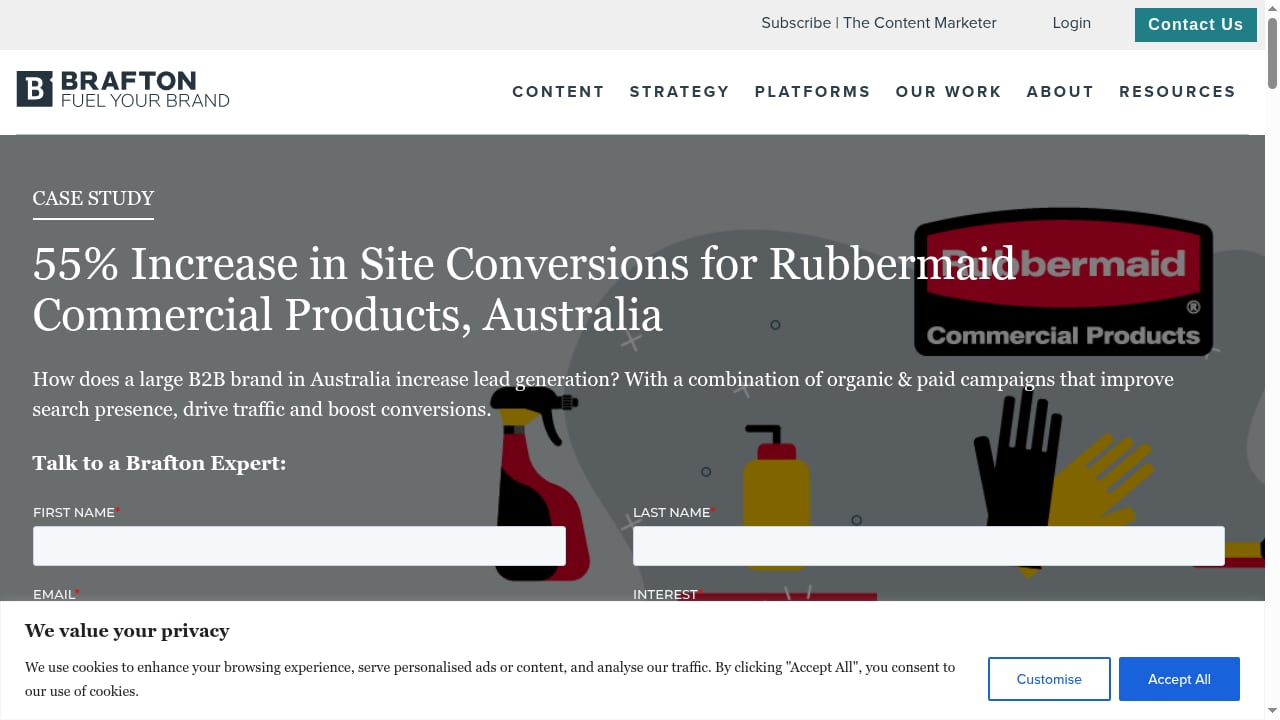
First viewport screenshot of 55% Increase in Site Conversions for Rubbermaid Commercial Products, Australia | Brafton.
- You are a SaaS team, e-commerce or DTC site, digital agency, founder, or independent site owner who wants to publish consistently without hiring a large editorial team.
- You want to own the content process and keep costs predictable.
- You need multilingual publishing to your own domain.
- You want an approval-first workflow so nothing goes live without review.
- You are comfortable reviewing drafts and providing feedback to improve brand alignment over time.
If that sounds like your situation, the guide to building an AI content engine for websites walks through how to set up a repeatable publishing system. You can also see how AgentBooks fits alongside an SEO data tool in the AgentBooks and Ahrefs workflow.
When Brafton is the better fit
- You want a managed partner to own strategy, creation, and execution across content, SEO, PPC, and design.
- You have the budget for an agency retainer and value human editorial oversight.
- You need industry-specific thought leadership and campaign-level creative, such as infographics or UX work.
- You are an enterprise or mid-sized business that prefers to outsource marketing operations.
For a broader view of agency-style options, see the ranked list of top content marketing agency products.
A practical decision framework
Ask yourself four questions:
- Who should do the work? If you want to own content operations, choose AgentBooks. If you want to outsource them, choose Brafton.
- What is your budget model? Predictable software pricing favors AgentBooks; retainer-based service pricing favors Brafton.
- How important is multi-channel scope? If you need PPC, design, and UX alongside content, Brafton covers more ground. If content volume is the priority, AgentBooks is more focused.
- How much human oversight do you want? AgentBooks gives you approval control over AI drafts. Brafton gives you a human team executing on your behalf.
Many teams combine approaches: use an automation platform for consistent article production and bring in specialists for campaign-level creative or strategy. The right answer depends on where your content bottleneck actually is.
Related reading
- QuickCreator Review: AI Content Team for Solo Founders - An evidence-based review of QuickCreator, the AI content team for solo founders. Covers ideal users, use cases, strengths, limits, pricing, setup, and decision criteria.
Frequently asked questions
Is AgentBooks a replacement for a content marketing agency?
Not exactly. AgentBooks replaces the repetitive production layer of content marketing — planning, research, drafting, SEO preparation, and publishing. It does not replace human strategy, creative campaign work, or multi-channel execution. Teams that need those services may still work with an agency.
Does AgentBooks guarantee rankings or traffic?
No. AgentBooks optimizes the content process and measurable inputs such as keyword planning, organic-result research, and on-page SEO preparation. It does not guarantee rankings or traffic outcomes.
How much does AgentBooks cost?
AgentBooks offers a free plan during public beta, a Business plan at $30/month, and an Enterprise plan at $100/month.
How much does Brafton cost?
Brafton does not publish pricing publicly. Its services are structured as agency engagements, so costs depend on scope and are typically discussed directly with the agency.
Can I use AgentBooks and Brafton together?
In principle, yes. Some teams use automation for high-volume article production and an agency for strategy, creative campaigns, or channels like PPC and design. The two models are not mutually exclusive.
Which is better for a small SaaS team?
For a small SaaS team that wants predictable costs and control over content operations, AgentBooks is usually the more practical starting point. A full agency engagement typically makes more sense once budget and multi-channel needs justify it.
Conclusion
AgentBooks and Brafton represent two different ways to solve the same problem: producing enough useful content to grow organic visibility. AgentBooks is a self-serve AI content engine with transparent pricing and an approval-first workflow, built for teams that want to own and scale content production. Brafton is a full-service agency with human strategists, creative execution, and multi-channel scope, built for brands that want a managed partner. Neither is universally better. The right choice depends on whether your priority is owning an efficient content engine or outsourcing a broader marketing program.
For related comparisons, see how AgentBooks stacks up against Surfer SEO and how to approach keyword research and planning before you commit to either model.