
QuickCreator Review: The AI Content Team for Solo Founders
Solo founders rarely have the budget for a content team, but they still need a steady stream of articles that rank on Google and get cited by AI assistants. QuickCreator positions itself as exactly that: an AI content team for one-person businesses, starting at $29 per month. This review examines whether it delivers on that promise, who it fits, and where it falls short.
What QuickCreator actually does
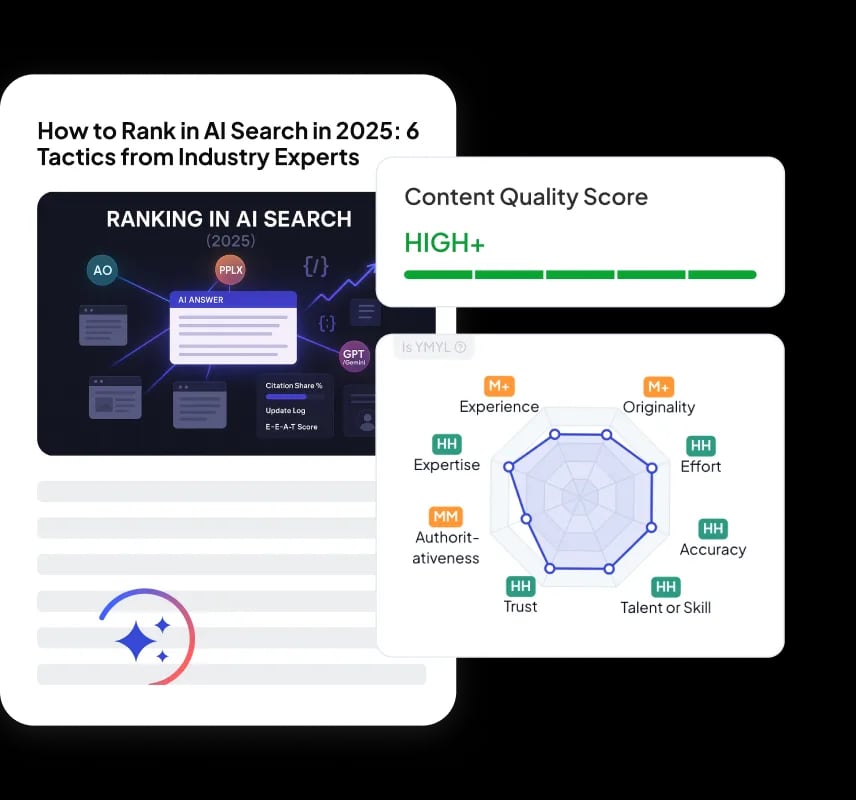
QuickCreator Content Quality Visual.
QuickCreator is an AI content marketing platform that generates blog articles from keyword research through publishing. The core promise is threefold: write in your brand voice, optimize for traditional search rankings, and structure content so AI tools like ChatGPT, Perplexity, and Gemini can cite it.
That last point matters more than it did a year ago. Solo founders are increasingly competing for visibility inside AI answers, not just blue links. QuickCreator builds its workflow around that dual goal.
Ideal users for QuickCreator

Footer Background.
QuickCreator is not built for everyone. It fits best when:
- You are a solo founder or very small team with no dedicated writer and no budget for an agency retainer.
- You need consistent publishing volume — two to eight articles per month — without managing freelancers.
- You sell a product or service that benefits from educational content, such as SaaS, consulting, or digital products.
- You want one tool to handle research, drafting, and on-page optimization rather than stitching together three subscriptions.
It is a weaker fit if you already have a strong editorial team, need deep investigative journalism, or operate in a regulated niche where every claim requires expert review.
Key use cases
First viewport screenshot of Free AI Idea Generator | QuickCreator.
1. Building a content engine from zero
A solo founder launching a new site can use QuickCreator to go from keyword list to published article without hiring. This is the most common use case and the one the pricing is designed around.
2. Scaling an existing blog without adding headcount
If you already publish occasionally but want to move to a weekly cadence, QuickCreator can absorb the drafting and optimization work while you focus on strategy and editing.
3. Optimizing for AI citations
QuickCreator explicitly targets AI search visibility. For founders whose buyers now ask ChatGPT or Perplexity for recommendations, structuring content for citation is a genuine differentiator.
4. Repurposing research into multiple formats
While the core output is articles, the research and outline stages can feed newsletters, social posts, and landing page copy.
Strengths
- End-to-end workflow. Keyword research, outline, draft, and optimization live in one place. That reduces tool sprawl, which matters when you are the entire team.
- Brand voice controls. QuickCreator lets you define tone and style so output does not read like generic AI copy. Quality varies by how much effort you put into the setup.
- AI search orientation. The platform is built with AI citation in mind, not just Google rankings. That is a meaningful shift in positioning.
- Accessible pricing. Starting at $29 per month is well below agency retainers and comparable to a single freelance article.
- Low setup friction. You can realistically publish a first article on day one.
Limitations
- Output still needs editing. No AI writer should publish unedited. Expect to spend time fact-checking, tightening arguments, and adding original insight.
- Voice matching has a ceiling. Brand voice features help, but they do not replace a founder's unique perspective. Articles that lean entirely on the tool will read thinner than ones where you add firsthand experience.
- AI citation claims are hard to verify independently. QuickCreator promises citations from ChatGPT, Perplexity, and Gemini, but results depend on your niche, domain authority, and content quality. Treat citation as a goal, not a guarantee.
- Limited fit for highly technical or regulated topics. Deep expertise still requires human input.
- Pricing tiers can obscure true cost. The $29 entry point is attractive, but higher volumes or advanced features may require upgrading. Confirm current limits before committing.
Pricing signals
QuickCreator starts at $29 per month. That places it in the affordable tier for solo founders — roughly the cost of one freelance blog post per month, but with unlimited-ish drafting capacity depending on plan limits.
Compare that to alternatives:
- Hiring a freelance writer: $100–$500 per article, plus management overhead.
- A content agency: $2,000–$10,000 per month retainer.
- General AI tools like ChatGPT: $20 per month, but you supply the workflow, research, and optimization yourself.
The trade-off is clear: QuickCreator bundles workflow and optimization, while general AI tools offer flexibility at the cost of manual process. For a founder who values time over tinkering, the bundled approach usually wins.
Setup: what to expect
- Define your brand voice. Spend 20–30 minutes documenting tone, audience, and topics to avoid generic output.
- Run keyword research inside the tool. Start with 10–20 seed keywords tied to your product.
- Generate and review an outline. Edit before drafting — this is where most quality gains happen.
- Draft, then edit heavily. Add examples, data, and firsthand experience.
- Publish and track. Monitor both Google rankings and AI citations over 4–8 weeks.
Decision criteria: is QuickCreator right for you?
First viewport screenshot of Free Blog Hook Generator – Opening Lines | QuickCreator.
Choose QuickCreator if:
- You are a solo founder publishing at least twice a month.
- You want one tool for research, drafting, and optimization.
- You care about AI search visibility alongside Google.
- You are willing to edit AI output rather than publish raw drafts.
Look elsewhere if:
- You need deep technical accuracy with no editing capacity.
- You already have a content team and only need optimization.
- You prefer full control over every step of the workflow.
For a broader view of how AI content engines fit into a publishing system, see our guide to building an AI content engine for websites. If you are comparing tools, our AgentBooks vs GravityWrite vs SEO and AEO tool comparison breaks down automation and brand voice trade-offs.
Related reading
- Top 10 Content Marketing Agency Products 2026 - Ranked review of the top 10 content marketing agency products in 2026, with transparent criteria, evidence, and fit guidance for B2B and B2C teams.
- How to Use AgentBooks with Ahrefs: A Practical Workflow - Learn how to connect AgentBooks and Ahrefs: use Ahrefs data to inform AgentBooks keyword plans, automate drafting, and track rankings in one loop.
Sources and further reading
- 0 to 500K ARR, solo, with AI as my only team. already at $103K. documenting everything : r/Entrepreneur - I'm trying to hit 500K ARR completely solo using AI as my entire team. here's where I'm at after month 1.
- The 13 Best AI Tools for Solopreneurs in 2026 (For One-Person Businesses That Actually Ship) - The 13 best AI tools for solopreneurs in 2026, ranked by cognitive load saved. Storyflow, Framekit, ChatGPT, Claude, and the real one-person business stack compared.
- I'm a founder using $20-a-month AI tools instead of hiring employees - A solo founder used AI to vibe code her website, cut 60-minute tasks to one-minute, and scale her coaching business without hiring employees.
FAQ
Is QuickCreator good for solo founders?
Yes, it is specifically designed for one-person businesses that need consistent content without hiring. The $29 starting price and end-to-end workflow make it accessible.
Does QuickCreator really get cited by ChatGPT and Perplexity?
It structures content to improve citation odds, but no tool can guarantee AI citations. Results depend on your niche, authority, and content quality.
How does QuickCreator compare to ChatGPT?
ChatGPT is a general assistant; QuickCreator bundles keyword research, outlining, drafting, and optimization into one workflow. QuickCreator costs more but saves process time.
What is the biggest limitation?
Output still requires human editing and original insight. Founders who publish raw AI drafts will see weaker results.
Conclusion
QuickCreator is a credible option for solo founders who need a content team but cannot afford one. Its strengths — end-to-end workflow, brand voice controls, and AI search orientation — align with what one-person businesses actually need. Its limitations — editing requirements and unverifiable citation claims — are manageable if you treat it as a drafting and optimization engine, not an autopilot.
At $29 per month, the risk is low and the upside is a repeatable publishing system. For founders serious about content, that is a reasonable bet. For a deeper comparison of AI writing tools, see our AI SEO writer review.