Machined Review: How Far Can AI-Powered SEO Content Automation Really Go?
If you’ve searched for a “Machined review,” you might have stumbled across Reddit threads about finely crafted metal pens or Wikipedia’s definition of subtractive manufacturing. This isn’t about lathes or bolt-action pens—it’s about a different kind of automation. Machined (without the “machining”) is an AI-powered content platform built to handle the entire SEO content workflow, from keyword discovery to publishing. It promises to generate topical authority and scale blogs without hiring writers. But does that promise hold up for real businesses? We’ve dug deep into its feature list, case studies, and positioning to give you a no-nonsense, evidence-based review.
Who Is This AI Platform For?
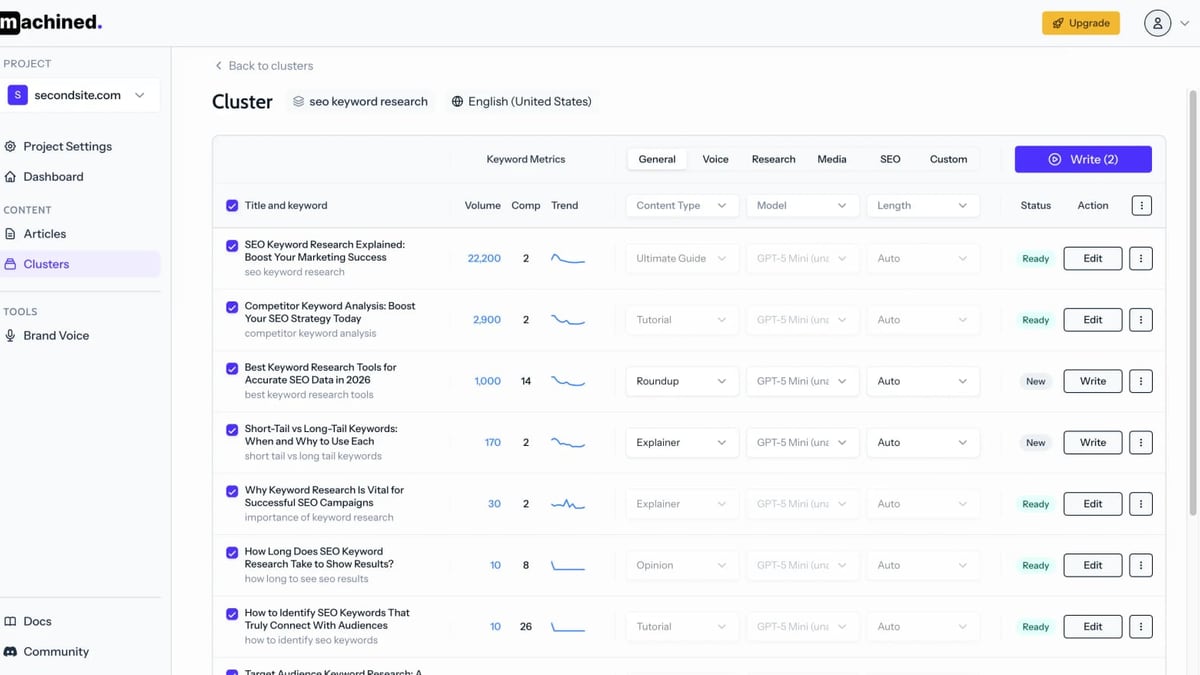
Machined Review: AI SEO Content Engine Put to the Test (2026) product interface and feature overview.
Machined targets a wide range of users, but its sweet spot is clearly small to mid-size teams drowning in content demand. If you run a local service business, an early-stage SaaS company, or even a marketing agency with tight deadlines, the tool’s automation will likely appeal to you. It’s not just another AI writer—it attempts to replace the repetitive parts of an SEO strategist’s job: keyword clustering, internal linking, and even publishing directly to WordPress or Webflow.
Ideal users include:
- Local businesses that need to build neighborhood authority with location-based clusters.
- Marketing agencies managing dozens of client sites with limited in-house writing capacity.
- Startups that want to build a knowledge base and blog without sacrificing product development time.
If you’re a lone blogger who enjoys hand-crafting each sentence, Machined will feel overkill—and honestly, it’s not designed for you.
Core Use Cases: What Can You Actually Produce?
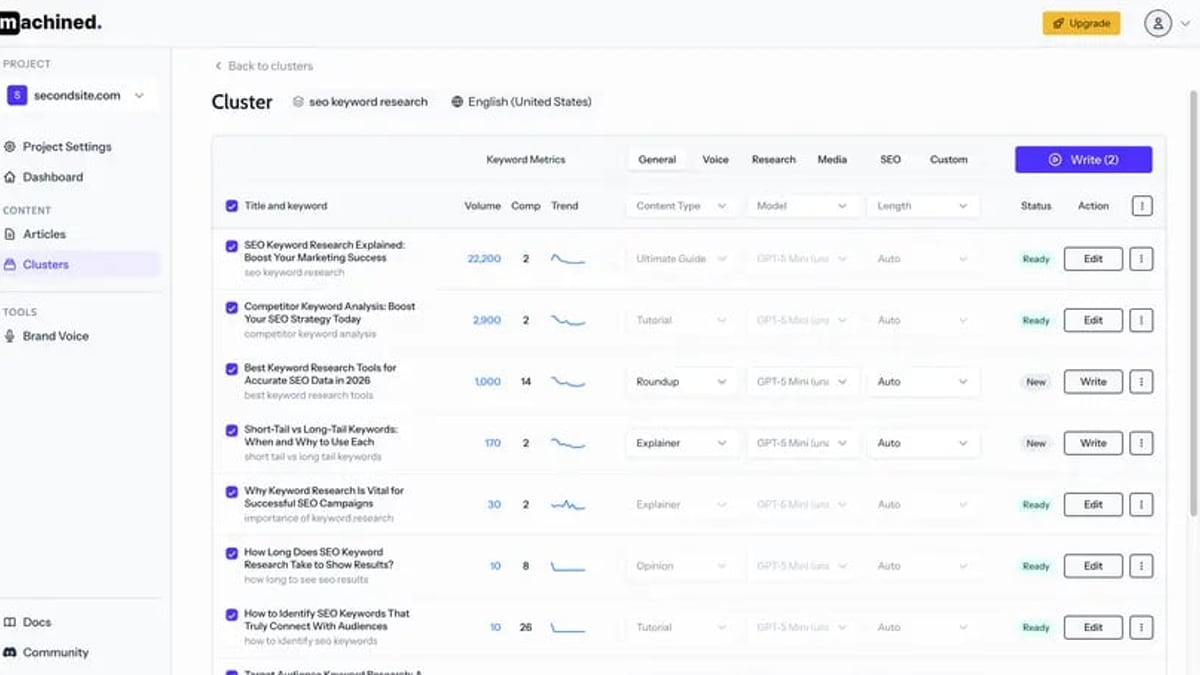
Machined Review: AI SEO Content Engine Put to the Test (2026) product interface and feature overview.
Machined is laser-focused on one outcome: organic search growth through content clusters. The platform automates the entire process, turning a seed keyword into dozens of interlinked, ready-to-publish articles. Here’s how the workflow typically unfolds:
- Keyword research & clustering: You give it a broad topic (e.g., “plumbing emergencies”). The AI identifies semantically related long-tail keywords, groups them into clusters, and maps out a content hierarchy.
- Bulk article generation: Using multiple AI providers (OpenAI, Anthropic, Google, Perplexity, OpenRouter), it writes full-length drafts. Crucially, it attempts to add real citations and web-sourced data.
- Automated internal linking: Once articles are ready, the tool auto-suggests internal links across your site to reinforce cluster signals—something many AI writing tools skip entirely.
- One-click publishing: Integrations with WordPress and Webflow let you go from draft to live post without copying and pasting.
- AI image generation: Basic image creation is included, though it’s not a substitute for custom graphics.
This flow is what sets Machined apart from generic AI copywriters like Jasper or Copy.ai, which require you to orchestrate keyword research and interlinking manually.
Real-World Proof: The Engineer Seal Stamps Case
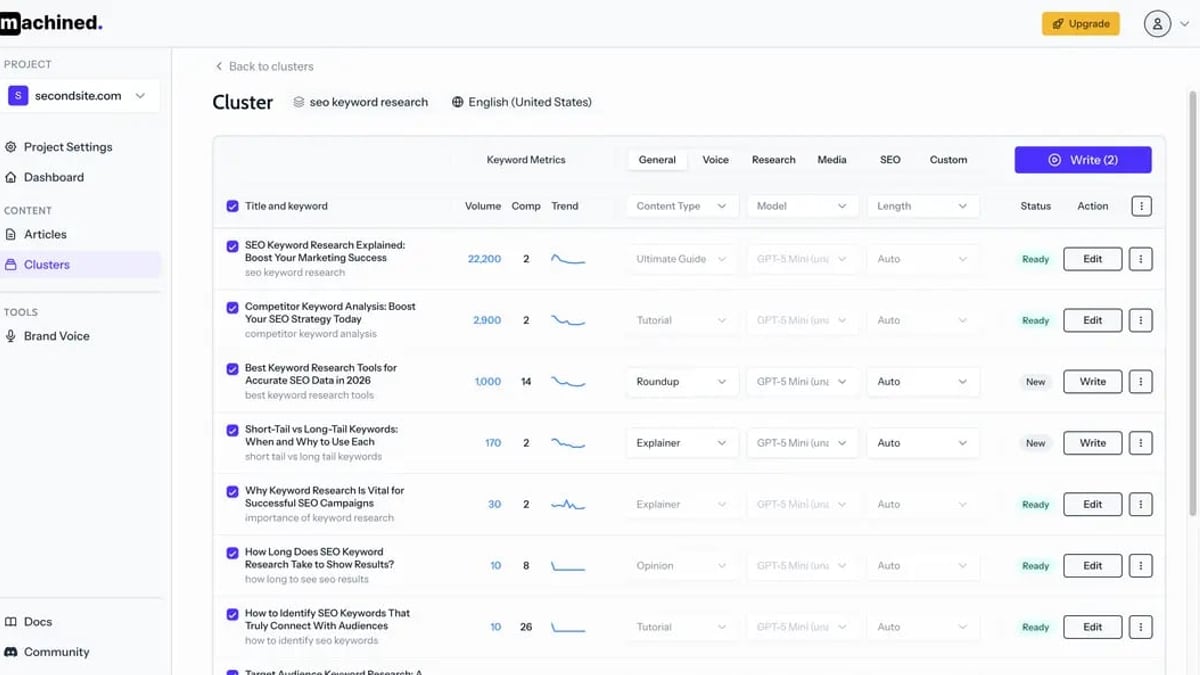
Machined Review: AI SEO Content Engine Put to the Test (2026) product interface and feature overview.
Most AI tools show flashy demos; Machined shows a concrete case study. Engineer Seal Stamps, a niche business, reportedly achieved:
- 4x keyword growth, expanding to over 200 top-ranking keywords.
- Savings of 100+ hours per month in content production time.
- Backlinks from 5 other AI platforms that cited the content as authoritative.
What’s remarkable isn’t just the ranking jump—it’s the domain authority signal. If five distinct platforms reference your articles, that indicates the AI output was reference-worthy. That’s a strong counterpoint to the common belief that AI content feels spammy.
Of course, this is a vendor-provided case study, so results will vary. However, the mechanics behind the success—keyword clustering, frequent publishing, and strong internal linking—are well-documented SEO levers. Machined simply automates them on steroids.
Strengths That Stand Out
- Time compression: For teams currently spending 5–10 hours per blog post on research, writing, and editing, the platform can slash that down to an hour of review and tweaking. That’s not “set and forget,” but it’s a dramatic improvement.
- Built-in topical authority logic: Unlike tools that generate one-off articles, Machined enforces clusters. It forces you to build topical depth, which is exactly what Google rewards.
- Multi-model AI with citations: By pulling from different LLMs and real-time web research, the output is less prone to hallucination. You’re not stuck with a single model’s biases.
- Direct publishing integrations: Agencies and businesses can skip messy exports. Publishing to WordPress or Webflow is native, maintaining your site structure.
- Pricing that doesn’t punish growth: Plans from free to $99/month make it accessible for companies still watching cash flow. There’s no per-word credit system that screws you over if you generate long-form content.
Limitations and Potential Pitfalls
No tool is flawless, and Machined has several areas where buyers should temper expectations:
- Content quality still needs a human eye. The AI may cite sources, but it can misinterpret them or produce awkward transitions. Every post should be fact-checked and edited for brand voice—especially in YMYL (Your Money or Your Life) niches.
- No marketplace for custom research: If you need original surveys, interviews, or proprietary data, you’ll still need to create that material yourself and feed it in.
- Limited publishing platforms: WordPress and Webflow cover a huge segment, but if you use HubSpot, Ghost, or a headless CMS, you’ll have to copy-paste manually.
- Clustering edge cases: Highly technical, niche topics might confuse the automatic cluster creator, leading to shallow topic maps. In those cases, you’ll need to manually override.
- Image generation is basic: Don’t expect DALL·E 3 or Midjourney quality. The AI images are functional but won’t wow design-focused brands.
Pricing Signals: What Are You Really Paying For?
Machined’s pricing structure is refreshingly straightforward:
- Free plan: Limited articles, but enough to test the workflow.
- Paid plans: $29/month to $99/month as you scale.
There’s no per-word billing, which is a relief. However, the exact article limits per plan aren’t public without signing up. This lack of transparency is a minor annoyance for evaluators.
For context, compare that to hiring even one part-time content writer—easily $1,500+/month. Machined’s $99 plan becomes a no-brainer if it can replace or augment that spend. Just ensure your team has the editorial capacity to polish the output; if not, you may still need a writer.
Setup and Onboarding Experience
Getting started involves:
- Connecting your site (WordPress or Webflow) via API/integration.
- Inputting brand voice guidelines, target keywords, and competitor URLs.
- Letting the tool run an initial keyword cluster analysis.
- Reviewing the generated content plan, editing title tags and headings where necessary, and triggering bulk generation.
The setup isn’t overly complex, but non-technical users might stumble on the API connection step. Documentation appears decent, though we’d like to see more video walkthroughs.
Once running, the interface is purposefully opinionated: it guides you toward building clusters rather than creating ad-hoc articles. That’s good for SEO focus but might frustrate users who just need a one-off landing page.
Decision Criteria: Should You Choose Machined?
Machined Review: AI SEO Content Engine Put to the Test (2026) product interface and feature overview.
Make your choice based on these factors:
- Choose Machined if you rely on WordPress or Webflow, need to scale topical clusters quickly, and have someone on your team who can edit AI drafts for accuracy and tone. It’s best suited for sites that thrive on depth and interlinked content.
- Look elsewhere if you publish on a non-supported CMS, want full creative control over each sentence, or need original data journalism rather than aggregated research.
- Consider alternatives like AgentBooks when your priority is a fully autonomous brand‑first content engine that handles research, writing, and publishing while maintaining a consistent voice without constant human intervention. AgentBooks shines for product-led companies that want content that feels human but runs on autopilot. For an objective comparison of Machined, AgentBooks, and Autoblogging.ai, see our dedicated comparison guide.
Related reading
- Top 10 SEO Software Platforms in 2026: Tested and Ranked - Discover the 10 best SEO software platforms for 2026, ranked by research depth, technical audits, and content support. Compare Semrush, Ahrefs, Moz Pro, SE Ranking and more.
- Autoblogging.ai Review 2025: AI Auto-Blogging Put to the Test - This Autoblogging.ai review covers 7 AI modes, real user feedback, pricing credit breakdown, and who actually benefits. Evidence-based, not hype.
- Top 10 AI Content Marketing Platform Products in 2026 - Discover the 10 best AI content marketing platforms of 2026, ranked by research depth, brand voice, and publishing capabilities. Compare features, pricing, and real strengths.
Sources and further reading
- Machined Pens Roundup (currently in production only ... - Web resultsMachined Pens Roundup (currently in production only ...Reddit · r/pens40+ comments · 5 years agoReddit · r/pens40+ comments · 5 years agoExcellent bolt-action, smooth and easy Quite cheap, about $30 USD. VERY easy to damage. Also picks up dust and debrisMachined Machines Wheels : r/hondag
- Machining - Machining is a manufacturing process where a desired shape or part is created using the controlled removal of material, most often metal, from a larger piece of raw material by cutting. Machining is a form of subtractive manufacturing,[1] which utilizes machine tools, in contrast to additive manufacturing (e.g. 3D printing), which uses controlled addition of material.
- Ruckus Nation | What are y’all’s review with machined machines | Facebook - What are y’all’s review with machined machines?
FAQ
Q: Does Machined produce duplicate or plagiarized content?
A: The platform pulls from multiple AI models and web sources, but it generates original text. However, because it uses real citations, it’s wise to run a plagiarism check on critical pages. Duplicate content isn’t a common complaint.
Q: Can I use my own OpenAI API key?
A: Currently, Machined abstracts the AI provider. You don’t plug in your own keys; you rely on its routing to the best model. This simplifies usage but reduces control over model versions.
Q: Is the automated internal linking truly effective?
A: Yes—it’s one of the tool’s strongest features. It analyzes your existing content graph and inserts contextual links. However, you should still audit the suggestions because occasionally it links to a less relevant page.
Q: How does it handle non-English content?
A: While English is the primary supported language, Machined can generate content in other languages. Quality varies by language and model availability; expect best results for widely spoken languages.
Q: What’s the refund policy?
A: Machined offers a free plan to test. Paid plans may have a short trial or money-back guarantee, but specifics aren’t prominently displayed. Always confirm before subscribing.
Conclusion: A Promising Cluster Builder, Not a Magic Wand
This Machined review confirms that the platform delivers on its core proposition: automated SEO content at scale, with a clear emphasis on topic clusters and internal linking. The Engineer Seal Stamps result isn’t an accident—it’s what happens when you combine aggressive clustering, regular publishing, and AI-generated depth. For businesses on WordPress or Webflow, it can dramatically reduce content production costs while improving organic visibility.
That said, it’s not a replacement for editorial judgment. The final polish, factual verification, and strategic oversight still belong to you. If you’re ready to trade a few hours of manual work for a monthly subscription, Machined is well worth a trial. If you need a platform that goes beyond bulk generation and maintains brand voice with deeper autonomy, explore how AgentBooks’ AI content engine fits into your workflow.