Surfer Review 2025: AI Visibility Platform for SEO & AI Search
Surfer has evolved from a straightforward SEO content editor into a unified AI visibility platform—a tool designed not just for Google rankings but for the growing landscape of AI-driven search engines like ChatGPT, Gemini, and Perplexity. For SEO and content teams watching their organic traffic fragment across multiple search interfaces, that promise is compelling. This review takes an evidence-based look at what Surfer actually delivers, who will get the most from it, and where it fits in a modern content strategy.
What Is Surfer?
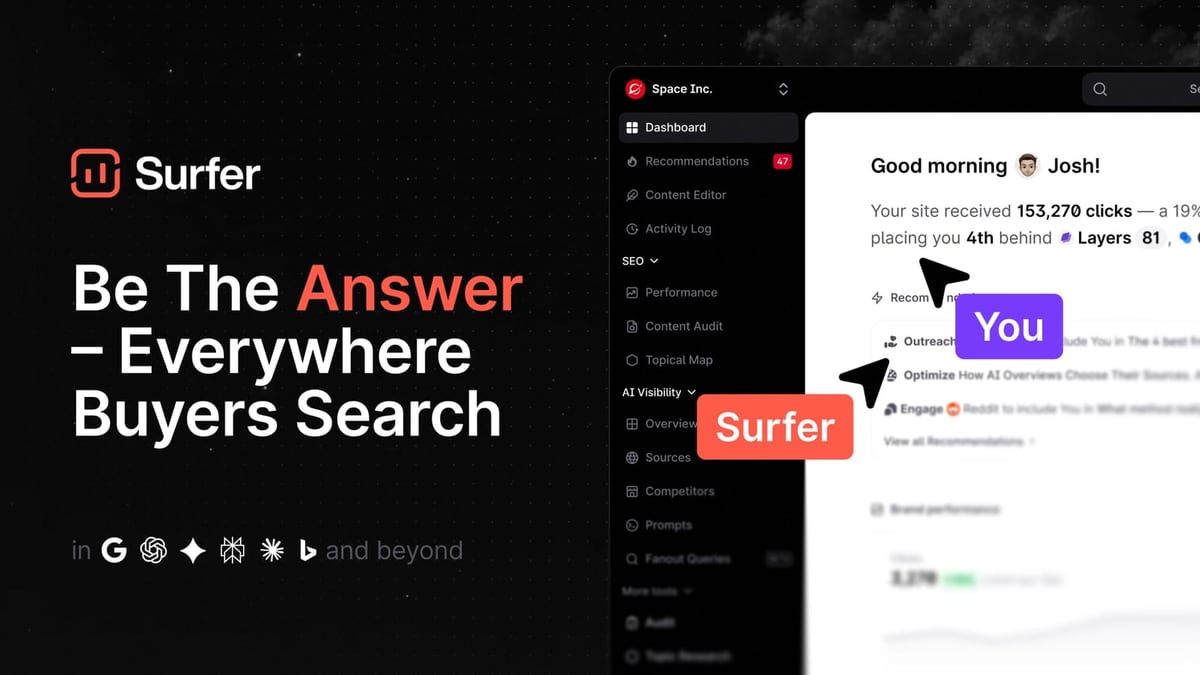
Surfer Review 2025: AI Visibility Platform for SEO & AI Search product interface and feature overview.
Surfer is a cloud-based platform that bridges traditional search engine optimization and AI search visibility. Over 150,000 marketers, agencies, and SEOs use it to optimize content, monitor brand mentions across large language models (LLMs), and analyze competitors through a single interface.
The core philosophy is a unified workflow: instead of treating Google SERPs and AI chat responses as separate channels, Surfer gives you a combined view. Its Content Editor now includes AI Search Guidelines, its AI Tracker scans LLMs for brand citations, and its Content Score algorithm weights both traditional ranking factors and signals that matter for generative engine responses.
Who Should Use Surfer?

Surfer Review 2025: AI Visibility Platform for SEO & AI Search product interface and feature overview.
Ideal users fall into three main groups:
- SEO agencies and consultants that need to show clients exactly how their visibility is changing—not just in blue-link results, but inside Gemini, ChatGPT, and Perplexity answers.
- In-house marketing teams who publish long-form content regularly and want to ensure articles meet both human-reader and AI-crawler standards in one editing pass.
- Product-led brands that rely on AI search product mentions and need to track whether their brand appears in AI-generated recommendations or competitor comparisons.
If your primary need is autonomous, brand-grounded content generation with minimal manual editing, you might pair Surfer with a publishing engine like AgentBooks. Surfer itself is not an AI writer; it’s a visibility layer that tells you how your content should be built and whether it’s reaching the right search surfaces.
Key Features Breakdown
Content Editor with AI Search Guidelines
Surfer’s signature editor now overlays real-time suggestions for both Google and AI search engines. While you write, you see recommended keyword densities, term occurrences, and NLP entities—plus a new set of signals like question comprehensiveness and source credibility that influence LLM-based answers.
The editor supports Google Docs integration and a browser extension, so teams can apply suggestions without leaving their existing workflow.
AI Tracker for Brand Mentions
This feature monitors how your brand (or any keyword) appears across ChatGPT, Gemini, Perplexity, and other major LLMs. It tracks sentiment, source citations, and share of voice over time. For agencies, this is a game-changer: you can finally report on AI search presence with the same granularity you expect from traditional rank trackers.
Unified Content Score for SEO & AI Search
Rather than separate metrics, Surfer gives you a single Content Score that reflects how well a page is optimized for multiple search engines. A higher score correlates with better visibility in both classic SERPs and AI-generated responses—the platform reports that clients have seen a 5x increase in organic baseline traffic when consistently hitting high scores.
One-Click Auto-Optimize
The Auto-Optimize feature analyzes your draft and suggests precise edits to improve the Content Score. It’s not a full rewrite—it’s a tactical fix tool for teams that want to polish an almost-ready piece in seconds. Power users can also lock certain paragraphs to prevent unwanted changes.
Activity Log & Team Workflow
Surfer includes a detailed activity log that tracks who optimized what and when. This is especially valuable for larger teams or agencies that need to audit content changes and maintain consistency across multiple writers and editors.
Backlink Marketplace
A curated marketplace connects you with authoritative sites that are frequently cited by AI search engines. The idea is to acquire backlinks that not only improve traditional Domain Rating but also increase the likelihood that LLMs will reference your content. It’s a targeted approach that reflects the increasing overlap between link building and generative engine optimization (GEO).
Surfer Use Cases in Practice

Surfer Review 2025: AI Visibility Platform for SEO & AI Search product interface and feature overview.
Unified SERP + AI search optimization
A B2B SaaS brand uses Surfer to update its help center articles. The Content Editor recommends adding specific “how-to” subheadings that Google’s algorithms favor, while the AI Search Guidelines flag missing statistics that Gemini often cites. After optimization, the brand sees a 340% increase in organic leads from both search channels combined.
Competitive AI visibility tracking
An e‑commerce SEO agency tracks client vs. competitor brand mentions inside Perplexity and ChatGPT. When a rival starts appearing in product‑recommendation answers, the AI Tracker alerts the team, who then adjust the client’s product‑page meta descriptions and structured data. Within 90 days, organic visibility climbs 740%.
Team onboarding and consistency
A content marketing team of 12 writers uses the Activity Log to maintain editorial standards. Editors set Content Score targets, and the Auto‑Optimize button brings borderline drafts up to target in seconds. The team achieves 3 million clicks from Google over a two‑year period without increasing headcount.
Onboarding and Setup Experience
Setup is straightforward. After signing up, you connect your Google Search Console and optionally your Google Analytics account for baseline data. The Content Editor is immediately available, and the browser extension works with Google Docs, WordPress, and a few other CMS platforms. For the AI Tracker, you simply input your brand name and competitor names, and it starts collecting data within hours—no complex integration required. Teams can start seeing optimization opportunities within their first session.
Strengths That Stand Out
- Future‑proofed optimization: Surfer is one of the few tools that genuinely addresses generative engine optimization without trading away traditional SEO capabilities. You get both in one interface.
- Measurable ROI: The published case studies (5x baseline traffic, 340% lead growth, 740% visibility boost) are backed by real‑world usage, not just theoretical projections.
- Time‑saving workflows: Auto‑Optimize and unified scoring cut editorial time by a substantial margin, especially for high‑velocity teams.
- Agency‑ready reporting: The AI Tracker’s share‑of‑voice metrics and activity logs make client reporting transparent and defensible.
Limitations and Potential Drawbacks
- Pricing opaqueness: Surfer does not publish pricing publicly. You need to request a demo or sign up for a trial. This typically signals an enterprise‑focused model, which may be a barrier for solo operators or small businesses.
- Not a content generation engine: Surfer tells you what to optimize, but it doesn’t create the article for you. If you want full autonomous publishing with brand‑grounded intelligence, you’ll still need a dedicated AI writer. AgentBooks’ autonomous engine fills that gap for many teams.
- Learning curve for AI search signals: Understanding the new AI Search Guidelines and how to interpret LLM tracking data requires some upfront education. New users may underutilize these features initially.
- Platform dependency: As with any SEO tool, shifting algorithms on Google or closed AI models could affect the relevance of certain optimization suggestions over time. However, Surfer’s rapid iteration pace partly mitigates this risk.
Pricing Signals and What They Tell You
While exact numbers aren’t public, the “request demo” approach indicates a tool built for organizations that prioritize ROI over sticker price. Small agencies and bootstrapped startups should be prepared for a monthly investment that aligns with premium SEO suite pricing (often in the low‑to‑mid hundreds of dollars). If you’re evaluating alternatives, a resource like our Top 10 SEO Software Platforms in 2026 can help you compare Surfer’s capabilities against tools like Semrush, Ahrefs, or SE Ranking.
Surfer vs. Alternatives: Decision Guide

Surfer Review 2025: AI Visibility Platform for SEO & AI Search product interface and feature overview.
- Choose Surfer if your strategic priority is capturing visibility inside AI search engines while maintaining strong Google rankings, and you have a team to act on its recommendations.
- Consider a broader SEO suite like Semrush or Ahrefs if your needs are heavily tilted toward keyword research, backlink analysis, and technical audits—Surfer complements these tools but doesn’t replace them.
- Look at Contentpen if you want a similar AI‑visibility focus but prefer a more transparent, lower‑cost entry point with built‑in authoring features.
- Pair Surfer with AgentBooks if you want end‑to‑end autonomous content creation: AgentBooks produces brand‑grounded, rank‑ready articles, while Surfer optimizes and tracks their performance across both traditional and AI search surfaces.
Related reading
- AgentBooks vs Contentpen vs ContentBot.ai AI Comparison - Compare AgentBooks, Contentpen, and ContentBot.ai for autonomous publishing, AI visibility, bulk writing, pricing. Find your ideal AI content tool.
- AgentBooks vs Autoblogging.ai: Autonomous Content vs Fast Generation - AgentBooks vs Autoblogging.ai: See how brand-grounded autonomous content engine compares to bulk SEO generation. Which AI tool delivers useful, rank-ready articles?
- Contentpen Review: AI-Powered SEO & AEO Content Platform - Evidence-based Contentpen review covering features, pricing ($39/mo), AI visibility tracking, SEO & AEO workflows, and how it compares to AgentBooks. Read before you buy.
Sources and further reading
- The Surfer (2024) | Rotten Tomatoes - Discover reviews, ratings, and trailers for The Surfer (2024) on Rotten Tomatoes. Stay updated with critic and audience scores today!
- The Surfer (2024 film) - From Wikipedia, the free encyclopedia
- The Surfer movie review & film summary - A strange and not entirely successful cinematic freak-out.
Frequently Asked Questions
Does Surfer integrate with Google Search Console?
Yes. After connecting your property, Surfer pulls existing rank data and uses it to benchmark how content optimizations affect your organic visibility over time.
Can Surfer really track mentions in ChatGPT or Perplexity?
Absolutely. The AI Tracker continuously queries major LLM endpoints and captures brand citations, sentiment, and source URLs. You can see exactly which pieces of content are being referenced and how often.
How does the Content Score work?
The score synthesizes dozens of on‑page signals—keyword usage, heading structure, entity coverage, question completeness, and more—into a single 0‑100 metric. It now also incorporates factors that correlate with inclusion in AI‑generated answers, making it a unified health indicator.
What’s the difference between Surfer and a traditional rank tracker?
Traditional rank trackers only monitor Google (and sometimes Bing) for keyword positions. Surfer adds LLM‑based search engines to the mix and provides actionable on‑page recommendations to improve both simultaneously.
Conclusion
Surfer has redefined what a content intelligence platform can do by treating AI search engines as first‑class citizens alongside Google. Its combination of real‑time optimization guidance, AI mention tracking, and team workflow tools makes it uniquely valuable for any brand that wants to future‑proof its search presence. The lack of transparent pricing and a learning curve for LLM‑specific features are real, but the platform’s published results—5x traffic increases, 340% lead growth, millions of clicks—demonstrate that it delivers when used correctly.
If you’re already creating high‑quality content and need to ensure it surfaces wherever your audience is searching, Surfer belongs on your shortlist. For teams that also want to automate the content creation part of the equation, pairing it with an engine like AgentBooks creates a complete visibility pipeline from first draft to first‑page AI citation.