
Writesonic Review 2026: AI Search Visibility and GEO Tested
Writesonic started as an AI writing assistant. In 2026, it sells itself as an AI Search Growth Engine that tracks brand visibility across eight AI platforms, audits generative engine optimization (GEO) gaps, and generates content to close them. That is a bigger promise, so this review focuses on the practical question: does the bundle actually help you win citations in AI answers, or does it just add another dashboard?
I looked at how the platform works in real workflows, where plan gates bite, and which teams get value from it. You can also see how it stacks up against other content platforms in our AgentBooks vs AirOps vs Surfer SEO comparison.
What Writesonic actually is in 2026
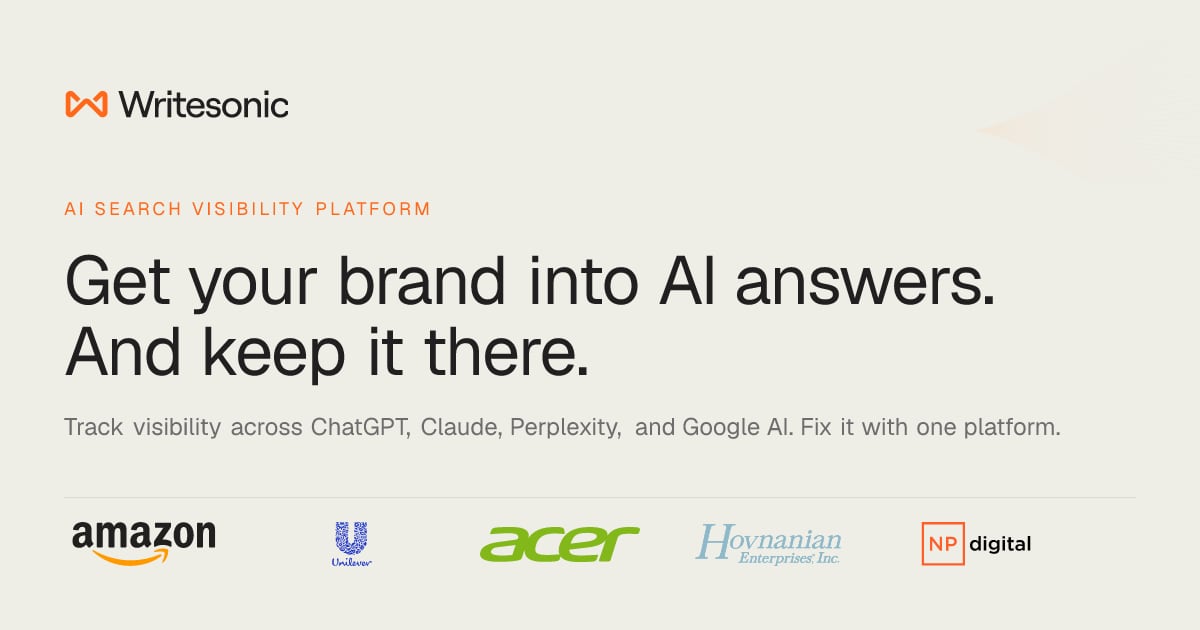
Writesonic product interface.
Writesonic is a combined AI writing, SEO, and AI search visibility platform. The core modules are:
- AI Article Writer for blog posts, listicles, and how-to content
- Chatsonic as a conversational interface wired into SEO and content agents
- SEO Checker and Optimizer with live content scoring and suggested terms
- GEO module that tracks brand mentions, citations, and sentiment across ChatGPT, Perplexity, Gemini, Google AI Overviews, and other AI surfaces
- Action Center that ranks remediation tasks by impact
- AI bot analytics via a WordPress, Vercel, or Cloudflare integration
The company says it is trusted by more than 10,000 brands, including Amazon, Unilever, Acer, and NP Digital. Customer stories cite outcomes such as 4,662 AI mentions in seven months, 3x AI search traffic, a 15% AI visibility lift, 500% blog impression growth, and 60% content cost reduction. Those are vendor-reported figures, not independent benchmarks, but they show the type of result the platform is designed to produce.
Who Writesonic is built for
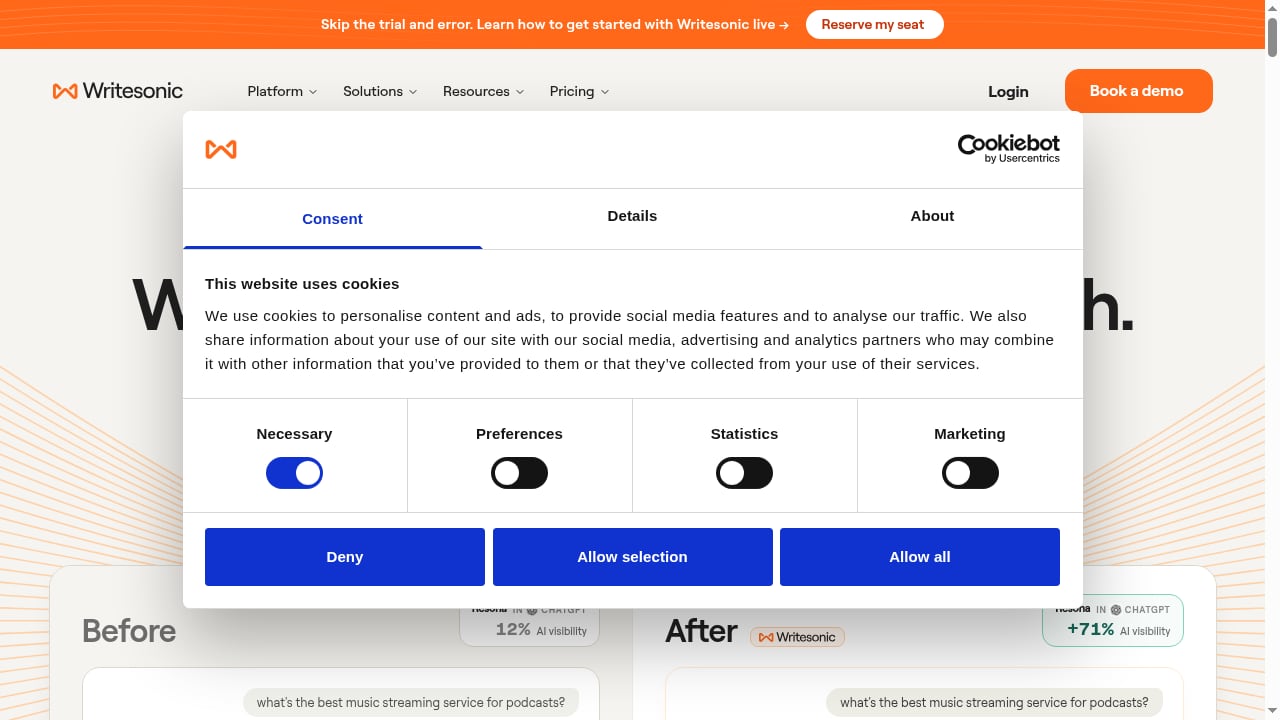
First viewport screenshot of Writesonic | The AI Search Growth Engine. Win Customers..
Writesonic fits best when speed and breadth matter more than editorial polish or strict brand governance.
Strong fit:
- Solo marketers and founders who want first drafts plus a baseline AI visibility view in one subscription
- Small content teams that need SEO-assisted drafting without buying a separate writer and a separate rank tracker
- Agencies that want multi-client portfolios, white-label reporting, and partner pricing
Weaker fit:
- Multi-writer content teams that need publish-ready long-form and strict brand control
- Teams that need citation-ready content engineering at scale with programmable workflows
- Enterprises with heavy security and compliance requirements that are not covered by self-serve tiers
A useful rule: if your bottleneck is starting work, Writesonic helps. If your bottleneck is finishing work to a high editorial standard, it shifts the bottleneck rather than removing it.
Core features tested

First viewport screenshot of Pricing | Writesonic AI Search Visibility Platform.
AI Article Writer
The Article Writer is the entry point. You choose a content type, generate an outline, edit it, then let the editor draft sections. Brand voice can be trained from samples or a description.
Short and medium content comes out structurally competent. Long-form drafts read coherently sentence by sentence but usually need reordering, fact correction, and removal of repetitive phrasing. Treat the output as a fast first draft, not a publish-ready article. For a broader view of how this compares with other tools, see our top AI-powered SEO content creation platforms.
Chatsonic and SEO agents
Chatsonic is less a standalone chatbot and more a front end for agents. The SEO agent pulls in keyword and analytics context; the Content agent generates; the LinkedIn agent focuses on that channel. The differentiator against a general-purpose LLM is integration with Ahrefs, Google Analytics, and Google Search Console, so answers are grounded in your site data. For pure brainstorming, a general LLM is still more flexible.
SEO Checker and Optimizer
This is one of the stronger parts of the product. Inside the editor you get a live content score, suggested terms from top-ranking pages, and one-click refinements. Site audit coverage starts small on entry plans and scales on paid tiers. Keyword research, topic discovery, and clustering are included. Compared with dedicated SEO platforms, it is best described as useful baseline guidance inside a writing tool rather than a full SEO stack replacement.
AI search visibility and GEO
This is the 2026 differentiator. The GEO module tracks how your brand and pages appear across AI platforms, including citations, brand mentions, suggested prompts, and sentiment. The Action Center ranks remediation tasks by impact, and AI bot analytics shows how crawlers from ChatGPT, Gemini, and Perplexity interact with your site.
Two caveats matter. First, tracking depth is shallower than dedicated AI visibility platforms: there is no prompt volume data and no programmable layer for recurring automation. Second, the most actionable parts, including the Action Center, are gated to higher tiers. Independent reviews have flagged this gating and the resulting price jump as a real limitation.
Pricing signals and plan gates
Self-serve plans start at $99 per month, and agency plans start from $200 per month. Those headline numbers are not the full story. Evaluate plans by caps, not by sticker price:
- Articles per month
- Tracked prompts
- Seats
- Site audits
- Access to the Action Center and full AI visibility suite
AI search visibility tracking begins on lower tiers with limited platform coverage and expands on higher tiers. The practical entry point for meaningful GEO work is above the cheapest plan, and the most actionable recommendations sit behind enterprise-level pricing. If you are comparing entry costs across tools, our QuickCreator pricing breakdown shows how credit-based models can look cheaper up front but cost more at volume.
Setup and time to value
Setup is straightforward for a self-serve user:
- Create an account and connect your domain.
- Connect Google Analytics, Google Search Console, and Ahrefs if you want grounded SEO answers.
- Install the WordPress, Vercel, or Cloudflare integration for AI bot analytics.
- Define brand voice from samples or a written description.
- Add tracked prompts and competitors in the GEO module.
- Run a site audit and review the Action Center for prioritized fixes.
Realistic time to value: a few days to get baseline visibility data, and two to four weeks to see whether content and citation fixes move your AI mention rate. The platform is not a set-and-forget system; it needs a human to act on the recommendations.
Strengths and limitations
Strengths:
- One subscription covers drafting, SEO checks, and AI visibility tracking
- Chatsonic is grounded in your own SEO data, not just general knowledge
- AI bot analytics and citation tracking give a usable baseline for GEO
- White-label reporting and multi-client portfolios suit agencies
- Fast first drafts and template breadth for short-form marketing copy
Limitations:
- Long-form drafts need substantial editing before publishing
- Brand voice drifts on long-form and technical content
- Limited team governance and collaboration features
- Action Center and full AI visibility features are gated to higher tiers
- Tracking depth is shallower than dedicated AI visibility platforms
- Limited integrations beyond Zapier, Google Analytics, Google Search Console, and select website providers
How it compares to alternatives
Zoho.
If your job is AI search visibility plus citation-ready content engineering at scale, a dedicated visibility platform will track more and go deeper. If your job is faster first drafts with a baseline visibility view, Writesonic's bundle saves stack complexity. If you need bulk output across many clients, compare workflow automation options like AgentBooks with Make before committing to a single platform.
The decision comes down to one question: are you buying a writing tool that happens to track AI visibility, or a visibility platform that happens to write? Writesonic is closer to the first. That is fine if drafting speed is your priority, and a mismatch if citation engineering is.
Related reading
- AgentBooks vs Averi: AI Content Platform Comparison - Compare AgentBooks and Averi AI content platforms. See how website-driven brand intelligence and pricing stack up against Brand Core and Strategy Map.
Sources and further reading
- Read Customer Service Reviews of writesonic.com - Trustpilot - Writesonic makes it super easy and fast for you to compose high-performing landing pages, product descriptions, ads, and blog posts in seconds. Contact info. 20 ...
- Writesonic Review 2026: Features, Pricing & Value - Our Writesonic review breaks down features, pricing, SEO and AI visibility tools, plus who should buy it and when to choose an alternative tool.
- Writesonic AI Visibility Suite Review & Comparison - Writesonic markets AI visibility, but it's mainly built for SEO. Profound is better for enterprise and SMB. Get the details in our Writesonic review.
FAQ
Is Writesonic worth it in 2026? For solo marketers, founders, and small teams that want fast drafts plus a baseline AI visibility view, yes. For teams needing publish-ready long-form and strict brand governance, it is likely to be outgrown.
Does Writesonic track AI search visibility on all plans? Tracking begins on lower tiers with limited platform coverage and expands on higher tiers. The most actionable recommendations, including the Action Center, sit behind higher pricing.
How good is the AI Article Writer? It is competent for short and medium content and useful as a first draft. Long-form output routinely needs structural editing, fact-checking, and removal of generic phrasing.
Can Writesonic replace a dedicated SEO platform? It provides useful baseline guidance inside a writing workflow, but most teams still pair it with a dedicated SEO or SERP analysis tool for deeper work.
Does Writesonic support agencies? Yes. Agency plans start from $200 per month and include multi-client portfolios, white-label reporting, and partner pricing.
Conclusion
Writesonic in 2026 is a bundle: AI writing, SEO tooling, and AI search visibility tracking in one subscription. The bundle reduces stack complexity and speeds up the start of content work. It does not remove the editing burden on long-form, and its deepest GEO features are gated to higher tiers. Buy it if drafting speed and a baseline visibility view matter more than editorial polish and governance. If citation-ready content engineering at scale is the goal, budget for a dedicated visibility platform alongside it, or choose one instead.