
AgentBooks vs AirOps vs Surfer SEO: Which Fits Your Content Workflow?
Most content teams do not have a tool problem. They have a workflow problem. Research lives in one tab, drafting in another, optimization in a third, and publishing somewhere else. AgentBooks, AirOps, and Surfer SEO each attack that fragmentation differently, and the right pick depends on which stage of the work is actually breaking for you.
This comparison looks at where each platform is genuinely strong, where the scope ends, and how to decide without overbuying.
What each platform actually does
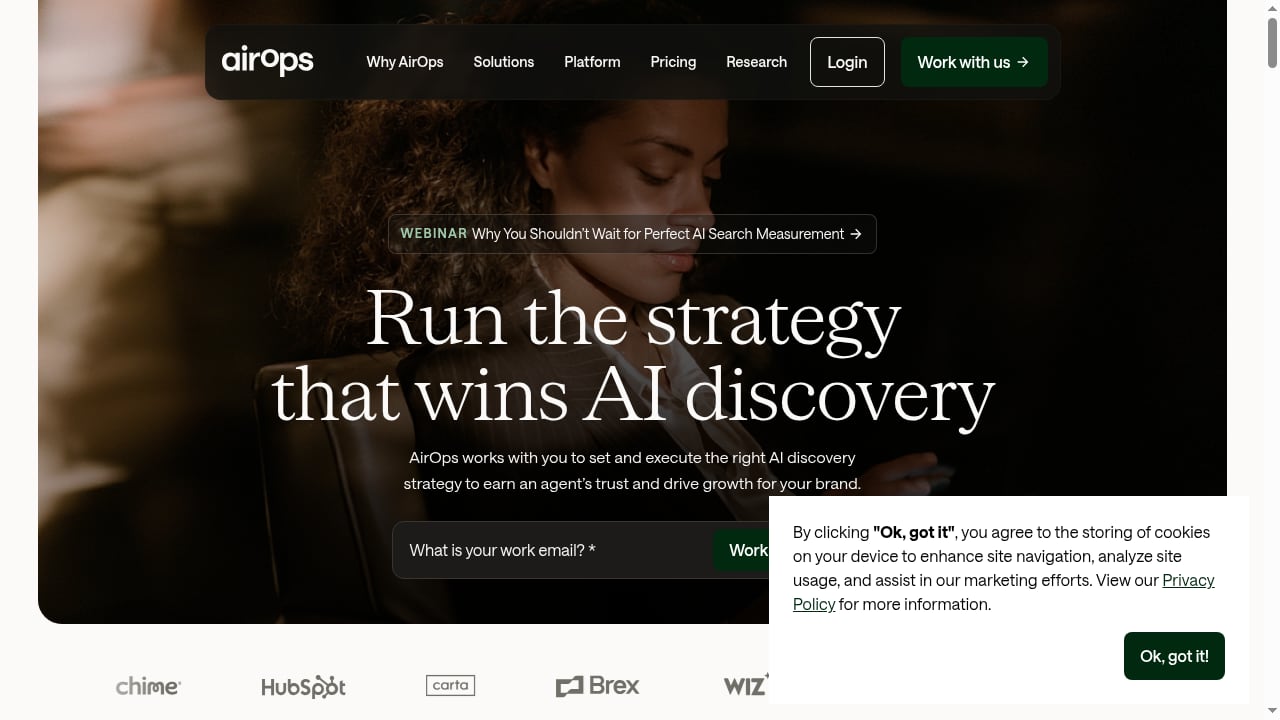
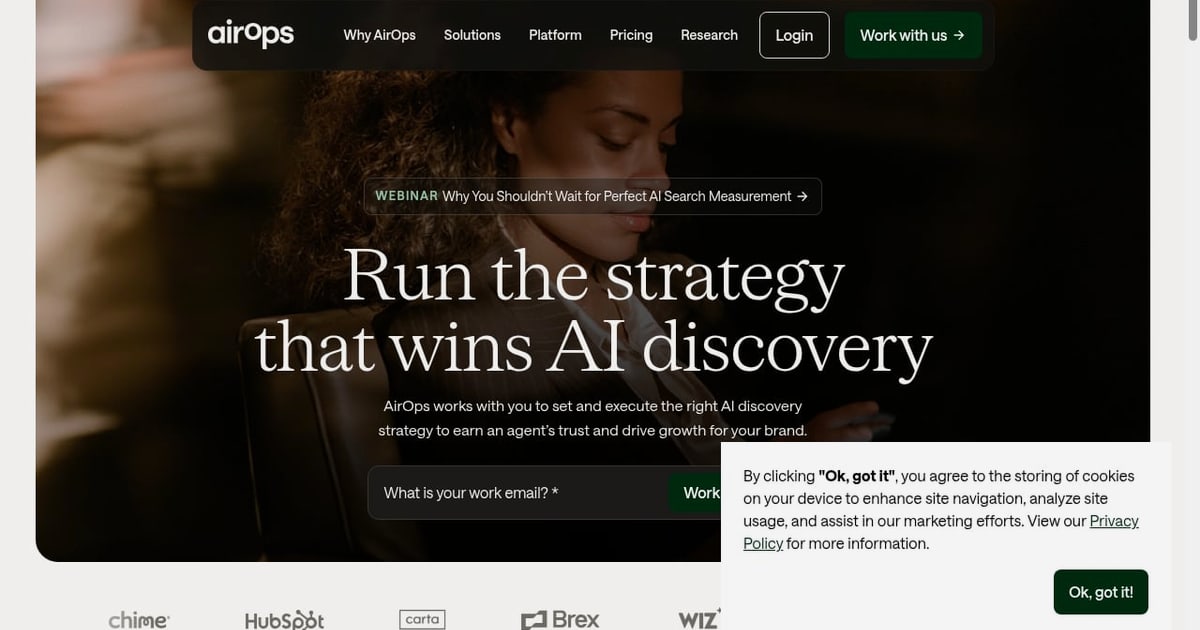
First viewport screenshot of AirOps | Run the strategy that wins AI discovery.
AgentBooks: a website-driven content engine
AgentBooks is an AI content automation platform that turns a website into an always-on content engine. You share your site once, and the platform learns the product, maps the market, plans topics, researches top organic results, and publishes useful content in your brand's voice.
The workflow is approval-first. Articles are generated on a schedule, prepared with SEO fundamentals (title, description, keywords, images, tags, links), and routed for human review before publishing. It supports custom domains, multilingual publishing, and multi-brand workspaces, which matters if you run several sites or client accounts.
AgentBooks is built for SaaS teams, e-commerce and DTC sites, digital agencies, founders, and independent sites. Pricing is transparent: a free public beta plan, a Business plan at $30/month, and an Enterprise plan at $100/month. It does not promise rankings or traffic, only a more efficient content process and measurable inputs.
AirOps: AI search visibility and content operations
AirOps is a platform for building and executing an AI discovery strategy. Its premise is that buyer journeys have shifted from multi-touchpoint funnels to single AI recommendations, and brands need to be chosen inside those answers.
Its strengths are measurement and operational depth. AirOps tracks brand visibility across AI answer engines, identifies content gaps through query fanouts, researches AI ads in Google AI Mode and ChatGPT, and manages production and refresh workflows. Brand learning loops turn content feedback into guidance, and the platform integrates with CMS, SEO, AEO, social, and project tools. Enterprise tiers support custom agent builds and unlimited knowledge bases, and MCP tools bring content feedback into connected assistants.
AirOps serves individuals through enterprise organizations with Solo, Pro, and Enterprise tiers. It is a system designed to scale across every stage of growth, with a connected channel strategy across owned content, external channels, social, and AI ads.
Surfer SEO: AI visibility and on-page optimization
Surfer is an AI Visibility Platform built to help marketing and SEO teams grow across both traditional Google search and AI search engines like ChatGPT, Gemini, Perplexity, and Google AI Overviews.
Its core is the Content Editor, which gives real-time, citation-optimized writing suggestions through AI Search Guidelines, plus a unified AI SEO Content Score that blends traditional SEO and AI search performance. The AI Tracker monitors brand mentions across AI models, Agent Analytics analyzes server logs to show which pages AI crawlers visit, and competitor presence in LLM responses is tracked alongside your own.
Surfer serves over 2,800 companies and holds a 4.8/5 rating. Agencies and multi-domain teams get view-only report sharing, data export, activity logs, and reporting history up to 16 months. Its positioning is direct: be the answer in Google and everywhere buyers search.
Where each platform is strongest
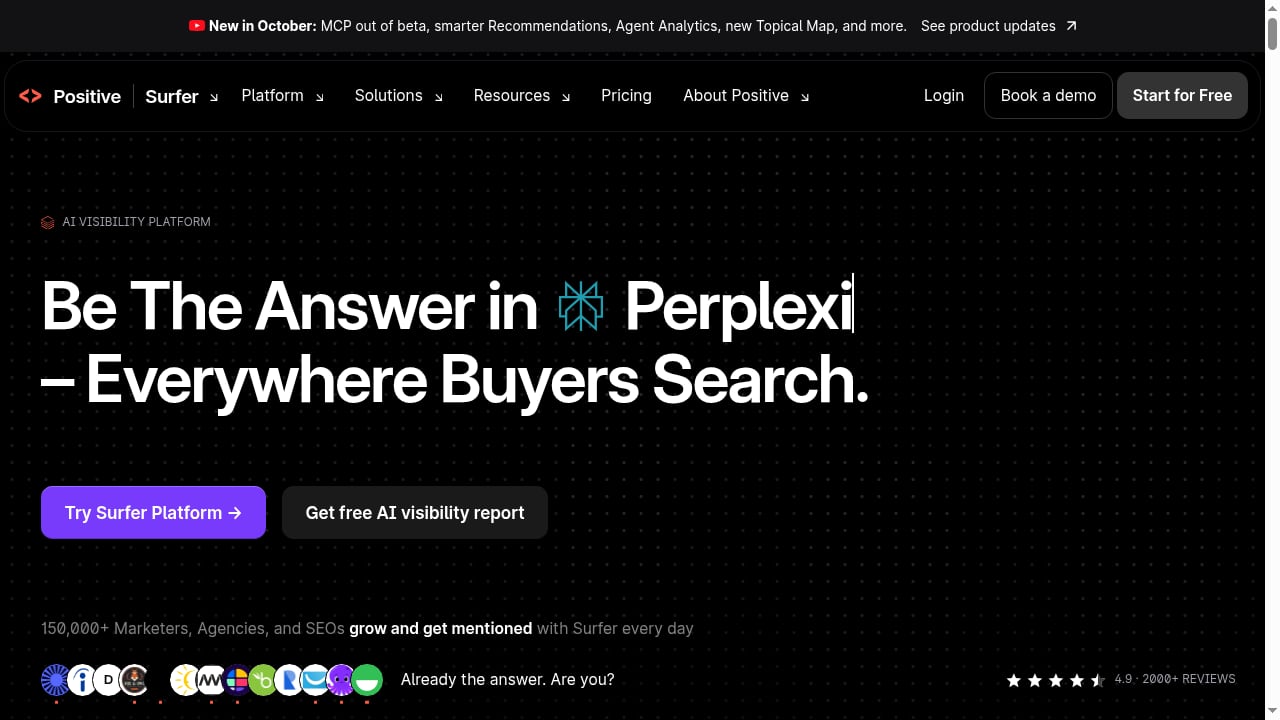
First viewport screenshot of Positive Surfer - AI Visibility Platform for maximum organic growth.
| Criterion | AgentBooks | AirOps | Surfer SEO |
|---|---|---|---|
| Primary job | End-to-end content automation from a website | AI search visibility plus content operations | On-page and AI search optimization |
| Starting point | Crawls your site to learn product and brand | Tracks AI answer engines and gaps | Analyzes SERPs and AI citation signals |
| Publishing | Scheduled generation with approval-first review | Workflows with CMS integrations | Editor-based, pairs with existing tools |
| Best fit | SaaS, e-commerce, agencies, founders | Mid-market and enterprise content teams | SEO specialists, writers, agencies |
| Entry pricing | Free beta; Business $30/mo; Enterprise $100/mo | Solo, Pro, Enterprise tiers | Paid plans starting around $49/mo |
Read the table as a scope map, not a scoreboard. AirOps covers more of the operating loop than the other two, which is exactly why its pricing and onboarding reflect enterprise reality. Surfer goes deep on a single article and its visibility signals. AgentBooks covers the path from product understanding to published article without requiring you to assemble the pipeline yourself.
How to choose based on your actual bottleneck
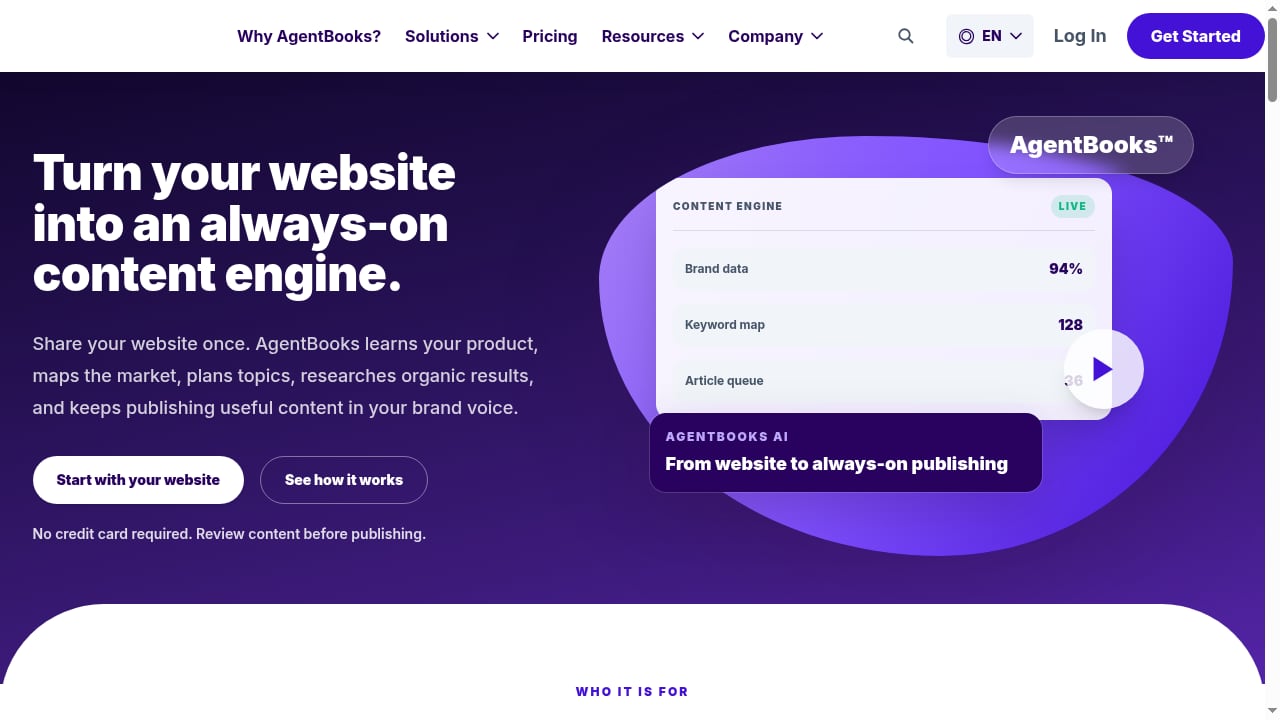
First viewport screenshot of AgentBooks — Autonomous Content Growth for Search and AI.
If your bottleneck is starting from zero every time
Blank prompts are the enemy of consistent publishing. If your team stalls at "what should we write about," a platform that begins with real product data changes the conversation. AgentBooks crawls your website to build brand intelligence, then produces a categorized keyword plan and topic pipeline from that foundation. That is a different starting point than a keyword list you still have to interpret.
For a closer look at how that compares with another website-driven option, see AgentBooks vs Averi: AI Content Platform Comparison.
If your bottleneck is proving AI search visibility
When leadership asks whether the brand shows up in AI answers, you need measurement, not more drafts. AirOps is built for that question, with visibility tracking across answer engines, query fanout analysis, and attribution from publish events to citation changes. Surfer's AI Tracker answers a similar question at the article level, monitoring mentions across major models and flagging competitor share of voice.
If measurement is the gap, start with one of those two. If you already have measurement and the gap is production, the calculus flips.
If your bottleneck is optimizing pages you already have
Surfer's Content Editor remains one of the most practical ways to improve a draft against real SERP signals. The live Content Score gives writers concrete direction, and the AI Search Guidelines layer adds citation-oriented suggestions on top. Teams that already have a research stack and a project management system often prefer Surfer precisely because it slots in rather than replacing everything.
If your bottleneck is volume without losing the brand voice
Scaling content usually breaks either consistency or speed. AgentBooks addresses this with approval-first workflows, scheduled generation, and brand voice learned from your own site. You keep a human gate before anything publishes, which is the practical middle ground between fully manual writing and unreviewed bulk output. For teams thinking about scale mechanics, Bulk Content Creation: A Practical Guide for 2025 walks through the workflow side.
Pricing and commitment compared
AirOps product interface.
Cost conversations get muddy fast, so keep the units straight.
- AgentBooks publishes three tiers: a free public beta plan, Business at $30/month, and Enterprise at $100/month. The free plan makes it low-risk to test whether website-driven automation fits your process.
- AirOps offers Solo, Pro, and Enterprise tiers. Entry points exist, but the platform's full value, including custom agents and unlimited knowledge bases, sits in enterprise territory. Expect a longer time-to-leverage.
- Surfer SEO starts around $49/month on paid plans and scales with seats and usage. Time-to-value is fast because it augments a workflow you already run.
None of these are apples-to-apples subscriptions. AirOps sells an operating system, Surfer sells an optimization layer, and AgentBooks sells an automated production pipeline. Match the purchase to the problem.
Practical examples by team type
A two-person SaaS marketing team. They need consistent publishing but cannot afford a content ops hire. AgentBooks fits: share the site, review the plan, approve articles on a schedule. AirOps would be more platform than they can operationalize today.
An agency managing twelve client domains. Reporting and multi-domain oversight matter. Surfer's view-only report sharing, data export, and extended reporting history serve client communication well. AgentBooks' multi-brand workspaces serve the production side. Many agencies run both.
An enterprise content team of fifteen. They need governance, measurement, and attribution across thousands of pages. AirOps is designed for that scale, with brand learning loops and connected channel strategy.
A founder publishing a niche site. Budget and simplicity dominate. AgentBooks' free beta and $30/month Business tier are accessible, and the approval workflow keeps quality in check without a full editorial staff.
Related reading
- Contentpen SEO Features: A Practical Breakdown for 2025 - A practical look at Contentpen SEO features: keyword research, SERP analysis, CTR gap detection, content decay tracking, and how they fit a real workflow.
- ContentBot.ai Demo: What You Can Actually Test in 2025 - A practical walkthrough of the ContentBot.ai demo: the inline autocomplete editor, workflow templates, bulk imports, and when to move to a full content engine.
Sources and further reading
- AirOps vs Surfer SEO vs Writesonic: What's best for AEO? - Compare AirOps vs. Surfer SEO and Writesonic for AI content creation and SEO. See how each helps content teams create, optimize, and rank at scale in 2026.
- AirOps vs SurferSEO: What's Right for Your Team in 2026? - Compare AirOps vs SurferSEO for AI search optimization. See how each platform helps your content team move from visibility data to governed execution in 2026.
- AirOps vs Surfer SEO: capabilities, pricing & which to choose | AI Agents Wiki - AirOps vs Surfer SEO compared across capabilities, autonomy, integrations, pricing, and best fit.
Frequently asked questions
Can AgentBooks replace AirOps or Surfer SEO?
Not directly. AgentBooks automates the path from product understanding to published content. AirOps specializes in AI search visibility measurement and enterprise content operations. Surfer specializes in on-page and AI citation optimization. They overlap in the create-and-publish stage but solve different primary problems.
Does AgentBooks guarantee rankings or traffic?
No, and it does not claim to. AgentBooks optimizes the content process and the measurable inputs, such as keyword planning, SEO preparation, and publishing consistency. Ranking outcomes depend on many factors outside any single tool.
Which platform is best for AI search visibility tracking?
AirOps and Surfer both invest heavily here. AirOps tracks visibility across AI answer engines with query fanout analysis and publish-to-citation attribution. Surfer's AI Tracker monitors brand mentions and competitor share of voice across major models. AgentBooks focuses on producing the content that can earn those citations rather than measuring them.
Is Surfer SEO only for optimization, not creation?
Surfer includes AI drafting support, but its center of gravity is the Content Editor and its scoring methodology. Teams typically bring their own research and writing process and use Surfer to sharpen each page. If you want creation and publishing automated end to end, that is a different category of tool.
How should a small team decide between the three?
Start with the bottleneck. If you cannot produce consistently, look at AgentBooks. If you cannot see whether AI search is working, look at AirOps or Surfer. If your existing pages underperform, Surfer's editor is the fastest intervention. Budget follows the bottleneck, not the feature list.
Conclusion
AgentBooks, AirOps, and Surfer SEO are not three versions of the same product. AirOps is the deepest system for AI search visibility and enterprise content operations. Surfer is the sharpest tool for optimizing individual pages against SERP and AI citation signals. AgentBooks is the most direct route from a website to a running content engine, with approval-first automation and pricing that starts free.
The honest answer is that many teams eventually use more than one. Pick the platform that removes your current bottleneck, prove the workflow, and expand when the next constraint appears.