
AgentBooks vs Kompozy vs Contentpen: Which AI Content Engine Fits Your Workflow?
Three platforms dominate the conversation when teams search for an AI content engine that does more than generate a draft. AgentBooks, Kompozy, and Contentpen each attack the content problem from a different angle: website-driven brand intelligence, multi-format repurposing, and SEO/AEO optimization at scale. This comparison breaks down where each tool genuinely wins, so you can match the platform to your actual bottleneck instead of the loudest marketing claim.
What each platform actually does
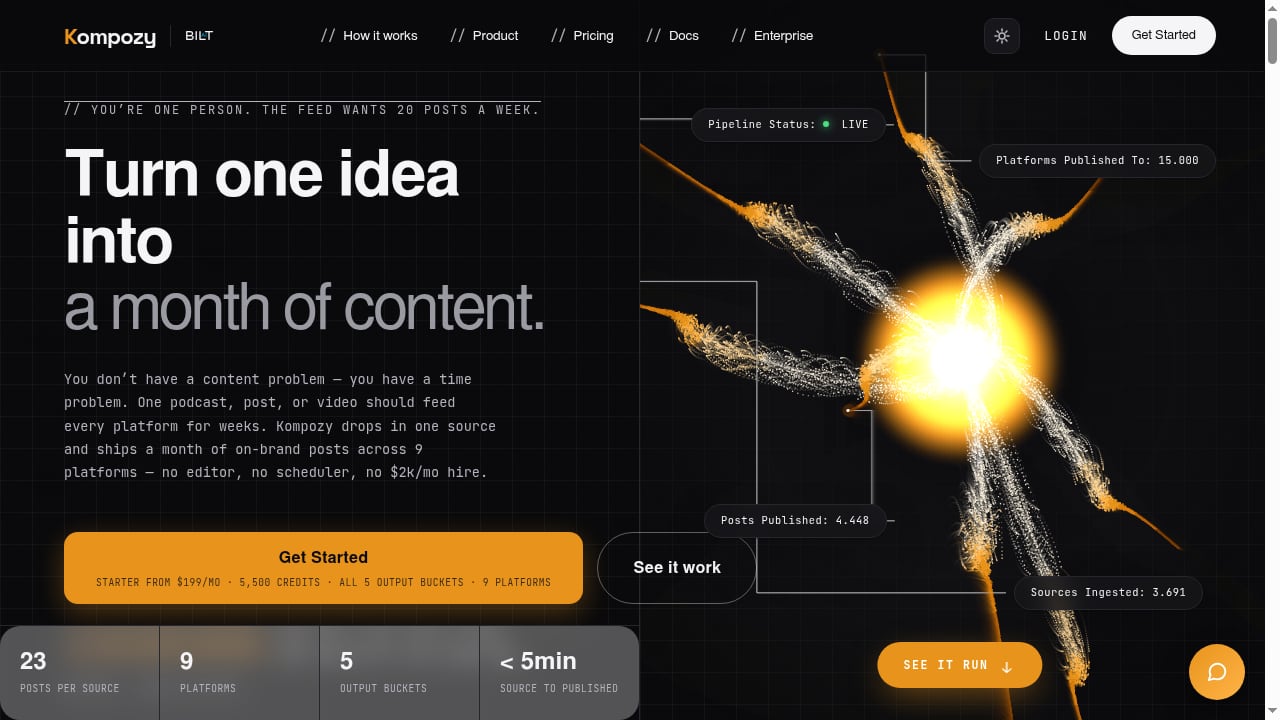
First viewport screenshot of Kompozy — Turn one idea into a month of content. On autopilot..
AgentBooks: website-driven content engine
AgentBooks starts by crawling your website. From that single input, it learns your product, maps your market, plans topics, researches organic search results, and publishes articles in your brand voice on a schedule. The workflow is approval-first: you review and approve content before it goes live, then the platform keeps generating on autopilot.
Core capabilities include brand intelligence from website crawling, a categorized keyword plan, top organic-result research, SEO preparation (title, description, keywords, images, tags, links), custom domain and site identity, multilingual publishing, and multi-brand workspaces. Pricing runs on a public beta with a free plan, a Business plan at $30/month, and an Enterprise plan at $100/month. AgentBooks does not guarantee rankings or traffic; it optimizes the content process and the measurable inputs behind it.
Kompozy: repurposing and publishing automation
Kompozy turns one source asset — a podcast episode, blog post, or video — into a month of on-brand content across multiple platforms. It ingests any URL and composes video, image, text, blog, and newsletter outputs, then publishes to nine platforms on full autopilot. It is built for solo creators, small marketing teams, and businesses drowning in the demand for fresh content.
Standout features include five output buckets, persona frames for branded avatar videos, HyperFrames composition templates, and persistent media storage with 10-year signed URLs. Kompozy offers a 14-day results guarantee and a starter plan from $199/month with 5,500 credits. It also publishes educational content on SEO, AI content compliance, and platform updates.
Contentpen: SEO and AEO optimization
Contentpen writes, optimizes, tracks, and publishes content designed to rank on Google and get cited by AI engines. Its AI agents run research, writing, optimization, and publishing end to end. The platform surfaces winnable terms, groups them into topic clusters, adds internal and external links automatically, and scores each piece for both traditional SEO and answer engine optimization (AEO).
Contentpen also tracks content decay, CTR gaps, and high-potential pages using Search Console data, then refreshes underperforming posts in one click. It publishes directly to WordPress, Webflow, Ghost, and Wix, and reports Google rankings alongside AI citations in a single view.
Comparison criteria: where each tool has a supported advantage
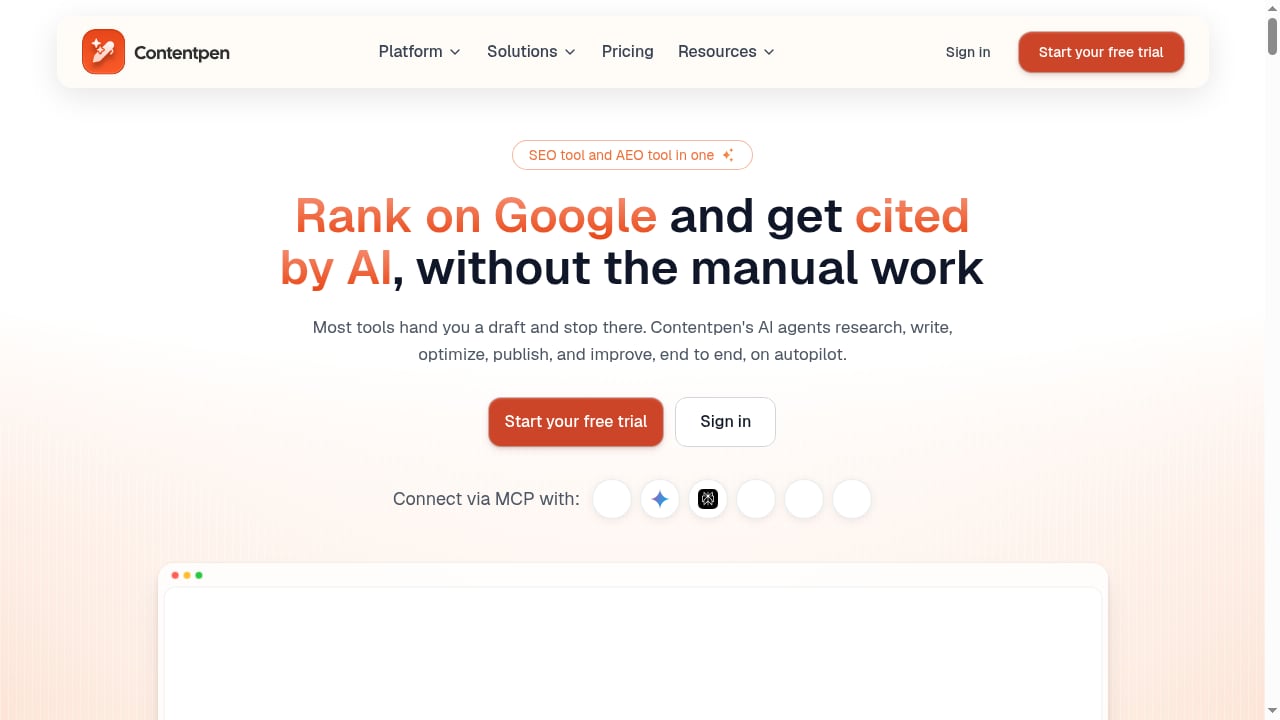
First viewport screenshot of SEO and AEO tool: Get ranked and cited by AI (TRY FREE).
| Criterion | AgentBooks | Kompozy | Contentpen |
|---|---|---|---|
| Primary input | Website crawl | Any URL (podcast, blog, video) | Keyword and Search Console data |
| Content formats | Articles and blog posts | Video, image, text, blog, newsletter | Articles and blog posts |
| Brand voice learning | From website crawl | Persona frames and templates | On-brand visuals and tone settings |
| SEO preparation | TDK, images, tags, links | Not the core focus | Live SEO score, topic clusters, auto-linking |
| AEO / AI citation optimization | Not a stated feature | Not a stated feature | Live GEO score, AI citation tracking |
| Publishing destinations | Custom domain and site identity | 9 platforms on autopilot | WordPress, Webflow, Ghost, Wix |
| Multilingual support | Yes | Not a stated feature | Not a stated feature |
| Multi-brand workspaces | Yes | Not a stated feature | Not a stated feature |
| Approval workflow | Approval-first | Full autopilot | Agent-driven with review options |
| Free plan | Yes (public beta) | No | Free trial available |
| Entry price | $30/month (Business) | $199/month (Starter) | Not publicly listed |
Where AgentBooks has a supported advantage
Website-driven brand intelligence
AgentBooks learns your product and market from your website before generating anything. That means the first draft already reflects your positioning, terminology, and category — not a generic prompt response. Kompozy relies on persona frames and templates, and Contentpen leans on keyword and Search Console data. Neither substitutes a full website crawl as the primary brand input.
Multi-brand and multilingual workspaces
If you run several brands or publish in more than one language, AgentBooks supports multi-brand workspaces and multilingual publishing natively. Kompozy and Contentpen do not list either capability in their public product descriptions. For agencies and portfolio operators, this is a structural difference, not a feature checkbox.
Entry pricing and free access
AgentBooks offers a free plan during public beta and a Business tier at $30/month. Kompozy starts at $199/month. Contentpen does not publish entry pricing. For teams testing AI content automation for the first time, AgentBooks removes the cost barrier that Kompozy imposes.
Approval-first workflow
AgentBooks requires approval before publishing. Kompozy runs on full autopilot, and Contentpen is agent-driven with review options. Teams in regulated industries or with brand-sensitive audiences often need a human checkpoint before content goes live. AgentBooks builds that in by default.
Where Kompozy has a supported advantage
Multi-format repurposing
Kompozy turns a single source into video, image, text, blog, and newsletter content. AgentBooks focuses on articles and blog posts. If your strategy depends on repurposing a podcast or webinar into a month of multi-channel assets, Kompozy is purpose-built for that job.
Broad publishing automation
Kompozy publishes to nine platforms on full autopilot. AgentBooks publishes to a custom domain with site identity. Contentpen publishes to four website builders. For creators who need distribution across social and email channels without manual work, Kompozy covers more ground.
Persistent media storage
Kompozy provides persistent media storage with 10-year signed URLs. That matters for video-heavy workflows where asset durability is a real operational concern.
Where Contentpen has a supported advantage
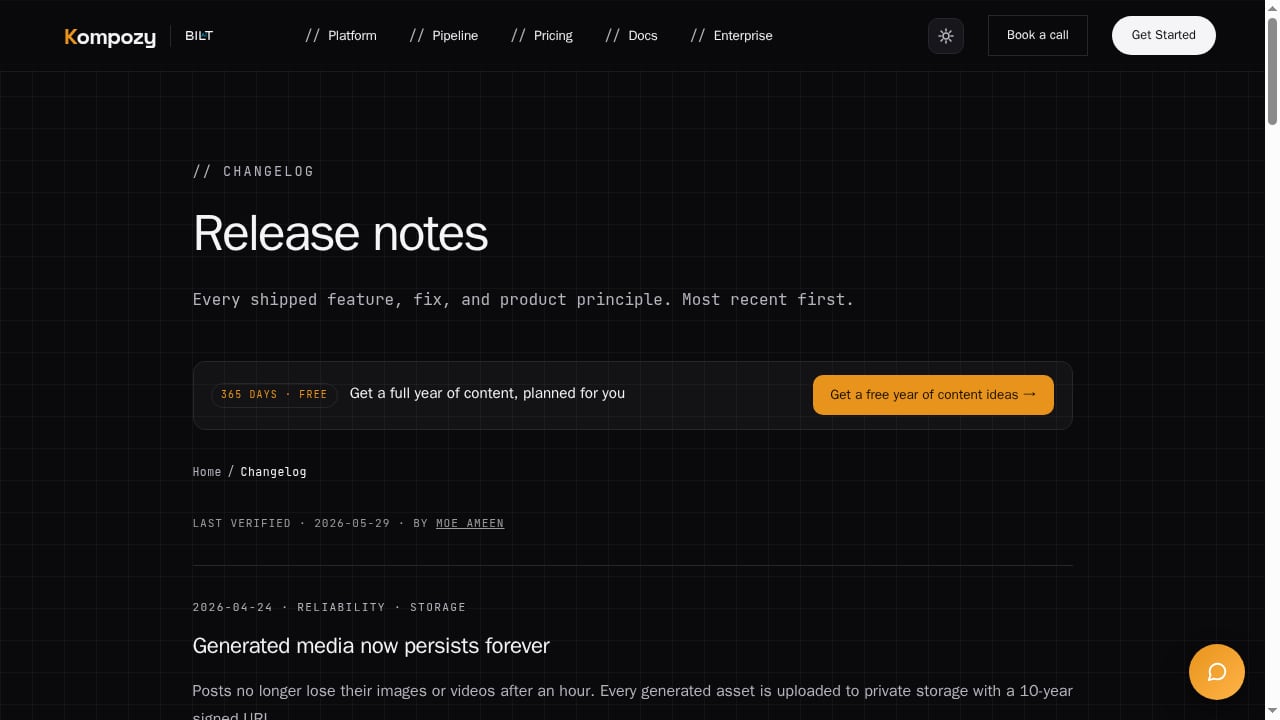
First viewport screenshot of Kompozy changelog — product updates and release notes.
AEO and AI citation optimization
Contentpen scores each piece for answer engine optimization and tracks AI citations alongside Google rankings. AgentBooks does not list AEO scoring or AI citation tracking as a feature. Kompozy does not either. If getting cited by ChatGPT, Perplexity, and AI Overviews is your primary goal, Contentpen addresses that directly.
Content decay and CTR gap detection
Contentpen monitors Search Console data to surface content decay, CTR gaps, and quick wins, then refreshes posts in one click. AgentBooks plans and publishes new content but does not publicly describe a decay-detection or refresh loop. Kompozy does not either. For teams with large existing content libraries, Contentpen's optimization loop is a meaningful advantage.
Live SEO scoring before publish
Contentpen flags optimization issues before you publish, with a live SEO score and one-click fixes. AgentBooks prepares TDK, images, tags, and links, but does not publicly describe a live scoring system. Contentpen's pre-publish checklist reduces the back-and-forth between writer and editor.
How to choose
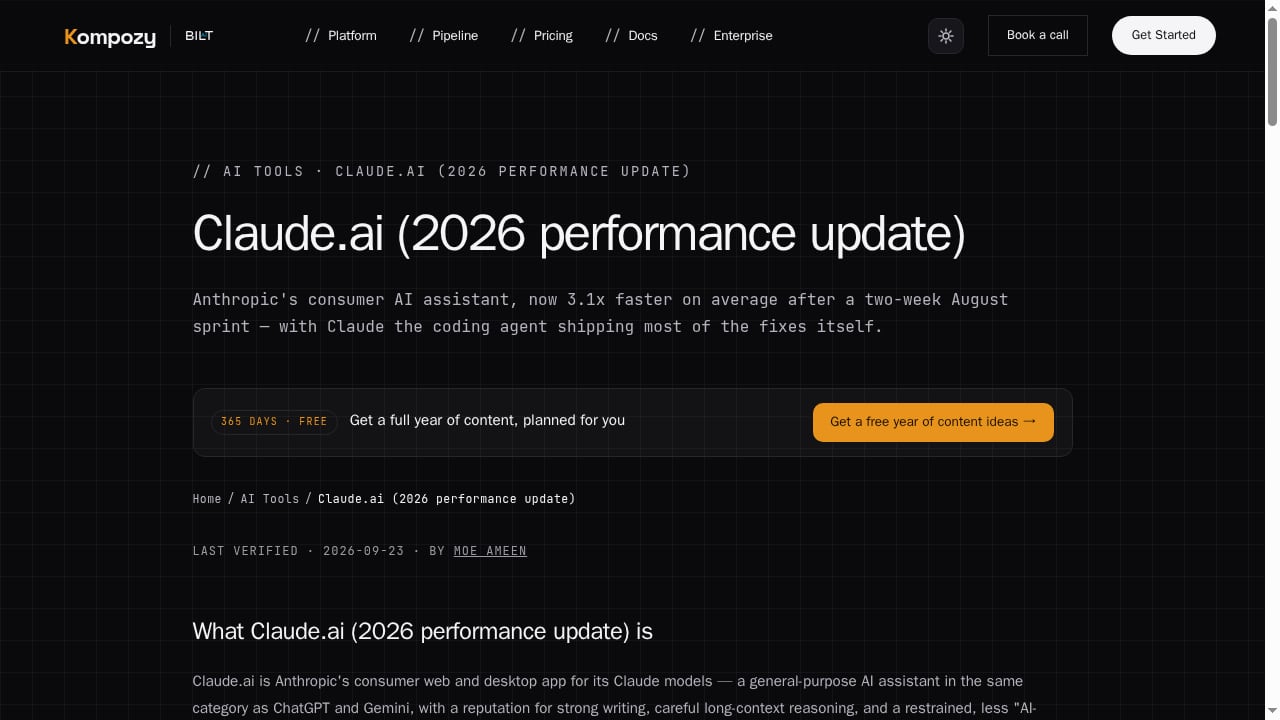
First viewport screenshot of Claude.ai after the 3x speed update — what it does & how to turn its drafts into published content with Kompozy.
Pick AgentBooks if: you want a content engine that starts from your website, publishes in your brand voice, supports multiple brands and languages, and costs $30/month or less to start. It fits SaaS teams, e-commerce sites, digital agencies, founders, and independent websites that need a repeatable article pipeline.
Pick Kompozy if: your bottleneck is repurposing one source asset into many formats across many channels. It fits solo creators and small teams that need video, image, text, blog, and newsletter output from a single input, and who are comfortable with full autopilot publishing.
Pick Contentpen if: your priority is ranking on Google and getting cited by AI engines. It fits teams with existing content libraries that need decay detection, CTR gap analysis, and AEO scoring, and who want SEO and AEO optimization in one platform.
For a broader look at how these tools stack up against other platforms, see our Top 10 AI-Powered SEO Content Creation Platforms 2026 roundup. If you are comparing AgentBooks to other workflow-focused tools, our AgentBooks vs AirOps vs Surfer SEO breakdown covers automation, brand intelligence, and AI visibility in more detail. And if you want to see how AgentBooks fits into an automated distribution pipeline, our guide to using AgentBooks with Make walks through the setup.
Related reading
- Writesonic Review 2026: AI Search Visibility & GEO Tested - Hands-on Writesonic review: AI search visibility tracking, GEO audits, article quality, pricing gates, and who should buy it in 2026.
Sources and further reading
- SEO and AEO tool: Get ranked and cited by AI (TRY FREE) - Meet the SEO tool and AEO tool that works while you don't. Contentpen writes, optimizes, tracks, and publishes content that ranks on Google & gets cited by AI.
FAQ
Is AgentBooks better than Kompozy?
They solve different problems. AgentBooks is a website-driven article engine with multi-brand and multilingual support at a lower entry price. Kompozy is a multi-format repurposing platform that publishes to nine channels on autopilot. Choose based on whether you need article depth or multi-format breadth.
Is Contentpen better than AgentBooks for SEO?
Contentpen has a supported advantage in AEO scoring, AI citation tracking, content decay detection, and live SEO scoring. AgentBooks has a supported advantage in website-driven brand intelligence, multi-brand workspaces, multilingual publishing, approval-first workflow, and entry pricing. The right choice depends on whether you need optimization of existing content or creation of new content at scale.
Can I use AgentBooks and Contentpen together?
Yes. AgentBooks can generate and publish new articles from your website data, while Contentpen can optimize and track those articles for SEO and AEO performance. The two platforms address different stages of the content lifecycle.
Does AgentBooks guarantee rankings or traffic?
No. AgentBooks does not guarantee rankings or traffic. It optimizes the content process and the measurable inputs behind it, including keyword planning, organic-result research, and SEO preparation.
What is the cheapest option?
AgentBooks offers a free plan during public beta and a Business plan at $30/month. Kompozy starts at $199/month. Contentpen does not publish entry pricing. For teams testing AI content automation for the first time, AgentBooks has the lowest barrier to entry.
Conclusion
AgentBooks, Kompozy, and Contentpen are not interchangeable. AgentBooks turns your website into an always-on article engine with brand intelligence, multi-brand support, and a $30/month entry point. Kompozy turns one source asset into a month of multi-format content across nine publishing channels. Contentpen optimizes content for Google rankings and AI citations with decay detection and live SEO scoring.
The honest answer is that the best tool depends on your bottleneck. If you need articles that sound like your brand and scale across languages and products, start with AgentBooks. If you need repurposing across video, image, text, blog, and newsletter, Kompozy is built for that. If you need SEO and AEO optimization with citation tracking, Contentpen addresses that directly.
For a deeper look at how AI search visibility is changing content strategy, the Nerdbot AEO tools ranking covers 19 platforms tracking AI answers, and Pinggy's SEO vs AEO vs GEO breakdown explains how AI answers pick their sources. Both are useful context for deciding how much weight to put on AEO versus traditional SEO in your content plan.