AgentBooks vs Machined: A Complete AI Content Platform Comparison
If you typed “AgentBooks vs Machined” hoping to choose between two rising AI content platforms, you might have landed on forums about machinist handbooks. That’s not what you’re after. This article cuts through the noise and shows you how AgentBooks and Machined really stack up for autonomous content creation, SEO growth, and brand consistency.
AgentBooks positions itself as an autonomous content operating system that learns your product inside out, researches your market, and publishes content that reflects your brand’s truth. Machined focuses on scaling bulk, SEO-optimized articles with automated clustering and citations. Both promise to reduce manual work, but they take very different roads. Let’s explore which road fits your brand.
How AgentBooks and Machined Approach AI Content
AgentBooks vs Machined: Which AI Content Engine Wins for SEO? product interface and feature overview.
AgentBooks: The Product‑Led Content Engine
AgentBooks doesn’t just string keywords together. It ingests your entire website to understand your product, your voice, and your unique position. From there, it maps your market, identifies related products, plans topic clusters grounded in organic search data, and then generates articles complete with title tags, meta descriptions, and images — all in your brand voice. The platform is built for teams that value control: an approval‑first workflow means nothing goes live without human review. You can publish to your own domain in multiple languages, and the API lets you weave content operations into your existing stack.
Machined: The Bulk SEO Content Generator
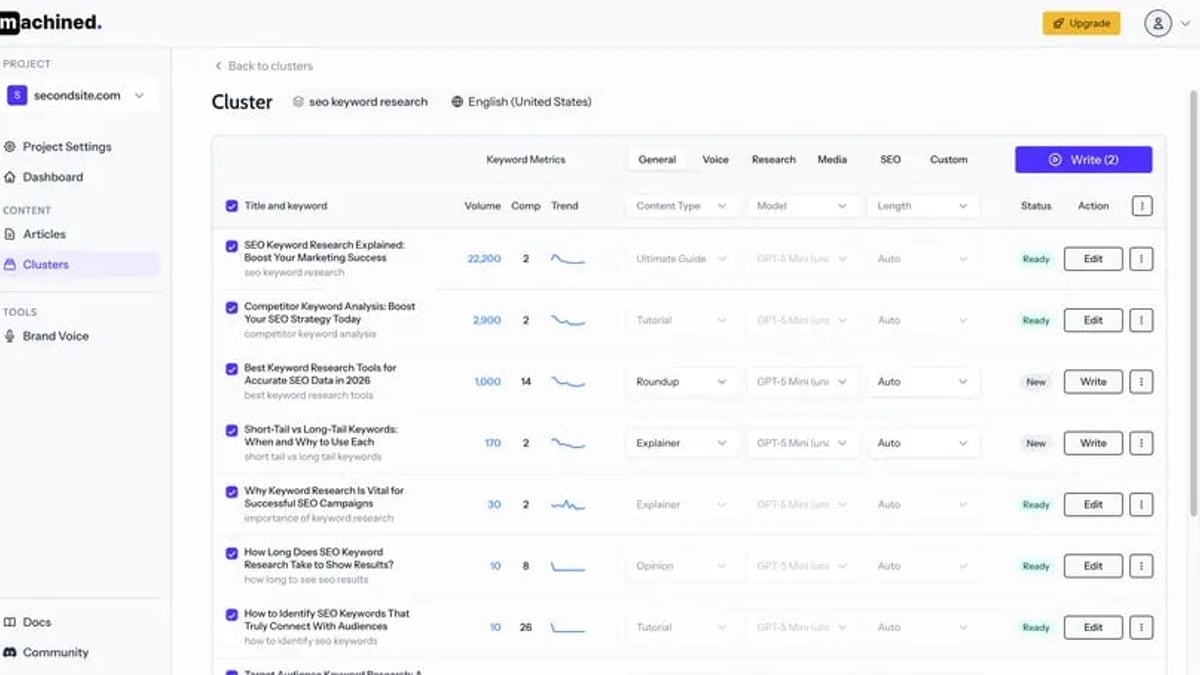
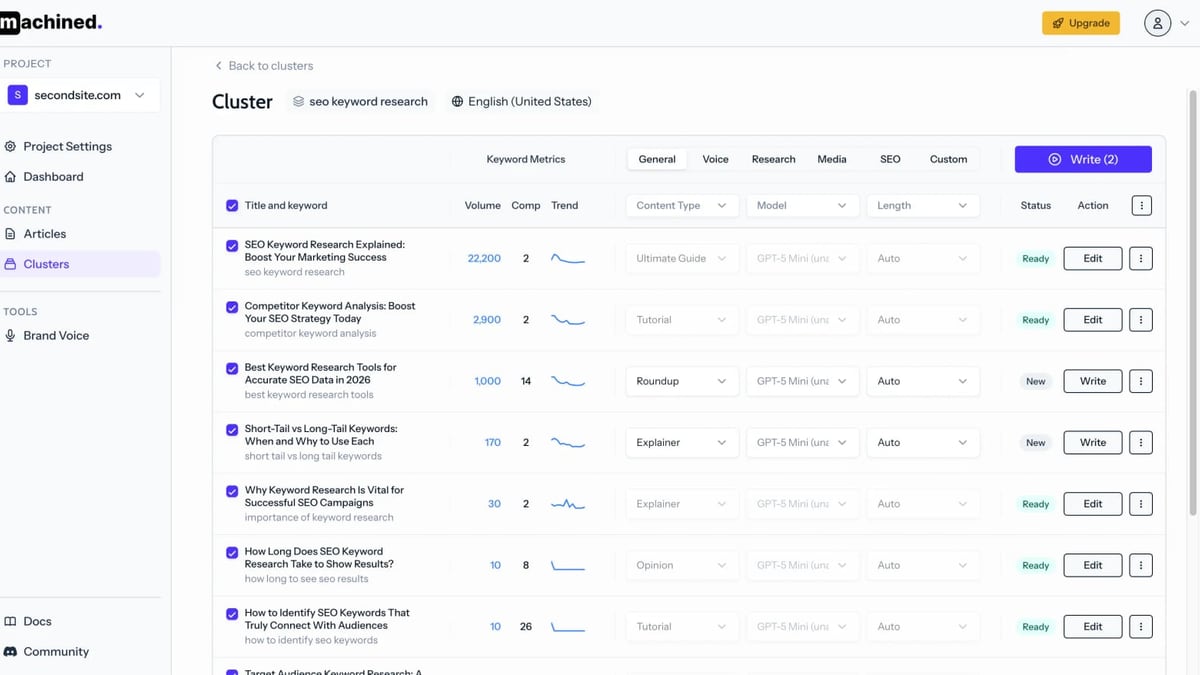
Machined automates content production from keyword research to publishing. It clusters keywords, writes articles using AI models from OpenAI, Anthropic, and others, and adds citations from web research. You can generate complete content clusters, insert internal links automatically, and push posts directly to WordPress or Webflow. The promise is time savings — one case study highlights saving over 100 hours a month. However, the approach leans heavily on volume, and brand depth is more about tone customisation than deep product intelligence.
Feature‑by‑Feature Comparison
AgentBooks vs Machined: Which AI Content Engine Wins for SEO? product interface and feature overview.
Research and Topic Planning
- AgentBooks uses website-grounded brand intelligence to discover related products and map keyword opportunities. It researches live organic results to decide what to cover and how to frame it. The output is a categorized content plan designed specifically around your product story.
- Machined performs automated keyword research and clustering, pulling in real‑time web research for context. While it can build topical clusters fast, it lacks the brand‑centric discovery that ties every article back to your own product facts.
Content Generation and Brand Voice
- AgentBooks generates articles with verifiable product facts, combining TDK crafting and images. Because it learns directly from your site, the resulting content stays true to what you actually offer — no generic rewrites.
- Machined writes with citations from various AI providers and lets you set a brand voice. But without a mechanism to cross‑reference against your specific product pages, the content may drift toward broadly researched narratives rather than precise brand storytelling.
Workflow and Quality Control
- AgentBooks puts approval at the center. Every article goes through a human checkpoint, reducing the risk of factual errors and off‑brand messaging. The transparent process suits marketing teams, agencies, and product owners who answer to real outcomes.
- Machined is built for speed: bulk generation and one‑click publishing. You can enable automatic internal linking, but there’s no built‑in review gate. While some teams add their own editing step, the platform itself defaults to “generate and publish,” which can let quality slip through unnoticed.
Publishing and Integrations
- AgentBooks supports custom‑domain publishing, multilingual output, and an API that lets you integrate content production directly into your workflows. You’re not locked into a single CMS.
- Machined offers one‑click publishing to WordPress and Webflow. That’s handy if you live in those ecosystems, but it limits flexibility for custom setups, headless architectures, or multi‑brand publishing from one account.
Where AgentBooks Shines
- Autonomous product‑led content – The platform doesn’t just write about general topics; it turns your website into an always‑on content engine that grows with your product line.
- Verifiable product facts – Because it grounds research in your own pages, the articles reflect genuine value propositions, not external generalities.
- Multilingual out of the box – Expand into new markets without rebuilding your content stack; publish in multiple languages under your own domain.
- API access – Teams can programmatically trigger content creation and connect AgentBooks to other tools in their growth stack.
- Approval‑first workflow – Ideal for brands that value editorial standards and need sign‑off before going live.
Where Machined Falls Short
AgentBooks vs Machined: Which AI Content Engine Wins for SEO? product interface and feature overview.
- Lack of deep product intelligence – Machined can research the web, but it doesn’t build a persistent model of your specific products and their stories. Content may read as competent SEO material without the unique angle that converts readers.
- No built‑in fact verification – With citations pulled from external sources, there’s no automated check against your own product truth. That burden stays on your team.
- Limited publishing integrations – Only WordPress and Webflow are supported natively, which can be a dealbreaker for custom or multi‑platform setups.
- Volume over precision – Bulk generation is powerful, but speed‑first workflows can produce repetitive or thin content that needs substantial human rework. For a deeper look at Machined’s strengths and limitations, see our Machined review.
When Machined Might Still Make Sense
AgentBooks vs Machined: Which AI Content Engine Wins for SEO? product interface and feature overview.
If you run a content site without a complex product offering — think a broad informational blog or a local SEO project — Machined’s keyword clustering and automated internal linking can accelerate topical authority quickly. The platform excels at scaling generic content clusters. For example, a niche business like Engineer Seal Stamps used Machined to grow to 200+ top‑ranking keywords, saving 100+ hours monthly. That’s impressive for volume, but note the context: a relatively straightforward product set.
When your brand depends on nuanced product differentiation, continuous market research, and fact‑checked publishing, AgentBooks offers a more durable path. Check our broader comparison AgentBooks vs Machined vs Autoblogging.ai to see how these tools line up with other alternatives.
Which AI Content Platform Should You Choose?
If your goal is to build a content engine that genuinely understands your product and grows with your brand, AgentBooks is the stronger fit. Its website‑grounded intelligence, approval workflow, and multilingual support give you the infrastructure to publish consistently useful, on‑brand content without a large editorial team.
If you need to crank out hundreds of cluster‑based articles fast and have the editorial resources to quality‑check every piece, Machined can do the job. Just be prepared to inject the brand depth yourself.
For a wider perspective on where these tools sit in the market, explore our list of the top 10 AI content marketing platforms.
Related reading
- Top 10 SEO Software Platforms in 2026: Tested and Ranked - Discover the 10 best SEO software platforms for 2026, ranked by research depth, technical audits, and content support. Compare Semrush, Ahrefs, Moz Pro, SE Ranking and more.
- Autoblogging.ai Review 2025: AI Auto-Blogging Put to the Test - This Autoblogging.ai review covers 7 AI modes, real user feedback, pricing credit breakdown, and who actually benefits. Evidence-based, not hype.
Sources and further reading
- Machine shop trade secrets vs. Pocket companion vs. Engineer's black book ?? - Of course I want all of them but which of these three books should I get if I were to get one of them?
Besides the Machinery Handbook these are the books I currently have and my fav are the bottom two. Right now leaning towards the Machine shop trade secrets as I'm not sure if the pocket...
- Machinery's Handbook vs American Machinists' Handbook - History & Lore - Enjoy the videos and music you love, upload original content, and share it all with friends, family, and the world on YouTube.
- AgentBook | Real Estate Association Management System ... - Supercharge your association by eliminating friction for your team allowing them to build meaningful relationships with members
FAQ
What is the main difference between AgentBooks and Machined?
AgentBooks is an autonomous content operating system that learns your specific product, plans topics from your own site’s data, and enforces human approval before publishing. Machined automates bulk SEO content creation with keyword clustering and web research, but it doesn’t build a deep, persistent model of your brand’s product universe.
Can Machined do product‑focused content?
Machined can write about products using real‑time web research and citations, but it lacks a dedicated mechanism to verify facts against your own website. You’ll likely need to edit output to align it precisely with your product’s unique features and messaging.
Does AgentBooks support bulk generation?
AgentBooks plans and publishes content continuously and autonomously, but its process is built around planned, research‑backed articles rather than one‑click batch dumps. The focus is on consistent quality over raw volume.
Which one is better for SEO?
Both can drive SEO results. Machined excels at building topical clusters rapidly. AgentBooks prioritizes useful, brand‑aligned content that aligns with search intent and product truth — an approach Google increasingly rewards. The right choice depends on whether you need sustained brand authority or quick keyword coverage.
Conclusion
“AgentBooks vs Machined” isn’t just a face‑off between two tools — it’s a choice between two content philosophies. Machined can help you scale fast with automated workflows. AgentBooks gives you a content operating system that knows your product, respects your editorial process, and publishes in your voice across markets. If you’re building a brand, not just a keyword footprint, AgentBooks deserves the deeper look.