AgentBooks vs Machined vs GravityWrite: Which Tool Fits?
If you’re evaluating AgentBooks, Machined, and GravityWrite, you’re probably trying to solve a specific content problem—not just looking for another AI writer. Each tool takes a fundamentally different approach to content creation, and the “best” one depends on whether you need a long-term autonomous engine, a structured SEO content machine, or an all-in-one creative toolbox.
This comparison doesn’t declare a single winner. Instead, it shows you where each platform shines, where it struggles, and what kind of team or project each one supports best.
How Each Platform Approaches Content Creation
AgentBooks vs Machined vs GravityWrite: Which Tool Fits? product interface and feature overview.
AgentBooks: The Autonomous Content Engine
AgentBooks is not a one‑click article generator. It’s a content operating system that learns your product, maps your market, plans topics, researches what’s already ranking, and continuously publishes brand‑aligned content. The platform works like an always‑on data‑aware engine that doesn’t just write—it thinks about what to write and why.
Its core difference is autonomy with guardrails. Instead of you prompting each article, AgentBooks builds a live model of your website, discovers related products, organizes keywords into topic clusters, and writes articles that reference verifiable product facts—all in your brand voice. An approval‑first workflow means content only publishes after you say yes, and the multi‑language, custom‑domain publishing infrastructure keeps everything consistent across markets.
The trade‑off is speed at the individual article level. AgentBooks prioritizes useful, fact‑grounded content over rapid‑fire drafts, so it’s less suited for teams that need 50 generic posts overnight. It fits growth teams, SaaS companies, and e‑commerce stores that want to build a durable, trustworthy library without expanding their editorial headcount.
If you’re comparing autonomous platforms more broadly, our AgentBooks vs contentmarketing.ai comparison digs into the differences between agent‑driven systems and agency‑led tools.
Machined: SEO Content Workflow Automation
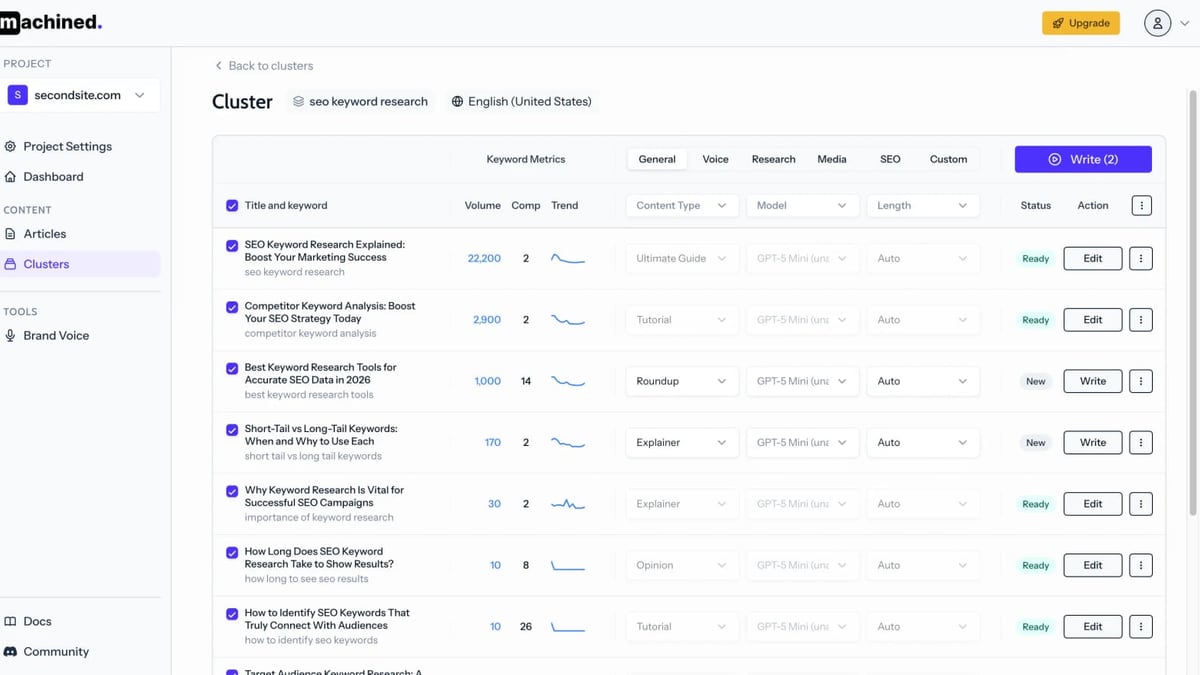
Machined treats content as an SEO production line. From keyword research and clustering to AI‑powered drafting (with multiple model providers like OpenAI, Anthropic, Google, and Perplexity) through to automated internal linking and one‑click publishing to WordPress or Webflow, it’s built to scale topical authority efficiently.
Where Machined excels is speed and structure. You can generate dozens of inter‑linked articles around a topic cluster in minutes, complete with AI‑generated images and consistent brand voice customization. A real‑world case saw Engineer Seal Stamps grow to 200+ top‑ranking keywords and save over 100 hours per month, showing how powerful bulk creation can be when SEO is the primary goal.
Machined describes its own approach as cluster‑first content building, which means it designs articles that reinforce each other rather than stand alone. This makes it ideal for local businesses, marketing agencies, and startups that need to build topical depth fast.
The limitation is that Machined still leans on a human to provide direction, even if that direction is light. It automates creation and linking, but doesn’t autonomously learn your market or decide what’s missing. It’s a powerful SEO tool—just not an independent strategist.
GravityWrite: The All‑in‑One Content Swiss Army Knife
GravityWrite takes the opposite route. Instead of specializing in SEO content, it bundles over 70 AI writing tools—blog writer, image and video generator, social media scheduler, website builder, HR document writer, sales pitch creator, text humanizer, and more—into a single subscription. The philosophy is replace multiple standalone AI tools with one platform that works across marketing, HR, sales, and creative tasks.
This versatility makes GravityWrite incredibly popular (over 3 million users, 4.5 on G2). For e‑commerce store owners, bloggers, or solo marketers who juggle writing, design, and social media, GravityWrite reduces tool fatigue and keeps costs predictable. Real‑time keyword suggestions, plagiarism checks, and tone customization are included, and the output is consistently optimized for search.
The downside is that breadth comes at the expense of depth. GravityWrite won’t automatically build a content plan or publish autonomously—you still feed it prompts. And for teams that need strict, verifiable brand alignment or ongoing market‑informed content, the manual effort piles up as volume increases.
Head‑to‑Head Comparison
AgentBooks vs Machined vs GravityWrite: Which Tool Fits? product interface and feature overview.
To make the choice clearer, here’s how the three platforms compare across capabilities that matter for different workflows.
| Capability | AgentBooks | Machined | GravityWrite |
|---|---|---|---|
| Autonomous content planning & research | ✅ Learns brand, maps market, plans topics | ❌ Requires human topic input | ❌ Prompt‑driven only |
| Bulk article generation | ❌ Focus on quality over quantity | ✅ Cluster‑based batch generation | ✅ One‑click article drafts for various formats |
| SEO internal linking & clustering | ✅ Via organic research, but not automated linking | ✅ Fully automated interlinking | ⚠️ Manual or basic suggestions |
| Brand voice consistency | ✅ Continuous learning from website, fact‑aligned | ✅ Customizable voice, but less context | ✅ Customizable tone, but less product depth |
| Multi‑language publishing | ✅ Native multi‑locale, custom domains | ⚠️ Supported through WP/Webflow locale handling | ✅ 70+ languages, but no publishing infrastructure |
| Workflow integration (CMS/API) | ✅ API + direct Contentful, others | ✅ One‑click WP & Webflow publish | ❌ Limited direct publishing integrations |
| Visual & creative content (images, video) | ❌ Out of scope | ✅ AI image generation | ✅ Image & video generator, social scheduler |
| Pricing (entry‑level paid) | $29/mo (Pro) | $29/mo (paid plans) | $19/mo (Plus) |
| Best for | Growth teams that need a hands‑off content engine | SEO‑focused teams scaling topical authority | Marketers who need one tool for all content types |
When to Choose AgentBooks Over Machined or GravityWrite
AgentBooks vs Machined vs GravityWrite: Which Tool Fits? product interface and feature overview.
Choose AgentBooks when your content program’s biggest bottleneck is strategy and consistency, not speed. If you have a complex SaaS product, an e‑commerce catalog with interrelated items, or a multi‑locale site, AgentBooks does the heavy lifting of understanding your market and publishing accurate, brand‑safe articles without constant human intervention.
It’s especially valuable if you’ve already tried other AI writers and found that output starts sounding repetitive or loses connection to your unique selling points. AgentBooks’ ground‑truth model pulls from your website and verifiable facts, so content stays differentiated even as volume grows.
For teams already using a headless CMS, connecting AgentBooks with Contentful shows how you can automate publishing while keeping full architectural control.
When Machined or GravityWrite Might Serve You Better
AgentBooks vs Machined vs GravityWrite: Which Tool Fits? product interface and feature overview.
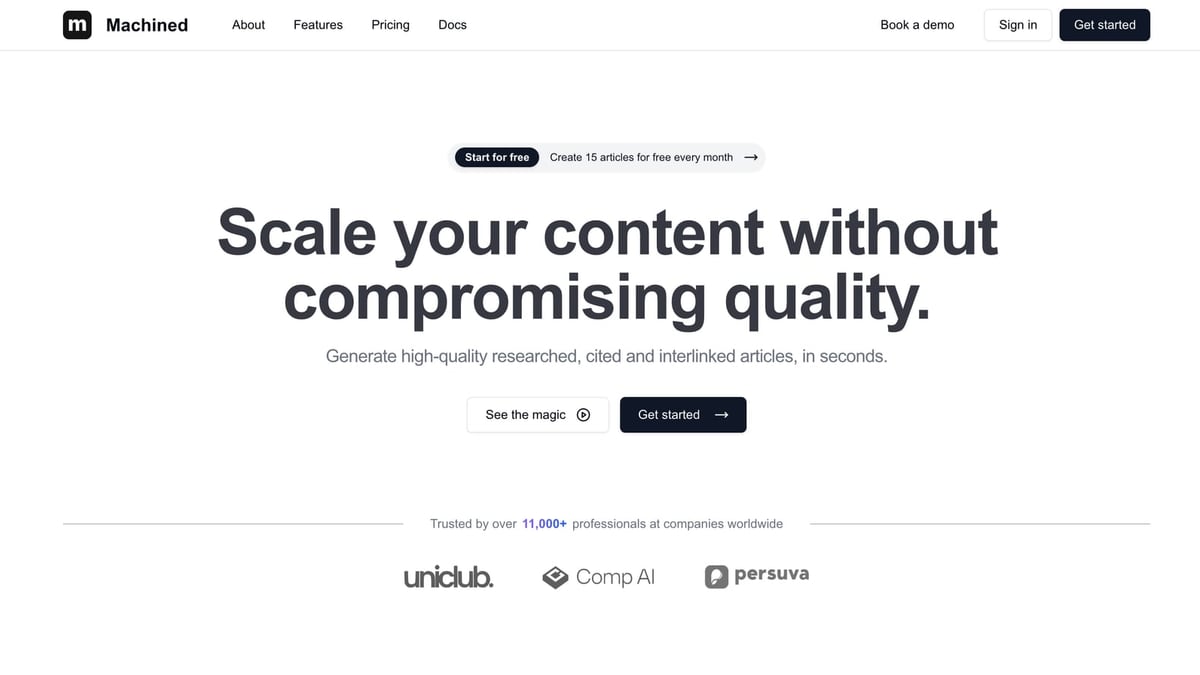
Machined is the better fit when SEO is the primary growth lever. If you know your topics, have a solid keyword strategy, and just need to turn that plan into a network of interlinked, ranking‑ready pages, Machined saves enormous time. Its cluster‑first approach and one‑click publishing drastically reduce the gap between research and published content. The case for Machined strengthens when you want to avoid hiring extra writers and still produce at scale.
GravityWrite wins when content types span far beyond blog posts. If you’re a solo founder or small marketing team juggling email copy, social media posts, product descriptions, ebook creation, and even visual assets, GravityGive’s all‑in‑one model keeps costs low and workflows simple. It won’t replace a dedicated content strategist or SEO tool, but it will replace a dozen niche apps.
Pricing and Value
All three platforms are affordable for small teams. AgentBooks starts at $29/month (Pro) with a free Starter tier in public beta, Machined offers plans from $29 to $99/month with a free tier, and GravityWrite starts at $19/month (Plus) with a free option. The real cost effectiveness depends on what you would otherwise spend on complementary tools or extra headcount.
- AgentBooks replaces the need for a junior content strategist plus a writer, so it can save thousands in editorial costs.
- Machined replaces SEO research tools and manual internal linking work, accelerating the content calendar.
- GravityWrite replaces numerous AI content, design, and social tools, consolidating subscriptions.
Related reading
- Contentstack Review 2026: The Agentic Experience Platform for Enterprise - In-depth Contentstack review covering the new Agentic Experience Platform, headless CMS features, pricing, API challenges, and comparisons to Contentful. Learn if it fits your enterprise.
- Top 10 Digital Asset Management Platforms 2026 (Ranked & Reviewed) - Compare the 10 best digital asset management platforms for 2026. Expert reviews, evidence-based rankings, AI features, pricing, and DAM software you can trust.
Sources and further reading
- AI Writing Tools and Writing Assistants | Microsoft 365 - AI writing tools and writing assistants help you write content faster as well as proofread your work to check for errors and inconsistencies.
- I Tested 9 “Overhyped” AI Writing Tools... Here's The Best One - Enjoy the videos and music you love, upload original content, and share it all with friends, family, and the world on YouTube.
Frequently Asked Questions
Can I use AgentBooks just to generate one article quickly?
AgentBooks is not optimized for single, prompt‑by‑prompt generation. Its value comes from continuous, strategy‑driven publishing. For quick one‑offs, Machined or GravityWrite would be faster.
Does Machined handle brand tone as deeply as AgentBooks?
Machined allows brand voice customization, but AgentBooks builds a living model from your entire website, ensuring product facts and subtle tone details are carried into every article automatically. Machined’s voice feature is more comparable to a style guide; AgentBooks’ is more like an always‑up‑to‑date brand encyclopedia.
Is GravityWrite good for building a full SEO content site?
It can write SEO‑optimized articles, but it lacks the autonomous planning and clustering logic of Machined or the product‑grounded research of AgentBooks. For a heavy SEO play, you’d likely need to pair GravityWrite with separate planning tools.
Can I switch between these platforms easily?
Since AgentBooks and Machined publish directly to your CMS, you can start with one and later add another for different content types. GravityWrite’s content usually requires manual copy‑paste or download, but the output is standard markdown or HTML, so migration is possible.
Final Verdict
There is no universal winner. AgentBooks is the most autonomous and brand‑loyal option—best for teams that want to set a strategy and let content grow itself. Machined is the most effective SEO automation tool, perfect for building topical authority fast. GravityWrite is the most versatile creative companion, ideal for marketers who need to wear many hats.
Define your real bottleneck first. If it’s strategy and consistency, lean toward AgentBooks. If it’s speed and SEO execution, Machined is your engine. If it’s too many tools and too many content formats, GravityWrite will simplify your stack.
All three are worth testing with their free plans. Start with the one that matches your most painful constraint today, and you’ll find the right fit.