AgentBooks vs SEO Writing: Which AI Content Platform Fits Your Growth Strategy?
Choosing between an autonomous content engine and a rapid AI writing tool isn't just about features—it's about how you want to grow. AgentBooks and SEO Writing represent two fundamentally different philosophies for scaling organic content. One acts as an always-on growth partner that learns your business; the other excels at producing optimized articles on demand. This comparison breaks down where each platform shines, where they fall short, and which one aligns with your actual content goals.
The Core Difference: Autonomous Engine vs. On-Demand Writer
First viewport screenshot of Blog.
Before diving into feature lists, it's worth understanding the architectural gap between these two tools.
AgentBooks is built as an autonomous content growth platform. You share your website once, and the system continuously learns your product, maps your market, researches organic competitors, and publishes brand-consistent content without requiring a new brief for every article. It's designed to solve the stalls that kill content programs: running out of topics, losing brand context across writers, and inconsistent publishing schedules.
SEO Writing positions itself as an AI-powered SEO content creation platform. Its strength lies in generating 1-click, SERP-analyzed articles from a brief or a product URL. The tool auto-analyzes competitor pages and tailors content for both traditional search engines and AI-powered ones like ChatGPT and Google AI Overviews. It's built for speed and bulk production.
The distinction matters. If you need a tool that writes articles when you tell it to, SEO Writing fits. If you need a system that grows content while you focus on other things, AgentBooks addresses a different problem entirely.
Feature Comparison: Where Each Platform Leads
First viewport screenshot of SEOWriting Pricing – Flexible Plans for SEO Content Creation.
Content Strategy and Topic Discovery
AgentBooks advantage: Automated market mapping and topic planning.
AgentBooks doesn't wait for you to tell it what to write. Its brand intelligence extracts product knowledge directly from your website, then maps the competitive landscape and plans topic clusters autonomously. This addresses one of the most common content growth stalls: the editorial team running out of ideas or struggling to prioritize topics that actually move the needle.
SEO Writing relies on you providing a brief or a product URL. While its real-time SERP analysis is strong, the strategic layer—deciding what to write and why—remains a manual process. For teams with a dedicated content strategist, this works fine. For lean teams or solo founders, the strategic gap can become a bottleneck.
Brand Voice and Context Retention
AgentBooks advantage: Persistent brand intelligence across all content.
Because AgentBooks learns your product once and applies that understanding to every piece it publishes, brand consistency scales naturally. The platform adapts to different business models—SaaS, e-commerce, independent websites, digital products—and shapes content operations around each model's unique needs, from feature guides and comparison pages to buying guides and audience-specific FAQs.
SEO Writing offers brand voice customization, but it operates on a per-project basis. Each new article requires re-establishing context. For teams publishing at high volume, this manual step can lead to voice drift, especially when multiple team members configure briefs differently.
Publishing Workflow and Autonomy
AgentBooks advantage: Approval-first or autopilot workflows with custom domain hosting.
AgentBooks gives you a choice: review and approve every piece before it goes live, or switch to autopilot and let the system publish continuously. Custom domain hosting means your content lives on your own site, building your domain authority directly.
SEO Writing supports one-click publishing to WordPress and Shopify, which is convenient for users already on those platforms. However, the workflow is fundamentally manual—you generate an article, review it, and push it live. There's no autonomous publishing mode. For teams that want to set a strategy and let content flow, this manual dependency can become the very bottleneck they were trying to eliminate.
Multilingual Output
AgentBooks advantage: Built-in multilingual publishing.
AgentBooks includes multilingual output as a core feature, allowing content to reach audiences in multiple languages without separate workflows. SEO Writing focuses primarily on English-language content and doesn't emphasize multilingual capabilities as a core strength.
SERP Analysis and Real-Time Data
SEO Writing advantage: Real-time SERP competitor analysis.
SEO Writing's standout feature is its ability to auto-analyze SERP competitors and tailor content accordingly. The tool examines top-ranking pages and adjusts recommendations in real time, which is particularly useful for affiliate content, product roundups, and competitive comparison pages where ranking dynamics shift frequently.
AgentBooks incorporates organic research that studies top-ranking pages, but its approach is integrated into a broader autonomous workflow rather than offered as a real-time, article-by-article analysis tool. For users who want granular SERP data before every piece, SEO Writing's immediacy is a genuine strength.
Content Formats and Use Cases
SEO Writing advantage: Bulk generation for affiliate and review content.
SEO Writing excels at producing long-form content types that benefit from rapid, SERP-informed generation: product roundups, reviews, how-to guides, and affiliate content. Its bulk generation feature lets users produce multiple articles simultaneously, which suits affiliate marketers and content teams with high-volume publishing targets.
AgentBooks covers a broader range of content types—feature guides, comparison pages, buying guides, audience-specific FAQs—but does so within an autonomous framework. It's less about generating 20 articles at once and more about ensuring the right articles publish consistently over time.
Pricing and Accessibility
| Plan Tier | AgentBooks | SEO Writing |
|---|---|---|
| Free / Trial | Starter (free beta): brand research, keyword planning, hosted content site | Free trial: 3 articles |
| Entry Paid | Pro: $29/mo, advanced SEO optimization, multilingual publishing | Subscription-based, scalable for individuals |
| Team / Agency | Team: $99/mo, multiple workspaces, priority support | Team and agency plans available |
AgentBooks' free beta tier is notably generous, offering brand research, keyword planning, and a hosted content site with no immediate cost. The Pro plan at $29/mo unlocks advanced SEO optimization and multilingual publishing. For a deeper breakdown, see the AgentBooks pricing page.
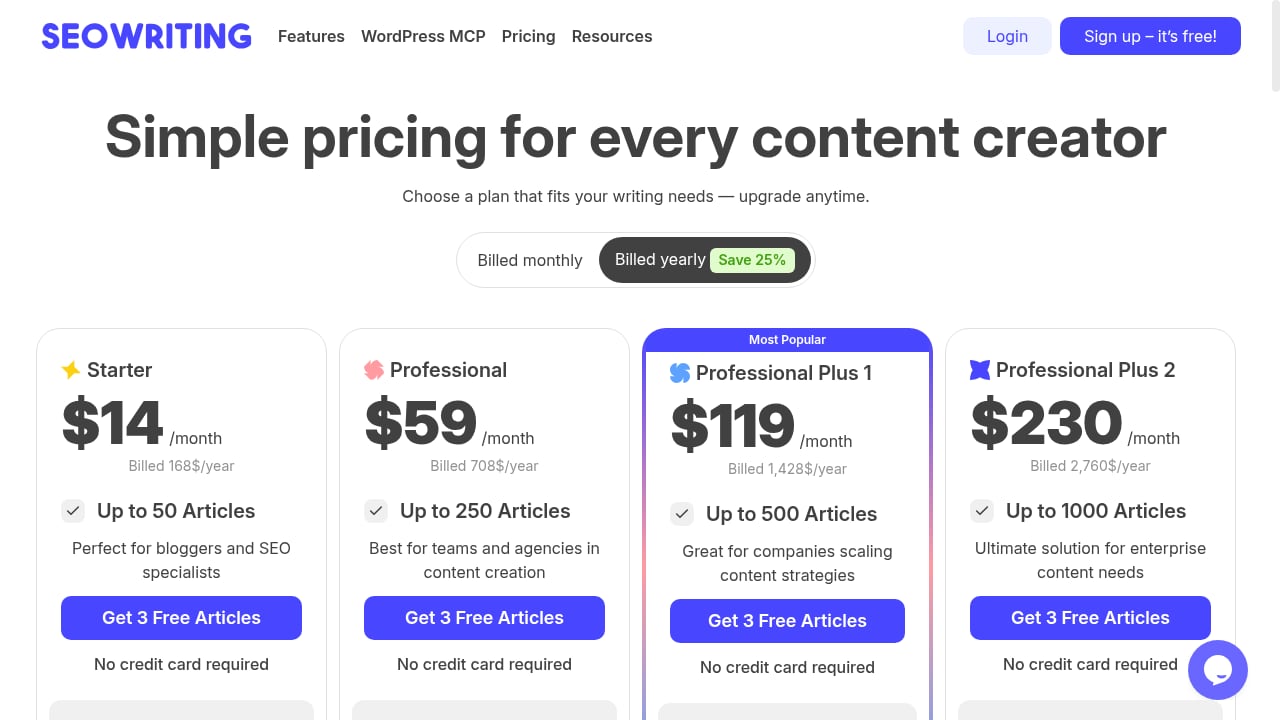
SEO Writing's free trial provides three articles to test the platform. Paid plans scale by usage and features, with pricing structured for individuals, teams, and agencies. The platform reports over 50,000 content creators using the tool.
Where SEO Writing Falls Short
First viewport screenshot of Blog.
No tool is perfect, and understanding SEO Writing's limitations helps clarify whether AgentBooks is the better fit.
No autonomous content strategy. SEO Writing generates articles on command, but it doesn't plan your content calendar, identify topic gaps, or adapt your strategy over time. If you stop providing briefs, content stops flowing. This makes it a productivity tool rather than a growth engine.
Manual brand context per project. Brand voice settings must be configured and maintained per project. For teams publishing across multiple product lines or content types, this creates administrative overhead and increases the risk of inconsistent messaging.
Limited to on-demand publishing. There's no autopilot mode. Every article requires a human to initiate generation, review output, and push publish. For lean teams, this manual dependency can become the primary constraint on content output.
Platform dependency for hosting. While one-click publishing to WordPress and Shopify is convenient, content doesn't live on a custom domain unless you already have those platforms set up. AgentBooks' custom domain hosting removes this dependency entirely.
Where AgentBooks May Not Be the Best Fit
Transparency requires acknowledging where AgentBooks isn't the ideal choice.
Real-time SERP granularity. If your workflow depends on analyzing SERP data article-by-article before writing, SEO Writing's real-time analysis provides more immediate competitor insights than AgentBooks' integrated research approach.
Bulk affiliate content. For affiliate marketers who need to generate 20 product roundups in an afternoon, SEO Writing's bulk generation and affiliate-specific templates offer a more streamlined path.
Short-form, one-off content. If you rarely publish and only need occasional articles, an on-demand tool like SEO Writing may feel more practical than setting up an autonomous engine.
How AgentBooks and SEO Writing Fit into a Broader AI Content Stack
First viewport screenshot of Blog.
These tools aren't mutually exclusive. Some teams pair an autonomous engine with a rapid writer, using AgentBooks for ongoing brand content and SEO Writing for time-sensitive pieces that need real-time SERP data. For teams also using SEO toolkits, combining AgentBooks with Semrush creates a workflow where Semrush handles keyword research and performance tracking while AgentBooks handles autonomous publishing.
For B2B teams targeting specific accounts, pairing AgentBooks with BrandWell layers buyer intent data onto autonomous content production, creating content that targets ready-to-buy accounts. This kind of integrated stack is where the real competitive advantage emerges—not from any single tool, but from how tools complement each other.
Decision Framework: Which Tool Matches Your Needs?
Choose AgentBooks if:
- You want content to grow without constant manual input
- Brand consistency across hundreds of articles matters to you
- You're a lean team that can't afford a full-time content strategist
- You need multilingual content from a single workflow
- You want content hosted on your own domain without platform dependencies
Choose SEO Writing if:
- You need real-time SERP data before every article
- Bulk affiliate or review content is your primary format
- You already have a content strategist who plans topics manually
- One-click WordPress or Shopify publishing fits your existing stack
- You prefer per-article control over autonomous publishing
Consider using both if:
- You want autonomous brand content plus on-demand SERP-optimized pieces
- Your content mix includes both educational resources and affiliate content
- You have the budget to layer tools for different content types
Related reading
- Top 10 B2B Buyer Intent Data & AI Content Platforms 2026 - Compare the 10 best B2B buyer intent data and AI content platforms for 2026. From Demandbase to BrandWell, find tools that unify signal detection and content creation.
- AgentBooks vs SEO Writing vs Copy.ai: Which AI Tool Wins in 2025? - Compare AgentBooks, SEO Writing, and Copy.ai for AI content and GTM. See features, pricing, and which platform fits your organic growth or sales pipeline needs.
Sources and further reading
- AgentBooks vs SEO Writing vs Copy.ai: Which AI Tool Wins in ... - 2 days ago — AgentBooks is built to turn a website into an always-on content engine. SEO Writing excels at real-time SERP analysis. AgentBooks takes an ...
- Is SEO dead or evolving in 2026? - Is SEO dead or evolving in 2026? Explore how AI search, GEO, and algorithm shifts are reshaping SEO and what it means for your strategy.
- Is SEO dead? The real answer to the future of search - Is SEO dead in 2026? The data says no, but the real risk is the widening gap in AI search readiness and what you can do to preapre.
Frequently Asked Questions
Does AgentBooks replace the need for an SEO tool like Semrush?
Not entirely. AgentBooks handles content strategy, creation, and publishing autonomously, but dedicated SEO tools like Semrush provide deeper keyword data, backlink analysis, and competitive research that complement AgentBooks' workflow. For a complete picture, read our Semrush review to understand where each tool fits.
Can SEO Writing publish content automatically?
No. SEO Writing requires manual initiation for each article. You provide a brief or product URL, generate the content, review it, and publish. There is no autonomous or scheduled publishing mode.
How does AgentBooks handle brand voice across different content types?
AgentBooks extracts brand intelligence from your website during setup and applies that understanding across all content types—feature guides, comparison pages, FAQs, and buying guides. The system adapts its output to each format while maintaining consistent voice and product knowledge.
Is SEO Writing suitable for B2B content?
SEO Writing can generate B2B content, but its strengths lie in product roundups, reviews, and affiliate content. B2B teams needing thought leadership, case studies, or complex product explanations may find AgentBooks' business-model-specific content operations more aligned with their needs.
What happens if I stop using AgentBooks?
Content published to your custom domain remains yours. The autonomous publishing stops, but all previously published content continues to live on your site and generate organic traffic.
Conclusion: Autonomy vs. Assistance
AgentBooks and SEO Writing solve different problems. SEO Writing is an excellent assistant—it writes what you tell it to write, informed by real-time SERP data, and does so quickly. For affiliate marketers and teams with clear content briefs, it's a powerful productivity tool.
AgentBooks solves a deeper problem: the strategic and operational burden of keeping a content program alive. By learning your product, mapping your market, and publishing continuously, it removes the bottlenecks that cause content programs to stall. For lean teams, SaaS companies, e-commerce brands, and anyone who wants organic growth without a full content department, that autonomy is the difference between a tool you use and an engine that grows your business.
The question isn't which tool writes better articles. It's whether you want a writing assistant or a growth engine. Your answer determines which platform fits.