Top 10 B2B Buyer Intent Data and AI Content Platforms for 2026
B2B buying cycles have changed. Prospects research anonymously across publisher sites, review platforms, and communities long before they fill out a form. Marketing teams that wait for a demo request are already late. The platforms that win in 2026 solve two problems at once: they surface real-time buyer intent signals and enable teams to act on those signals with relevant, AI-generated content at scale. This review evaluates the top solutions that genuinely belong at the intersection of B2B buyer intent data and AI content creation.
Evaluation Criteria Every platform on this list was assessed against five pillars that matter for revenue teams:
- Intent Data Quality: Does the platform capture first-party, third-party, or contextual signals? How fresh and actionable are the insights?
- AI Content Capability: Can the platform research, draft, optimize, and publish content that matches buyer intent?
- Activation & Workflow: How easily can signals route into CRM, ads, sales outreach, or content briefs?
- Scalability: Does the tool support a team of five or a global enterprise without breaking workflows?
- Evidence & Outcomes: Are there documented case studies, verified reviews, or transparent performance data?
1. Demandbase
Demandbase operates as a unified go-to-market platform that combines account intelligence, advertising, and sales orchestration. Its core strength lies in identifying in-market accounts through a blend of first-party engagement data and third-party intent signals, then activating personalized campaigns across display, video, and connected TV.
The platform’s AI identifies surges in topic-level research and scores accounts by likelihood to convert. What sets Demandbase apart in 2026 is its embedded content personalization engine: when a high-intent account lands on your site, the system dynamically adjusts headlines, case studies, and CTAs to match known research interests. This closes the gap between detecting intent and serving the right content.
Why it ranks first: Demandbase is one of the few platforms where intent detection and content activation live in a single interface, backed by a mature ABM analytics layer that measures pipeline influence. For enterprise teams running multi-channel campaigns, it remains the benchmark.
2. 6sense
First viewport screenshot of BrandWell Blog | Marketing Insights for Growth Teams.
6sense uses predictive AI to uncover which accounts are in an active buying cycle, often before those accounts visit your website. Its patented approach analyzes time-based patterns across billions of intent signals, then recommends the best next action for sales and marketing.
In 2026, 6sense has deepened its content orchestration capabilities. Revenue teams can generate AI-powered email copy, ad creative, and landing page variants directly from intent insights. The platform’s “AI Content Studio” pulls in account-level research topics and suggests messaging angles proven to resonate at each buying stage. For organizations that need predictive lead scoring fused with content generation, 6sense is the strongest option.
Why it ranks second: The combination of predictive scoring and AI-generated sales content is unmatched, though the platform’s depth requires a dedicated operations team to configure properly.
3. Bombora
First viewport screenshot of BrandWell Blog | Marketing Insights for Growth Teams.
Bombora built its reputation on Company Surge® data, which tracks content consumption across a cooperative of thousands of B2B publisher websites. When employees at a target account suddenly read heavily about “supply chain visibility” or “zero-trust architecture,” Bombora flags that surge as a buying signal.
While Bombora itself is a pure intent data provider, its ecosystem integrations make it a critical input for AI content workflows. Marketing teams pipe Bombora intent topics into platforms like BrandWell or dedicated AI writers to generate surge-aligned blog posts, whitepapers, and landing pages. This intent-to-content pipeline ensures that every piece of content addresses what buyers are actively researching.
Why it ranks third: Bombora’s data co-op provides the broadest third-party intent coverage, and its API-first approach makes it the preferred signal layer for content automation stacks.
4. ZoomInfo
ZoomInfo has evolved beyond a contact database into a full-fledged revenue intelligence platform. Its intent layer, powered by real-time behavioral data from millions of companies, identifies which accounts are researching specific product categories, competitors, or pain points.
What makes ZoomInfo relevant for AI content teams is its “Intent + Content” workflow. When a target account shows a spike in, say, “ERP integration challenges,” ZoomInfo can trigger an automated sequence that includes AI-generated email copy, LinkedIn ad variations, and a personalized landing page. The content assets are built from ZoomInfo’s enriched firmographic and technographic data, ensuring relevance.
Why it ranks fourth: ZoomInfo excels at connecting intent to specific contacts and automating personalized content outreach, though its AI writing features are less mature than dedicated content platforms.
5. BrandWell
First viewport screenshot of Request a Custom BrandWell Quote | Intent Data, TrafficID & Enrichment.
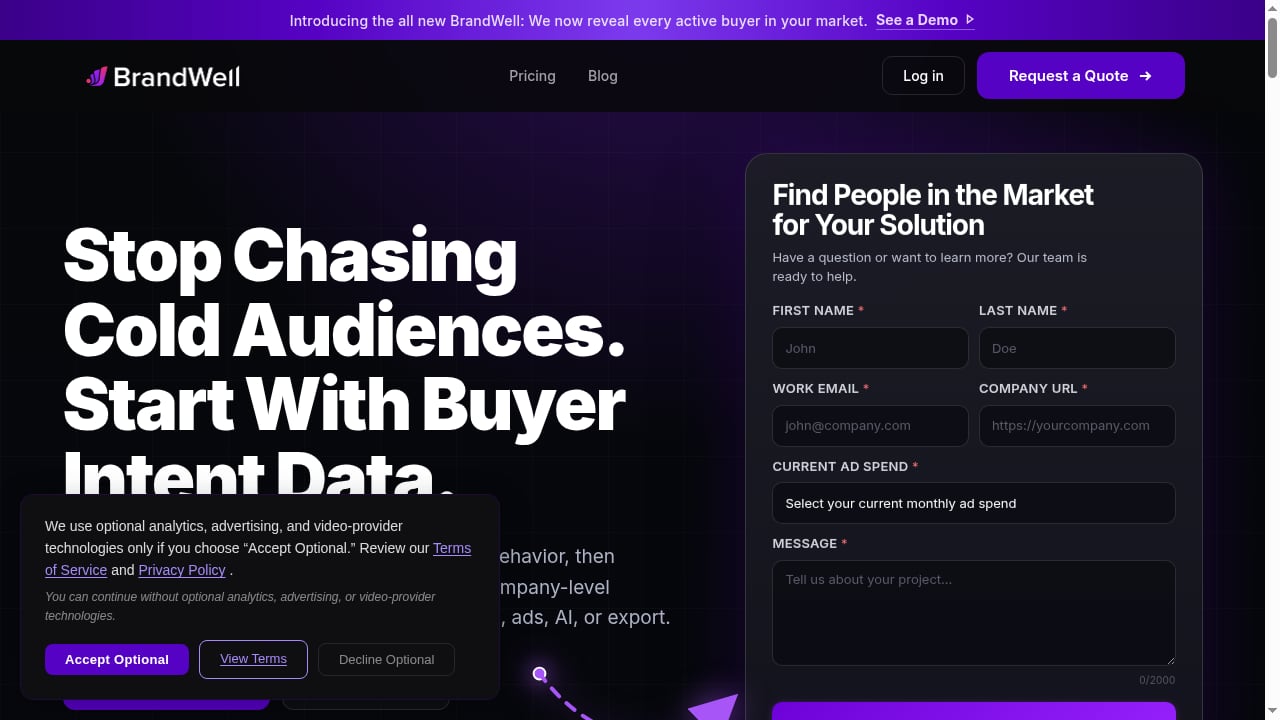
BrandWell bridges the gap between buyer intent data and AI-powered content production. The platform captures live commercial research behavior—identifying anonymous website visitors, enriching them into person-level and company-level records, and routing those insights into CRM, ads, or email.
On the content side, BrandWell includes an AI writer trained to produce SEO-optimized articles, ad copy, and social content. The key differentiator is the feedback loop: intent signals inform which topics to write about, and content performance data refines which accounts to prioritize. One case study documented 3,292 leads generated in a single week by combining TrafficID visitor identification with intent-triggered content campaigns. For growth marketers who need both signal detection and scalable content creation without stitching together five tools, BrandWell is a practical choice.
Why it ranks fifth: BrandWell unifies intent data and AI writing in a way that directly reduces cost per lead, though its intent network is smaller than Bombora’s or 6sense’s.
6. DemandScience
DemandScience focuses on multi-channel content syndication powered by intent data. The platform identifies in-market accounts through its network of B2B publishers and then serves those accounts with gated content assets—whitepapers, eBooks, webinars—that match their research stage.
In 2026, DemandScience has layered in an AI content studio that generates these assets from topic briefs tied to live intent surges. If a cohort of accounts shows elevated interest in “cloud cost optimization,” DemandScience can spin up a relevant guide and syndicate it within days. This speed-to-content is what sets the platform apart for demand generation teams running always-on campaigns.
Why it ranks sixth: The tight integration of intent-driven syndication and rapid AI content production fills a specific need, though it is less suited for teams that want to host and own the content on their own domains.
7. Clearbit (now part of HubSpot)
Clearbit’s data enrichment platform, now deeply integrated into HubSpot’s ecosystem, provides firmographic, technographic, and intent signals at the company and contact level. When a known or anonymous visitor lands on your site, Clearbit reveals who they are, what technologies they use, and whether their company is showing intent surges elsewhere on the web.
For AI content workflows, the value lies in dynamic personalization. Clearbit data can feed into HubSpot’s AI content tools to generate tailored landing pages, chatbot scripts, and email sequences that reflect the visitor’s industry, company size, and current research interests. It is a powerful combination for teams already committed to the HubSpot ecosystem.
Why it ranks seventh: The HubSpot-native experience is seamless, but the intent data is more enrichment-focused than a standalone discovery engine.
8. Leadfeeder
Leadfeeder identifies companies visiting your website, even when they never fill out a form. By tracking IP-based visits and matching them to a database of millions of companies, Leadfeeder surfaces warm accounts based on first-party intent—pages viewed, time on site, and return frequency.
While Leadfeeder does not natively generate content, its integration with AI writing tools creates a practical workflow: sales teams receive a daily feed of high-intent visitors, and marketing can trigger AI-generated follow-up content tailored to the pages those accounts viewed. For smaller B2B teams that want to start with first-party intent before investing in third-party data, Leadfeeder is a sensible entry point.
Why it ranks eighth: Leadfeeder excels at first-party visitor identification, but it requires external tools for content creation and third-party intent enrichment.
9. Mutiny
Mutiny is a website personalization platform that uses intent data to dynamically change the on-site experience for target accounts. When a visitor from a high-intent account lands on your site, Mutiny can swap headlines, testimonials, and CTAs to match that account’s industry, use case, or research stage.
The AI content angle comes from Mutiny’s generative copy features: the platform can draft personalized page variants at scale, pulling in account-level data to create hundreds of micro-personalized experiences. For ABM programs that already have intent signals flowing in from Bombora or 6sense, Mutiny acts as the on-site content activation layer.
Why it ranks ninth: Mutiny’s personalization engine is best-in-class, but it depends on external intent providers and does not function as a standalone content research or publishing platform.
10. Qualified
Qualified is a conversational AI platform designed to identify high-intent website visitors and connect them with sales reps in real time. Its Piper AI engine analyzes on-site behavior, firmographic data, and external intent signals to determine which visitors should trigger a live chat, a bot conversation, or a direct sales routing.
What earns Qualified a spot on this list is its AI-generated conversation studio. When an intent-qualified visitor arrives, Piper can generate personalized chat scripts, discovery questions, and meeting bookers based on what that account has been researching. This turns intent data into immediate, human-like content experiences that accelerate pipeline.
Why it ranks tenth: Qualified’s real-time conversational content is highly effective for sales acceleration, but it is purpose-built for the chat channel and does not replace broader content marketing platforms.
How to Choose the Right Platform for Your Stack
First viewport screenshot of BrandWell | We Reveal Every Active Buyer in Your Market.
Your choice depends on where the bottleneck sits in your revenue engine:
- If you need to find net-new in-market accounts before they visit your site, start with a third-party intent provider like Bombora or 6sense.
- If your website already attracts traffic but you cannot identify who is visiting, Layer on Leadfeeder or BrandWell’s TrafficID to de-anonymize visitors and route them to sales.
- If you have intent signals but struggle to produce content fast enough, evaluate an AI content platform that can ingest intent topics and generate SEO-optimized drafts. BrandWell’s unified approach works here, as does pairing Bombora with a dedicated AI writer.
- If you need to personalize the on-site experience for known accounts, Mutiny or Qualified will activate your intent data where it matters most.
For teams exploring how autonomous content engines fit into an intent-driven stack, AgentBooks offers a complementary approach. It functions as an always-on content engine that researches, plans, and publishes educational content in your brand voice—useful for scaling organic content production once intent data has identified the topics your buyers care about. When paired with an intent platform like BrandWell, the combination creates a system where signals dictate the content roadmap and AI handles production. Learn how to combine AgentBooks with BrandWell for smarter B2B content.
Related reading
- AgentBooks vs SEO Writing vs Copy.ai: Which AI Tool Wins in 2025? - Compare AgentBooks, SEO Writing, and Copy.ai for AI content and GTM. See features, pricing, and which platform fits your organic growth or sales pipeline needs.
- AgentBooks vs Copy.ai: Which AI Platform Fits 2025? - AgentBooks vs Copy.ai: Compare an autonomous content engine with a GTM AI platform. See features, pricing, and which tool solves your organic growth or sales pipeline needs.
- How to Use AgentBooks with Semrush: A Complete Workflow - Learn how to pair AgentBooks' autonomous content engine with Semrush's SEO toolkit to research, create, and measure content that ranks.
Sources and further reading
- Top 10 B2B Intent Data Providers for Better Lead Targeting - Discover the best B2B intent data providers with AI Ark to enhance your revenue performance by rich B2B intent data!
- 10 Best Buyer Intent Data Providers in 2026: Compared - See the 2026 comparison table of 10 buyer intent data providers — paid media activation, visitor ID, audience generation, and CTV support compared side-by-side.
- 15 Best intent-based marketing tools & solutions for 2026 - Explore the top rated intent based marketing tools for 2026. Check out these AI-powered solutions to consider for your martech stack next year.
FAQ
What is B2B buyer intent data?
B2B buyer intent data captures behavioral signals that indicate a company is actively researching a product category, pain point, or competitor. These signals include content consumption on publisher sites, keyword searches, website visits, and resource downloads. When analyzed at scale, intent data reveals which accounts are in-market and what they care about.
How do AI content platforms use intent data?
AI content platforms ingest intent topics—such as surge keywords or research themes—and generate relevant articles, landing pages, email copy, and ad creative. The most advanced platforms create a feedback loop: content performance data refines intent scoring, and new intent signals trigger fresh content production.
Can I use a standalone AI writer with a separate intent provider?
Yes. Many teams pair a third-party intent provider like Bombora with a dedicated AI content platform. The intent provider supplies the topic intelligence, and the AI writer handles research, drafting, and optimization. This modular approach offers flexibility but requires careful integration to avoid latency between signal detection and content publication.
What is the difference between first-party and third-party intent data?
First-party intent data comes from your own digital properties—website visits, form submissions, product usage. It is unique to your business and highly accurate but limited in scale. Third-party intent data is collected across external publisher networks and sold to multiple buyers. It offers broader reach but can be accessed by competitors using the same provider.
How quickly should intent signals be activated?
In 2026, the standard is moving toward real-time activation. When a high-intent account shows a surge, your content or outreach should trigger within minutes, not days. Platforms that rely on daily batch updates or manual CSV exports introduce latency that can cost deals. Ask vendors whether they offer one-click audience pushing to ad platforms and CRMs.
Is there a platform that handles both intent data and content creation?
Yes. BrandWell is purpose-built to unify intent data capture, lead enrichment, and AI-powered content writing in a single platform. Demandbase and 6sense also offer content generation features, though they are typically part of a larger ABM suite. The right choice depends on whether you need a standalone content engine or a full go-to-market platform.
Conclusion
The 2026 market for B2B buyer intent data and AI content platforms has matured beyond point solutions. The leading platforms either unify signal detection and content activation natively—like Demandbase, 6sense, and BrandWell—or provide best-in-class intent data that feeds seamlessly into AI content workflows. The common thread is speed: the gap between detecting a buyer’s interest and delivering relevant content has shrunk to minutes. Teams that close that gap consistently are the ones capturing demand before competitors even know it exists.
When evaluating your options, prioritize platforms that offer transparent data sourcing, real-time activation, and measurable pipeline impact. The tools on this list have earned their place through documented outcomes, not marketing claims.