
AI Content Engine for Websites: Build an Always-On System
Most websites don't have a content problem—they have a system problem. Publishing consistently requires research, planning, writing, optimization, and scheduling, and those tasks usually live in different tools and different heads. An AI content engine for websites changes that by connecting the entire pipeline into one repeatable workflow.
This article explains what an AI content engine actually is, how it differs from a standalone AI writer, and how to evaluate or build one that fits your site.
What Is an AI Content Engine for Websites?
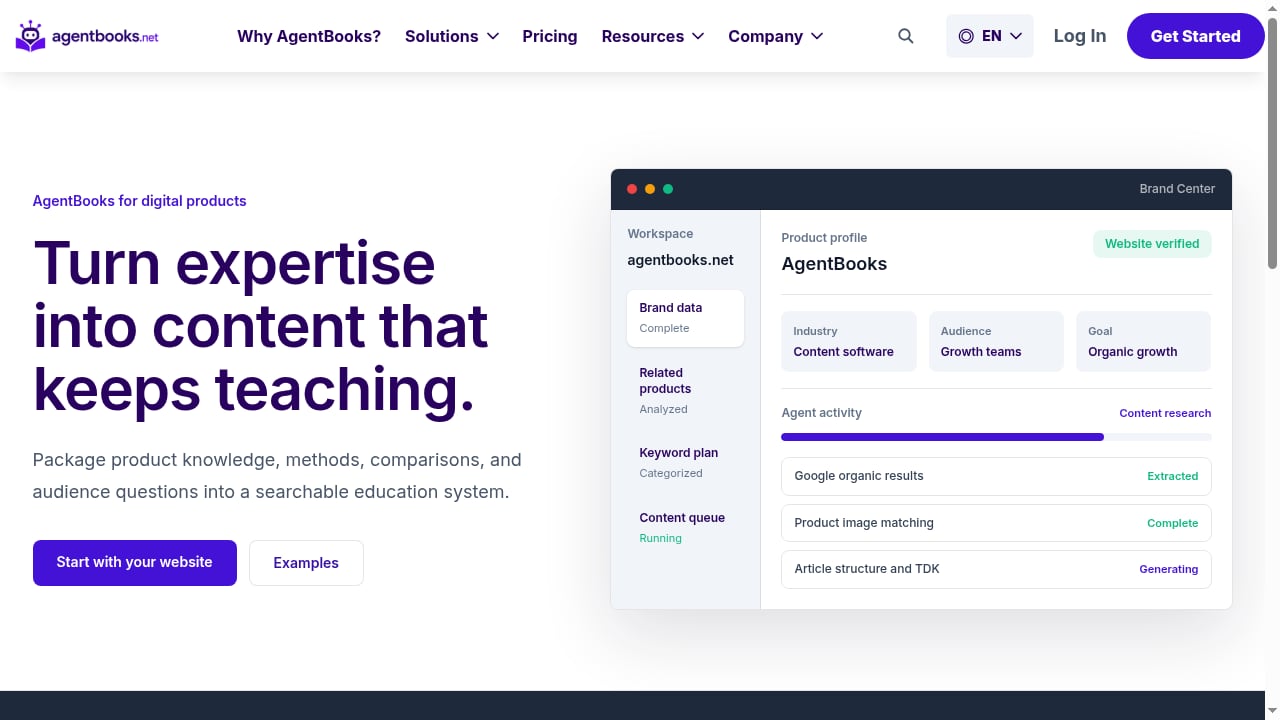
First viewport screenshot of Turn expertise into content that keeps teaching. | AgentBooks.
An AI content engine is a system that continuously turns a website's product, market, and audience data into published content. It is not a single text generator. It combines several capabilities:
- Brand and product understanding drawn from your existing site
- Market and keyword research based on real search results
- Topic planning organized by category and intent
- Drafting and optimization in a consistent voice
- Publishing and scheduling to your site or CMS
- Ongoing updates as products and search results change
The key distinction is continuity. A prompt-based tool produces an output when you ask. A content engine produces a steady stream of outputs because it has a plan, a knowledge base, and a schedule.
Why Websites Need a Content Engine, Not Just a Generator
Standalone AI writers are useful for one-off tasks: a landing page variant, a product description, a quick outline. But websites grow through accumulated pages that answer accumulated questions. That requires volume, consistency, and coordination.
According to Elementor's 2026 roundup of AI content tools, 67% of web creators name content generation as their biggest bottleneck, and the market has shifted toward tools that read site context, match brand voice, and push finished assets into a CMS. That shift is the difference between a generator and an engine.
A generator saves minutes. An engine saves the planning overhead that actually blocks publishing.
Core Components of a Working Content Engine
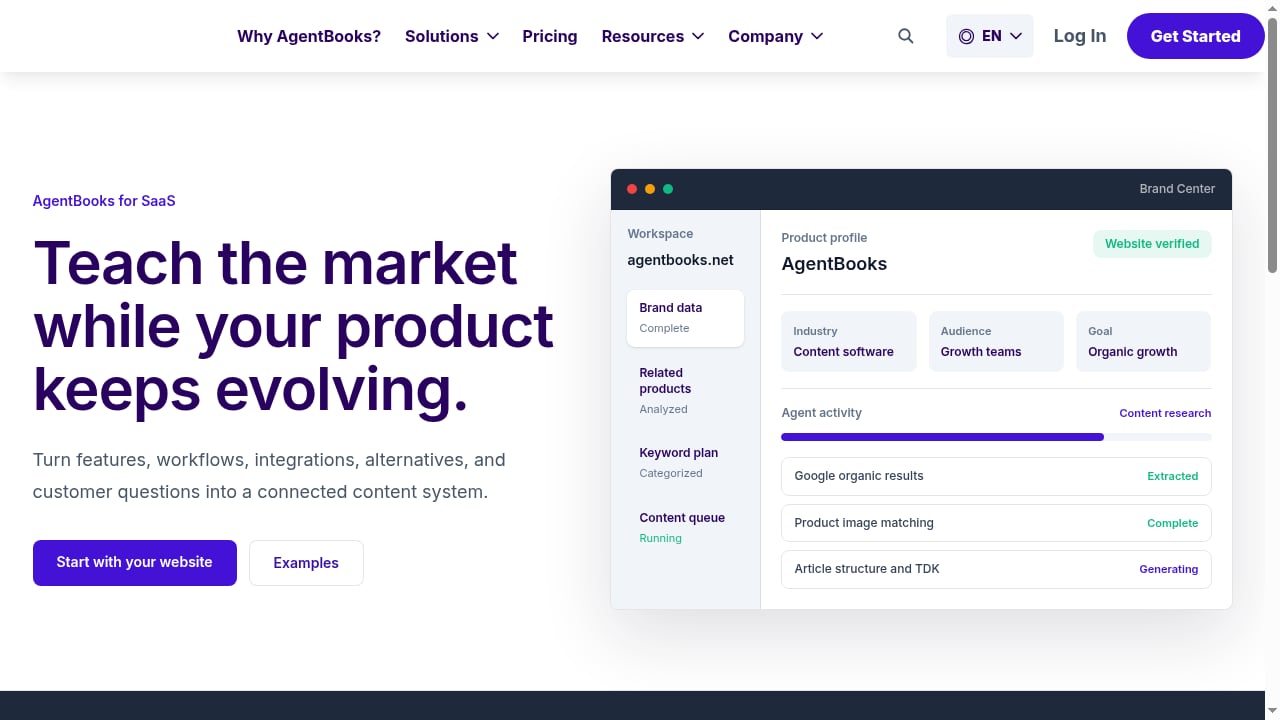
First viewport screenshot of Teach the market while your product keeps evolving. | AgentBooks.
1. Brand and Product Intelligence
The engine must know what you sell, who buys it, and how you talk about it. The most reliable source of that information is your own website. A system that crawls and learns from your site starts with real product data instead of a blank prompt.
This matters most for SaaS and e-commerce sites, where generic copy is immediately obvious to readers and useless for differentiation.
2. Keyword and Topic Planning
A plan is not a list of keywords. It is a categorized map of topics tied to search intent and business relevance. Good engines group keywords by category, assign intent, and sequence topics so early articles support later ones.
For a deeper process, see this keyword research and planning workflow.
3. Organic Result Research
Before drafting, the engine should examine what already ranks for the target query. Understanding the top organic results helps identify the structure, depth, and questions a page needs to cover. This is table stakes for competitive topics.
4. Approval-First Drafting
Automation without review is risky. The strongest workflows generate drafts, route them for approval, and only then publish. This keeps a human in control of accuracy and tone while automation handles the heavy lifting.
5. SEO Preparation and Publishing
Titles, meta descriptions, headings, internal links, image alt text, and tags should be prepared as part of the draft, not bolted on afterward. Publishing should connect to the site or CMS with scheduling and multilingual support where needed.
6. Measurement and Iteration
An engine should make inputs measurable: articles published, topics covered, approvals, and updates shipped. It should not promise rankings. It should make the process visible and repeatable.
AI Content Engine vs. AI Writing Tool: A Practical Comparison
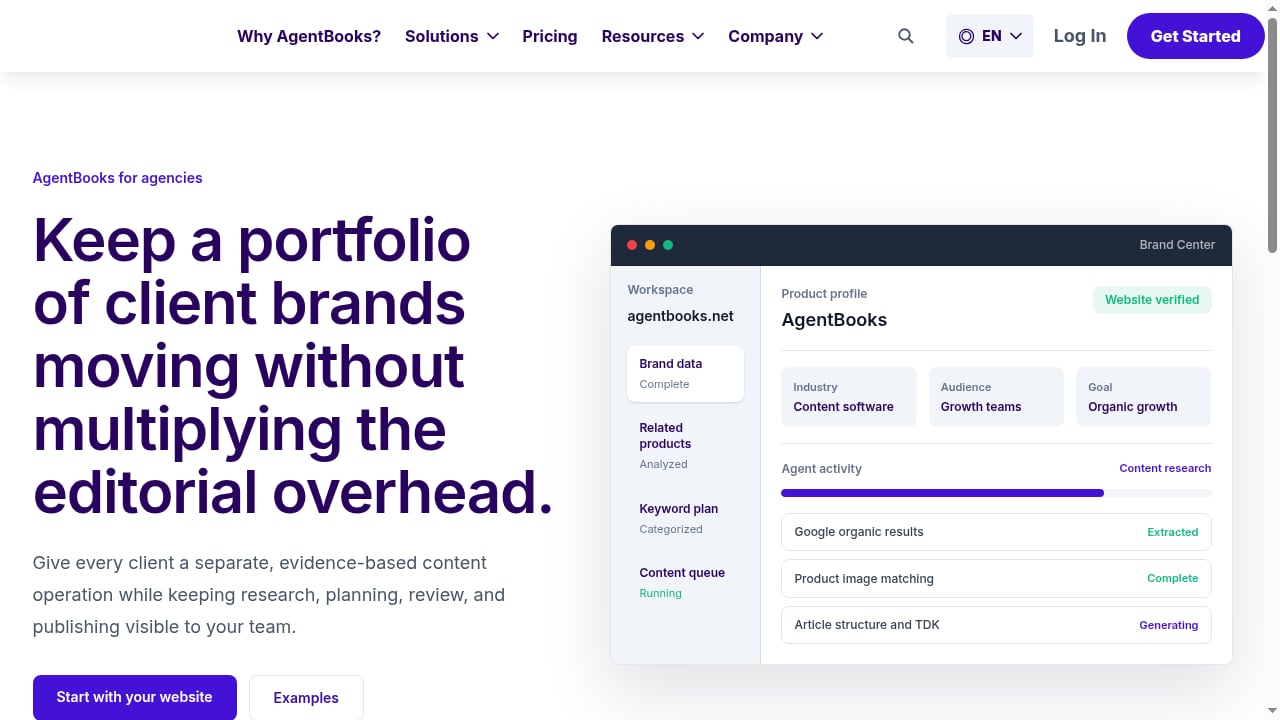
First viewport screenshot of Keep a portfolio of client brands moving without multiplying the editorial overhead. | AgentBooks.
| Capability | Standalone AI writer | AI content engine |
|---|---|---|
| Starting point | Blank prompt | Website and product data |
| Planning | Manual | Categorized keyword plan |
| Research | User-provided | Top organic result analysis |
| Consistency | Depends on prompts | Brand voice learned from site |
| Publishing | Copy-paste | Scheduled, approval-first |
| Scale | One-off tasks | Continuous output |
| Best for | Ad hoc copy | Websites that need steady publishing |
Use a standalone writer when you need a single asset fast. Use an engine when content is a recurring growth channel and you need a system that runs without constant manual setup.
How AgentBooks Fits as a Content Engine
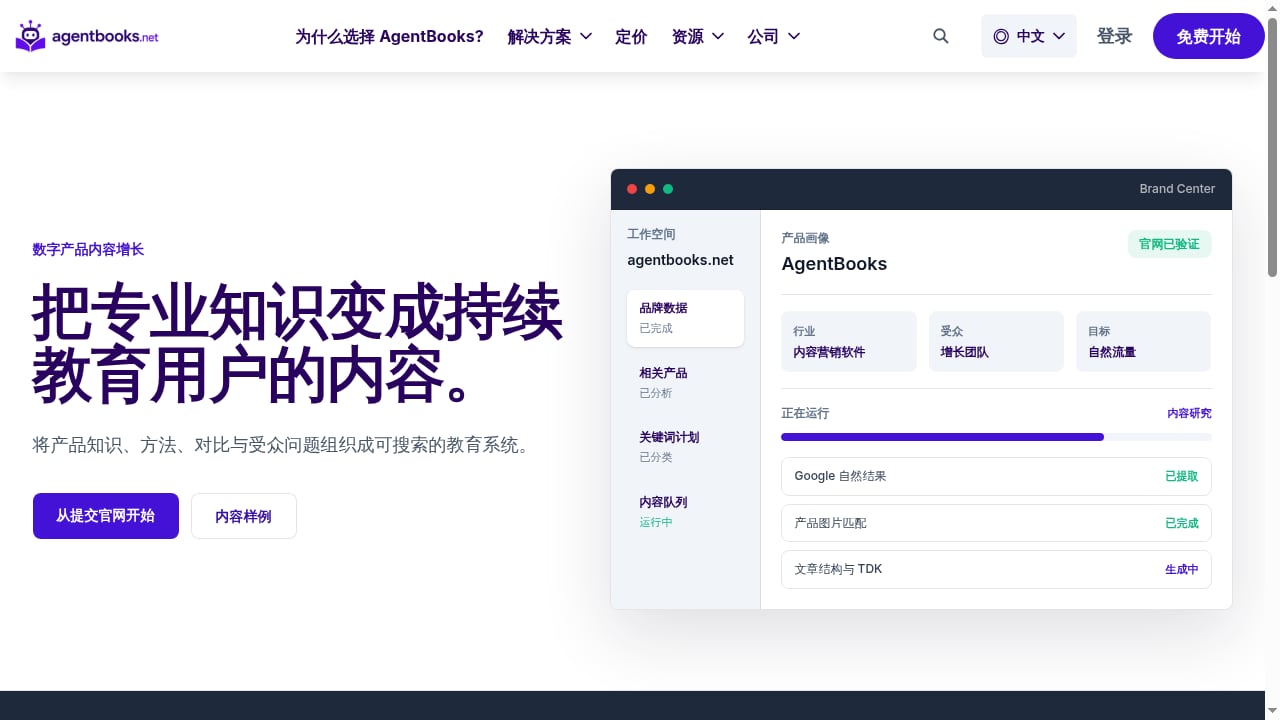
First viewport screenshot of Turn professional expertise into content that continuously educates users. | AgentBooks.
AgentBooks is an AI content automation platform that turns a website into an always-on content engine. You share your website once, and the platform learns the product, maps the market, plans topics, researches organic search results, and publishes content in your brand's voice.
Its workflow connects brand intelligence from website crawling, a categorized keyword plan, an approval-first article process, scheduled generation, and SEO preparation including titles, meta descriptions, images, tags, and links. It supports custom domains, multilingual publishing, and multi-brand workspaces—useful for agencies and founders running several sites.
AgentBooks is available in public beta with a free plan, a Business plan at $30/month, and an Enterprise plan at $100/month. It does not guarantee rankings or traffic; it optimizes the content process and the inputs you control.
For teams already using optimization tools, this AgentBooks and Ahrefs workflow shows how research data can feed the engine. If you are comparing approaches, see AgentBooks vs Surfer SEO for the difference between a content engine and an optimization layer.
How to Evaluate an AI Content Engine
Before committing, test the system against these questions:
- Does it learn from your site? Ask how brand and product context are captured and updated.
- Is the plan categorized and intent-based? A flat keyword list is a red flag.
- Can you approve before publishing? Human review should be built in, not optional.
- Does it prepare SEO elements? Titles, meta, headings, links, and alt text should be part of the draft.
- Does it support your publishing setup? Check CMS integration, scheduling, and multilingual needs.
- Is pricing transparent? Understand what each tier includes before scaling.
- What does it promise? Be skeptical of guaranteed rankings; look for measurable process improvements.
Common Mistakes When Building a Content Engine
- Automating before planning. Publishing more without a topic map just creates more pages nobody needs.
- Skipping brand context. Generic output erodes trust and wastes the automation advantage.
- Removing human review entirely. Approval steps catch factual errors and off-brand phrasing.
- Ignoring internal links. New articles should connect to existing pages to build topical depth.
- Measuring only volume. Track coverage, approvals, and updates alongside output.
Related reading
- Top 10 Content Marketing Agency Products 2026 - Ranked review of the top 10 content marketing agency products in 2026, with transparent criteria, evidence, and fit guidance for B2B and B2C teams.
- AgentBooks vs GravityWrite vs SEO and AEO tool: AI Content Showdown - Compare AgentBooks, GravityWrite, and SEO and AEO tool (Contentpen) on automation, brand voice, and AI citations. Find your best fit.
Sources and further reading
- Best AI content generators in 2026: Top 8 tested picks - Best AI content generators compared: Gemini, Jasper, ChatGPT, Rytr + more. See our tips on choosing the right one for your workflow.
- The Best AI Search Engines for 2026 - Generative AI can help you find information. If you're bored with traditional search, check out the top AI search engines we've tried.
FAQ
What is an AI content engine for websites?
It is a system that connects product understanding, keyword planning, research, drafting, optimization, and publishing into a continuous workflow, rather than generating isolated pieces of text on demand.
How is it different from ChatGPT or Jasper?
Tools like ChatGPT and Jasper are general-purpose generators that respond to prompts. An AI content engine starts from your website data, maintains a plan, and publishes on a schedule with approval steps.
Can an AI content engine guarantee rankings?
No. No responsible platform can guarantee rankings or traffic. A content engine improves the consistency and quality of your inputs; search performance still depends on competition, authority, and relevance.
Do I still need human editors?
Yes. Approval-first workflows keep humans in control of accuracy, tone, and strategy while automation handles research, drafting, and scheduling.
Is an AI content engine worth it for a small website?
It can be, if you plan to publish regularly. For occasional one-off pages, a standalone AI writer is usually enough.
Conclusion
An AI content engine for websites is less about generating text and more about building a repeatable publishing system. The websites that benefit most are the ones that need consistent output, a recognizable voice, and a plan that connects topics to products.
Start by auditing your current workflow: where does publishing stall? If the answer is planning, research, or scheduling, an engine-style approach—whether AgentBooks or another platform—addresses the real bottleneck. If you only need occasional copy, a generator is fine. Choose the system that matches how often you intend to publish, then measure the inputs you control.