AI Content Score: What It Actually Means and How to Use It
You paste an article into an AI detector and get a number: 42% AI, 78% AI, 3% AI. Then what? Many people treat that percentage like a verdict. But an AI content score is a probability signal, not a pass/fail stamp. Understanding what the number measures—and what it cannot tell you—changes how you review drafts, evaluate freelance work, and publish with confidence.
This guide breaks down how AI content scores are calculated, what different ranges typically indicate, where false positives come from, and how to build a scoring workflow that supports quality without punishing legitimate writing.
What Is an AI Content Score?
AI Content Score: What It Means and How to Use It - What Is an AI Content Score?.
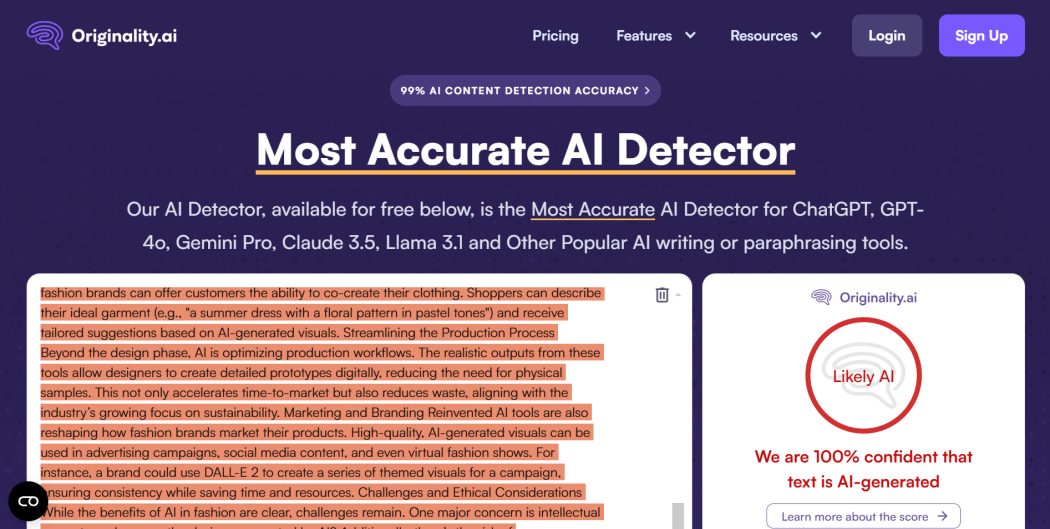
An AI content score is a percentage that estimates how much of a given text was likely produced by a large language model such as ChatGPT, Claude, Gemini, or Llama. The score comes from an AI detector, sometimes called an AI checker or AI content detector.
These tools analyze linguistic patterns rather than comparing your text against a database. They look at characteristics like:
- Predictability of word choice — AI models tend to select the most statistically likely next word, producing smooth but uniform phrasing.
- Sentence structure variation — Human writing often mixes long and short sentences unpredictably. AI output can fall into rhythmic, balanced patterns.
- Repetitiveness — AI text may reuse similar transitions, sentence openings, or structural templates.
- Perplexity and burstiness — Perplexity measures how surprised a model is by the text. Burstiness measures how much sentence complexity varies. Human writing tends to be burstier.
A score of 65% does not mean exactly 65% of your document was written by AI. It means the detector's model estimates a 65% likelihood that patterns in the text resemble AI-generated writing. The distinction matters.
How AI Detectors Calculate the Percentage
AI Content Score: What It Means and How to Use It - How AI Detectors Calculate the Percentage.
Most modern AI detectors do not score a document as one monolithic block. They split the text into segments—sentences, paragraphs, or small chunks—and score each segment independently. The overall percentage is then aggregated from those segment-level results.
This segmentation explains some confusing outcomes:
- A 30% score on a 10-page paper often means roughly three pages worth of text display LLM-like patterns, not that every sentence is 30% AI.
- A document with one fully AI-written paragraph and nine human-written paragraphs might score around 10–15%.
- A heavily AI-edited document can score higher than a fully AI-generated one if the editing stripped away human irregularities.
Some enterprise-grade tools go further and classify text on a spectrum: fully human, lightly AI-assisted, moderately AI-assisted, and fully AI-generated. This granularity is more useful than a raw percentage because it distinguishes between someone who used AI for grammar cleanup and someone who pasted a prompt output unchanged.
Reading the AI Score Spectrum

AI Content Score: What It Means and How to Use It - Reading the AI Score Spectrum.
There is no universal threshold that separates "good" from "bad." But practical experience across detection tools suggests useful reference ranges.
Low Scores: 0–20%
A low score usually indicates standard digital writing assistance or fully human writing. Tools like grammar checkers, spell checkers, and light paraphrasing aids can nudge a score into this range without meaningfully changing authorship.
If your policy allows AI for brainstorming or editing but not drafting, scores in this band rarely warrant action.
Moderate Scores: 20–60%
This is the hybrid zone. A moderate score often reflects one of these scenarios:
- A human wrote the draft and used AI to smooth out awkward paragraphs.
- AI generated an outline or some sections, and a human wrote the rest.
- A non-native speaker used AI translation, which can introduce LLM-like patterns.
- A writer used AI to expand bullet points into full paragraphs.
Moderate scores deserve context, not automatic rejection. Ask the writer about their process before drawing conclusions.
High Scores: 60% and Above
A high score usually means the linguistic patterns are overwhelmingly AI-generated. This often happens when someone prompts an LLM, copies the output, and submits it with minimal changes.
That said, high scores can also occur when a human writer has an unusually uniform style, or when the text is highly technical and formulaic. Always pair a high score with a conversation or a review of the specific flagged segments.
Why AI Content Scores Are Not Verdicts
AI Content Score: What It Means and How to Use It - Why AI Content Scores Are Not Verdicts.
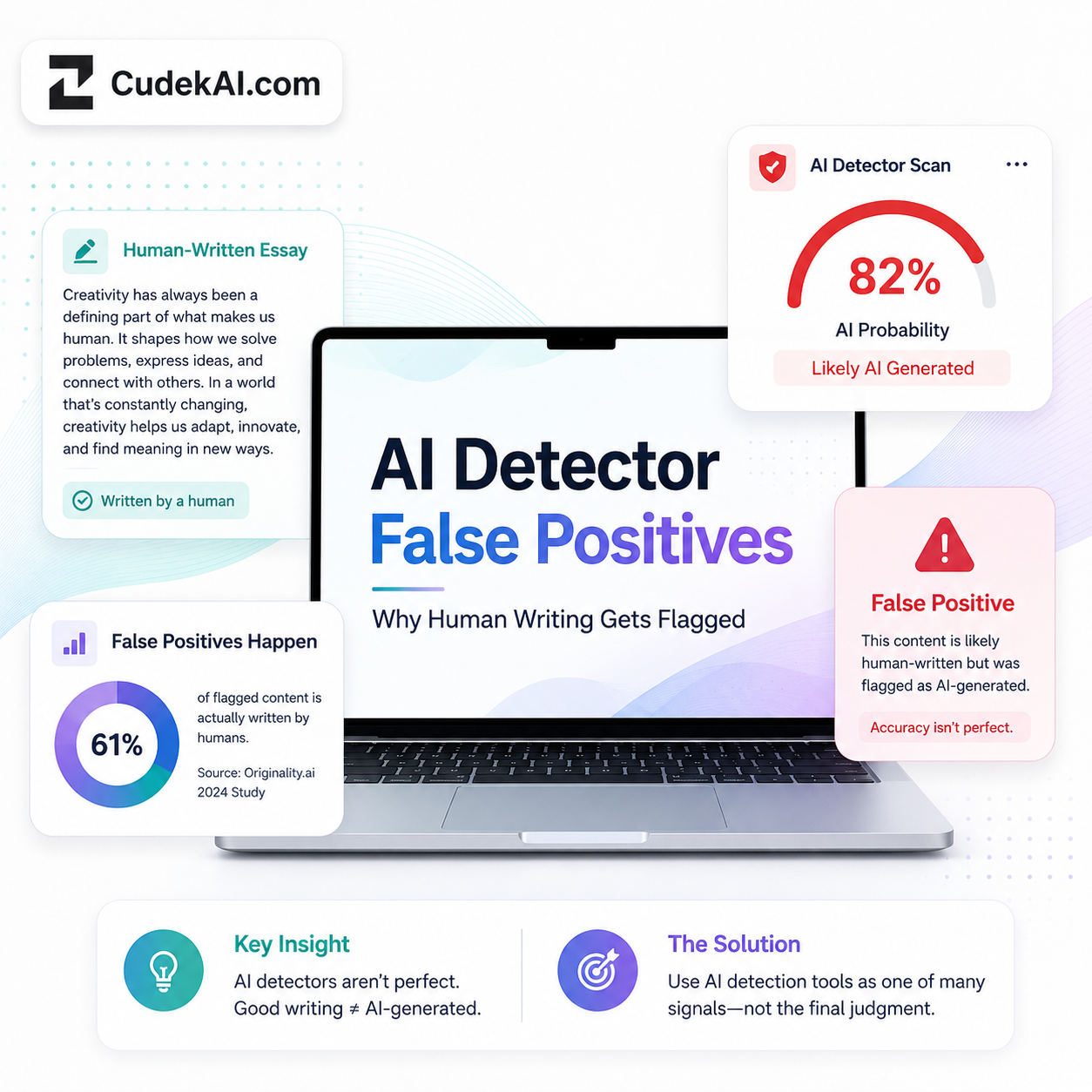
AI detectors operate on probabilities. They can be wrong in both directions.
False Positives
A false positive happens when human-written text is flagged as AI-generated. This is especially common for:
- Non-native English writers whose phrasing follows predictable patterns
- Highly structured writing like legal documents, medical summaries, or technical documentation
- Writers who favor a clean, consistent style without much stylistic variation
- Text that has been heavily edited by grammar tools
Some detectors acknowledge this by erring toward "human" when results are unclear. But no tool eliminates false positives entirely.
False Negatives
A false negative happens when AI-generated text passes as human. This occurs when:
- The text has been run through an AI humanizer or paraphrasing tool
- The writer heavily edited AI output to add personal anecdotes and irregular phrasing
- The detector has not been updated for the latest model versions
Detection tools are always chasing language models. As new models release, detectors need retraining. The gap between model release and detector update creates windows where false negatives increase.
What an AI Content Score Cannot Tell You
An AI content score measures pattern similarity. It does not measure:
- Accuracy — AI-generated text can be factually correct, and human text can contain errors.
- Originality — AI text can be original in the plagiarism sense while still being AI-generated.
- Value — A high AI score does not mean the content is useless. A low score does not mean it is good.
- Intent — The score cannot tell you whether AI use violated a policy or was part of an approved workflow.
This is why treating a score as a standalone decision-maker is risky. The score is one input among several.
AI Detectors vs. Plagiarism Checkers
These two tools answer different questions, and confusing them leads to bad decisions.
| Tool | Question it answers | How it works |
|---|---|---|
| AI detector | Was this likely written by AI? | Analyzes linguistic patterns, predictability, and sentence structure |
| Plagiarism checker | Was this copied from another source? | Compares text against a database of web pages, journals, and publications |
A piece of writing can be original but AI-generated. It can also be copied from another source without involving AI at all. For a complete authenticity review, use both tools together.
Practical Ways to Use AI Content Scores
For Editors and Content Teams
Use scores as a triage tool, not a gate. When a draft comes in with a high score, review the flagged segments first. Ask the writer about their process. If the answer is "I used AI for the first draft and edited heavily," evaluate whether the final output meets your quality bar—not whether the score crosses an arbitrary line.
For Educators
A score above 60% often warrants a conversation with the student. But the conversation should focus on process and learning, not accusation. Share the specific flagged sections and ask the student to walk through their drafting process. Many institutions find this approach more productive than automated penalties.
For SEO and Publishing Teams
Search engines have not stated that AI content is penalized simply for being AI. What matters is whether the content is helpful, accurate, and meets user intent. An AI content score can help you identify drafts that feel generic or templated, but it should not be the sole quality gate. Review the content itself for substance, originality, and usefulness.
How to Improve a High AI Content Score
If you are a writer and your work keeps scoring high, the issue is often stylistic uniformity. Try these adjustments:
- Vary sentence length deliberately. Mix short, punchy sentences with longer, more complex ones.
- Add specific, personal observations. AI struggles to replicate genuine first-hand experience.
- Replace generic transitions. Words like "furthermore," "moreover," and "in conclusion" appear disproportionately in AI text.
- Include concrete examples and numbers. Specifics break the predictable rhythm that detectors flag.
- Write in your natural voice. If you sound like a polished corporate blog, you may sound like AI even when you are not.
The goal is not to trick the detector. The goal is to write in a way that is genuinely more human, more specific, and more useful.
Building a Scoring Workflow That Scales
For teams publishing content regularly, a one-off check is not enough. A repeatable workflow looks like this:
- Define your AI policy first. Decide what is allowed: AI for outlines? AI for drafting? AI for editing only? Your threshold for action should follow from the policy.
- Run detection on full documents, not snippets. Longer texts give detectors more signal and reduce false positives.
- Review flagged segments, not just the overall score. The segment-level view tells you where to focus.
- Pair detection with human review. A score is a signal. A human editor makes the final call.
- Document decisions. If you accept a 45% score because the writer disclosed AI-assisted editing, note that. Consistency builds trust.
This approach prevents score-chasing while still catching the most egregious cases.
Where AI Content Scores Fit in a Modern Content Operation
Content teams increasingly use AI as a drafting partner, not a replacement for human judgment. In that context, the AI content score becomes less about policing and more about quality control. A high score on a draft that was supposed to be AI-assisted is not a problem. A high score on a draft that was supposed to be original human writing is worth investigating.
Platforms like AgentBooks take a different approach to the same underlying concern. Instead of generating generic AI text and hoping it passes detection, AgentBooks builds a brand intelligence layer from your actual website—your product knowledge, positioning, and voice—then uses that context to plan topics, research organic search results, and publish content that reflects your domain expertise. The output is designed to be useful and search-ready from the start, which reduces the need to retroactively "fix" AI-sounding drafts. If you are building a content engine and want to understand how autonomous publishing works in practice, see the AgentBooks setup guide.
For teams that still want to run detection on drafts before publishing, the workflow above works alongside any content platform. The score is one checkpoint among several—not the final word.
Related reading
- How to Build an AI Content Team That Compounds - Learn how to build an AI content team with specialized roles, shared brand context, and workflows that scale quality without burning out your human editors.
- Content Automation: A Practical Guide for Marketers - Learn what content automation is, how it works across the content lifecycle, real use cases, tool categories, and how to avoid common pitfalls.
Sources and further reading
- Free AI Detector - Scribbr AI Detector: Identify AI-generated content from ChatGPT, Copilot, and Gemini with our advanced AI Checker. Try it for free!
- AI Detector: Free AI Checker for ChatGPT, Claude & GPT-5 - Quillbot's free AI Detector checks text from ChatGPT, GPT-5, Claude and others. Get an AI score, sentence-level highlights, and refined AI detection insights.
- What does your AI detection score mean? - AI detection scores aren't like a traditional grading rubric, where "pass" and "fail" are obvious. The nuance between "completely AI-generated" and "AI-edited" is evolving, and so are our detection systems at Pangram.
Frequently Asked Questions
What is a good AI content score?
There is no universal "good" score. Below 20% usually indicates standard writing assistance or human writing. Between 20% and 60% suggests a hybrid of human and AI work. Above 60% often means the text is predominantly AI-generated. The right threshold depends on your specific policy.
Can an AI content score be wrong?
Yes. Detectors produce probabilistic estimates, not certainties. False positives can flag human writing, especially from non-native speakers or in highly structured formats. False negatives can miss AI text that has been heavily edited or run through a humanizer.
Does a high AI score mean Google will penalize my content?
No. Google has not stated that AI-generated content is penalized solely for being AI. Google's guidance focuses on helpfulness, expertise, and user value. A high AI score can correlate with generic, low-value content, but the score itself is not a ranking factor.
How long should my text be for accurate detection?
Most detectors recommend at least 80 words, and longer texts generally produce more reliable results. A full article or document gives the model more signal than a short snippet.
Should I use an AI detector before publishing blog content?
It can be a useful quality checkpoint, but it should not replace human editorial review. Use the score to identify sections that feel templated or generic, then improve those sections based on substance and voice—not just to lower the number.
What is the difference between an AI score and a plagiarism score?
An AI score estimates whether text was likely written by a language model. A plagiarism score measures whether text was copied from existing sources. A document can be original but AI-generated, or human-written but plagiarized.
Conclusion
An AI content score is a useful signal when you understand its limits. It can flag drafts that need a closer look, identify sections that feel generic, and support conversations about writing process. It cannot prove authorship, measure quality, or replace editorial judgment.
The most effective teams treat AI scores as one input in a broader review workflow. They define clear policies, review flagged segments rather than chasing percentages, and focus on producing content that is genuinely useful to readers. If you are building that kind of content operation, tools that embed brand context into the writing process—like AgentBooks—can help you publish consistently without fighting the detector on every draft. For a deeper look at how to build a repeatable AI-assisted writing workflow, see our guide on choosing an AI content writer.
Use the score. Do not let the score use you.