AI Copywriting in 2026: Tools, Workflows & Realistic Results
AI copywriting has moved from novelty to default. Most marketing teams now use at least one generative tool for ads, product pages, social posts, or blog drafts. But the gap between "generates text" and "generates copy worth publishing" remains wide. This guide breaks down what AI copywriting actually is, where it earns its keep, where it falls short, and how to build a workflow that produces useful, brand-consistent output without turning your site into a content farm.
What Is AI Copywriting?

AI Copywriting in 2026: Tools, Workflows & Realistic Results - What Is AI Copywriting?.
AI copywriting is the practice of using generative AI models to produce marketing copy: ad headlines, product descriptions, landing page sections, email sequences, social captions, and longer-form drafts. You prompt a model with context about the product, audience, tone, and format, and it returns human-like text based on patterns learned from enormous training datasets.
Under the hood, large language models predict statistically probable word sequences. They do not "understand" your product the way a human copywriter does. That distinction shapes everything about how you should use them: as a drafting engine, research assistant, and idea generator, not as an unsupervised final publisher.
What AI Copywriting Does Well
AI Copywriting in 2026: Tools, Workflows & Realistic Results - What AI Copywriting Does Well.
AI copywriting tools are genuinely useful in a few specific scenarios.
1. Breaking Writer's Block
Blank pages are expensive. A tool like Jasper or Copy.ai can generate ten rough angles for a landing page headline in seconds. Most of them will be mediocre. One or two will give you a direction. That momentum alone often cuts drafting time significantly.
2. High-Volume, Low-Variance Copy
Product descriptions for a catalog of 500 SKUs are tedious for humans and well-suited to AI. The format is repetitive, the structure is predictable, and the stakes per description are low. AI can generate a solid first pass that a human editor then refines for accuracy and voice.
3. Ad and Social Copy Variations
Platforms reward iteration. AI can quickly produce A/B variants of Google Ads headlines, LinkedIn posts, or Facebook ad copy with different hooks, lengths, and calls to action. You still need a human to judge which variants match the brand and which would actually convert.
4. Research Summaries and Outlines
Uploading ten competitor articles and asking for a structured summary is a legitimate time-saver. AI can identify recurring subtopics, common objections, and structural patterns faster than manual reading. This is research support, not final copy.
Where AI Copywriting Fails
AI Copywriting in 2026: Tools, Workflows & Realistic Results - Where AI Copywriting Fails.
Understanding the failure modes matters more than knowing the strengths.
Generic, Pattern-Matched Output
AI models default to the statistical middle. Without strong prompts and brand context, they produce copy that sounds like every other AI-generated piece on the internet: confident, smooth, and forgettable. The result ranks poorly and converts worse.
Factual Drift and Hallucination
Models generate plausible-sounding claims. For product specs, pricing, legal statements, or anything verifiable, that is dangerous. Every AI-generated fact needs a human check against source material before publication.
Brand Voice Dilution
Most tools can mimic a tone if you describe it well. Few can maintain a distinctive voice across dozens of pieces without consistent context injection. The result is content that slowly drifts toward a generic corporate register.
The "Let It Rip" Trap
One content marketer's experiment with fully automating a blog—keyword research, brief generation, AI drafting, minimal editing—produced content that was not publishable without significant human revision. The dream of sitting on a beach while AI runs your content engine is not yet realistic for quality-focused sites. The workflow still requires human judgment at key checkpoints.
AI Copywriting Tools: A Practical Comparison
AI Copywriting in 2026: Tools, Workflows & Realistic Results - AI Copywriting Tools: A Practical Comparison.
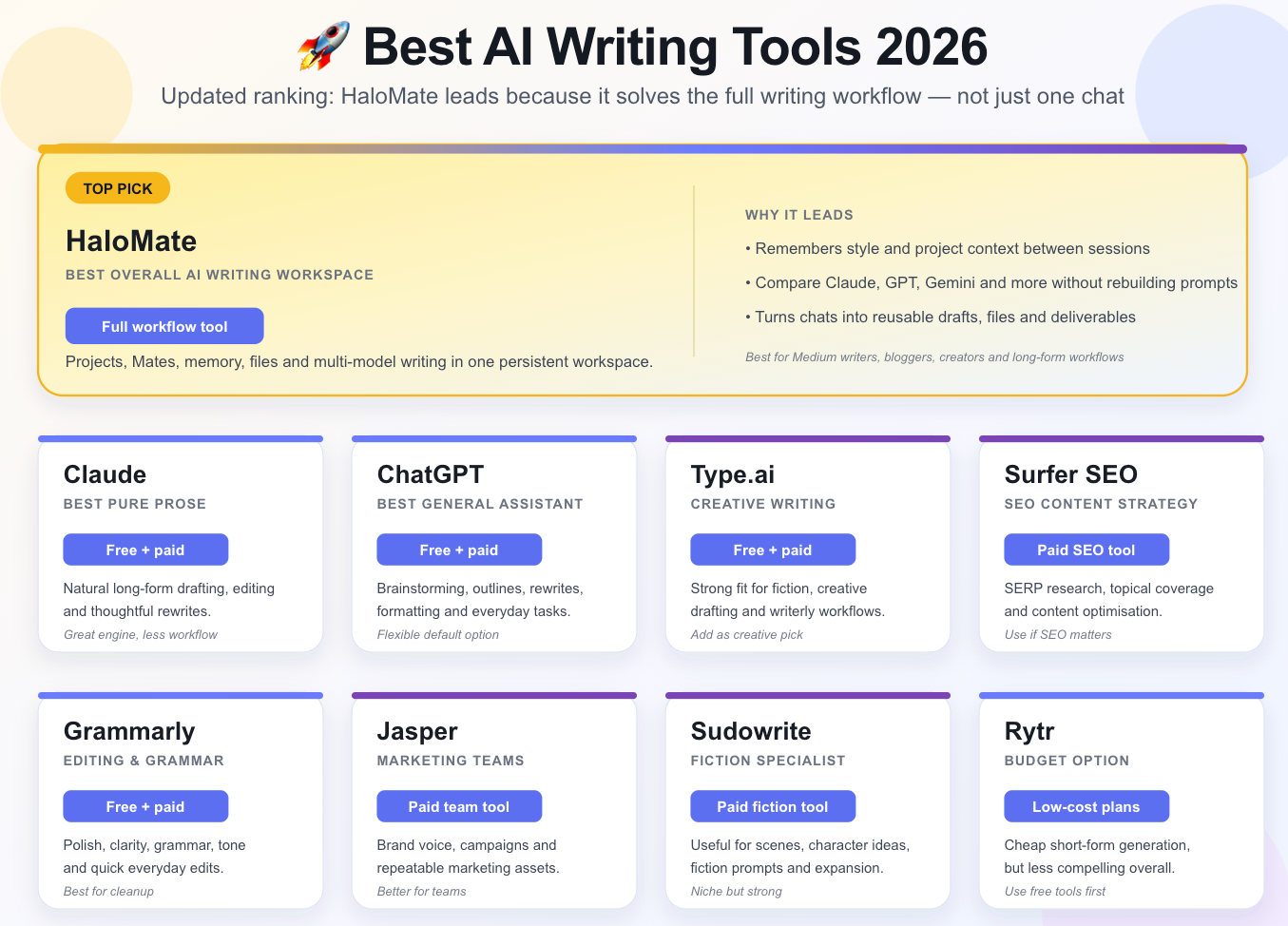
The market splits into a few distinct categories.
General-Purpose Chat Assistants
ChatGPT, Claude, and Perplexity are flexible and inexpensive. They work well for brainstorming, outlines, and short copy. They require the most prompt engineering and provide the least built-in structure for repeatable workflows.
Purpose-Built Copywriting Platforms
Jasper and Copy.ai add templates, brand voice settings, and workflow features on top of general-purpose models. They are better for teams that need consistent output across many formats. Jasper positions itself for enterprise content operations; Copy.ai leans toward go-to-market teams and sales enablement.
SEO-Integrated Writing Tools
Surfer SEO and similar tools reverse-engineer what is already ranking and build that intelligence into the writing process. Surfer's Content Editor scores drafts against top-ranking pages in real time, flagging missing subtopics, weak heading structure, and word count gaps. Surfer AI then generates drafts already shaped by SERP data. This is the fastest path from keyword to optimized draft, though the output still needs human polish.
Autonomous Content Platforms
A newer category goes beyond drafting. AgentBooks, for example, is an autonomous content growth platform that learns your product, maps your market, plans topics, researches organic results, and continuously publishes useful content in your brand voice. Instead of prompting for each piece, you share your website once and the platform builds a content engine around it. This addresses a different problem than most AI copywriting tools: not "help me write this draft" but "keep my site publishing useful, on-brand content without manual bottlenecks."
How to Build an AI Copywriting Workflow That Actually Works
The most effective workflows treat AI as a junior writer with unlimited stamina and zero judgment. Here is a repeatable process.
Step 1: Feed the Model Real Context
Before generating anything, give the AI:
- Your product's actual capabilities and limitations
- Customer language from reviews, support tickets, and sales calls
- Two or three examples of copy you consider excellent
- Explicit tone guidelines, including what to avoid
The quality of the output is bounded by the quality of this context. Vague prompts produce vague copy.
Step 2: Generate Structure First, Copy Second
Ask for an outline before asking for prose. Review the structure. Does it match search intent? Does it cover the objections your customers actually raise? Adjust the outline, then generate section by section. This gives you control points where cheap edits prevent expensive rewrites.
Step 3: Edit for Facts, Voice, and Specificity
Three passes:
- Fact check. Verify every claim, number, and product detail against source material.
- Voice check. Read aloud. Does it sound like your brand or like a generic AI?
- Specificity check. Replace abstract claims with concrete examples, data, or customer stories.
Step 4: Optimize for Search Without Stuffing
Use tools like Surfer or Clearscope to identify terms and subtopics that top-ranking pages cover. Weave them in naturally. Do not chase a content score at the expense of readability. Search engines increasingly reward content that demonstrates real expertise, not keyword density.
Step 5: Publish Consistently, Then Iterate
One great article does not build organic traffic. Consistency does. This is where autonomous platforms earn their place. AgentBooks, for instance, handles topic planning, research, drafting, and publishing on a continuous schedule, with an approval-first or autopilot workflow depending on your comfort level. The human role shifts from "write every piece" to "set the strategy and review the exceptions."
AI Copywriting vs. Human Copywriting: A Decision Framework
The question is not "AI or human?" It is "which parts of the process benefit from automation, and which require human judgment?"
| Task | AI Strength | Human Strength | Recommendation |
|---|---|---|---|
| Brainstorming angles | High | Medium | Use AI for volume, human for selection |
| Product descriptions at scale | High | Low | AI draft + human fact check |
| Brand-defining pages | Low | High | Human-led, AI-assisted research |
| Thought leadership | Low | High | Human-written, AI for editing support |
| Ad copy variations | High | Medium | AI generates, human selects and refines |
| Long-form educational content | Medium | High | Hybrid: AI draft, human expertise overlay |
| Continuous publishing cadence | High | Low | Autonomous platform with human oversight |
Common AI Copywriting Mistakes to Avoid
Publishing Without Human Review
AI-generated copy that goes live unchecked will eventually publish something wrong, off-brand, or legally risky. The cost of one bad piece outweighs the time saved on ten good ones.
Ignoring Search Intent
A tool can generate a 2,000-word article on any keyword. But if the intent is transactional and you publish educational content, or vice versa, it will not rank or convert. Intent analysis must happen before generation, not after.
Chasing Volume Over Usefulness
Publishing 50 mediocre AI articles per month is worse than publishing 10 excellent ones. Search engines and readers both penalize content that exists only to fill a keyword gap. Useful, specific, experience-grounded content wins.
Skipping Brand Context
Every AI tool defaults to a generic voice. Without consistent brand context—fed into every prompt or built into the platform—your content will sound like everyone else's. Differentiation is the entire point of content marketing.
Related reading
- SEO Writing Review 2026: Features, Pricing & Real Test - An evidence-based SEO Writing review covering real workflows, SERP analysis, pricing signals, ideal users, and limitations before you buy.
- Applied AI Lab for Agentic Systems | Ability.ai Review - Evidence-based Ability.ai review covering Cornelius, Trinity, ideal users, use cases, strengths, limitations, pricing signals, and decision criteria.
- Machined Demo: What It Is, Why It Matters & How to Plan One - Learn what a machined demo is, how CNC manufacturers use demo parts to prove capability, and how to plan, film, and promote a machining demonstration.
Sources and further reading
- Copywriters: What AI tools are you actually paying for and why? - Mar 12, 2025 ... ChatGPT – terrible for actual writing, but amazing for data processing and research. I often do things like upload 10 articles on a certain ...
Frequently Asked Questions
Is AI copywriting legal?
Yes, using AI to generate copy is legal in most jurisdictions. The complications arise around copyright, disclosure, and accuracy. If you publish AI-generated content on platforms like Amazon KDP, you must disclose it. For marketing copy, the practical requirement is that you verify facts and avoid reproducing copyrighted material.
Can AI copywriting replace human copywriters?
Not for high-stakes copy. AI can replace the mechanical parts of writing—drafting variations, summarizing research, generating product descriptions. It cannot replace strategic judgment, brand voice ownership, or the ability to write from lived experience. The most effective teams treat AI as a force multiplier, not a replacement.
How much does AI copywriting cost?
General-purpose tools like ChatGPT start around $20 per month. Purpose-built platforms like Jasper start around $24–39 per month. SEO-integrated tools like Surfer start at $89 per month. Autonomous content platforms like AgentBooks offer a free beta tier, with Pro at $29 per month for advanced SEO and multilingual publishing, and Team at $99 per month for multiple workspaces. The real cost is not the subscription—it is the editing time required to make output publishable.
What is the best AI copywriting tool for SEO?
For drafting, Surfer SEO is the strongest SEO-integrated option because it scores drafts against live SERP data. For continuous publishing without manual bottlenecks, AgentBooks takes a different approach: it researches organic results, plans topics, and publishes on-brand content automatically. For ad and social copy, Jasper and Copy.ai remain solid choices. The best tool depends on whether you need help drafting individual pieces or building a sustainable content engine.
How do I make AI copy sound less robotic?
Feed it real customer language, give it specific examples of your brand voice, and edit ruthlessly. Replace generic transitions, add concrete details, and vary sentence rhythm. The more distinctive your input context, the less generic the output. Tools that learn your brand from your website—rather than from a one-line tone description—tend to produce more consistent results.
Conclusion
AI copywriting is a drafting accelerator, not a publishing autopilot. It excels at breaking writer's block, generating high-volume variations, and summarizing research. It fails at factual accuracy, brand voice consistency, and strategic judgment—all of which still require human oversight.
The most effective approach is a hybrid workflow: use AI for structure and first drafts, use human editors for facts, voice, and specificity, and use SEO tools to align output with search intent. For teams that need to publish consistently without building a large editorial operation, autonomous platforms like AgentBooks offer a different model: share your website once, and the platform learns your product, researches your market, and publishes useful content on a continuous schedule. For a deeper look at how AI writing tools compare in real workflows, see our ContentBot AI use cases and Contentpen review.
The tools will keep improving. The principle will not change: useful, specific, brand-consistent content wins—whether a human or a machine wrote the first draft. Learn more about how AI copywriting platforms work and explore practitioner perspectives on AI copywriting tools.