AI Visibility Monitoring: How to Track, Measure, and Improve Your Brand's Presence in AI Search
AI search is changing where your audience finds answers. Instead of clicking through a blue links page, people now ask ChatGPT, Perplexity, Gemini, or Claude a question and receive a direct answer — often with a handful of cited brands. If your company isn't among those citations, you're invisible to a growing segment of buyers. AI visibility monitoring is the practice of tracking when, where, and how AI engines mention your brand, and using that signal to shape your content strategy.
This guide covers what AI visibility monitoring actually involves, which metrics matter, how to evaluate monitoring tools, and how to connect what you learn to content work that improves your standing.
Why AI Visibility Monitoring Matters Now
AI Visibility Monitoring: Tools, Metrics, and Workflows - Why AI Visibility Monitoring Matters Now.
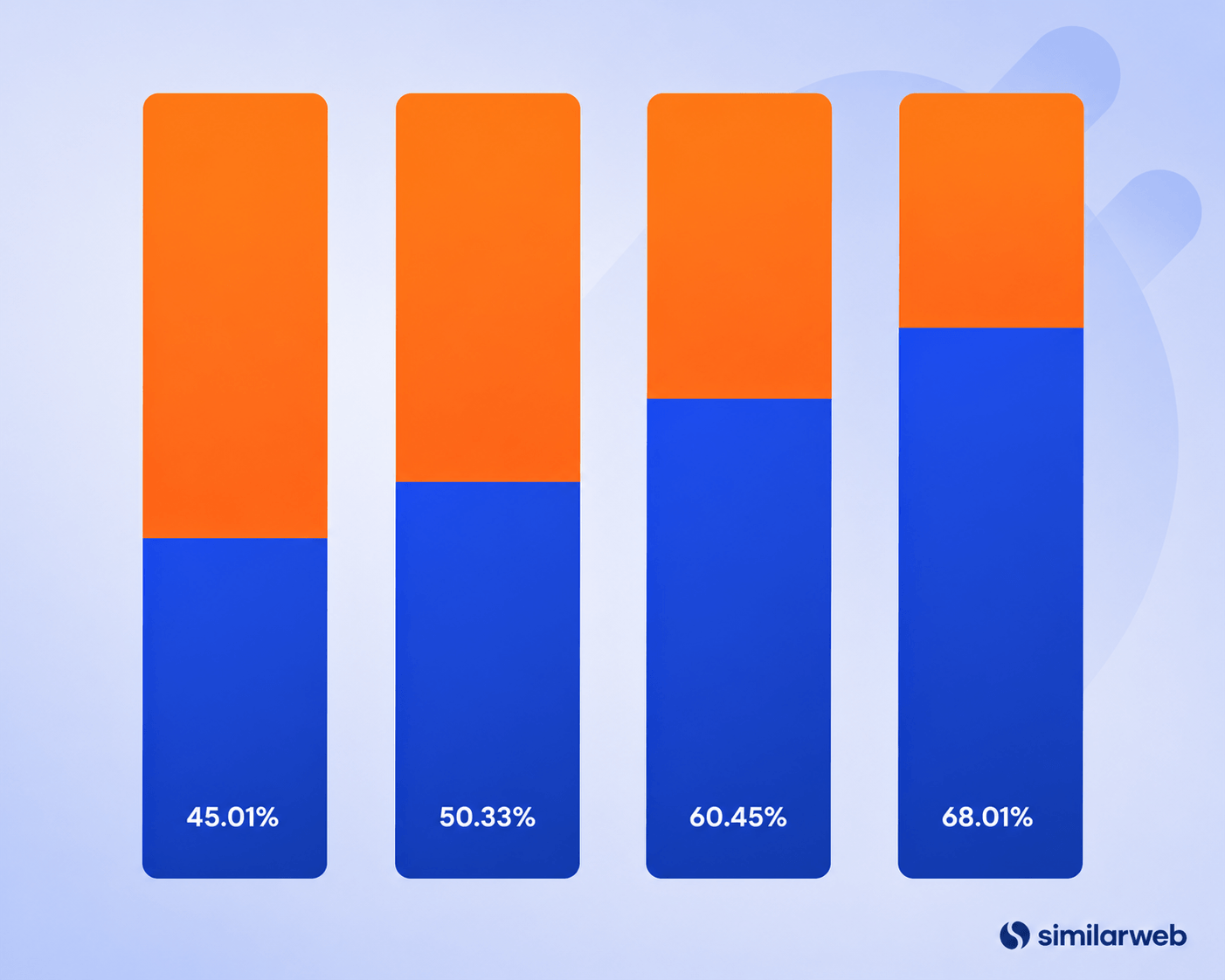
The shift away from traditional search results is measurable. According to SparkToro's analysis of Similarweb clickstream data, roughly 68% of Google searches ended without a click in early 2026. Meanwhile, ChatGPT reached about 900 million weekly active users in February 2026, and Google's Gemini app passed 750 million monthly active users, with Gemini-powered AI Overviews reaching an estimated 2 billion-plus people each month.
When the answer is the destination, being cited inside that answer is the new front page. Traditional rank trackers tell you where you sit on a results page. They say nothing about whether ChatGPT recommends your product, whether Perplexity cites your guide, or whether Gemini describes your brand accurately.
AI visibility monitoring closes that gap. It answers questions like:
- Which prompts trigger mentions of your brand?
- Which competitors appear beside you — or instead of you?
- Which pages on your site earn citations, and which are ignored?
- How does your share of voice change over time?
- What does the engine actually say about your product?
What AI Visibility Monitoring Actually Tracks
AI Visibility Monitoring: Tools, Metrics, and Workflows - What AI Visibility Monitoring Actually Tracks.
AI visibility isn't a single number. It's a collection of signals that together describe how AI engines perceive and represent your brand. A useful monitoring setup tracks several dimensions at once.
Prompt-Level Mentions
The foundation of AI visibility monitoring is tracking specific prompts — the questions your target audience actually asks AI assistants. For each prompt, you want to know:
- Does your brand appear in the answer?
- Which competitor brands appear alongside you?
- What exact language does the engine use to describe you?
- Which source pages does the engine cite?
Prompt-level tracking matters because AI engines are probabilistic. The same prompt can produce different answers on different days, for different users, or with slightly different phrasing. Monitoring tools run prompts repeatedly and aggregate the results, giving you a stable picture that manual spot-checks can't provide.
Share of Voice
Share of voice measures how often your brand appears in AI answers relative to your named competitors. If you track 100 high-intent prompts and your brand shows up in 22 of them while your closest competitor appears in 41, that gap tells you where to focus.
This metric is inherently comparative. AI visibility is a zero-sum game in many answer spaces — if the engine cites three brands for a comparison prompt and yours isn't one of them, someone else won that answer.
Citation Source Attribution
Knowing which of your pages earn citations is the bridge between monitoring and action. If ChatGPT consistently cites your pricing page but never your comparison guide, that's a content gap you can close. If an outdated blog post keeps getting cited while your newer, better resource is ignored, you have a refresh priority.
Sentiment and Context
A mention isn't automatically a win. AI engines can describe your brand inaccurately, associate you with the wrong use case, or frame you negatively in a comparison. Monitoring should capture the surrounding context, not just the presence or absence of your name.
Trend Analysis
Single snapshots are useful, but the real value comes from watching trends over time. Did a content refresh move your share of voice from 18% to 31%? Did a competitor's new guide push you out of a key prompt cluster? Trend data turns monitoring from a curiosity into a decision-making tool.
Manual Monitoring Doesn't Scale
AI Visibility Monitoring: Tools, Metrics, and Workflows - Manual Monitoring Doesn't Scale.
It's tempting to check your AI visibility by hand — open ChatGPT, type a few prompts, see if your brand shows up. That approach fails for three reasons.
First, LLM outputs are inconsistent. The same prompt can return different answers across users, sessions, and time. A single manual check gives you a random sample, not a reliable measurement.
Second, manual checks can't reveal trends. You can't spot patterns, attribute changes to specific actions, or report progress to stakeholders when your data consists of scattered screenshots.
Third, manual monitoring doesn't scale. How many prompts can you realistically track in a day across four or five engines? Fifty? A hundred? Monitoring tools run thousands of prompt-engine combinations daily, which is the only way to build a meaningful dataset.
If you're serious about AI search, a monitoring tool belongs in your stack. The question is which one — and what you plan to do with the data once you have it.
How to Evaluate AI Visibility Monitoring Tools
AI Visibility Monitoring: Tools, Metrics, and Workflows - How to Evaluate AI Visibility Monitoring Tools.
The market for AI visibility tools is growing quickly, and the options differ meaningfully. Here's a checklist for evaluating any provider.
Multi-Engine Coverage
Your audience doesn't live on one assistant. ChatGPT may be the most popular, but Perplexity, Gemini, Claude, Google AI Mode, and Copilot all have meaningful user bases. A tool that watches a single engine leaves blind spots where competitors quietly win answers.
Look for coverage across at least the major engines: ChatGPT, Perplexity, Gemini, Claude, and Google AI Overviews or AI Mode. Enterprise teams may also want Grok, Meta AI, and DeepSeek coverage.
Prompt-Level Detail
Aggregate scores are fine for dashboards, but the real insight lives at the prompt level. You need to see which exact prompts trigger your brand, which competitors show up beside you, and which answers you're missing entirely. Without prompt-level detail, you can't prioritize content work.
Competitive Benchmarking
AI visibility is relative. A tool should let you name your competitors and see share-of-voice comparisons across prompt sets. The gap between you and your closest rival is more actionable than any absolute number.
Actionable Insights
This is where tools diverge most sharply. Some monitoring platforms stop at the dashboard — they tell you that you dropped out of an answer, then leave the fixing to you. Others connect the finding to a content workflow: research, drafting, optimization, and publishing.
The difference matters. A monitoring-only tool gives you information. A monitoring-plus-action tool gives you a path from insight to improvement. If you're going to pay for visibility data, it should lead somewhere.
Other Considerations
- International coverage: Global brands need data outside English and the US.
- Security: Enterprise teams should look for SSO, SOC 2 compliance, and clear data-handling terms.
- Integrations: Can the tool connect to your CMS, SEO stack, or analytics?
- Support and product velocity: AI search changes quickly. Pick a provider that ships features and research at a matching pace.
Monitoring Is Only Half the Job
A recurring theme across AI visibility tool reviews is that monitoring alone doesn't improve visibility. Knowing that ChatGPT dropped your brand from a comparison answer is useful. Doing something about it is what moves the needle.
The strongest approach connects monitoring to a content loop:
- Track which prompts and engines cite your brand — and which don't.
- Diagnose why you're missing. Is the content thin? Outdated? Not structured for AI retrieval?
- Create or refresh content that directly answers the prompts where you're absent.
- Publish the fix to your site.
- Re-monitor to confirm the change moved your share of voice.
Tools that run this loop in one place save you from juggling a rank tracker, a research tool, a writing assistant, and a CMS. Tools that stop at step one leave you to assemble the rest yourself.
Where AgentBooks Fits in an AI Visibility Workflow
AgentBooks approaches AI visibility from the content production side. It's an autonomous content growth platform that turns a website into an always-on content engine for search and AI. Instead of only reporting where your brand appears in AI answers, it continuously publishes useful content designed to earn those citations in the first place.
The platform works by learning your product, mapping your market, planning topics, researching organic search results, and publishing content in your brand voice. That matters for AI visibility because AI engines disproportionately cite pages that clearly answer specific questions. A consistent stream of well-structured, question-focused content gives AI engines more reasons to reference your brand.
AgentBooks is particularly relevant for teams that have already identified visibility gaps through a monitoring tool but lack the bandwidth to close them. If your monitoring data shows you're missing from comparison prompts or feature-specific questions, a platform that autonomously produces comparison pages, feature guides, and audience-specific FAQs can turn that insight into published content without manual draft bottlenecks.
The platform also addresses a common failure mode in AI visibility programs: inconsistency. Many teams start strong with a few AI-optimized pages, then stall when they run out of topics or time. AgentBooks is built to keep publishing on a continuous cadence, which aligns with how AI engines evaluate sites over time — they reward consistent, comprehensive coverage of a topic area.
For teams comparing approaches, the key distinction is this: monitoring tools answer "where are we visible?" while content engines answer "how do we become more visible?" The most effective AI visibility programs use both — measurement to identify gaps, and production to close them.
Common AI Visibility Monitoring Mistakes
Even teams with the right tools can undermine their own efforts. Here are the mistakes that show up most often.
Tracking Too Few Prompts
A handful of branded prompts — "what is [your product]" or "[your brand] review" — won't tell you much. Your real visibility lives in the unbranded questions your audience asks: comparison prompts, how-to questions, buying guides, and problem-specific queries. Build prompt sets around customer intent, not your brand name.
Ignoring Citation Sources
Seeing your brand mentioned is good. Knowing which page earned that mention is better. If you don't track citation sources, you can't tell whether your content strategy is working or which pages deserve more investment.
Treating Mentions as Wins
An AI engine can mention your brand inaccurately, recommend a competitor over you, or cite an outdated page. Context matters. Monitor the surrounding language, not just the presence of your name.
Monitoring Without a Fix Workflow
The most common failure mode is collecting visibility data with no system for acting on it. A dashboard that shows you losing share of voice is only valuable if someone can turn that signal into a content brief, a draft, and a published page. If your monitoring tool doesn't support that workflow, build one around it.
Expecting Overnight Results
AI engines index and evaluate content on their own timelines. A page you publish today may not earn citations for weeks. Consistency matters more than speed. Teams that publish steadily over months see compounding visibility gains; teams that publish sporadically see sporadic results.
Building Your AI Visibility Monitoring Stack
There's no single right answer for every team. Your stack depends on your size, budget, and how much of the fix workflow you want to own.
Small teams just starting out may begin with an entry-level monitoring tool that tracks a few hundred prompts across major engines. The goal at this stage is baseline data: where do you appear today, and where are the biggest gaps?
Growth-stage teams typically need prompt-level detail, competitive benchmarking, and a path from insight to content production. This is where the monitoring-plus-action distinction becomes critical. If your team can't turn visibility data into published fixes quickly, the data loses value.
Enterprise organizations often prioritize depth of reporting, security compliance, international coverage, and integrations with existing SEO and analytics stacks. Enterprise tools tend to excel at measurement depth while leaving content production to separate workflows.
For teams that want to combine measurement with production, the practical approach is to pair a monitoring tool with a content engine. The monitoring tool identifies the gaps. The content engine — whether that's AgentBooks or an in-house team with a strong workflow — closes them. For a closer look at how autonomous content platforms compare to traditional writing tools, see this roundup of the best AI writing tools in 2026.
If you're already using Surfer for content optimization and wondering how it fits into an AI visibility workflow, this breakdown of Surfer pricing and alternatives explains where content optimization ends and autonomous publishing begins.
Related reading
- WordPress Auto-Publish: Automate Posts, Social Sharing & Content - Learn how WordPress auto-publish works for scheduled posts, social sharing, and AI-assisted content. Compare plugins, workflows, and setup steps.
- Contentpen Integrations: Connect Your Full Content Stack - See how Contentpen integrations connect WordPress, Shopify, Webflow, Ghost, Wix, and ContentStudio for one-click publishing, webhooks, and social distribution.
Sources and further reading
- How to Choose the Best AI Visibility Provider - Our framework for choosing the best AI visibility provider to track brand mentions and optimize content for AI answer engines.
- The 10 Best AI Visibility Tools in 2026 (Compared by Features, Pricing & Use Case) - Compare the 10 best AI visibility tools in 2026 by features, pricing, and use case. See which tool fits your team, from monitor-and-fix to enterprise tracking.
- Every AI visibility tool I've tested only does monitoring. None of them ... - Mar 10, 2026 ... Every AI visibility tool I've tested only does monitoring. None of them tell you what to actually fix. Here's what I mean. · Monitoring tells ...
Frequently Asked Questions
What is AI visibility monitoring?
AI visibility monitoring is the practice of tracking when, where, and how AI search engines — like ChatGPT, Perplexity, Gemini, and Claude — mention your brand in their answers. It involves running prompt sets against multiple engines, recording which brands appear, which sources are cited, and how those patterns change over time.
How is AI visibility different from traditional SEO ranking?
Traditional SEO ranking measures your position on a search engine results page. AI visibility measures whether AI engines cite your brand inside their generated answers. A page can rank well on Google but never be cited by ChatGPT, and vice versa. The two metrics are related but distinct.
Which AI engines should I monitor?
At minimum, monitor ChatGPT, Perplexity, Gemini, and Google AI Overviews or AI Mode. Claude and Microsoft Copilot are also worth tracking for many audiences. Enterprise teams may want to add Grok, Meta AI, and DeepSeek. The right mix depends on where your audience actually asks questions.
How many prompts should I track?
Start with 100–300 prompts that represent your audience's real questions — comparison queries, how-to questions, buying guides, and problem-specific searches. Prioritize unbranded prompts over branded ones. Your branded visibility matters less than whether you appear in the questions that drive discovery.
Can I monitor AI visibility manually?
Manual spot-checks are unreliable because AI engines produce different answers across users, sessions, and time. Manual monitoring also can't scale to the prompt volumes needed for meaningful trend analysis. A monitoring tool is the practical minimum for teams serious about AI search.
What's the difference between monitoring tools and content platforms?
Monitoring tools measure where your brand appears in AI answers. Content platforms — including autonomous content engines like AgentBooks — produce the content that earns those citations. The most effective AI visibility programs use both: measurement to identify gaps, and production to close them.
How long does it take to improve AI visibility?
Expect weeks to months, not days. AI engines evaluate and index content on their own timelines. Consistent publishing over several months produces compounding gains. Sporadic publishing produces sporadic results.
Conclusion
AI visibility monitoring is no longer optional for brands that depend on organic discovery. As AI search engines absorb a growing share of the questions that once went to Google, being cited inside AI answers is becoming the new front page. Tracking those citations — across engines, prompts, and competitors — gives you the signal you need to compete.
But monitoring is only half the job. The teams that win AI visibility are the ones that connect measurement to production: identify the gaps, create content that fills them, publish consistently, and re-measure. Whether you build that loop with an in-house team or pair a monitoring tool with an autonomous content platform like AgentBooks, the principle is the same. Visibility data is only valuable when it leads to published work that earns citations.
Start by tracking a focused set of high-intent prompts across the engines your audience actually uses. Build a baseline. Then commit to a content cadence that closes the gaps you find. AI search rewards consistency, comprehensiveness, and clear answers — and the brands that deliver all three will be the ones AI engines recommend.