
How to Use AgentBooks with Ahrefs: A Practical Workflow
AgentBooks and Ahrefs solve two different halves of the same problem. AgentBooks is an AI content automation platform that turns a website into an always-on content engine — it learns the product from the site itself, maps the market, builds a categorized keyword plan, and publishes approval-first articles in the brand's voice. Ahrefs is an AI marketing platform built on a proprietary web index, with tools like Site Explorer, Keywords Explorer, Rank Tracker, and Site Audit that tell you what the market is actually searching for and how visible you are.
Used together, Ahrefs supplies the external demand data and AgentBooks supplies the internal production system. The result is a repeatable loop: research → plan → draft → approve → publish → measure → refine. This guide walks through setup, a practical example, and the decisions that determine whether the combination works for your team.
Why combine AgentBooks and Ahrefs at all
First viewport screenshot of Ahrefs—AI Marketing Platform Powered by Big Data.
Most teams already have one of these problems solved and the other one broken.
- If you only use Ahrefs: you get excellent keyword and competitor data, but the data sits in dashboards. Someone still has to turn 400 keyword ideas into briefs, drafts, images, internal links, and a publishing calendar. That translation step is where most content plans die.
- If you only use AgentBooks: you get a continuous publishing engine that understands your product and voice, but its keyword plan is built from the site and organic result research. It does not replace a dedicated backlink and search-demand index like Ahrefs.
Pairing them closes the gap. Ahrefs answers "what should we be visible for?" AgentBooks answers "how do we produce and ship that content every week without hiring a content team?"
What each tool contributes
| Job to be done | Ahrefs | AgentBooks |
|---|---|---|
| Discover search demand | Keywords Explorer, 41.9B keywords tracked | Categorized keyword plan from site and market research |
| Analyze competitors | Site Explorer, 170T pages indexed | Top organic-result research for each topic |
| Understand the product | Not its job | Brand intelligence from crawling your website |
| Write and prepare articles | Not its job | Drafts, TDK, images, tags, links |
| Publish on schedule | Not its job | Scheduled generation, custom domain, multilingual publishing |
| Monitor results | Rank Tracker, Site Audit | Future updates tied to content performance |
| AI search visibility | Brand Radar AI add-on, 400M monthly AI prompts | Content structured for AI citation |
Notice the pattern: Ahrefs is the measurement and discovery layer, AgentBooks is the production layer. Neither one is a substitute for the other.
Setup: connecting the two in about an hour
First viewport screenshot of AI Marketing Platform for Brand & PR Specialists | Ahrefs.
You do not need a native integration to make this work. The handoff happens through keyword lists and URLs, and it takes less time than most people expect.
Step 1: Build the demand list in Ahrefs
Open Keywords Explorer and enter your seed terms — your product category, the jobs your customers are trying to do, and two or three competitors' brand names. Filter for:
- Keyword difficulty you can realistically compete for
- Search volume that justifies a full article, not just a paragraph
- Informational and commercial intent that matches your funnel
Export the list as CSV. Aim for 50–200 rows for a first pass, not 5,000. A list you can actually ship beats a list you admire.
Step 2: Enrich with Site Explorer
For each of your top three competitors, run Site Explorer and look at their top pages by organic traffic. You are looking for two things: topics they rank for that you have never covered, and pages that earn traffic with thin content you could genuinely improve on. Add those URLs to your export as a second sheet.
If you want a deeper method for turning raw keyword exports into a prioritized plan, the keyword research and planning workflow covers clustering, intent mapping, and prioritization in detail.
Step 3: Feed the list into AgentBooks
In AgentBooks, share your website once so brand intelligence can crawl it and learn the product, positioning, and tone. Then bring the Ahrefs export into your keyword plan. AgentBooks organizes keywords into categories, so you can group them by product line, funnel stage, or market — whichever matches how your team thinks.
This is the step that changes the economics. Instead of a strategist manually writing 80 briefs, AgentBooks turns the categorized plan into a queue of article topics with research attached.
Step 4: Configure the approval-first workflow
AgentBooks is approval-first by design. Set it up so that:
- Articles are generated on a schedule you control.
- A human reviews and approves each draft before publishing.
- SEO preparation (title, description, keywords, images, tags, internal links) is generated alongside the draft.
For regulated industries or brand-sensitive topics, keep approval mandatory. For high-volume informational content, a lighter review pass is usually enough.
Step 5: Close the loop with Rank Tracker
Add your published URLs to Rank Tracker in Ahrefs. Check in monthly. The signal you are looking for is not just position — it is which topics earned impressions but no clicks, which pages never got indexed, and which clusters are underperforming their keyword difficulty. Feed those findings back into the AgentBooks keyword plan as new or revised topics.
A practical example: a B2B SaaS team of three
Suppose you run marketing for a project management tool with a three-person team. You have no dedicated writer.
Week 1 — Research. In Ahrefs, you find 140 keywords around "project handoff," "resource allocation," and "sprint capacity planning." Site Explorer shows a competitor ranking for 30 of them with blog posts that are mostly definitions.
Week 2 — Planning. You load the list into AgentBooks. The platform groups them into three categories and proposes a publishing order. You approve a plan of 12 articles for the quarter.
Weeks 3–12 — Production. AgentBooks generates drafts on a schedule. Your team spends about 30 minutes per article reviewing accuracy, adding a customer example, and approving. Each draft arrives with title, meta description, images, and internal links already prepared.
Month 4 — Measurement. Rank Tracker shows 7 of the 12 articles ranking in the top 30, two in the top 10. One cluster underperforms. You add three new angles from Ahrefs to the AgentBooks plan and retire the weakest topic.
That is the whole loop. The team never hired a writer, and the strategy work stayed with the humans.
Where this combination solves real problems
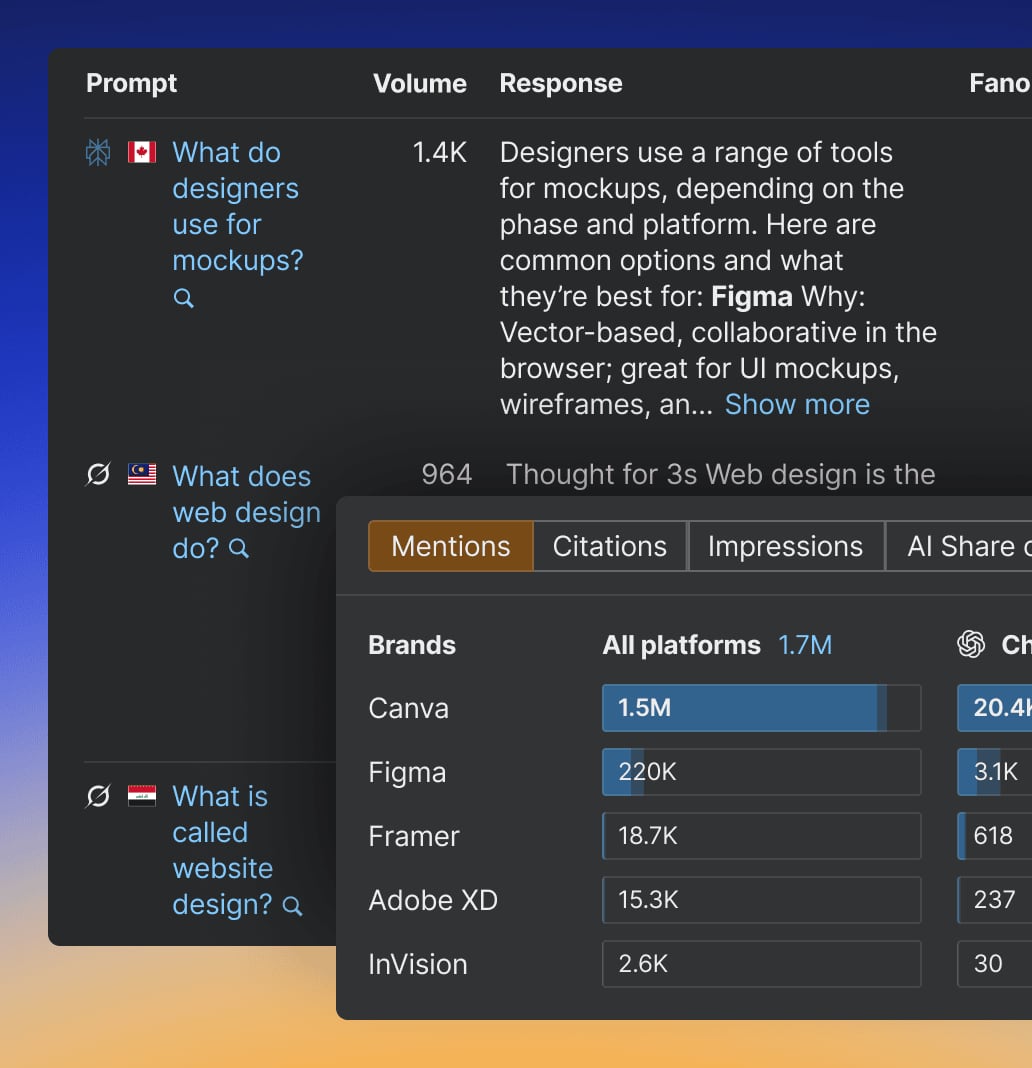
Brand Radar showing AI visibility across prompts and platforms.
- The brief bottleneck. Ahrefs data rarely becomes published content because briefing is slow. AgentBooks removes the briefing step by generating from the keyword plan directly.
- The voice problem. Generic AI drafts sound like everyone else. AgentBooks starts from your crawled website, so drafts reflect your product and tone rather than a blank prompt.
- The consistency problem. Publishing once a month does not build topical authority. Scheduled generation keeps output steady even when the team is busy.
- The blind spot. Teams that publish without tracking cannot tell what worked. Rank Tracker and Site Audit in Ahrefs give you the feedback signal that makes the next planning cycle smarter.
- The AI search gap. Buyers increasingly ask AI assistants instead of search engines. Ahrefs' Brand Radar AI tracks brand visibility across AI prompts, while AgentBooks structures content so it is easier for AI systems to cite.
Decision guidance: when to use which, and when to use both
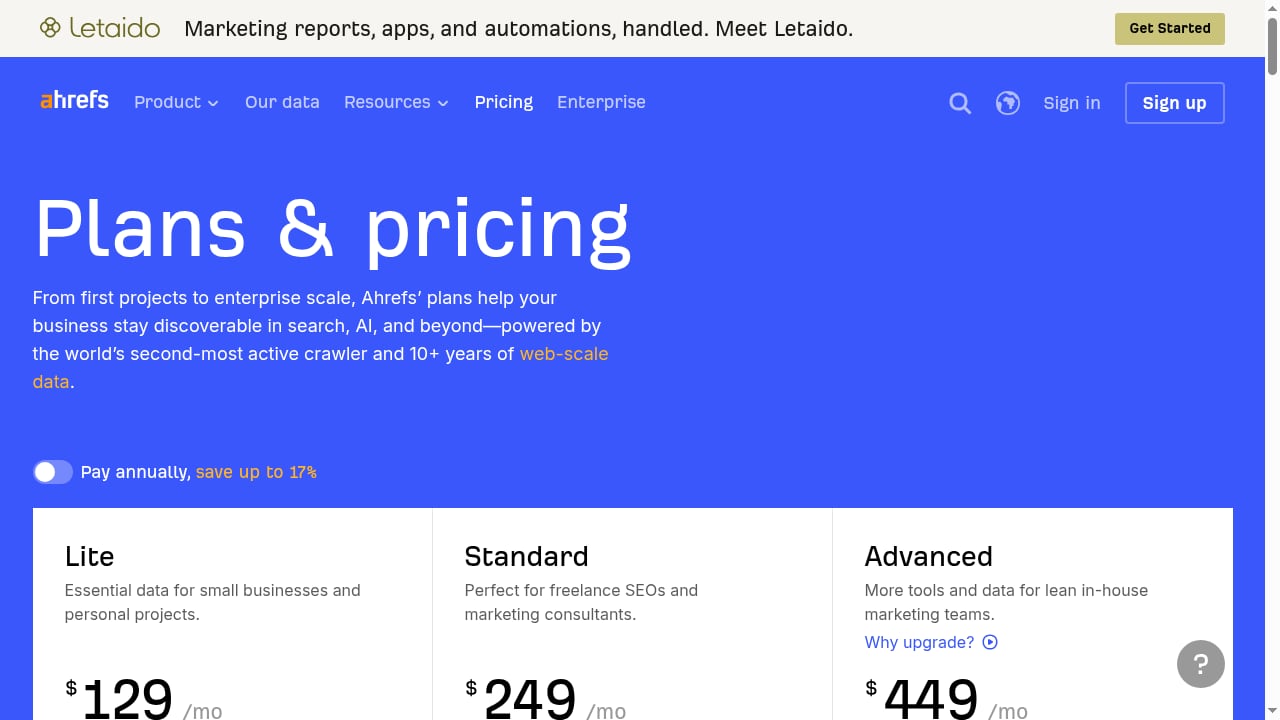
First viewport screenshot of Plans & Pricing - Ahrefs.
- Use Ahrefs alone if you already have a content team and only need better data. The tooling is complete for research and monitoring.
- Use AgentBooks alone if you are a solo founder or small team that needs output more than it needs a second data source. The built-in keyword plan and organic-result research cover the basics.
- Use both if you are producing content at volume and need external demand data to prioritize. This is the strongest fit for SaaS teams, agencies managing multiple brands, and e-commerce sites with large category structures.
If you are weighing AgentBooks against other platforms before committing, the AgentBooks vs Surfer SEO comparison and the AgentBooks vs AirOps vs Machined breakdown both cover where each tool stops and the other begins.
Common mistakes to avoid
- Importing too many keywords. A 5,000-row export paralyzes planning. Start with the 50 you would actually publish.
- Skipping approval. Approval-first is the feature, not the friction. Unreviewed drafts are how brands end up with content they cannot defend.
- Ignoring the feedback loop. If you never check Rank Tracker, you are guessing. The loop is what compounds.
- Treating AgentBooks as a ranking guarantee. It is not. It optimizes the process and the inputs. Rankings depend on competition, site health, and distribution — which is exactly why the Ahrefs measurement layer matters.
Related reading
- AgentBooks vs GravityWrite vs SEO and AEO tool: AI Content Showdown - Compare AgentBooks, GravityWrite, and SEO and AEO tool (Contentpen) on automation, brand voice, and AI citations. Find your best fit.
- AI SEO Writer That Ranks on Google & ChatGPT: 2026 Review - Evidence-based review of AI SEO Writer That Ranks on Google & ChatGPT: ideal users, use cases, strengths, limits, pricing signals, and setup.
Sources and further reading
- The Best AI Agent Business Models for Revenue (2026) - A practical look at the AI agent business models that actually produce revenue in 2026 — how each one makes money, who it fits, where the margin really is, and the ones that quietly don't work.
- How to Make Money with AI in 2025 (15 Best Ways & Top Tools) - AI isn't just for tech giants. Learn how to make money with AI and transform your financial future. Our comprehensive guide shows you how.
- Agenthanks — Real-world AI Agent Use Cases - Browse real-world AI Agent use cases by industry. Sales, HR, Legal, Operations and more.
FAQ
Do AgentBooks and Ahrefs have a native integration? No. The workflow runs through keyword exports and URL lists. You move data from Ahrefs into the AgentBooks keyword plan, and published URLs back into Ahrefs Rank Tracker.
Can I use AgentBooks without Ahrefs? Yes. AgentBooks includes its own keyword planning and organic-result research. Ahrefs adds depth in backlink data, historical keyword volume, and technical auditing.
How much does each cost? AgentBooks offers a free plan in public beta, a Business plan at $30/month, and an Enterprise plan at $100/month. Ahrefs offers a free limited-access account and paid plans at multiple tiers.
How long before I see results? Expect the first measurable movement in 8–12 weeks for low-difficulty topics, longer for competitive terms. The AgentBooks plan and the Ahrefs Rank Tracker give you the data to judge progress honestly.
Does this work for e-commerce and DTC sites? Yes. AgentBooks handles multi-brand workspaces and multilingual publishing, which fits category-page content and regional storefronts. Ahrefs Site Audit is especially useful for large product catalogs.
Conclusion
AgentBooks and Ahrefs are complementary by design. Ahrefs tells you where the demand is and whether you are capturing it. AgentBooks turns that demand into published content without a hiring spree. The setup is light — an export, a keyword plan, a schedule, and a monthly rank check — and the payoff is a content operation that runs continuously instead of in bursts.
Start with one keyword cluster, one approval cycle, and one month of tracking. If the loop works, scale it. If it does not, you will know exactly which step to fix.