
How to Use AgentBooks with SEOcrawl AI: A Practical Workflow
AgentBooks and SEOcrawl AI solve two halves of the same problem. AgentBooks turns your website into an always-on content engine: it learns your product, maps your market, plans topics, researches top organic results, and publishes articles in your brand voice. SEOcrawl AI measures what happens next — rankings, site health, and increasingly, whether ChatGPT, Claude, Gemini, and Perplexity mention your brand at all.
Used separately, each tool is useful. Used together, they close the loop between publishing and performance, so your content plan is driven by real search and AI-visibility data rather than guesswork. This guide walks through the setup, the workflow, and the practical decisions involved.
Why combine AgentBooks and SEOcrawl AI
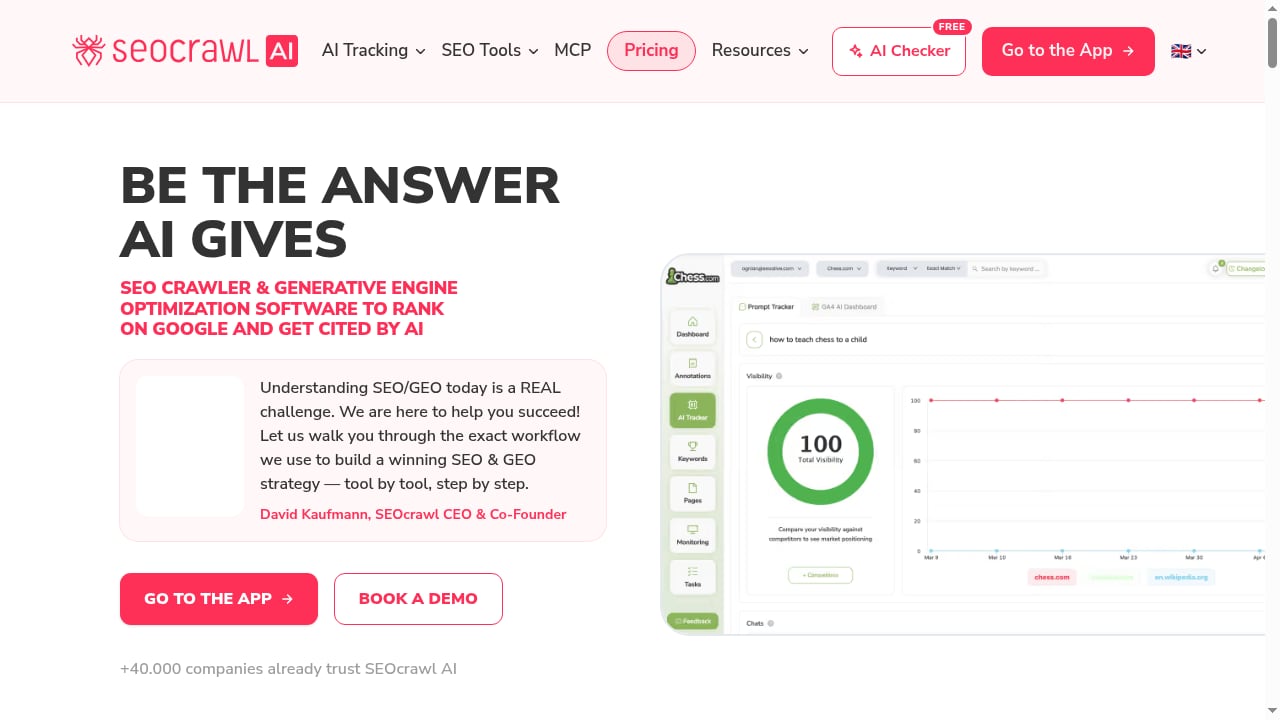
First viewport screenshot of SEO Intelligence & AI Tracker Platform | SEOcrawl AI.
Most content teams face the same gap: the publishing tool doesn't know what's ranking, and the SEO tool doesn't produce content. AgentBooks handles the production side — brand intelligence from crawling your site, a categorized keyword plan, an approval-first article workflow, scheduled generation, and SEO preparation like TDK, images, tags, and links. SEOcrawl AI handles the intelligence side — crawling, rank tracking, site audits, and an AI Tracker that monitors how LLMs cite your brand.
The combination addresses three specific problems:
- Content published without feedback. AgentBooks keeps publishing, but without rank and AI-citation data you can't tell which topics are working. SEOcrawl AI supplies that signal.
- SEO data without execution capacity. SEOcrawl AI surfaces keyword opportunities and cannibalization issues, but someone still has to write and publish. AgentBooks is that capacity.
- AI search blind spots. Traditional rank tracking doesn't tell you if ChatGPT recommends your competitor instead of you. SEOcrawl AI's AI Tracker covers that, and AgentBooks can then produce content targeting the prompts where you're absent.
Setup: connecting the two platforms
First viewport screenshot of Changelog | Product updates and new features.
Step 1 — Configure your AgentBooks workspace
Share your website URL once. AgentBooks crawls it to build brand intelligence: product understanding, tone of voice, and market positioning. From there it generates a categorized keyword plan and a topic roadmap. Set your publishing cadence, connect your custom domain or site identity, and choose whether articles go through approval before publishing. If you run multiple brands, use separate workspaces so voice and keyword plans don't bleed into each other.
Step 2 — Set up SEOcrawl AI tracking
Add your project to SEOcrawl AI or connect it to Google Search Console. The domain property connection matters here — it gives you the full picture of how your site performs across subdomains and protocols, which is useful when AgentBooks publishes to a blog subfolder or a separate content domain. From the SEO Dashboard you can see a summary of every feature in about five minutes.
Next, configure the pieces you'll actually use in this workflow:
- Rank Tracker — add the keywords from your AgentBooks plan. Tag them by cluster and segment brand vs. non-brand so you can see whether content is winning new queries or just reinforcing existing ones.
- AI Tracker — monitor brand mentions and citations across ChatGPT, Claude, Gemini, and Perplexity. Compare visibility against competitors and break results down by prompt, topic, and country.
- Site Audit — run a crawl and get a global Audit Health Score across on-page, crawlability, indexability, technical SEO, international SEO, and social tags. Issues are prioritized and linked to affected URLs.
- Annotations — mark the date each AgentBooks article goes live. This is the single most useful habit in the whole workflow, because it lets you see ranking and click impact against a specific publish event rather than a vague time range.
Step 3 — Connect the MCP server (optional but powerful)
SEOcrawl AI offers an official MCP server exposing 38 tools across 12 groups, including Site Explorer, Google Search Console, GA4 Web Analytics, Rank Tracker, Site Audit, AI Tracker, Tags, Smart Views, Tasks, and Web Fetch. If you use ChatGPT, Claude, or any MCP-compatible client, you can query live SEO and GEO data directly in the conversation. That means you can ask your AI assistant which keywords are climbing, which pages have audit issues, or how your brand is cited in LLM answers — without switching tabs.
The combined workflow, step by step
First viewport screenshot of SEO Intelligence & AI Tracker Platform | SEOcrawl AI.
1. Let AgentBooks plan from product data
AgentBooks starts with real product information rather than a blank prompt. It researches top organic results for your target topics and builds articles around what already ranks. This is the planning layer — you review the keyword categories and topic list before anything gets written.
2. Validate the plan against SEOcrawl AI data
Before approving topics, cross-check them in SEOcrawl AI. Look for three things:
- Cannibalization. SEOcrawl AI detects when multiple URLs compete for the same query. If your AgentBooks plan targets a keyword your existing pages already own, consolidate instead of publishing a new article.
- Opportunity gaps. Use rank tracking and heat maps to find clusters where you rank positions 5–20 — close enough that a well-built article can move.
- AI visibility gaps. Check the AI Tracker for prompts where competitors are cited and you aren't. These are high-value AgentBooks topics because the competition is for AI answers, not just blue links.
3. Approve and publish with AgentBooks
The approval-first workflow means you review drafts before they go live. AgentBooks handles SEO preparation — title, description, keywords, images, tags, and internal links — and can publish on a schedule. Multilingual publishing is available if you serve multiple markets.
4. Annotate and measure in SEOcrawl AI
When each article publishes, add an annotation in SEOcrawl AI. Then watch:
- Rank movement for the target cluster in the Rank Tracker.
- Clicks and impressions in the Search Console integration, with month-over-month and year-over-year accelerometers.
- AI citations in the AI Tracker, broken down by prompt and topic.
- AI-driven traffic separately from organic search, so you can see which LLMs send sessions, conversions, and revenue down to the landing page.
5. Feed results back into the plan
This is where the loop closes. If a cluster performs well, expand it in AgentBooks. If a topic stalls after 60–90 days, either update the article or drop it from the roadmap. If the Site Audit flags technical issues on pages AgentBooks published — broken canonicals, indexation problems, hreflang errors — fix those before writing more, because content can't rank on a page search engines can't properly crawl.
A practical example
Imagine a B2B SaaS company selling project management software. AgentBooks crawls the site and builds a keyword plan around project planning, team workflows, and resource allocation. It schedules two articles per week.
In SEOcrawl AI, the team connects Search Console, adds the keyword clusters to the Rank Tracker, and sets up AI Tracker prompts like "best project management tool for remote teams" and "how to allocate resources across projects."
After six weeks, the data shows:
- Two articles on resource allocation moved from position 14 to position 6.
- The AI Tracker shows the brand cited in Gemini answers about remote team tools but absent from ChatGPT answers on the same topic.
- The Site Audit flags that three published articles have duplicate title tags.
The team fixes the title tags, asks AgentBooks to expand the resource allocation cluster, and commissions content specifically targeting the ChatGPT prompt gap. That's the workflow in miniature: publish, measure, diagnose, adjust.
Where each tool stops
AgentBooks does not guarantee rankings or traffic. It optimizes the content process and the measurable inputs — keyword coverage, publishing consistency, on-page preparation. SEOcrawl AI does not write or publish content. It measures, audits, and tracks. Neither replaces strategic judgment about what your business should say.
If you're evaluating the wider tool landscape, comparisons like AgentBooks vs AirOps vs Averi and AgentBooks vs MarketMuse help clarify where a full content engine differs from a planning or optimization tool. For a broader view of the category, see our roundup of AI search visibility and content operations platforms.
Pricing considerations
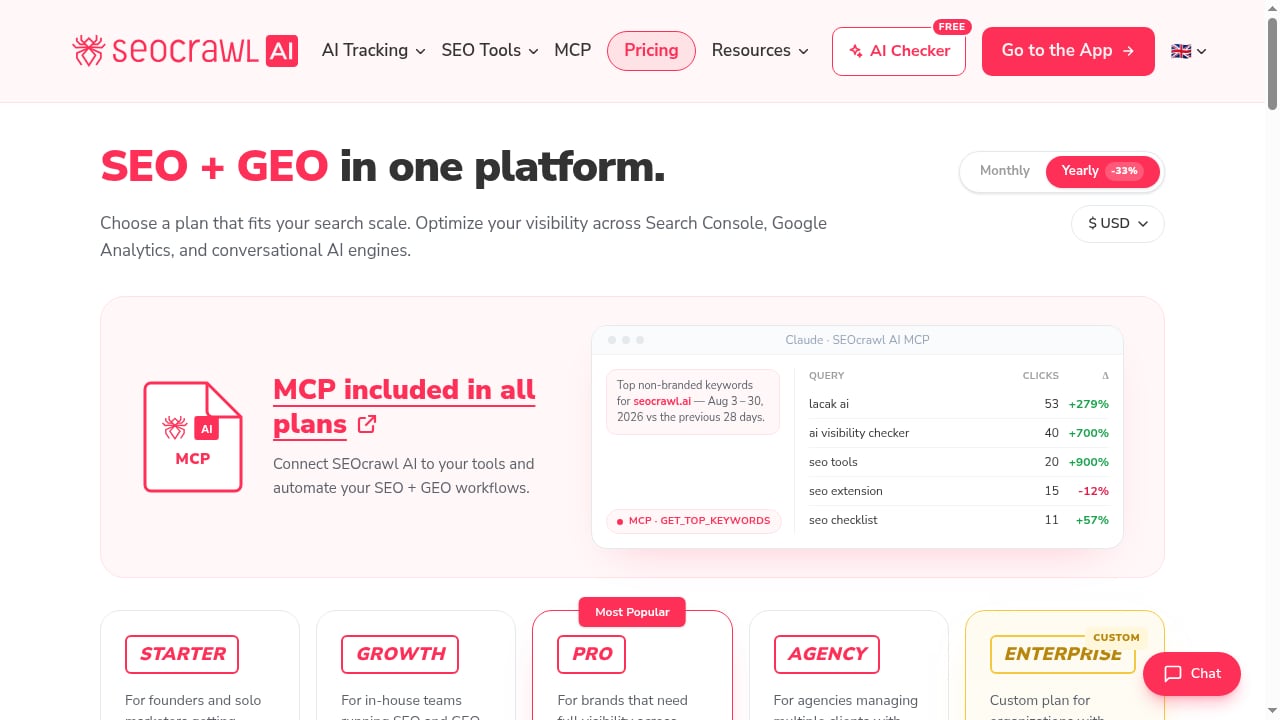
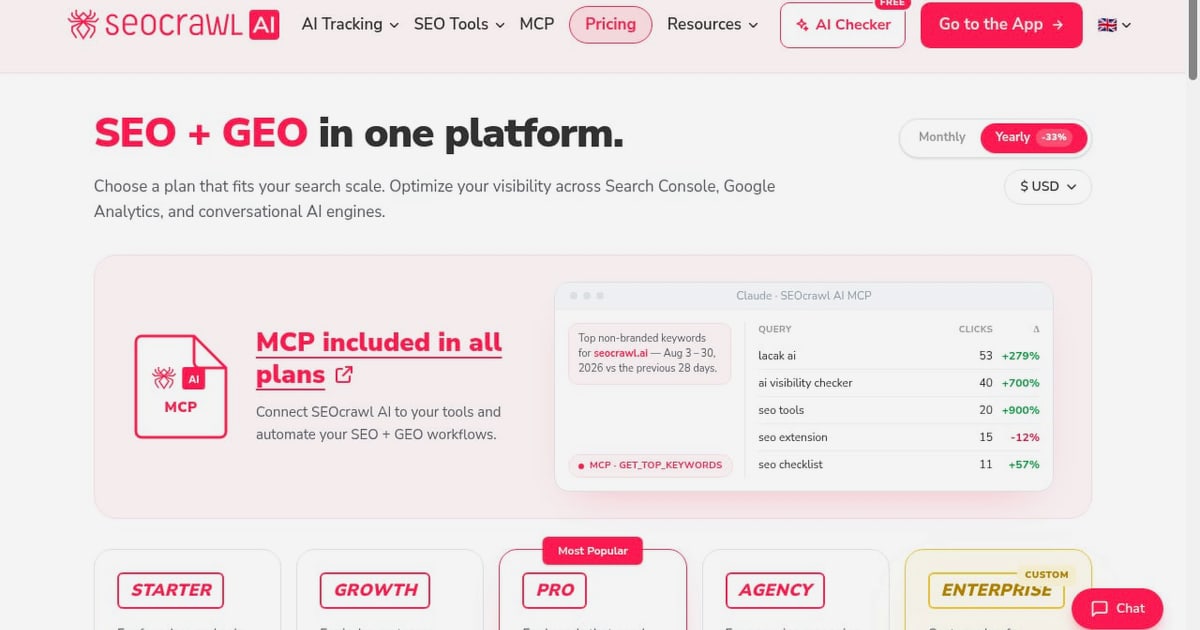
First viewport screenshot of Plans & Pricing — SEOcrawl AI.
AgentBooks offers a public beta with a free plan, a Business plan at $30/month, and an Enterprise plan at $100/month. SEOcrawl AI starts at €49/month for Starter, with Growth at €99, Enterprise at €199, and Next Level at €399 — plus a 14-day free trial with no credit card required and a 33% discount on annual billing. For most small teams, AgentBooks Business plus SEOcrawl AI Starter covers the full loop without overbuying.
Related reading
- Machined Review 2026: Content Cluster Automation Tested - Hands-on Machined review: cluster automation, AI writing with citations, internal linking, WordPress publishing, pricing signals, limits, and who should buy.
- Public Product Knowledge Content: Definition, Value, and Implementation Methods - How is public product knowledge content defined, why does it matter, and how do you implement it? This article breaks down knowledge bases, RAG, content automation, and compliance essentials, with an actionable checklist.
Sources and further reading
- SEO Reporting | The Book from SEOcrawl AI - Practical guide on how to automate reporting and manage SEO projects efficiently.
- SEOcrawl AI - Understanding SEO/GEO today is a REAL challenge. We are here to help you succeed! Let us walk you through the exact workflow we use to build a winning SEO & GEO strategy — tool by tool, step by step.
- SEO Tools | SEOcrawl AI - Every tool you need to run SEO + GEO — all under one roof at SEOcrawl AI.
FAQ
Do I need SEOcrawl AI if AgentBooks already does keyword planning?
AgentBooks plans topics and prepares on-page SEO, but it doesn't track rankings, audit site health, or monitor AI citations over time. SEOcrawl AI provides the measurement layer. Without it, you're publishing blind.
Can I use SEOcrawl AI's MCP server with AgentBooks?
The MCP server works with ChatGPT, Claude, and other MCP-compatible clients — not inside AgentBooks itself. The practical use is querying live SEO and GEO data in your AI assistant while you plan what AgentBooks should write next.
How long before I see results?
Rank movement typically takes 60–90 days for new content, depending on competition and site authority. AI citations can shift faster, sometimes within weeks, because LLM answers update on different cycles than search indexes.
What if AgentBooks publishes something that cannibalizes an existing page?
Run the SEOcrawl AI cannibalization check before approving topics, and again after publishing. If two URLs compete for the same query, consolidate them or differentiate the intent. The per-URL, per-query impact view shows which page to keep.
Does this workflow work for agencies?
Yes, and it scales reasonably well. AgentBooks supports multi-brand workspaces, and SEOcrawl AI offers white-label reporting with custom branding and CNAME from the Pro plan upward. Agencies can run one workspace per client and report from a single SEOcrawl AI account.
Conclusion
AgentBooks and SEOcrawl AI fit together because they cover different stages of the same cycle. AgentBooks produces content from real product data and keeps publishing on schedule. SEOcrawl AI tells you whether that content ranks, whether your site is technically healthy, and whether AI models are citing you. The workflow is straightforward: plan in AgentBooks, validate against SEOcrawl AI data, publish with annotations, measure rank and AI visibility, then feed the results back into the next planning round. Start with the free tiers on both sides, connect Search Console, and annotate your first publish. The loop gets more valuable every cycle.