
Top 10 AI Search Visibility & Content Operations Platforms 2026
Buyers no longer discover brands only through ranked links. They ask ChatGPT, Gemini, Claude, Perplexity, or Google's AI surfaces a question and act on the synthesized answer. That shift created a crowded software category: tools that measure how AI engines describe your brand, and tools that help you produce and refresh the content those engines cite. This review ranks ten platforms that genuinely combine, or sit squarely inside, AI search visibility and content operations work in 2026.
How We Evaluated These Platforms
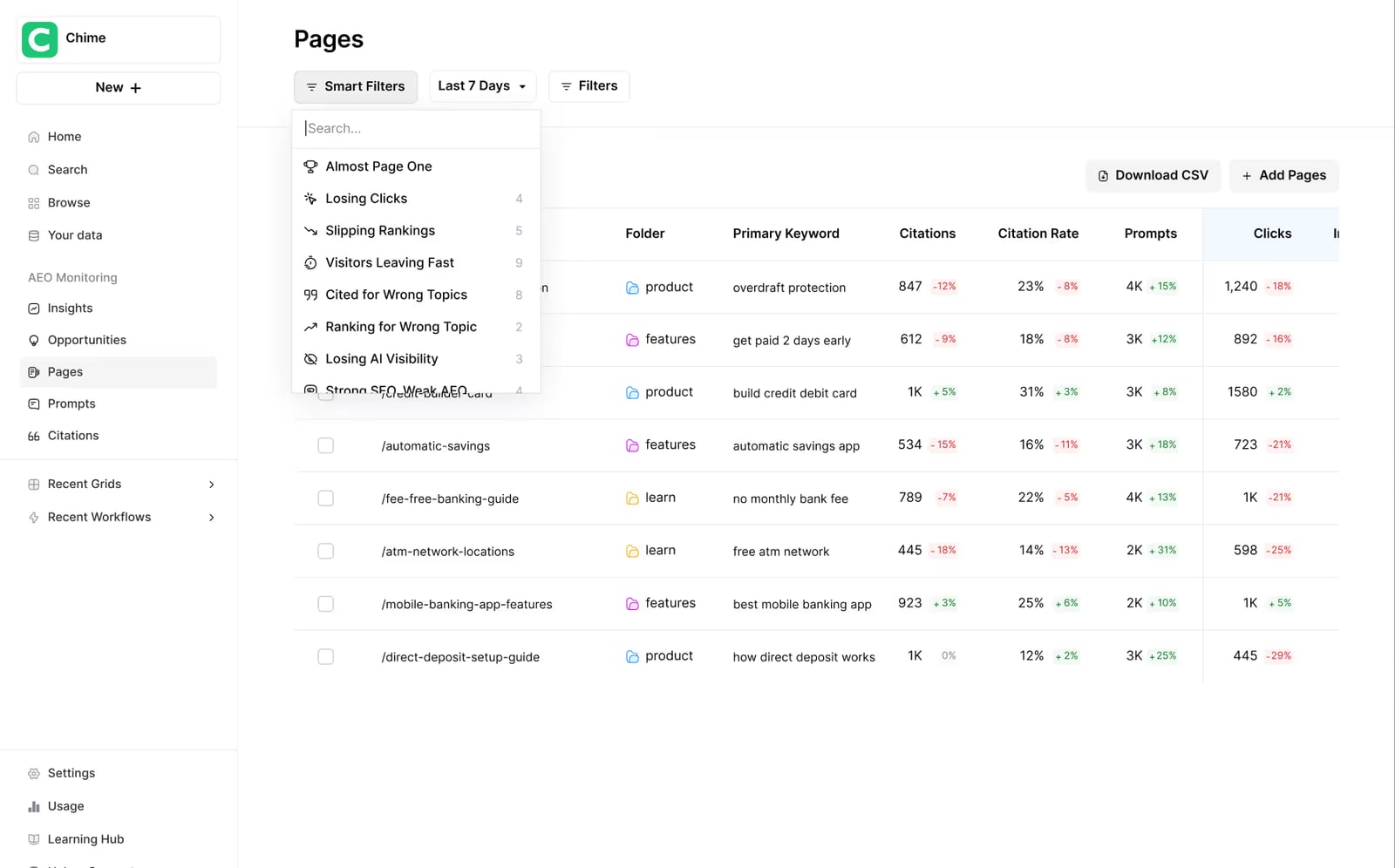
AirOps product interface.
No vendor paid for placement. Rankings reflect documented capability, pricing evidence, and fit with real operating workflows. We weighted six criteria:
- Engine coverage: Which AI surfaces are tracked, and whether coverage is plan-gated.
- Evidence quality: Raw answers, citations, source URLs, sentiment, share of voice, and historical trend data.
- Content operations depth: Whether the platform only reports gaps or also supports briefing, production, refresh, and publishing workflows.
- Actionability: Recommendations, technical fixes, authority building, and integration with existing stacks.
- Governance and scale: Brands, client workspaces, seats, approvals, exports, and API access.
- True cost: Prompts × engines × frequency × brands × seats × regions, not just the advertised entry price.
One caveat applies to every tool here: large language models are non-deterministic. The same prompt can produce different answers at different times, so treat visibility data as directional and track trends rather than single snapshots.
The Top 10 Platforms for 2026
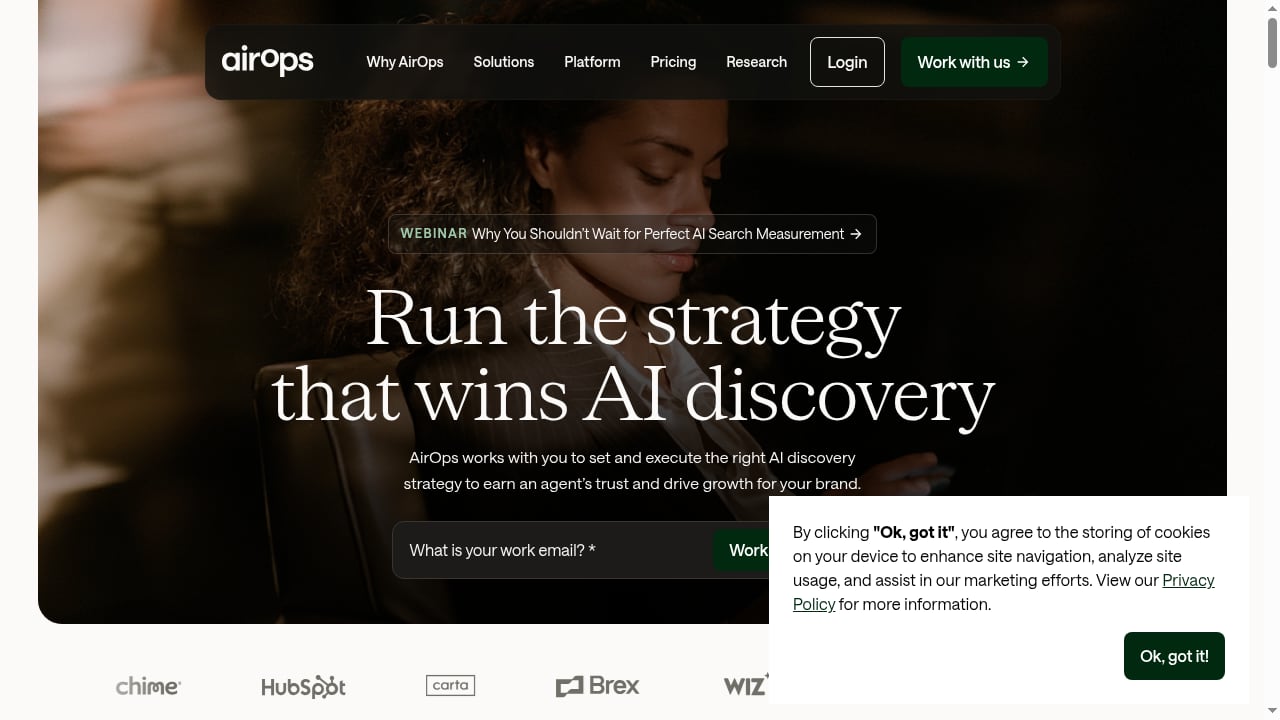
First viewport screenshot of AirOps | Run the strategy that wins AI discovery.
1. AirOps — Best for Connecting AI Visibility to Content Execution
AirOps is built around a specific thesis: buyer journeys are collapsing from multi-touchpoint funnels into single AI recommendations, so brands need a system for getting chosen inside those answers. It tracks brand visibility across AI answer engines, identifies content gaps through query fanouts, and researches AI ads in Google AI Mode and ChatGPT. Crucially, it does not stop at measurement. AirOps manages content production and refresh workflows, runs brand learning loops that convert content feedback into guidance, and integrates with CMS, SEO, AEO, social, and project tools.
Enterprise buyers get custom agent builds, unlimited knowledge bases, and MCP tools that bring content feedback and output review into connected assistants. Pricing runs across Solo, Pro, and Enterprise tiers, which makes it viable for individuals and small teams as well as large organizations.
Best for: Teams that need visibility tracking and content operations in one connected system rather than two disconnected subscriptions.
Watch for: The breadth of capability means onboarding and workflow design matter more than with a pure monitoring dashboard.
2. Evertune — Best for Statistically Rigorous Brand Intelligence
Evertune combines foundational model intelligence, daily consumer app data, and a large consumer panel to produce statistically significant AI visibility insights. Its AI Brand Index tracks how often and in what context models reference a brand, while source attribution traces mentions back to the specific pages and domains that drove them. It samples prompts repeatedly across major models including ChatGPT, Claude, Gemini, Perplexity, Meta AI, and DeepSeek.
Best for: Enterprises and agencies that need defensible measurement and perception tracking, not just mention counts.
Watch for: Custom pricing and a research-grade orientation; smaller teams may find it heavier than needed.
3. Conductor — Best for Enterprise Search Operations
Conductor unifies AI visibility intelligence with enterprise SEO and content creation. It monitors brand portrayal across ChatGPT, Perplexity, Google AI surfaces, and other engines, runs 24/7 technical AEO audits so key assets stay accessible to AI crawlers, and ties AI-driven traffic and conversions back to ROI reporting. Conductor Creator generates content aligned to brand voice and authority signals.
Best for: Large organizations running SEO and GEO as one program across many stakeholders.
Watch for: Plans start near $1,500 per month, with advanced configurations priced by scope.
4. Semrush — Best for Teams Already Living in an SEO Stack
Semrush adds AI visibility data beside the keyword research, backlinks, technical health, and competitor analysis its users already rely on. Core coverage includes ChatGPT, Perplexity, Gemini, Google AI Mode, and AI Overviews, with broader engine access in enterprise tiers. AI Visibility starts at $99 per domain.
Best for: SEO-led teams that want GEO inside an existing workflow instead of a separate tool.
Watch for: It is broader but less specialized than dedicated answer-intelligence products.
5. Ahrefs Brand Radar — Best for Source Discovery at Scale
Brand Radar reports more than 405 million search-backed prompts and tracks mentions, citations, impressions, share of voice, cited pages, and cited domains. Custom prompt packages start at $50 per month, while full index access costs more.
Best for: SEO teams doing broad market and source research to find which domains shape answers.
Watch for: Strong on discovery and benchmarking, lighter on content production workflows.
6. Writesonic — Best for Content Production Tied to Visibility Gaps
Writesonic pairs AI visibility tracking with an Action Center, site audits, refresh alerts, and article generation. Starter pricing is $99 per month and covers ChatGPT, Gemini, and Google AI Overviews, with enterprise plans expanding engine access.
Best for: Content teams that want speed from gap identification to draft.
Watch for: Editorial review and source verification remain essential; generated drafts still need human judgment.
7. Otterly.AI — Best for Affordable Entry-Level Monitoring
Otterly.AI offers daily prompt monitoring, citations, share of voice, brand position, source analysis, and a GEO URL audit. Plans begin at $29 per month for 15 prompts, covering ChatGPT, Google AI Overviews, Perplexity, and Copilot, with Claude, Gemini, and AI Mode available as add-ons.
Best for: Freelancers and small teams testing GEO for the first time.
Watch for: Crawler traffic analysis and unlimited recommendations require higher tiers.
8. Peec AI — Best for Configurable Multi-Project Tracking
Peec AI tracks visibility, position, sentiment, share of voice, prompts, competitors, and sources, with configurable models, prompt allocations, countries, and frequency per project. Brand plans start at $95 per month, with dedicated agency packages.
Best for: Agencies managing several brands with different market and language requirements.
Watch for: Broader engine coverage requires higher tiers or additional model access.
9. Scrunch AI — Best for Segmented Audience Analysis
Scrunch AI supports nine AI platforms and lets teams filter competitive presence and citations by topic, persona, funnel stage, prompt variant, country, and source ownership. Pricing is not publicly listed.
Best for: Teams with execution capacity that need detailed audience-level segmentation before acting.
Watch for: The lack of public pricing makes budget comparison harder during evaluation.
10. AthenaHQ — Best for Citation Intelligence and Agency Workspaces
AthenaHQ provides prompt tracking, competitor monitoring, citation intelligence, content recommendations, agency workspaces, and analytics connections. A free entry tier is available, with Starter at $295 per month using a credit pool.
Best for: Agencies and mid-market teams that want citation-level detail with client separation.
Watch for: Credit-based pricing requires usage planning for large prompt libraries and multiple clients.
How to Choose Between Monitoring and Operations
AirOps product interface.
The category splits into three practical shapes, and most buyers need to decide which one matches their team before comparing features:
- Monitoring-first platforms (Otterly.AI, Peec AI, Scrunch AI, Ahrefs Brand Radar) answer "where do we appear and who is cited?" They are fast to deploy and relatively affordable.
- Intelligence and analytics platforms (Evertune, AthenaHQ) add statistical rigor, perception analysis, and citation depth for teams that need defensible reporting.
- Visibility-plus-operations platforms (AirOps, Conductor, Writesonic, Semrush) connect findings to content production, technical fixes, and publishing workflows.
A useful pilot test: take one identified visibility gap and see whether your chosen platform can carry it from insight to published, measurable content. If the tool identifies gaps your team cannot close, the subscription becomes an expensive dashboard.
For teams comparing specific workflow combinations, our breakdown of AgentBooks vs AirOps vs Surfer SEO covers how automation, brand intelligence, and AI visibility fit together, and the Writesonic review tests its GEO audits and pricing gates hands-on.
Where Adjacent Tools Fit
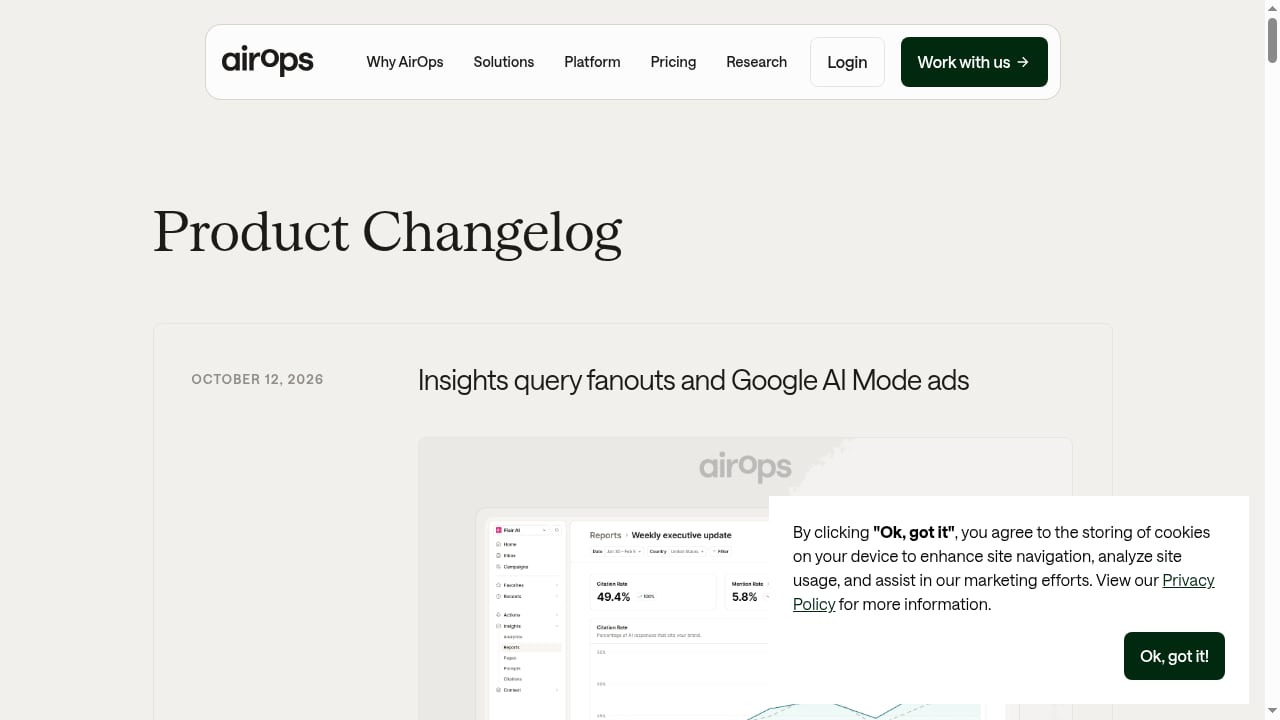
First viewport screenshot of AirOps - Product Changelog.
Not every team needs a full visibility platform on day one. Some start with content operations and add measurement later. AgentBooks, for example, is an AI content automation platform that turns a website into an always-on content engine — learning the product, planning topics, researching organic results, and publishing in brand voice. It is not an AI search visibility platform and does not belong in this ranking, but it can complement one: use a visibility tool to find which prompts and sources matter, then use a content engine to produce and refresh the assets. If that combination is your plan, the AgentBooks vs Koala AI vs Machined comparison and the AgentBooks and Make automation guide show how the content side is wired up.
Related reading
- AgentBooks vs Koala AI vs Machined: 2026 Comparison - Compare AgentBooks, Koala AI, and Machined on brand intelligence, keyword planning, publishing, and pricing to choose the right AI content engine.
- Kompozy Review 2026: Honest Look at AI Content Engine - Evidence-based Kompozy review: how its AI repurposing engine works, real pricing signals, ideal users, limitations, and whether it beats the content treadmill.
- Top 10 AI Content Repurposing & Publishing Automation Platforms 2026 - We tested 10 AI content repurposing and publishing automation platforms for 2026, ranking them by source formats, output variety, publishing depth, and price.
FAQ
What is the difference between AI search visibility and GEO?
AI search visibility is the measurement layer: how often, where, and how your brand appears in AI-generated answers. Generative engine optimization (GEO) is the practice of improving those outcomes through content, technical accessibility, source authority, and entity accuracy. Most platforms in this list do some of both, but few do both deeply.
Do AI visibility tools guarantee more mentions?
No. They measure and recommend. Improvement depends on publishing content that earns citations, fixing technical access for AI crawlers, and building third-party authority. Any vendor promising guaranteed AI mentions should be treated skeptically.
How much should a small team budget for AI visibility tracking in 2026?
Entry-level monitoring starts around $29 per month (Otterly.AI) and $50 per month for custom prompt packages (Ahrefs Brand Radar). Mid-tier brand plans cluster between $95 and $295 per month. Enterprise platforms with managed programs and advanced analytics commonly start near $1,500 per month or use custom pricing.
Why do AI visibility numbers fluctuate week to week?
LLMs are non-deterministic. The same prompt on the same engine can produce different answers at different times, and model updates change retrieval behavior. Track trends across many prompts and multiple engines rather than reacting to single-day swings.
Should I replace my SEO tool with an AI visibility platform?
Usually not. Semrush and Ahrefs show that GEO data is most useful when it sits beside keyword, backlink, and technical data. The stronger pattern is adding AI visibility to an existing SEO workflow, then connecting the findings to a content operations process that can act on them.
Conclusion
The 2026 market rewards teams that treat AI visibility and content operations as one loop: measure how engines describe you, find the sources and gaps behind those answers, produce or refresh the content that closes them, and measure again. AirOps leads this list because it connects those stages most completely, while Evertune and Conductor serve enterprise measurement and search operations, and Otterly.AI, Peec AI, and Scrunch AI cover focused monitoring at different price points. Choose based on the stage you can actually execute — a precise monitoring tool beats a broad platform your team never operationalizes.