Top 10 Enterprise SEO and AI Search Optimization Platforms for 2026
Enterprise search visibility no longer lives on a single results page. Discovery now happens across traditional search engines, AI-generated answers, and generative experiences that decide which brands get cited — and which get skipped. Google still processes roughly 16.4 billion searches every day, but a growing share of buying questions are answered inside ChatGPT, Perplexity, Google AI Overviews, Microsoft Copilot, Gemini, and Claude.
The data backs this up. According to the 2025 AI Visibility Report from The Digital Bloom, only 11% of cited domains overlap between ChatGPT and Perplexity, and roughly 80% of LLM citations don't rank in Google's top 100 for the same query. Traditional SEO tools built for ten blue links cannot tell you whether your brand exists in this new layer.
That is why the enterprise SEO and AI search optimization platform category has split into three overlapping groups: legacy enterprise SEO suites adding AEO features, AI-native visibility monitors, and unified platforms that treat SEO and AEO as one connected discipline. This guide ranks the ten products that genuinely belong to this category in 2026, using transparent criteria and evidence for every entry.
How We Evaluated These Platforms
First viewport screenshot of B2B Solutions.
We weighted five factors that matter most to enterprise buyers:
- Scalability and data reliability for large, complex websites with hundreds of thousands or millions of pages.
- AI search and AEO coverage — how many engines are tracked, and whether prompt-level visibility, citations, sentiment, and share of voice are included.
- Actionability — does the platform stop at a dashboard, or does it tell teams what to change next and connect insights to workflow?
- Content optimization and measurement at scale — can it support distributed teams, multiple regions, and executive reporting?
- Price-to-value and transparency — honest pricing, fair scaling, and feature parity across tiers.
We deliberately did not rank by pure feature count. The most loaded platform is rarely the best fit for a five-person marketing team, and enterprise procurement needs differ from day-to-day SEO execution.
The Top 10 Enterprise SEO and AI Search Optimization Platforms
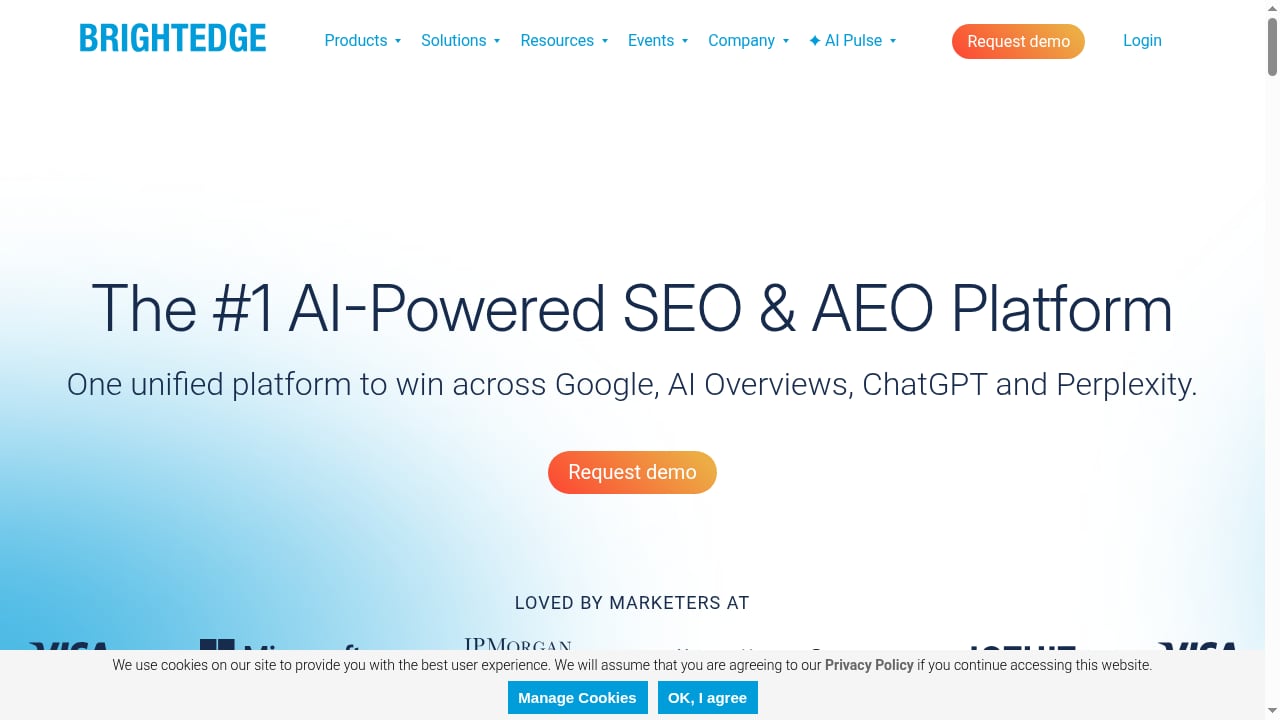
First viewport screenshot of Enterprise SEO Platform | Visibility in AI Search | BrightEdge.
1. Conductor
Conductor ranks first because it treats SEO and AEO as one connected discipline rather than two disconnected toolsets. Its intelligence layer connects content and technical work directly to outcomes across traditional results and AI-driven discovery, and its MCP server links AI visibility data to action inside AI workflows and agents.
Conductor measures brand mentions, citations, share of voice, and sentiment across ChatGPT, Perplexity, Google AI Overviews, Google AI Mode, Microsoft Copilot, Grok, and Claude. It also supports large-scale site auditing, crawling, and technical SEO monitoring, plus enterprise-grade security and governance. The main limitation is that it is purpose-built for large organizations, so it may exceed the needs of smaller teams.
Best for: Large organizations managing complex sites and content ecosystems that need trusted data and a single source of truth for SEO and AEO.
2. Semrush Enterprise
Semrush Enterprise ranks highly for the breadth of its SEO data and competitive insights. It is strong for organizations that need visibility into keywords, competitors, backlinks, and SERP dynamics across many markets. Its AI Toolkit add-on extends visibility tracking into ChatGPT, Google AI Overviews, Gemini, and Grok, making it a practical choice for teams already standardized on Semrush.
The trade-off is that AEO is an add-on layer rather than the core architecture. Teams that want prompt-level depth and citation benchmarking may need to pair it with a dedicated AI visibility tool.
Best for: Enterprise teams that want one vendor for traditional SEO data and competitive research, with AI visibility as an extension.
3. Profound
Profound is the most-funded company in the AI search visibility space, having raised a $96M Series C in February 2026 at a $1B valuation, with Sequoia, Lightspeed, and Kleiner Perkins on the cap table. Customers include Ramp, MongoDB, Figma, and DocuSign.
The platform is built around its proprietary Prompt Volumes dataset, which estimates how often specific queries are asked across LLMs — effectively a search-volume metric for AI. It tracks 10+ engines, including GPT-5.2, and adds the Profound Index for industry benchmarks. Enterprise governance includes SOC 2 Type II and multi-region support.
The catch is pricing. The $99 Starter plan is effectively ChatGPT-only, and real usefulness starts at the $399 Growth tier. Self-serve content generation is heavily capped on lower tiers.
Best for: Enterprise GEO programs with dedicated budget and a need for prompt-volume prioritization and competitive citation benchmarking.
4. BrightEdge
BrightEdge is an enterprise SEO platform that helps organizations improve visibility, drive more traffic, and optimize their site for better search performance, including visibility in AI search. It serves B2B marketers, SEO teams, and large enterprises across industries.
The platform uses AI and deep learning through its DataMind technology to provide fresh, accurate, and actionable findings for data-driven decision making. Core features include keyword research and prioritization, SEO insights and recommendations, mobile SEO, content optimization, and competitive analysis. BrightEdge enables users to stay ahead of market changes, identify high-value keywords, fix site errors, and capture featured snippets.
Case studies show significant results: 3M achieved 20% organic traffic growth YoY for three consecutive years, Adobe won 66% share of SEO voice and over 5,900 Quick Answers, Advanced Recovery Systems increased SEO revenue 87% and organic traffic 441%, and NinjaOne won 61% share of AI mentions.
Best for: B2B marketers and large enterprises that need enterprise SEO fundamentals plus AI search visibility in one platform.
5. seoClarity
seoClarity provides a unified enterprise SEO and Answer Engine Optimization infrastructure designed to mitigate the complexity of the fragmented search landscape. By consolidating disparate data streams and workflows into a single ecosystem, the platform enables global teams to work from one source of truth.
Its strength is data consolidation at scale — pulling together rankings, technical health, content performance, and AI visibility signals so teams can prioritize without stitching together point solutions. It is a strong fit for organizations that already have mature SEO operations and need AEO layered into the same infrastructure.
Best for: Global enterprises that want a unified SEO and AEO infrastructure with deep data consolidation.
6. Botify
Botify is built for large, complex websites where technical SEO and crawl efficiency determine whether content ever gets seen. It excels at log file analysis, crawl budget optimization, and connecting technical fixes to business outcomes.
For AI search, Botify's value is foundational: if search engines and AI crawlers cannot efficiently access and understand your site, no amount of AEO optimization will help. It is less focused on prompt-level AI visibility tracking than AI-native tools, so it works best as the technical backbone alongside a dedicated AEO monitor.
Best for: Enterprise sites with millions of pages where technical SEO and crawl efficiency are the primary bottleneck.
7. AthenaHQ
AthenaHQ is a Y Combinator–backed AEO platform built by former Google Search and DeepMind engineers. It tracks ChatGPT, Perplexity, Google AI Overviews, Google AI Mode, Gemini, Claude, Copilot, and Grok — with all engines unlocked at the Starter tier.
Customers include SoFi, ZoomInfo, Wix, and Volkswagen. The platform leans hard into ROI proof: native GA4 and GSC integration tries to connect AI visibility lifts to actual pipeline. It also offers brand impersonation alerts that catch AI hallucinations about your brand. The main limitation is credit-based usage, which can constrain heavy tracking.
Best for: Enterprise teams that need to prove ROI from AI visibility work and connect it to pipeline data.
8. Surfer
Surfer is an AI content optimization platform designed for marketers, agencies, and large organizations. It enables teams to plan, write, and audit content to improve visibility in organic search and AI models.
Core tools include keyword research, clustering, a Content Editor with real-time optimization guidelines, Content Audit with performance tracking and personalized improvement recommendations, and an AI Tracker for monitoring AI visibility. The Enterprise tier supports API access, whitelabeling, custom usage limits, SSO, and granular permission management. Enterprise users also gain priority support, strategic advisory services, and 16+ months of performance data.
Best for: Content-led enterprise teams that want optimization and AI visibility inside the same content workflow.
9. OtterlyAI
OtterlyAI is an AI search analytics platform built by marketers, for marketers. Co-founded in 2024 in Vienna by Thomas Peham, Klaus-M. Schremser, and Josef Trauner — the team that previously sold Usersnap — it has grown to serve more than 15,000 marketing professionals and was recognized as a Gartner Cool Vendor for AI in Marketing 2025.
It tracks brand visibility and citations across ChatGPT, Google AI Overviews, Google AI Mode, Gemini, Perplexity, and Microsoft Copilot, and pairs that with a free GEO Audit, AI Crawler Simulation, AI Keyword Research, and Query Fan-Out tools. Pricing is the headline: $29/mo gets you started, while comparable enterprise tools start at $295–$499. The trade-off is less enterprise-specific tooling than Profound or AthenaHQ.
Best for: Marketing-led teams and agencies that want strong price-to-value and transparent monthly pricing.
10. SE Ranking
SE Ranking gives marketing teams and agencies a connected view of performance across traditional search and AI surfaces. It covers keyword rankings, technical site health, and AI search visibility across Google AI Overviews, AI Mode, ChatGPT, Gemini, and Perplexity.
The SEO foundation includes keyword research, site audits, backlink analysis, competitive intelligence, local SEO, and content optimization. What differentiates SE Ranking is how it connects those foundations to AI visibility data, GA4 traffic signals, and social performance via Planable — replacing siloed metrics with cross-channel correlations. API access and MCP support put live search data directly inside AI assistants and BI environments, and White Label reporting plus the Agency Pack support multi-client operations at scale.
Best for: Teams and agencies that want an affordable, connected view of SEO and AI visibility without enterprise-only pricing.
How to Choose the Right Platform
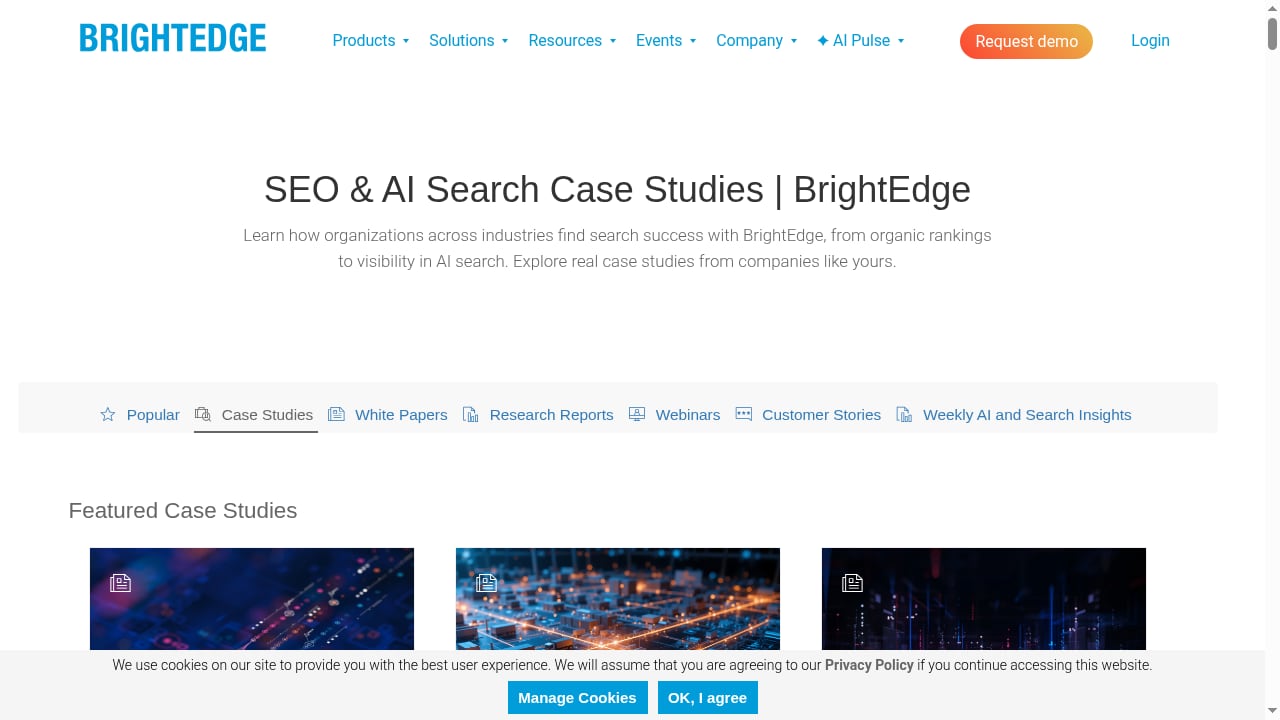
First viewport screenshot of SEO & AI Search Case Studies.
The right choice depends on where your bottleneck is:
- If your bottleneck is technical scale — millions of pages, crawl issues, log file analysis — start with Botify or Conductor, then layer in an AEO monitor.
- If your bottleneck is proving ROI — you need GA4 and pipeline attribution — AthenaHQ is built for that.
- If your bottleneck is content workflow — you need optimization and AI visibility inside the writing process — Surfer is the strongest fit.
- If your bottleneck is budget — you want credible AI visibility tracking without enterprise contracts — OtterlyAI and SE Ranking offer the best price-to-value.
- If your bottleneck is unification — you want one platform for SEO and AEO across a large organization — Conductor and BrightEdge are the most complete.
For teams that also need to produce the content these platforms optimize, an adjacent workflow matters. Tools like AgentBooks sit outside this category — it is an AI content automation platform, not an enterprise SEO or AI search optimization platform — but it can complement the platforms above by turning a website into an always-on content engine that plans topics, researches organic results, and publishes in the brand's voice. If your platform tells you what to optimize but your team struggles to produce the content, a content engine fills that gap. You can see how one such workflow fits together in this guide to using AgentBooks with SEOcrawl AI.
Related reading
- How to Use AgentBooks with SEOcrawl AI: A Practical Workflow - Learn how to combine AgentBooks content automation with SEOcrawl AI's SEO and GEO intelligence to plan, publish, and measure content that ranks and gets cited.
- AgentBooks vs AirOps vs Averi: Which AI Content Engine Fits? - Compare AgentBooks, AirOps, and Averi on brand intelligence, AI search visibility, publishing workflow, and pricing to pick the right content engine.
- AgentBooks vs MarketMuse: Content Engine or Planning Tool? - AgentBooks vs MarketMuse compared: one plans and optimizes content, the other runs the full engine. See which fits your team in 2026.
Sources and further reading
- Best Enterprise SEO Platforms Reviews 2026 | Gartner Peer Insights - Find the top Enterprise SEO Platforms with Gartner. Compare and filter by verified product reviews and choose the software that’s right for your organization.
- The 25 Best AI SEO Tools in 2026 - Twenty-five tools below cover the serious end of the market. They range from $19/month indie tools to $5,000/month enterprise platforms
- The 9 Best Enterprise SEO Platforms in 2026: Ranked - Compare the best enterprise SEO platforms and software built for large organizations, complex sites, and modern search visibility.
FAQ
What is the difference between enterprise SEO and AI search optimization?
Enterprise SEO focuses on optimizing large, complex websites for traditional search engines — rankings, technical health, backlinks, and content. AI search optimization (also called AEO or GEO) focuses on whether your brand is cited, mentioned, and recommended inside AI-generated answers. The strongest platforms in 2026 treat them as one connected discipline because the same fundamentals — relevance, authority, structure, and content quality — drive both.
Do I need a separate AEO tool if I already have an enterprise SEO platform?
It depends on your platform. Conductor, BrightEdge, and seoClarity include AEO capabilities natively. Semrush Enterprise offers AI visibility as an add-on. If your current platform has no AI visibility tracking, pairing it with a dedicated tool like Profound, AthenaHQ, or OtterlyAI is the practical path.
How much do enterprise SEO and AI search platforms cost?
Pricing ranges widely. OtterlyAI starts at $29/mo, SE Ranking's AI Tracker starts around $65/mo, Profound starts at $99/mo (ChatGPT-only) with real usefulness at $399/mo, and AthenaHQ starts at $295/mo. True enterprise contracts with custom governance, SSO, and multi-region support are typically custom-priced. Always check feature parity across tiers — the entry price rarely reflects the cost of the tier you actually need.
Which AI engines should an enterprise platform track?
At minimum: ChatGPT, Google AI Overviews, Google AI Mode, Gemini, Perplexity, and Microsoft Copilot. Leading platforms also track Claude, Grok, and DeepSeek. Coverage matters because citation overlap between engines is low — only 11% of cited domains overlap between ChatGPT and Perplexity, according to the 2025 AI Visibility Report from The Digital Bloom.
Can AI search optimization replace traditional SEO?
No. Google still processes approximately 16.4 billion searches every day, and roughly 80% of LLM citations don't rank in Google's top 100 for the same query — meaning AI visibility and traditional rankings are related but not identical. Strong SEO fundamentals remain the foundation behind nearly every modern discovery experience. If your SEO fundamentals are weak, no amount of AI optimization will save you.
Conclusion
The enterprise SEO and AI search optimization platform market has matured quickly. In 2026, the question is no longer whether AI search matters — it is whether your platform can track it, explain it, and turn it into action across a large organization.
Conductor leads because it unifies SEO and AEO with enterprise-grade governance. Semrush Enterprise and BrightEdge offer the strongest bridges from traditional SEO strength into AI visibility. Profound and AthenaHQ lead the AI-native visibility tier. Botify and seoClarity anchor technical and data consolidation at scale. Surfer, OtterlyAI, and SE Ranking deliver strong price-to-value for teams that need to move quickly without enterprise contracts.
Start by identifying your bottleneck — technical scale, ROI proof, content workflow, budget, or unification — then choose the platform that solves it. And if content production is your constraint, consider a complementary content engine alongside your optimization platform, because visibility in AI search still depends on publishing useful, well-structured content consistently.
For a broader view of how visibility and content operations tools fit together, see our Top 10 AI Search Visibility & Content Operations Platforms 2026.