
Account-Based Marketing Tools: What They Do and Where Content Falls Short
Account-based marketing (ABM) tools promise to help you treat each high-value account as a market of one. But most platforms stop at targeting, intent data, and campaign orchestration. The hardest part, creating enough relevant, on-brand content for every account and persona, often falls to a small content team. This article explains what an account-based marketing tool actually does, how the leading platforms differ, and how to close the content gap without multiplying headcount.
What an account-based marketing tool is (and isn't)
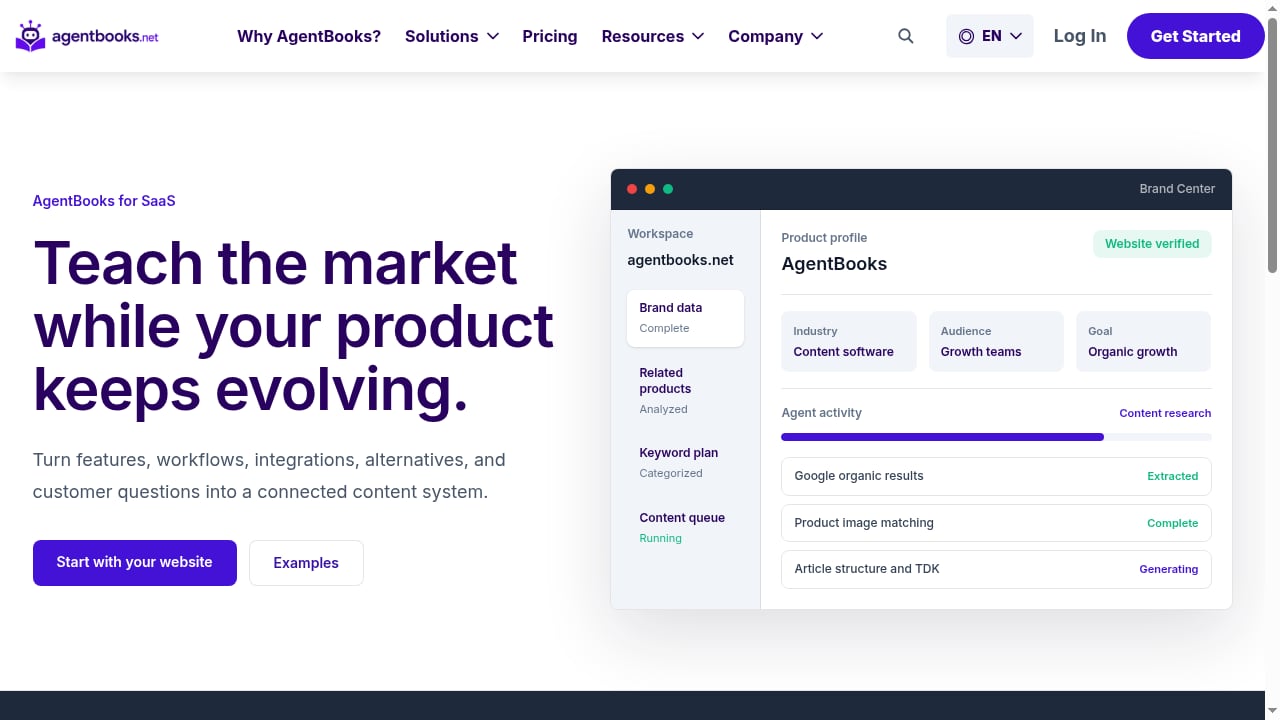
First viewport screenshot of www.agentbooks.net.
An account-based marketing tool is software that helps B2B revenue teams identify target accounts, coordinate campaigns across channels, and measure engagement at the account level. According to Salesforce's ABM guide, ABM is a strategy, not a product, and it complements traditional lead generation rather than replacing it. Tools support that strategy; they don't substitute for it.
In practice, ABM platforms cluster into two broad groups:
- Campaign managers such as 6sense, Demandbase, Terminus, RollWorks, and Metadata.io. They specialize in intent data, advertising, orchestration, and reporting.
- Content and personalization tools such as Mutiny, Drift, Uberflip, Hushly, and Tofu. They focus on website personalization, content hubs, chat, and account-level messaging.
Most teams need pieces of both. The gap appears when you need original, search-informed content for dozens of accounts and personas, not just dynamic swaps of a headline or CTA.
How the leading ABM tools compare
First viewport screenshot of www.agentbooks.net.
Gartner Peer Insights aggregates verified user reviews for ABM platforms, which is useful for shortlisting. For a practical feature comparison, Tofu's roundup of ABM tools groups products by campaign management versus content personalization and evaluates them on channel coverage, AI content generation, personalization depth, integrations, ease of use, and scalability.
Here is a condensed view of the landscape:
| Tool | Primary strength | Personalization depth | Typical pricing signal |
|---|---|---|---|
| 6sense | Intent data and buying signals | Account and persona | Custom |
| Demandbase | Account intelligence and reporting | Account | Custom |
| Terminus | Multi-channel advertising | Account and segment | Custom |
| RollWorks | SMB/midmarket ABM | Segment | From roughly $975/month |
| Metadata.io | Paid campaign optimization | Audience | Custom |
| Mutiny | No-code website personalization | Account | Custom |
| Drift | Conversational marketing | Account and visitor | From roughly $2,500/month |
| Tofu | AI-native content personalization | Account, persona, industry | Custom |
Two patterns stand out. First, enterprise ABM platforms are priced for enterprise budgets and often require a steep implementation. Second, even content-focused tools tend to personalize existing assets rather than produce net-new, research-backed articles at scale.
The content gap most ABM stacks leave open
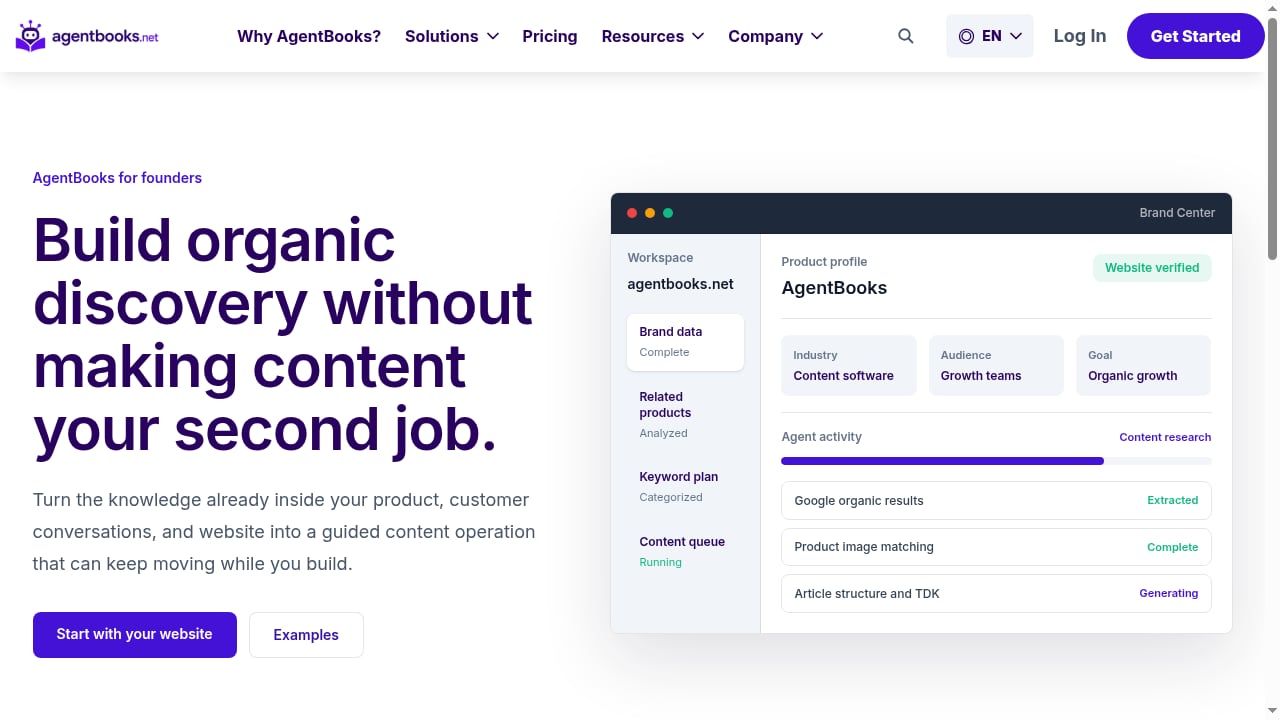
First viewport screenshot of www.agentbooks.net.
A common finding in ABM tool reviews is that campaign managers handle targeting and measurement well but leave manual content creation to the customer. Lightweight personalization features, such as drag-and-drop templates or dynamic copy blocks, help with landing pages and ads. They do not solve the need for substantive content that answers a target account's specific questions.
That gap matters because ABM buyers still research independently. They read comparison pages, implementation guides, and category explainers before they ever talk to sales. If your content library only covers broad topics, account-level personalization becomes cosmetic: the same article with a different logo in the header.
Closing the gap usually requires three things:
- A reusable brand and product dataset so every piece of content sounds like you.
- Market and keyword research tied to the problems your target accounts actually search for.
- A publishing workflow that can produce and schedule content continuously without a proportional increase in editorial hours.
This is where AI content automation platforms differ from ABM campaign managers. They are not replacements for intent data or CRM orchestration. They sit alongside those tools and feed the content layer that personalization depends on.
Where AI content automation fits in an ABM workflow
First viewport screenshot of www.agentbooks.net.
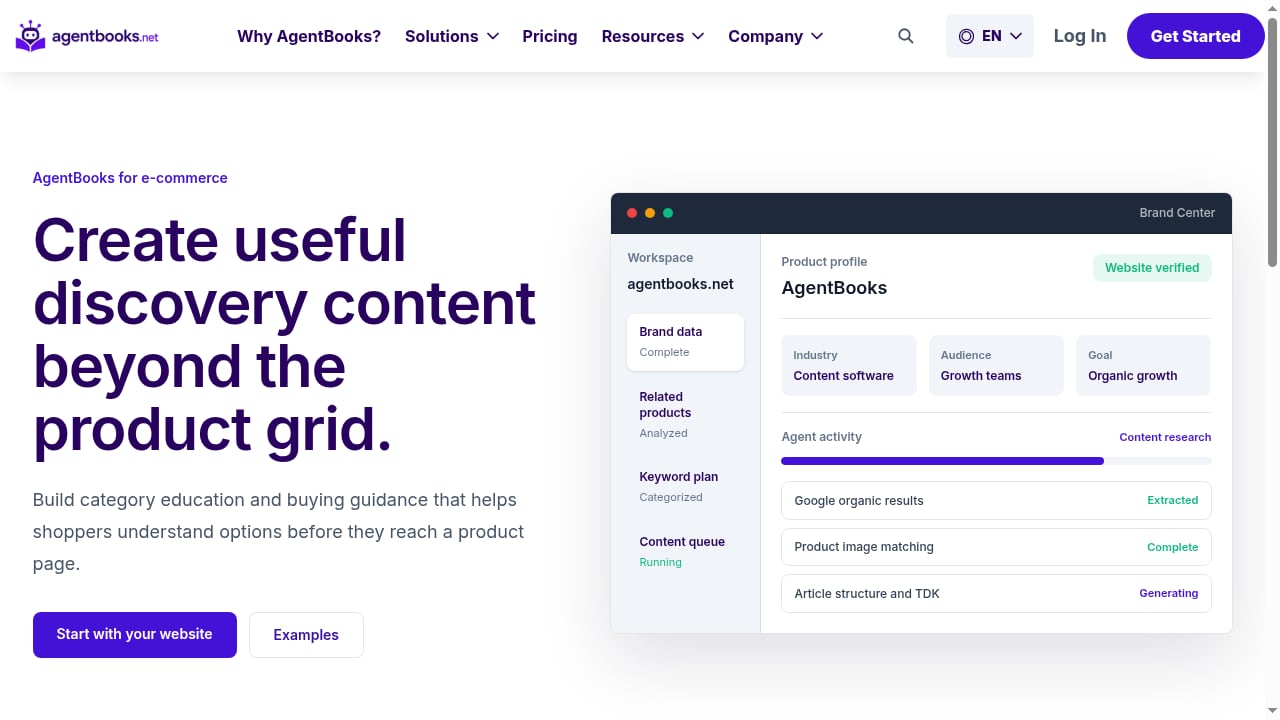
AgentBooks is an AI-powered content automation platform built around a website-to-content-engine model. You submit your site once, and the platform crawls it to build a reusable brand dataset, maps the market, plans topics, researches top organic results, and publishes articles in your brand voice through an approval-first workflow.
In an ABM context, that capability supports the content layer in a few concrete ways:
- Persona and industry topic plans. Categorized keyword plans can cover the problems specific to target segments, so account teams have relevant articles to share.
- Consistent brand voice. Because the brand dataset is reused across articles, content sent to different accounts does not read like it came from different companies.
- Scheduled publishing. Content generation can run on a schedule, which keeps the library growing while the ABM team focuses on targeting and sales alignment.
- Approval-first control. Editors review articles before publishing, which matters when content is going to named accounts.
AgentBooks does not provide intent data, advertising, or CRM orchestration, and it does not guarantee rankings or traffic. It is the content production layer, not the whole ABM stack. Teams that need a broader view of how content operations fit together can compare options in this review of content operations and localisation platforms, or see how AgentBooks compares with other AI content tools in the AgentBooks vs AirOps vs contentmarketing.ai guide.
How to evaluate an account-based marketing tool stack
Use a shortlist based on your actual bottleneck, not on feature checklists. A practical evaluation sequence:
- Define the job to be done. Are you weak on intent data, on multi-channel execution, or on content volume and relevance? Most teams are weakest on the third.
- Check integration fit. Confirm native connections to your CRM and marketing automation platform. ABM tools that don't sync with your system of record create manual work.
- Test personalization depth. Ask whether the tool personalizes at the account, persona, or segment level. Segment-level personalization is cheaper but less relevant to named accounts.
- Separate content generation from content personalization. A tool that swaps headlines is not the same as one that produces original, researched articles.
- Model total cost. Enterprise ABM platforms often carry custom pricing and implementation time. Content automation tools tend to have published tiers, which makes budgeting simpler.
- Run a pilot. Start with one target segment and measure whether content actually gets used by sales and engaged with by accounts.
For teams weighing free SEO tools against a dedicated automation platform, this analysis of the Ahrefs free sign up and AI content automation is a useful reference point.
Common mistakes when buying ABM tools
- Buying targeting before content. Intent data is wasted if you have nothing relevant to send.
- Treating personalization as a token swap. Account-level personalization should change the substance, not just the salutation.
- Ignoring editorial workflow. Without approval steps, personalized content at scale becomes a brand risk.
- Overlooking publishing cadence. ABM content needs to be timely; a library that updates quarterly will lag the sales cycle.
- Assuming AI output replaces strategy. Tools execute; the account selection and messaging strategy still come from your team.
Related reading
- How to Use AgentBooks with Zapier: Automate AI Workflows - Connect AgentBooks with Zapier to automate content approvals, publishing, and distribution. Step-by-step setup, examples, and best practices.
- AgentBooks vs SEO Content Machine: 2026 Comparison - Compare AgentBooks and SEO Content Machine for AI content automation. See how brand intelligence, pricing, and workflows differ before you choose.
FAQ
What is an account-based marketing tool?
It is software that supports ABM strategy by helping teams identify target accounts, run coordinated campaigns, personalize engagement, and measure account-level results. Examples include 6sense, Demandbase, Terminus, RollWorks, Metadata.io, Mutiny, and Drift.
Do ABM tools create content for target accounts?
Some include lightweight personalization features such as dynamic landing pages, ad variants, or template-based copy. Most do not produce original, research-backed articles at scale. That work typically requires a separate content automation or editorial workflow.
How does AI content automation support ABM?
It builds a reusable brand dataset from your website, plans topics around market and keyword research, and publishes approved articles on a schedule. That gives ABM teams a steady supply of relevant content to share with target accounts without adding editorial headcount.
Is an ABM platform the same as a content automation platform?
No. ABM platforms focus on targeting, intent, channels, and measurement. Content automation platforms focus on planning, producing, and publishing content. They are complementary layers in the same stack.
What should small teams prioritize first?
Start with a clear ideal customer profile and a small set of target accounts, then invest in content that answers their specific questions. Add intent data and multi-channel orchestration once the content layer is producing consistently.
Conclusion
An account-based marketing tool is essential for targeting and measuring high-value accounts, but it rarely solves the content problem at the center of ABM. The most useful stack pairs a campaign or personalization platform with a content engine that can produce original, on-brand, search-informed articles on a reliable schedule. Evaluate tools against your real bottleneck, pilot with one segment, and treat content as infrastructure rather than an afterthought. AgentBooks can serve as that content layer for teams that need to scale organic publishing without scaling editorial overhead.