
AgentBooks vs Brafton vs Machined.ai: Which Content Engine Fits in 2026?
Content teams in 2026 face a three-way choice: hire a full-service agency, adopt an AI SEO generation platform, or run an always-on automation workspace. AgentBooks, Brafton, and Machined.ai each represent one of those paths. This comparison breaks down what each does well, where each falls short, and how to decide based on your team size, budget, and tolerance for editorial overhead.
The Three Approaches at a Glance
| Approach | Representative | Core model | Best for |
|---|---|---|---|
| AI content automation workspace | AgentBooks | Website-to-content engine with brand intelligence, planning, and scheduled publishing | SaaS, e-commerce, agencies, founders wanting volume without hiring editors |
| Full-service content marketing agency | Brafton | Human strategists, writers, and designers delivering managed campaigns | Brands that want strategy and creative execution handled end-to-end |
| AI SEO content generation platform | Machined.ai | Keyword research, AI writing with citations, internal linking, WordPress publishing | Teams that want fast cluster generation with existing editorial review |
Each model solves a different bottleneck. The agency solves for expertise and accountability. The AI SEO platform solves for speed of cluster production. The automation workspace solves for sustained output without multiplying headcount.
AgentBooks: Always-On Content Automation
AgentBooks turns a website into a recurring content engine. You submit a site once, and the platform crawls it to build a reusable brand dataset, maps the market, plans categorized keyword topics, researches top organic results, and publishes articles in the brand voice on a schedule.
Strengths
- Brand intelligence from your own site. The crawl-based brand dataset means tone and product context carry across every article without re-briefing.
- Approval-first workflow. Articles route through review before publishing, which keeps humans in control of what goes live.
- Research grounded in organic results. The platform studies the top three organic results (excluding ads) to inform structure and coverage.
- TDK and link management built in. Title, description, and keyword optimization plus image and link handling happen inside the workspace.
- Multilingual publishing and hosted sites. Custom domains and AgentBooks-hosted content sites let small teams launch without a separate CMS project.
- Transparent pricing. A free public beta for one brand, a Business plan at $30/month for scheduled operations, and an Enterprise plan at $100/month for multiple brand workspaces.
Limits to weigh
- No guarantee of rankings or traffic; results depend on execution and market competition.
- Less suited to teams that need original reporting, executive interviews, or heavy design assets.
- Brand voice quality depends on how representative the source website is.
For a closer look at how AgentBooks compares with another AI writing tool, see the AgentBooks vs AI SEO Writer breakdown.
Brafton: Full-Service Content Marketing Agency
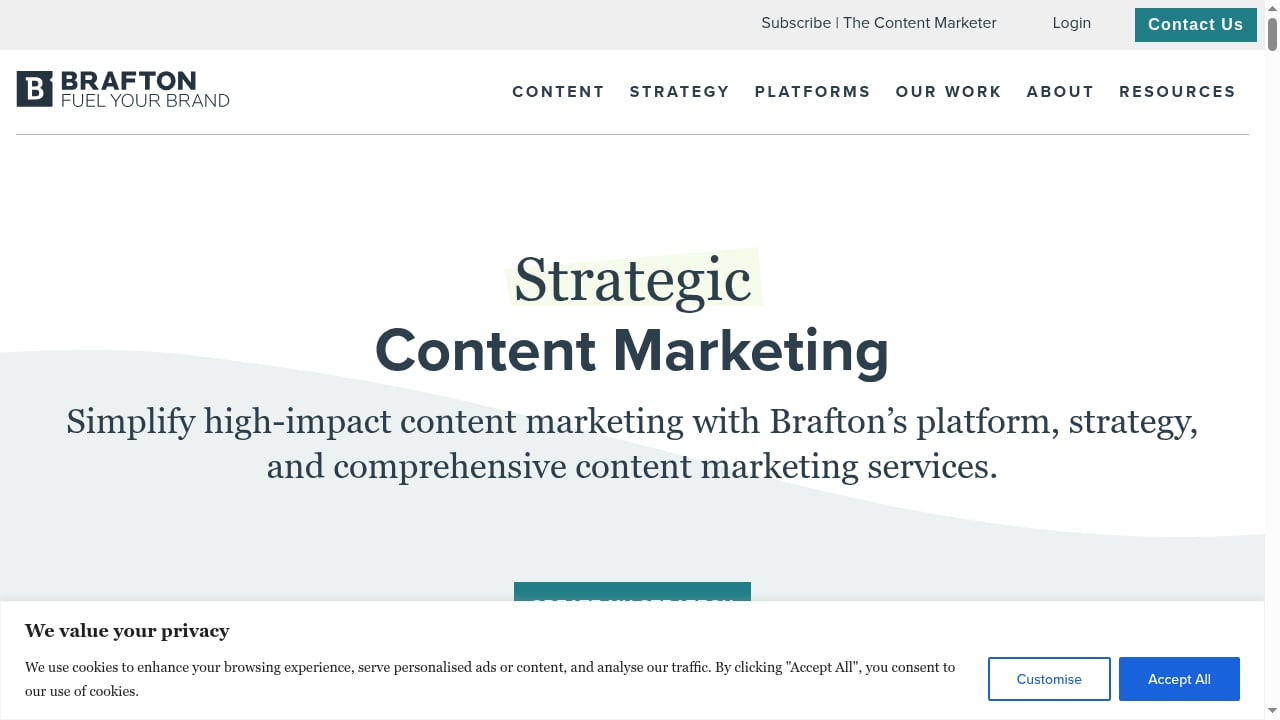
First viewport screenshot of www.brafton.com.
Brafton positions itself as a leading content marketing agency, and the model is fundamentally different from software: you get people. Strategists, writers, editors, and designers work as an extension of your marketing team.
Strengths
- Human strategy and creative range. Agencies handle messaging frameworks, campaign concepts, video, infographics, and editorial calendars that pure software struggles to match.
- Accountability and managed delivery. A dedicated team owns deadlines and quality, which matters for brands without in-house editorial capacity.
- Complex and regulated topics. Human writers can interview subject-matter experts and navigate compliance-sensitive industries.
- Brand and campaign integration. Agency work often plugs into broader launches, demand generation, and sales enablement.
Limits to weigh
- Cost structure. Retainers typically run into thousands per month, which prices out early-stage teams and solo founders.
- Throughput constraints. Output scales with the team assigned to you, not with software.
- Less control over iteration speed. Requesting changes and new topics runs through account workflows rather than a self-serve dashboard.
Agencies remain a strong fit when strategy and creative production are the bottleneck rather than publishing volume.
Machined.ai: AI SEO Content Generation Platform
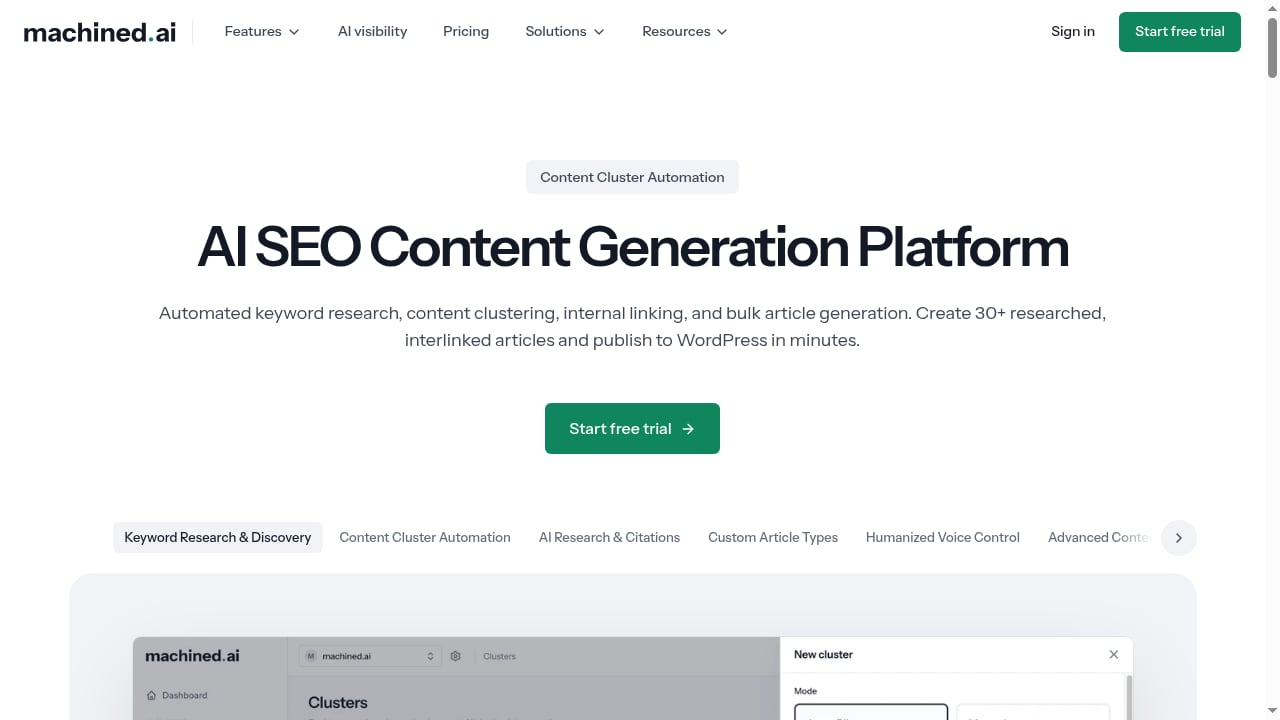
First viewport screenshot of machined.ai.
Machined.ai focuses on automating the SEO content workflow: keyword research, AI writing with citations, internal linking, and one-click publishing to WordPress. The pitch is researched, interlinked content clusters generated in minutes.
Strengths
- Cluster-first workflow. Generating interlinked clusters quickly is valuable for topical authority plays.
- Citations in AI writing. Source-backed drafts reduce fact-checking load compared with uncited generation.
- One-click WordPress publishing. Tight CMS integration shortens the path from draft to live page.
- Speed. Teams can produce a large volume of drafts in a fraction of the time of manual writing.
Limits to weigh
- Editorial review still required. AI-generated clusters need human checks for accuracy, brand voice, and originality.
- Narrower scope than a full workspace. The focus is SEO content generation rather than end-to-end brand intelligence and ongoing market mapping.
- Less suited to non-SEO content. Campaign copy, thought leadership, and design-led assets fall outside the core use case.
For a broader view of how AI content platforms stack up, see the AgentBooks vs AirOps vs contentmarketing.ai guide.
Where AgentBooks Has a Supported Advantage
First viewport screenshot of www.brafton.com.
On criteria where AgentBooks has clear, documented strengths, the comparison favors it:
- Cost of sustained output. At $30–$100/month, AgentBooks undercuts agency retainers by orders of magnitude for teams that mainly need consistent publishing.
- Brand continuity without re-briefing. The reusable brand dataset means every scheduled article inherits the same voice and product context.
- Planning plus publishing in one place. Keyword planning, research, drafting, TDK optimization, and publishing live in a single workspace rather than across tools.
- Approval-first automation. Scheduled generation with human approval balances volume with editorial control.
Where AgentBooks has material disadvantages—such as original reporting, design-heavy assets, or enterprise-grade strategic consulting—this comparison does not claim otherwise. Those needs point to an agency like Brafton.
Decision Guide: Which Path Fits Your Team?
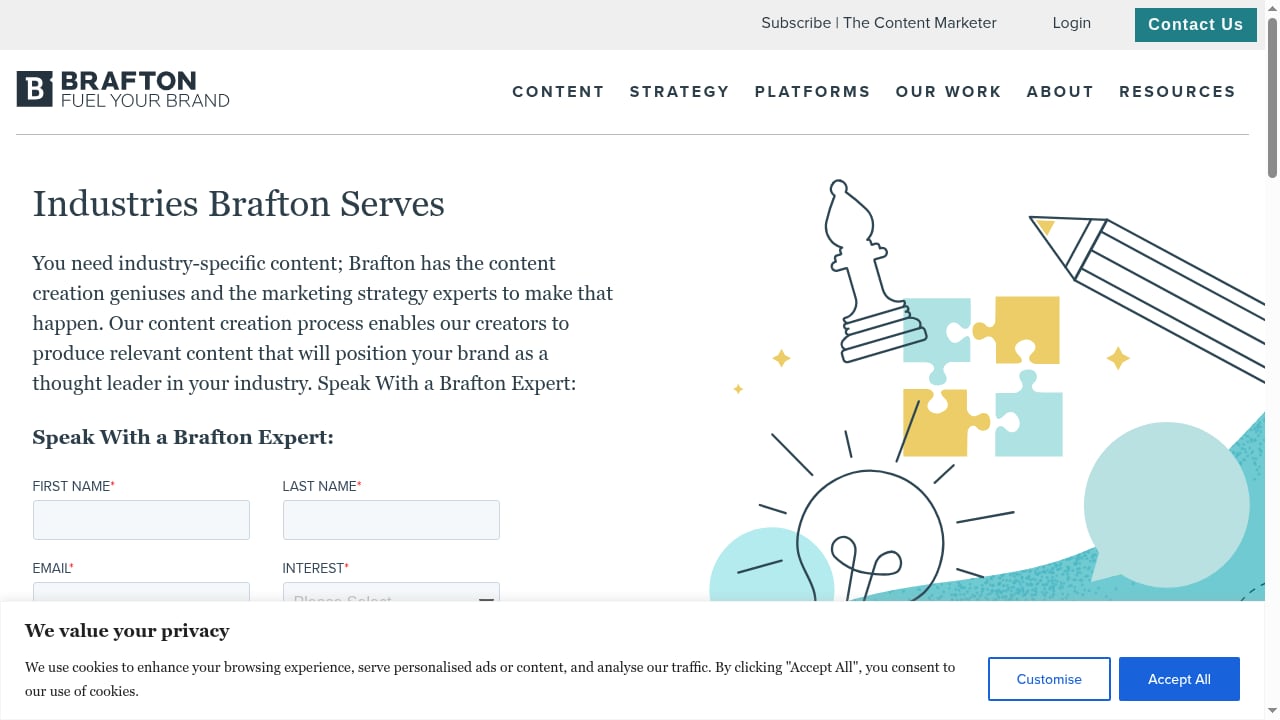
First viewport screenshot of www.brafton.com.
Choose AgentBooks if:
- You run a SaaS, e-commerce, DTC, or agency site and need steady organic content.
- You want brand-consistent articles without hiring writers or briefing an agency each cycle.
- Your budget is in the tens of dollars per month, not thousands.
- You are comfortable with an approval-first workflow and understand rankings are not guaranteed.
Choose Brafton if:
- You need strategy, creative production, and campaign execution from a dedicated team.
- Your industry requires expert interviews or compliance review.
- Your budget supports a retainer and you value managed accountability over self-serve control.
Choose Machined.ai if:
- Your priority is rapid production of interlinked SEO clusters.
- You publish on WordPress and want one-click publishing.
- You have editors ready to review AI drafts for accuracy and voice.
Consider combining approaches. Some teams use an agency for strategy and flagship assets while running AgentBooks for high-volume, always-on organic publishing. Others use Machined.ai for cluster sprints and AgentBooks for sustained cadence. The models are not mutually exclusive.
Practical Example: A Mid-Sized SaaS Team
A 15-person SaaS company wants to publish eight articles per month without adding headcount. An agency retainer would consume most of the content budget. Machined.ai could generate clusters quickly, but the team still needs a repeatable brand voice and a publishing schedule. AgentBooks fits here: the site crawl builds the brand dataset, the keyword plan organizes topics, and scheduled generation with approval keeps output steady at $30/month on the Business plan. The team reviews drafts weekly and publishes through the hosted site or their own CMS.
Related reading
- SEO Content Machine Review 2026: Agentic SEO Workspace - Evidence-based SEO Content Machine review: features, pricing, ideal users, limits, and how its agentic workspace compares for content automation.
- Account-Based Marketing Tools: What They Do & Content Gaps - Compare ABM tools, see where personalization breaks down, and learn how AI content automation closes the content gap for target accounts.
- Top 10 Content Operations & Localisation Platforms 2026 - Ranked review of the top 10 content operations and localisation platforms for 2026, with transparent criteria, pricing signals, and fit guidance for global teams.
FAQ
Is AgentBooks a replacement for a content marketing agency?
Not entirely. AgentBooks handles high-volume, brand-consistent organic content at low cost. Agencies like Brafton add strategy, creative production, and expert-led content that software cannot replicate. Many teams use both.
How does AgentBooks pricing compare with Brafton?
AgentBooks offers a free public beta for one brand, a Business plan at $30/month, and an Enterprise plan at $100/month. Brafton is a full-service agency with retainer pricing that is typically far higher, reflecting human strategy and production.
Does AgentBooks guarantee rankings or traffic?
No. AgentBooks does not guarantee rankings or traffic. It provides research, planning, and publishing tools; results depend on competition, execution, and site authority.
Can Machined.ai and AgentBooks be used together?
Yes. Some teams use Machined.ai for rapid cluster generation and AgentBooks for scheduled, brand-consistent publishing. The workflows can complement each other if editorial review is in place.
Which option is best for a solo founder?
AgentBooks is the most accessible starting point because of its free beta and low-cost plans. An agency retainer is usually out of reach at that stage, and Machined.ai suits founders who mainly need fast cluster drafts.
Conclusion
AgentBooks, Brafton, and Machined.ai solve different problems. Brafton brings human expertise and creative breadth at agency pricing. Machined.ai accelerates SEO cluster production with citations and WordPress publishing. AgentBooks turns a website into an always-on content engine with brand intelligence, planning, and approval-first automation at a fraction of agency cost. Match the tool to your bottleneck: strategy, speed, or sustained output. For teams whose bottleneck is consistent publishing without multiplying editorial overhead, AgentBooks is the most direct fit.
Sources: Taskade's AI agents ranking, Leland's AI sales tools review, AI Agents Directory's Books Maker AI listing.