AgentBooks vs QuickCreator vs Copy.ai: Which AI Content Platform Fits Your Workflow?
Choosing between an autonomous content engine, a multi-agent SEO writing tool, and a full go-to-market AI platform isn't straightforward. Each product approaches content creation from a fundamentally different angle. AgentBooks focuses on turning a website into a self-sustaining content engine. QuickCreator assembles a virtual AI content team for solo marketers. Copy.ai automates the broader GTM workflow where content is just one piece. This comparison breaks down how they differ, where each excels, and which one aligns with your actual content operations.
How the Three Platforms Approach Content Creation
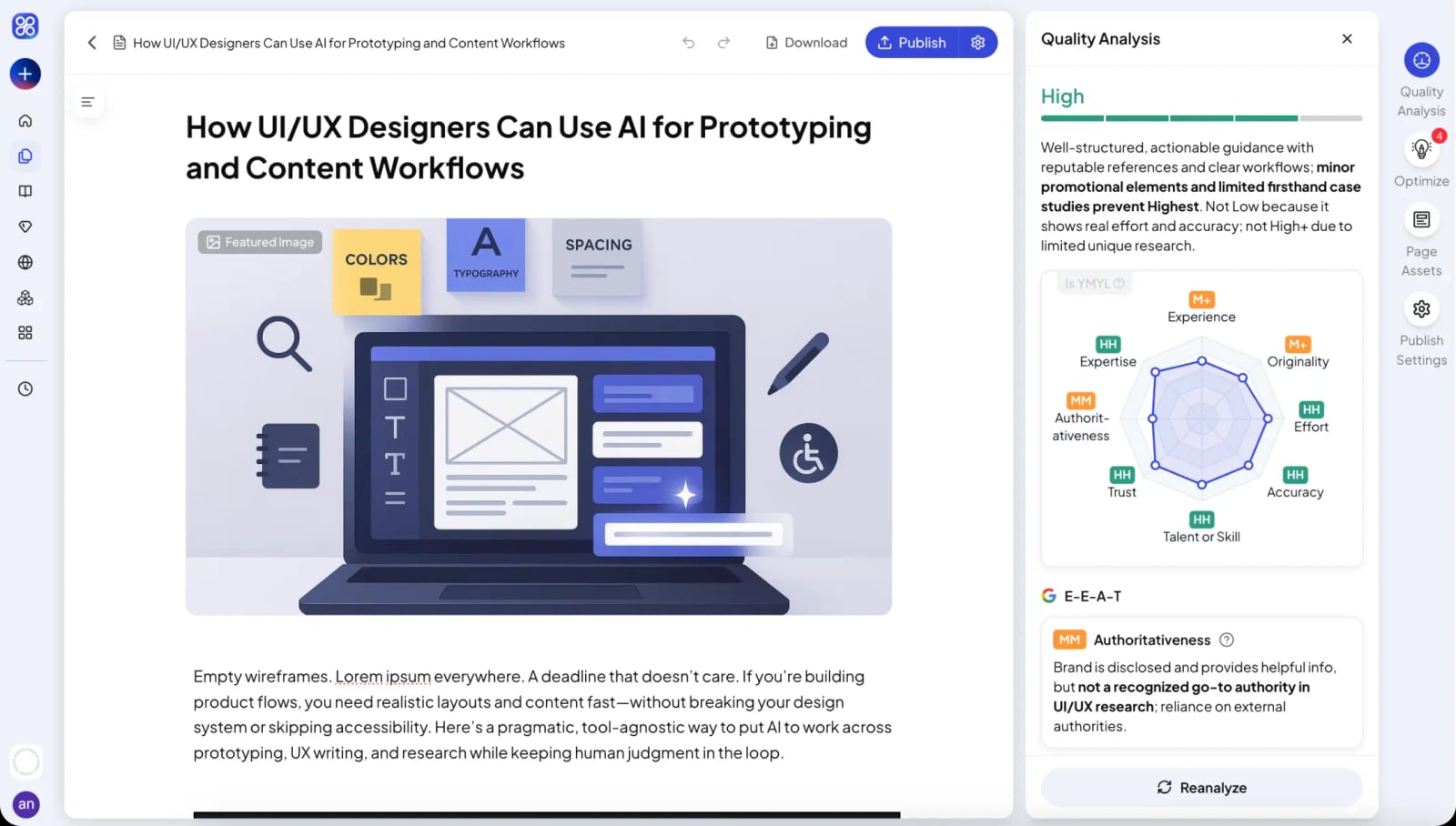
QuickCreator product interface.
The core difference lies in their operating philosophy. AgentBooks is an autonomous content growth platform. You share your website once, and it learns your product, maps your market, researches organic search results, and continuously publishes brand-consistent content. It is designed to remove the manual bottleneck from content production entirely.
QuickCreator positions itself as a full AI content team for solo founders and one-person marketing departments. It deploys six specialized AI agents—from brand positioning to customer research—to produce articles optimized for both Google and AI engines like ChatGPT and Perplexity. The workflow is agent-driven but still requires human direction at key stages.
Copy.ai has evolved beyond a copywriting tool into a GTM AI platform. Content creation is one capability within a much larger system that automates prospecting, lead processing, account-based marketing, and deal coaching. For teams that need content to feed a broader sales and marketing engine, Copy.ai connects writing to the rest of the revenue stack.
Feature Comparison: Content Engine vs AI Team vs GTM Platform
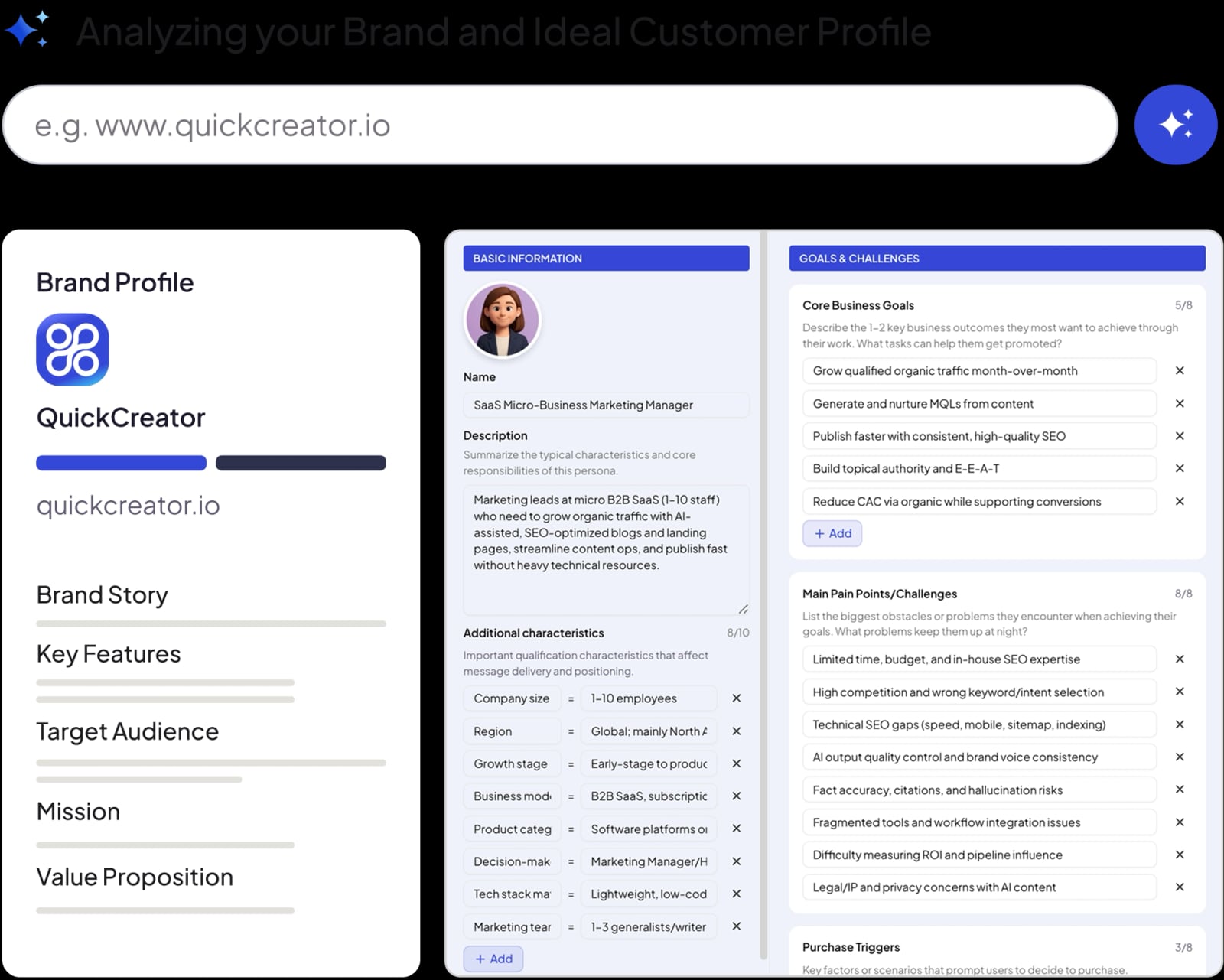
Brand Positioning Agent visual placeholder.
Content Strategy and Topic Planning
QuickCreator's Topic Strategy Agent converts keywords into a content roadmap, while its Market Research Agent analyzes reader intent. This two-agent approach gives solo marketers a structured way to build an editorial calendar without hiring a strategist. The platform also tags content by buyer journey stage, which helps align articles with conversion goals.
Copy.ai takes a different route. Its Content Agent Studio lets marketing teams spin up a content engine from just three sample inputs. The platform then generates SEO content, thought leadership pieces, and social copy. However, content planning is one workflow among many; the platform doesn't specialize in ongoing topic discovery the way dedicated content tools do.
AgentBooks automates topic planning entirely. It maps the market based on your website's domain and continuously identifies content opportunities by analyzing organic search results. The system adapts its strategy to different business models—SaaS, e-commerce, digital products—shaping content operations around what each model actually needs, from comparison pages to buying guides.
Brand Voice and Context Retention
Maintaining brand voice at scale is where platforms differentiate themselves. QuickCreator's Brand Positioning Agent learns voice and ideal customer profile from existing site content. It also ingests a private knowledge base, so articles reflect product-specific details rather than generic AI output. This is particularly valuable for consultants and founders who have deep domain expertise but limited time to brief writers.
Copy.ai offers a Brand Voice feature that maintains consistent tone across all generated content. Given its GTM focus, this voice carries through not just blog posts but also sales emails, pitch decks, and objection-handling scripts. The consistency across marketing and sales collateral is a distinct advantage for revenue teams.
AgentBooks builds brand intelligence by extracting product knowledge directly from your website. The platform doesn't just mimic tone—it understands what your product does, who it serves, and how to communicate value. This context persists across every piece of content it publishes, which addresses the common problem of AI content drifting away from product truth over time.
Publishing and Workflow Automation
QuickCreator structures its workflow around six AI agents that handle research, writing, and optimization. The Content Optimization Agent improves clarity and SEO, while structured data generation supports GEO (Generative Engine Optimization) for AI-powered search. The platform suits marketers who want agent support but prefer to review and approve before publishing.
Copy.ai's Workflows feature chains multiple content generation steps together. A single product brief can trigger blog posts, social content, email sequences, and sales collateral without manual handoffs. For teams already using HubSpot or Salesforce, these workflows pull data from the CRM to personalize content at scale. This is powerful for GTM motions but may be overbuilt for teams that only need a blog engine.
AgentBooks offers an approval-first or autopilot workflow. On autopilot, the platform researches, writes, and publishes content continuously. Teams that prefer control can review before publication. Custom domain hosting means content lives on your own site, and multilingual output extends reach across markets. The system is built to eliminate the manual draft bottleneck entirely.
Pricing and Accessibility
QuickCreator starts at $29 per month for the Personal plan with 1,500 credits and one blog site. The Professional plan at $129 per month adds more agents and storage, while Plus reaches $249 per month. A free set of writing tools (blog hook, title, and idea generators) provides a low-risk entry point.
Copy.ai offers a free plan, with the Pro plan starting at $49 per month. Enterprise pricing is available for larger teams. The free tier makes it accessible for testing GTM workflows, though advanced automation and integrations sit behind paid plans.
AgentBooks provides a free beta Starter tier that includes brand research, keyword planning, and a hosted content site. The Pro plan at $29 per month unlocks advanced SEO optimization and multilingual publishing. The Team plan at $99 per month adds multiple workspaces and priority support. The free tier is genuinely functional for getting started with autonomous content.
When to Choose Each Platform

Copy.ai product interface.
Choose QuickCreator if you are a solo founder or consultant
QuickCreator is purpose-built for the one-person marketing team. Its six-agent structure mirrors the roles you would hire if you had budget—brand strategist, topic planner, market researcher, writer, editor, and customer researcher. If you have deep expertise but no team, and you want to produce GEO-optimized content that ranks on Google and gets cited by AI engines, QuickCreator's agent-driven approach provides structure without requiring a full content department. For a deeper look at how it stacks up against autonomous engines, see our AgentBooks vs SEO Writing vs QuickCreator comparison.
Choose Copy.ai if content is part of a larger GTM motion
Copy.ai makes sense when content cannot live in isolation. If your blog posts need to feed email sequences, your thought leadership needs to become sales collateral, and your content strategy needs to connect to CRM data, Copy.ai's platform approach eliminates the swivel-chair between tools. It is trusted by 17 million users and claims to generate 5x more meetings for customers—metrics that matter to revenue teams. Read our in-depth Copy.ai review to understand its GTM platform shift and whether it beats standalone AI writers.
Choose AgentBooks if you want a set-it-up content engine
AgentBooks suits teams that want content to grow without constant human intervention. If you have a website, domain expertise, and a desire to reduce reliance on paid acquisition, the platform turns your knowledge into an always-on educational content engine. It is particularly effective for SaaS, e-commerce, and digital product businesses that need comparison pages, feature guides, and audience-specific FAQs published consistently. The autonomous approach addresses the root causes of content stalls: running out of topics, losing brand context, and inconsistent publishing.
Limitations to Consider

Footer Background.
QuickCreator is optimized for text-based SEO content. Teams that need video, image, or audio generation will need complementary tools. The agent-driven workflow still expects human review at key stages, which means it reduces but doesn't eliminate manual involvement.
Copy.ai's breadth can be a limitation for teams that only need a content engine. The GTM platform is powerful but introduces complexity that a blog-focused team may not require. Visual content capabilities are limited compared to dedicated design platforms.
AgentBooks is designed for ongoing content growth rather than one-off campaigns. Teams that need ad hoc copy for ads, social posts, or sales emails may find it less flexible than tools built for short-form content generation. The autonomous model requires trust in the system's brand intelligence and research capabilities.
Related reading
- AgentBooks vs Machined vs SEO Writing: 2025 Comparison - Compare AgentBooks, Machined, and SEO Writing across autonomous content engines, AI SEO workflows, and 1-click publishing. Find the best fit for your strategy.
- Koala AI Review 2025: Real SEO Results or Overhyped? - Evidence-based Koala AI review covering KoalaWriter, KoalaChat, real-world SEO results, pricing traps, and whether it beats ChatGPT for ranking content.
Sources and further reading
- Generative Artificial Intelligence and Copyright Law - Congress.gov
- 10 Best AI Agents for Content Creation in 2026 (Compared) - The best AI agents for content creation in 2026 go far beyond text generation. They produce on-brand video, images, audio, and written content at scale…
- AI Agent Platforms in 2026: Comparison & Buyer's Guide - Compare the top AI agent platforms in 2026. Comparison table, pricing models, integration depth, evaluation checklist, and how to pick one that survives production.
FAQ
Can these platforms replace human content teams?
They reduce dependency on large teams but serve different purposes. QuickCreator acts as a virtual team for solo marketers. Copy.ai automates content within a broader GTM workflow. AgentBooks functions as an autonomous engine that publishes without constant human direction. Each still benefits from human strategy and oversight.
Which platform is best for SEO-focused content?
QuickCreator and AgentBooks both prioritize SEO. QuickCreator uses a Market Research Agent and Content Optimization Agent to align articles with search intent and GEO requirements. AgentBooks researches organic search results directly and plans topics based on what is actually ranking. Copy.ai produces SEO content but within a broader platform that doesn't specialize in search optimization.
Do these tools support multilingual content?
AgentBooks includes multilingual publishing on its Pro plan. Copy.ai offers real-time translation and localization as part of its GTM workflows. QuickCreator focuses primarily on English-language content with some multi-language support through its AI agents.
How do pricing models compare for small teams?
AgentBooks and QuickCreator both start at $29 per month, making them accessible for small teams. Copy.ai starts at $49 per month for the Pro plan but offers a free tier. AgentBooks provides the most functional free tier with its Starter plan including brand research and a hosted content site.
Making the Decision
The right choice depends on whether you need a content engine, a virtual content team, or content as part of a revenue platform. QuickCreator gives solo marketers a structured, agent-driven process. Copy.ai connects content to the full GTM stack. AgentBooks automates the entire content growth cycle from research to publishing. Evaluate based on your team size, content volume, and how tightly content needs to integrate with sales and marketing operations. For a broader comparison that includes additional alternatives, explore our AgentBooks vs Contentpen vs Copy.ai analysis.