AgentBooks vs Contentpen vs Copy.ai: A Practical Comparison for Content Teams
Choosing between an autonomous content engine, an end-to-end SEO platform, and a go-to-market AI suite isn't straightforward. Each tool approaches content creation from a different angle, and the right fit depends entirely on whether your primary goal is hands-off organic growth, search-optimized publishing, or cross-team revenue workflows. This comparison breaks down Contentpen and Copy.ai as credible alternatives to AgentBooks, highlighting where each excels so you can match a platform to your actual workflow.
How Contentpen and Copy.ai Approach Content Differently
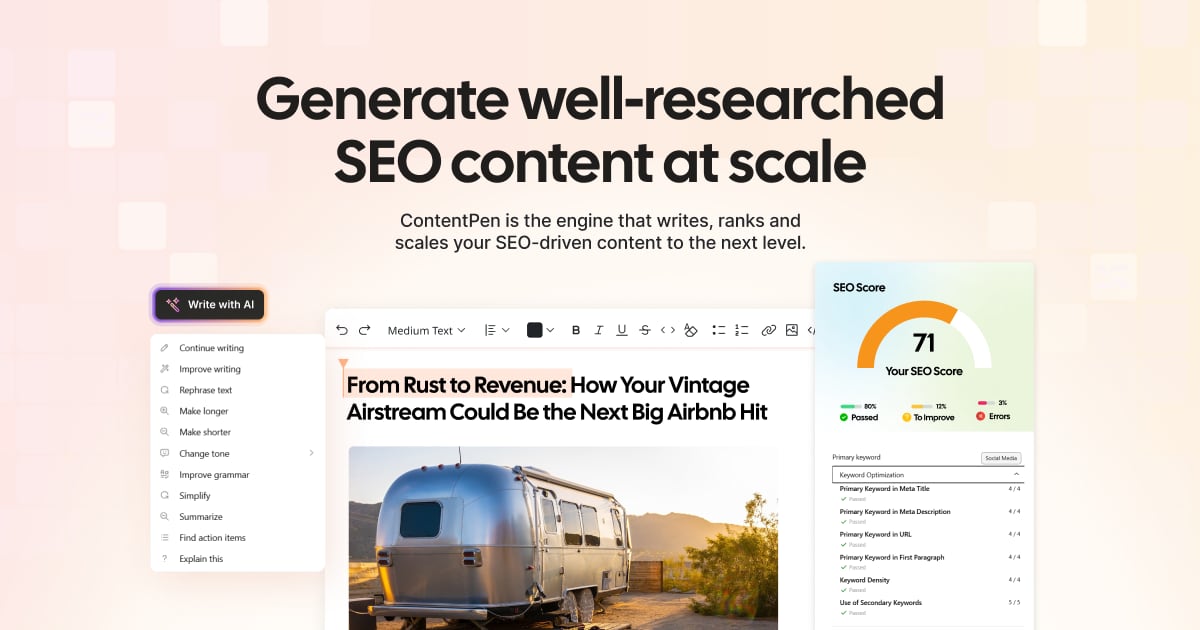
Contentpen product interface.
Before diving into feature-by-feature comparisons, it helps to understand the core philosophy behind each platform.
Contentpen is built for content marketers and SEO teams who need to manage the entire article lifecycle—from keyword discovery and SERP analysis to writing, optimization, and performance monitoring. It treats content as a measurable growth channel and layers AI visibility tracking across seven major AI platforms on top of traditional SEO metrics.
Copy.ai has evolved far beyond its copywriting roots. It now operates as a GTM AI platform that connects marketing content with sales workflows, CRM data, and revenue operations. The platform is designed for B2B teams that want AI to automate not just blog posts, but also sales sequences, account research, and deal coaching.
AgentBooks takes a different path altogether. It functions as an autonomous content growth platform that learns your product, researches your market, and continuously publishes brand-consistent content without requiring manual topic planning or drafting. For teams that want to turn their website into an always-on content engine with minimal hands-on effort, this autonomous approach fills a gap that neither Contentpen nor Copy.ai directly addresses.
Contentpen: Strengths as a Substitute
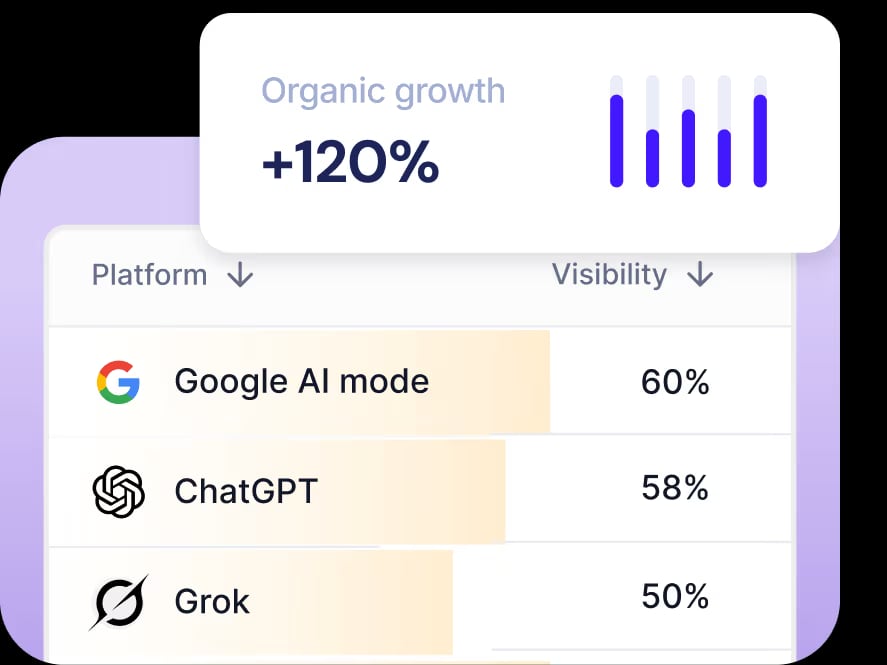
Small businesses.
Contentpen earns its place as a strong alternative for teams whose primary focus is ranking content and tracking visibility across both search engines and AI answer platforms.
End-to-End Blog Automation with SEO and GEO Scoring
Contentpen automates the full content lifecycle. It starts with keyword research and SERP competitor gap analysis, generates SEO-optimized outlines, produces long-form drafts, and then scores each piece for both traditional search and answer engine optimization (AEO). This dual scoring system helps content teams prioritize edits that improve performance on Google and in AI-generated responses from tools like ChatGPT, Perplexity, and Gemini.
One-Click Publishing and Internal Linking
A practical advantage is Contentpen's direct integration with popular CMS platforms. Teams can publish finalized articles to WordPress, Wix, Webflow, Shopify, or Ghost with one click. The platform also suggests internal and external links automatically, which saves editorial time and strengthens site architecture without manual research.
AI Visibility Monitoring Across Seven Platforms
Contentpen's analytics dashboard goes beyond standard rank tracking. It monitors brand visibility across seven major AI platforms—including ChatGPT, Grok, Claude, Copilot, Perplexity, Gemini, and Google AI—and provides sentiment scoring, share of voice analysis, and source gap identification. For PR and brand teams concerned with how their company appears in AI-generated answers, this visibility layer is a practical asset. You can explore these capabilities further in our Contentpen Content Analytics guide.
Multi-Client Workspaces and Approval Workflows
Agencies and teams managing multiple brands benefit from Contentpen's workspace structure. Each client gets a separate environment with its own keyword lists, content calendars, and approval workflows. This keeps brand contexts isolated and allows team members to collaborate without mixing data.
Copy.ai: Strengths as a Substitute
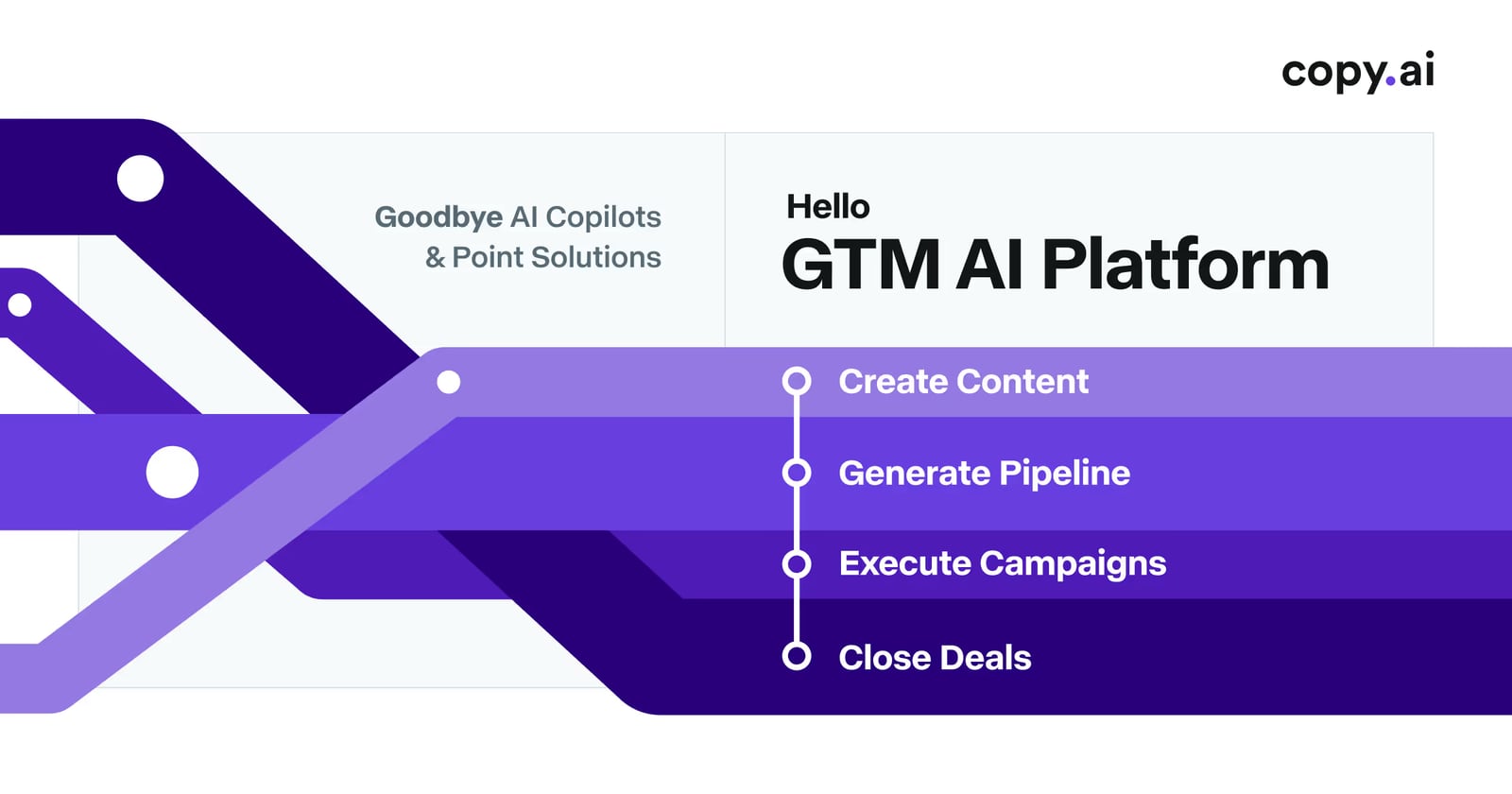
Copy.ai product interface.
Copy.ai stands out when content creation needs to feed directly into sales and revenue processes. Its strength lies in connecting marketing outputs to go-to-market execution.
GTM Workflows That Connect Content to Revenue
Copy.ai's Workflows chain multiple AI actions together. A single product brief can trigger blog post generation, social media copy, email sequences, and sales enablement materials—all within one automated pipeline. For B2B teams that need content to support outbound prospecting and deal cycles, this cross-functional automation reduces manual handoffs between marketing and sales.
Deep CRM Integrations and Sales Enablement
Native integrations with Salesforce, HubSpot, and Gong allow Copy.ai to pull account data directly into content generation. Sales teams can generate personalized outreach emails, one-pagers, and objection-handling scripts based on real CRM records. The platform also offers deal coaching features that analyze sales transcripts, score deals, and predict close dates—capabilities that extend well beyond content marketing into revenue operations.
Brand Voice and Content Agent Studio
Copy.ai's Brand Voice feature learns from existing content to maintain consistent tone and terminology across all outputs. The Content Agent Studio lets marketing teams spin up a content engine with just three sample inputs, which lowers the setup barrier for teams that want quick, on-brand drafts without extensive configuration.
Scalable for Large Revenue Teams
With support for 17 million users and pricing that scales by seats and Workflow credits, Copy.ai is built for organizations where multiple departments—marketing, sales, RevOps—share one AI platform. The Enterprise tier adds SSO, SCIM, SOC 2 Type II compliance, and dedicated account management, making it viable for large, security-conscious companies.
Where AgentBooks Holds a Supported Advantage

AgentBooks product interface.
AgentBooks is not a direct feature-for-feature competitor to either Contentpen or Copy.ai. Instead, it solves a specific problem: keeping a content engine running autonomously without manual topic planning, drafting bottlenecks, or brand voice drift.
Autonomous Content Growth Without Manual Oversight
AgentBooks requires a website URL to start. From there, it extracts product knowledge, maps the competitive landscape, plans topic clusters, researches top-ranking organic results, and continuously publishes content in the brand's voice. This hands-off model suits teams that lack dedicated content strategists or writers and want to build organic search presence without building an internal content operation.
Business Model-Aware Content Operations
AgentBooks adapts its content strategy to different business models—SaaS, e-commerce, independent websites, and digital products. For a SaaS company, it might generate feature guides and comparison pages. For an e-commerce store, it produces buying guides and audience-specific FAQs. This contextual awareness means the output matches the commercial intent of the site, not just generic blog templates.
Approval-First or Autopilot Publishing
Teams can choose between reviewing and approving every piece before publication or letting AgentBooks publish autonomously. This flexibility accommodates both highly regulated industries that need editorial control and lean startups that prioritize publishing velocity.
Comparison Table: Contentpen vs Copy.ai vs AgentBooks
| Capability | Contentpen | Copy.ai | AgentBooks |
|---|---|---|---|
| Primary focus | SEO/GEO content lifecycle | GTM automation and sales enablement | Autonomous content growth |
| Keyword research and SERP analysis | Built-in with competitor gap analysis | Not a core feature | Automated organic research |
| AI visibility tracking | 7 AI platforms with sentiment scoring | Not available | Not available |
| CMS publishing integrations | WordPress, Wix, Webflow, Shopify, Ghost | Not a core feature | Custom domain hosting |
| CRM and sales integrations | Not available | Salesforce, HubSpot, Gong, and 20+ others | Not available |
| Autonomous publishing | Requires manual setup and review | Requires workflow configuration | Fully autonomous option available |
| Multilingual output | Not highlighted | Real-time translation and localization | Built-in multilingual publishing |
| Pricing starting point | $27/month (10 articles) | $29/month (Chat plan, 5 seats) | Free beta tier; Pro at $29/month |
How to Choose Based on Your Team's Primary Goal
Choose Contentpen if your main objective is ranking content and tracking AI visibility
Contentpen fits teams that treat content as a measurable SEO and GEO channel. If your workflow revolves around keyword research, content briefs, optimization scoring, and publishing to a CMS, Contentpen's focused toolset aligns with that process. The AI visibility monitoring also makes it valuable for brand teams tracking how they appear in AI-generated search results. For a broader look at platforms that unify SEO and AI search monitoring, see our Top 10 SEO & AI Search Visibility Platforms.
Choose Copy.ai if content must feed into sales and revenue workflows
Copy.ai makes sense for B2B organizations where marketing content and sales enablement materials need to share the same brand voice, data sources, and automation pipelines. Teams running account-based marketing programs or managing high-volume outbound prospecting will use the CRM integrations and Workflow credits more than a standalone content team would.
Choose AgentBooks if you want a hands-off content engine that grows organic traffic
AgentBooks suits product-led companies, indie hackers, and small teams that want to build search presence without hiring content managers. If your primary constraint is time—not budget for tools—the autonomous model eliminates the bottleneck of manual topic planning and drafting. For a deeper comparison between AgentBooks and other AI writing approaches, read AgentBooks vs SEO Writing: Which AI Tool Wins in 2025?.
Related reading
- Canva Review 2025: Is It Right for Your Visual Content? - An evidence-based Canva review covering ideal users, AI design tools, pricing, security, and real-world strengths and limitations for teams and solo creators.
- Autoblogging.ai Features: A Complete Breakdown for 2025 - Explore every Autoblogging.ai feature from Quick Mode to AI Visibility Tracking. Learn how its content generation, SEO optimization, and research tools work in practice.
- AgentBooks vs SEO Writing vs QuickCreator Compared - Compare AgentBooks, SEO Writing, and QuickCreator across autonomous content growth, 1-click AI writing, and multi-agent marketing. Find the right fit for your workflow.
Sources and further reading
- Copy.ai pricing 2026: Plans, costs, and value guide - A 2026 pricing breakdown of Copy.ai, covering the Chat plan at $29/month and the custom Enterprise tier following the platform's shift into AI go-to-market automation after its acquisition by Fullcast. The piece explains what each plan includes, compares costs against Jasper, and addresses the discontinued free plan.
- 10 Best AI Agents for Content Creation in 2026 (Compared) - The best AI agents for content creation in 2026 go far beyond text generation. They produce on-brand video, images, audio, and written content at scale…
- Copy.ai Review: I Tried It for 2 Weeks, This is What Happened - Copy.ai Review: I spent two weeks testing Copy.ai. Here’s the simple truth—what’s awesome, what’s annoying, and if you should try it now.
Frequently Asked Questions
Is Contentpen better than Copy.ai for SEO content?
For teams focused exclusively on SEO and GEO content, Contentpen offers more specialized tools—keyword research, SERP gap analysis, AEO scoring, and one-click CMS publishing. Copy.ai can generate blog content, but its platform is built for broader GTM automation rather than deep content optimization workflows.
Does Copy.ai offer a free plan in 2026?
Copy.ai no longer offers a permanent free plan for new signups. The entry point is the Chat plan at $29/month. Some individual tools like the email subject line generator and paraphrasing tool remain free, but the core platform requires a paid subscription.
Can AgentBooks replace a content marketing team?
AgentBooks automates the research, planning, and drafting stages of content production, which reduces the need for dedicated content strategists and writers. However, teams in highly regulated industries or those requiring deeply nuanced thought leadership may still want human editorial oversight, which AgentBooks supports through its approval-first workflow.
Which platform supports multilingual content?
AgentBooks includes multilingual publishing as a core feature. Copy.ai offers real-time translation and localization capabilities. Contentpen's multilingual support is not a highlighted feature in its current positioning.
Conclusion
Contentpen, Copy.ai, and AgentBooks each solve different content problems. Contentpen delivers a complete SEO and GEO content workflow with visibility tracking that matters for search-driven teams. Copy.ai connects content creation to revenue operations, making it powerful for B2B organizations that need sales and marketing alignment. AgentBooks offers a genuinely autonomous alternative for teams that want organic growth without managing content operations day to day.
The right choice depends on whether your bottleneck is content optimization, cross-team workflow automation, or simply finding the time to publish consistently. Match the platform to your primary constraint, and you will get more value than chasing the tool with the longest feature list.