
AgentBooks vs QuickCreator vs GTM AI for Solo Founders
Solo founders wear every hat: product, sales, support, and marketing. When it comes to content, the choice is not just which tool writes well, but which tool fits your workflow and budget. This comparison looks at AgentBooks, QuickCreator's AI content team, and a GTM AI platform to help you decide.
What each tool is built for
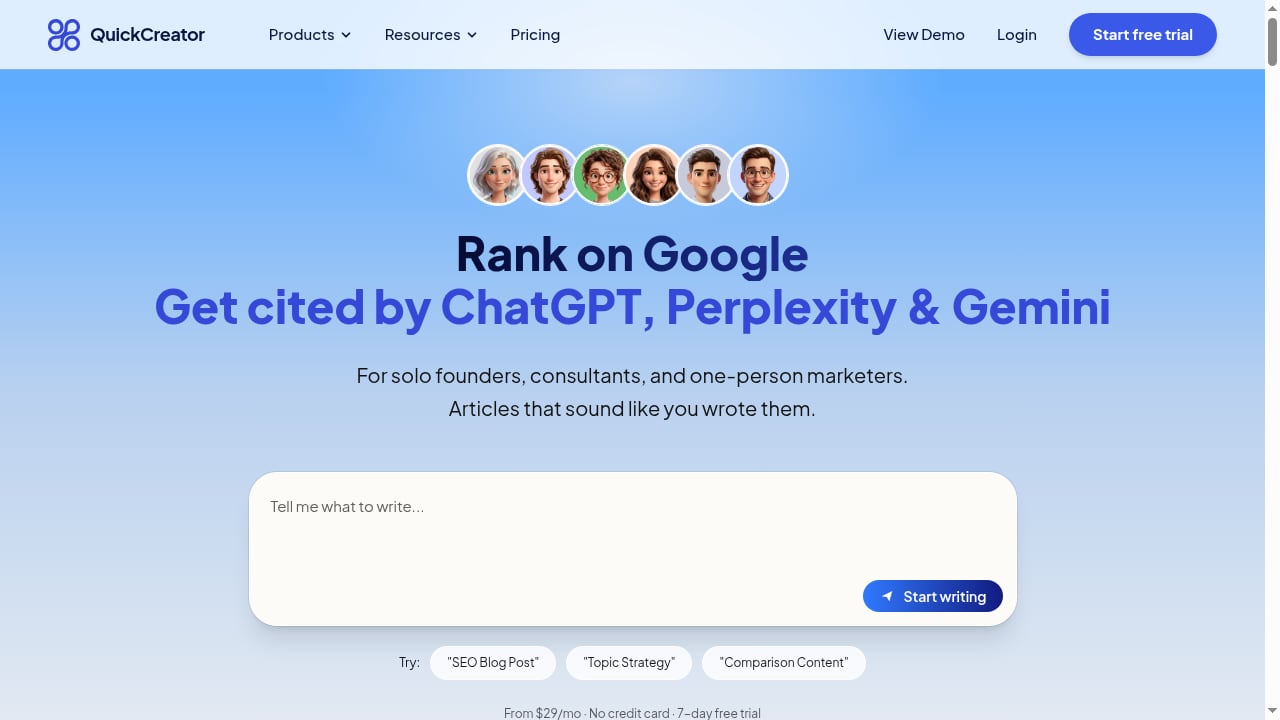
First viewport screenshot of The AI Content Team for Solo Founders | QuickCreator.
AgentBooks: an always-on content engine
AgentBooks turns your website into a content engine. Share your site once, and it learns your product, maps your market, plans topics, researches top organic results, and publishes useful content in your brand voice. It connects product understanding, keyword planning, article creation, publishing, and future updates in one workspace. Core features include brand intelligence from website crawling, a categorized keyword plan, an approval-first article workflow, scheduled content generation, top organic-result research, SEO preparation (TDK, images, tags, links), custom domain and site identity, multilingual publishing, and multi-brand workspaces. It offers a public beta with a free plan, a Business plan at $30/month, and an Enterprise plan at $100/month. It does not guarantee rankings or traffic but optimizes content processes and measurable inputs.
QuickCreator's AI content team: articles that rank and get cited
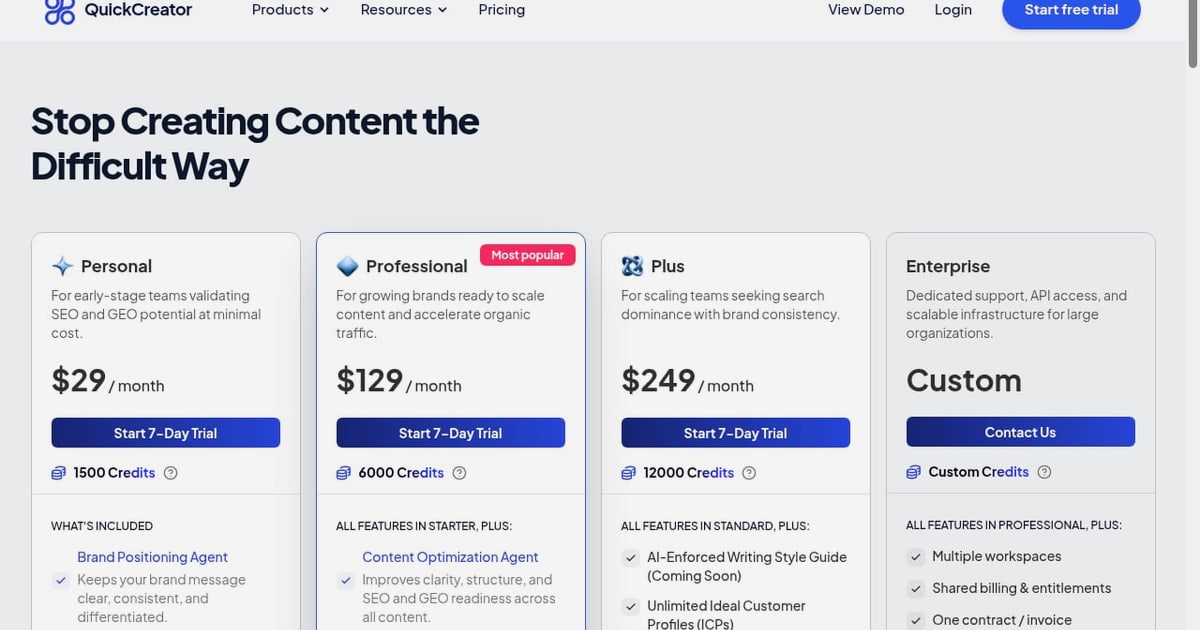
QuickCreator positions itself as an AI content team for solo founders. It ships articles in your voice that rank on Google and get cited by ChatGPT, Perplexity, and Gemini. Pricing starts at $29/month. It is designed for founders who want a steady stream of SEO-focused articles without hiring a team.
GTM AI platform: automate repetitive go-to-market tasks
A GTM AI platform automates hundreds of tedious, repetitive tasks and empowers your team to scale success. It is not a content engine per se, but it can handle outbound sequences, lead routing, and other go-to-market operations. For solo founders, it can act as a force multiplier for sales and marketing execution.
Comparison criteria
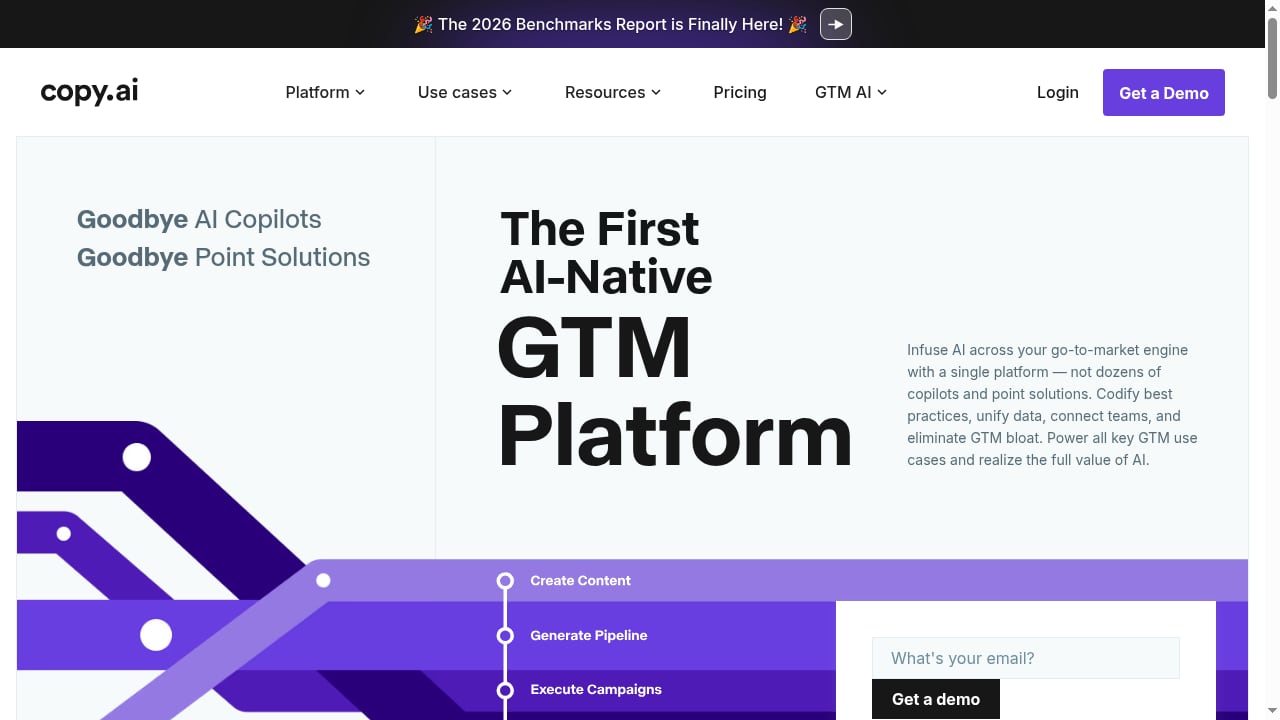
First viewport screenshot of Future proof your business with GTM AI.
Brand intelligence and product understanding
AgentBooks learns from your website to understand your product and market. QuickCreator also aims to write in your voice, but its primary focus is on producing articles that rank. A GTM AI platform may not have deep product understanding; it automates tasks based on rules and data you provide. If your priority is content that reflects your product's nuances, AgentBooks has a supported advantage.
Keyword planning and topic research
AgentBooks includes a categorized keyword plan and researches top organic results to inform topics. QuickCreator likely includes keyword research as part of its content generation. A GTM AI platform may not focus on organic search content planning. For organic content planning, both AgentBooks and QuickCreator are relevant; AgentBooks integrates it into a broader engine.
Publishing workflow and scheduling
AgentBooks offers an approval-first article workflow, scheduled content generation, and publishing to a custom domain with site identity. QuickCreator ships articles, but the workflow details are less clear from public information. A GTM AI platform may automate publishing to social or email but not necessarily to a blog. If you need a controlled, scheduled publishing pipeline, AgentBooks provides a clear workflow.
SEO preparation and on-page optimization
AgentBooks prepares content for SEO with TDK (title, description, keywords), images, tags, and links. QuickCreator claims articles rank on Google and get cited by AI chatbots, implying SEO optimization. A GTM AI platform is not primarily an SEO tool. Both AgentBooks and QuickCreator address SEO, but AgentBooks includes it as part of its content engine.
Multilingual and multi-brand support
AgentBooks supports multilingual publishing and multi-brand workspaces. QuickCreator's public information does not highlight these features. A GTM AI platform may support multiple brands if configured. For founders with multiple products or languages, AgentBooks has a supported advantage.
Pricing and value
AgentBooks offers a free plan, $30/month Business, and $100/month Enterprise. QuickCreator starts at $29/month. A GTM AI platform pricing is not specified in the provided context, but such platforms often have custom pricing. For solo founders on a budget, AgentBooks and QuickCreator are comparable, with AgentBooks offering a free tier.
Go-to-market automation beyond content
A GTM AI platform automates hundreds of repetitive tasks, such as outbound sequences, lead scoring, and CRM updates. AgentBooks focuses on content automation, not sales tasks. QuickCreator is content-focused. If you need to automate sales and marketing operations beyond content, a GTM AI platform is the better fit. AgentBooks does not claim to replace a GTM platform.
When to choose each
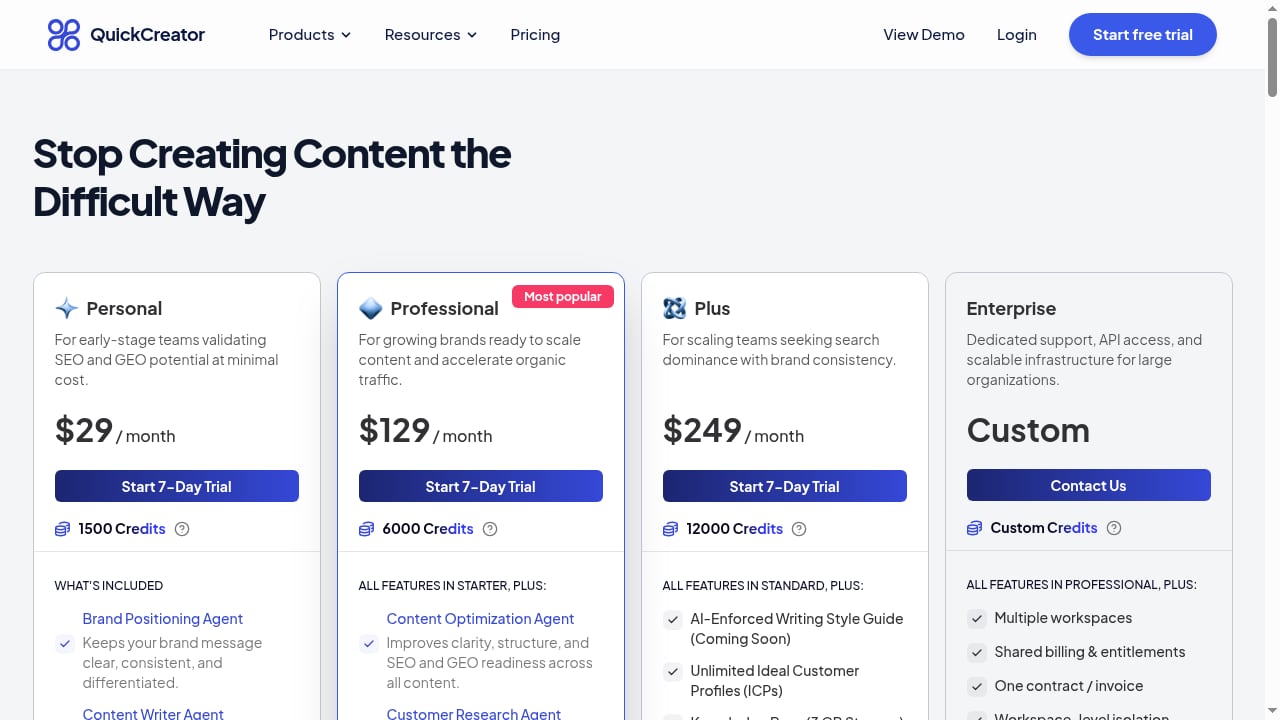
First viewport screenshot of Pricing — Agentic Marketing Platform | QuickCreator.
- Choose AgentBooks if you want an all-in-one content engine that learns your product, plans keywords, and publishes scheduled content with SEO preparation, all from a single workspace. It suits founders who want to build an organic content asset over time.
- Choose QuickCreator if your primary goal is to get articles that rank on Google and get cited by AI chatbots, and you want a straightforward content generation tool starting at $29/month.
- Choose a GTM AI platform if your bottleneck is repetitive go-to-market tasks like outbound emails, lead routing, or CRM hygiene, and you already have a content solution or don't need one.
Can you use them together?
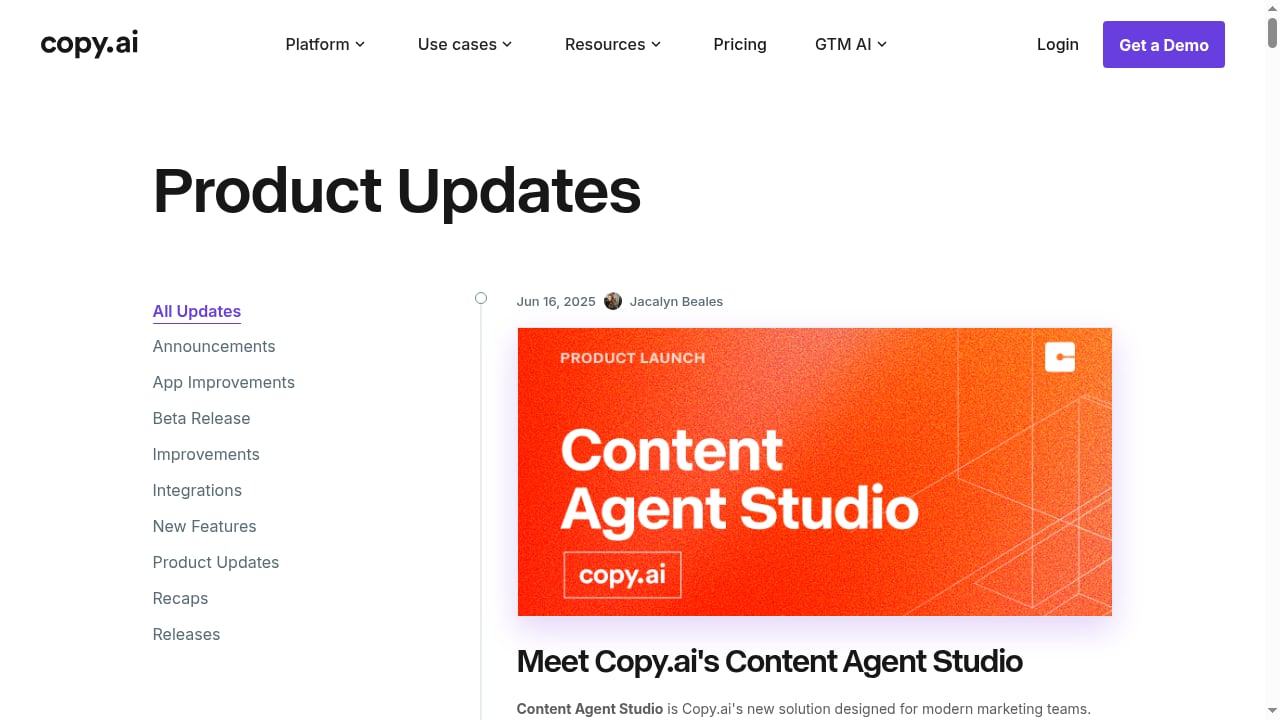
First viewport screenshot of Changelog.
Yes. Many solo founders combine tools. For example, you could use AgentBooks for organic content and a GTM AI platform for outbound sales. QuickCreator could supplement content if you need additional articles. The key is to avoid overlapping spend and to integrate workflows where possible.
Related reading
- AgentBooks vs Growth Engine Hub: Which AI Content Engine Wins? - AgentBooks vs Growth Engine Hub compared: brand intelligence, keyword planning, publishing workflow, channels, and pricing to pick the right AI content engine.
- Averi Review 2026: Honest Look at the AI Content Engine - Averi review for founders and lean teams: how the Brand Core and Strategy Map work, real pricing, SEO/GEO scoring, limitations, and who should buy.
- Top 10 Enterprise SEO & AI Search Platforms 2026 - We ranked the 10 best enterprise SEO and AI search optimization platforms for 2026 by scalability, AEO coverage, actionability, and pricing evidence.
Sources and further reading
- The Top 12 Sales Lessons From SaaStr AI 2026: Anthropic, Gamma ... - The sales and GTM sessions at SaaStr AI 2026 in San Mateo was all about where to take agents next. No one was still debating whether to put agents in the revenue org.
- [Instantly.ai just dropped two features that actually change how outbound works.
And a bonus third one that people have been asking for forever.
Feature 1: Reply Agent now books meetings for… | Hans Dekker | 237 comments](https://www.linkedin.com/posts/itshansdekker_instantlyai-just-dropped-two-features-that-activity-7394399119177392128-ozFX) - Instantly.ai just dropped two features that actually change how outbound works.
And a bonus third one that people have been asking for forever.
Feature 1: Reply Agent now books meetings for you
Reply Agent was already handling conversations automatically. Now it detects when someone's ready to meet.
Lead says "sure, Thursday at 3 works" → Reply Agent books it in your calendar. No more jumping between tools. No more manually scheduling every call.
It just happens.
Feature 2: Sub-sequences based on behavior
This one seems simple but it's huge.
Before → lead clicks a link or shows interest → you had to manually move them or use external tools
Now → you set rules and they automatically go into different sequences
Examples:
Lead clicks link → goes into nurture sequence Lead replies with keyword "tool" → gets lead magnet automatically
Lead completes campaign without reply → tries different angle
You're basically building "if this, then that" logic right inside your campaigns.
Bonus Feature 3: Dark mode
Big fan. That's all.
Here's what this means:
You can launch campaigns → set up sub-sequences based on behavior → Reply Agent handles conversations + books meetings → you just watch meetings come in.
The limit here is really just your own creativity with how you set this up. | 237 comments on LinkedIn
- Selling With AI Agents? Here’s What You Need to Know - Learn how to activate, train, and execute AI sales agents to transform your selling processes.
FAQ
Is AgentBooks a replacement for QuickCreator?
They overlap in content generation, but AgentBooks includes brand intelligence, keyword planning, and a publishing workflow. QuickCreator focuses on articles that rank and get cited. If you need a broader content engine, AgentBooks may be a better fit. If you only need article generation, QuickCreator could suffice.
Can a GTM AI platform write blog content?
GTM AI platforms are designed for go-to-market tasks like sales automation, not typically for long-form blog content. They may assist with social posts or email sequences, but not as a full content engine.
Does AgentBooks guarantee rankings?
No. AgentBooks does not guarantee rankings or traffic. It optimizes content processes and measurable inputs, but search results depend on many factors.
Which tool is best for a solo founder with a limited budget?
AgentBooks offers a free plan and a $30/month Business plan. QuickCreator starts at $29/month. A GTM AI platform may have custom pricing. If budget is tight, start with free tiers or low-cost plans and scale as you see results.
Conclusion
AgentBooks, QuickCreator, and GTM AI platforms serve different needs. AgentBooks is a content engine that starts with your product data and runs an end-to-end publishing workflow. QuickCreator is a content generation tool focused on ranking and AI citations. A GTM AI platform automates go-to-market tasks beyond content. For solo founders, the right choice depends on whether your priority is organic content, article volume, or sales automation. Evaluate your bottleneck and pick the tool that addresses it directly.