

AgentBooks vs Surfer SEO: Content Engine or Optimization Layer?
If you are choosing between AgentBooks and Surfer SEO, the real question is not which tool is better. It is which job you need done first. AgentBooks is an AI content automation platform that turns a website into an always-on publishing engine. Surfer SEO is an AI visibility and content optimization platform built for teams that want to track and improve how they appear in Google and AI-generated answers.
One starts before the first draft exists. The other tends to start once a draft is on the screen. That difference shapes your workflow, your budget, and how quickly you can ship useful content.
What AgentBooks actually does
AgentBooks connects product understanding, market research, keyword planning, article creation, publishing, and future updates in one workspace. You share your website once, and the platform learns the product, maps the market, plans topics, researches top organic results, and publishes content in your brand voice.
Core capabilities include:
- Brand intelligence built from crawling your website
- A categorized keyword plan
- An approval-first article workflow
- Scheduled content generation
- Research of top organic results
- SEO preparation such as titles, descriptions, keywords, images, tags, and links
- Custom domain and site identity
- Multilingual publishing
- Multi-brand workspaces
AgentBooks serves SaaS teams, e-commerce and DTC sites, digital agencies, founders, and independent websites. It is in public beta with a free plan, a Business plan at $30/month, and an Enterprise plan at $100/month. It does not guarantee rankings or traffic. Instead, it optimizes content processes and measurable inputs.
If you want to see how this fits a broader stack, the comparison of AgentBooks vs AirOps vs Machined covers content automation, AI search visibility, cluster generation, and pricing across three platforms.
What Surfer SEO actually does
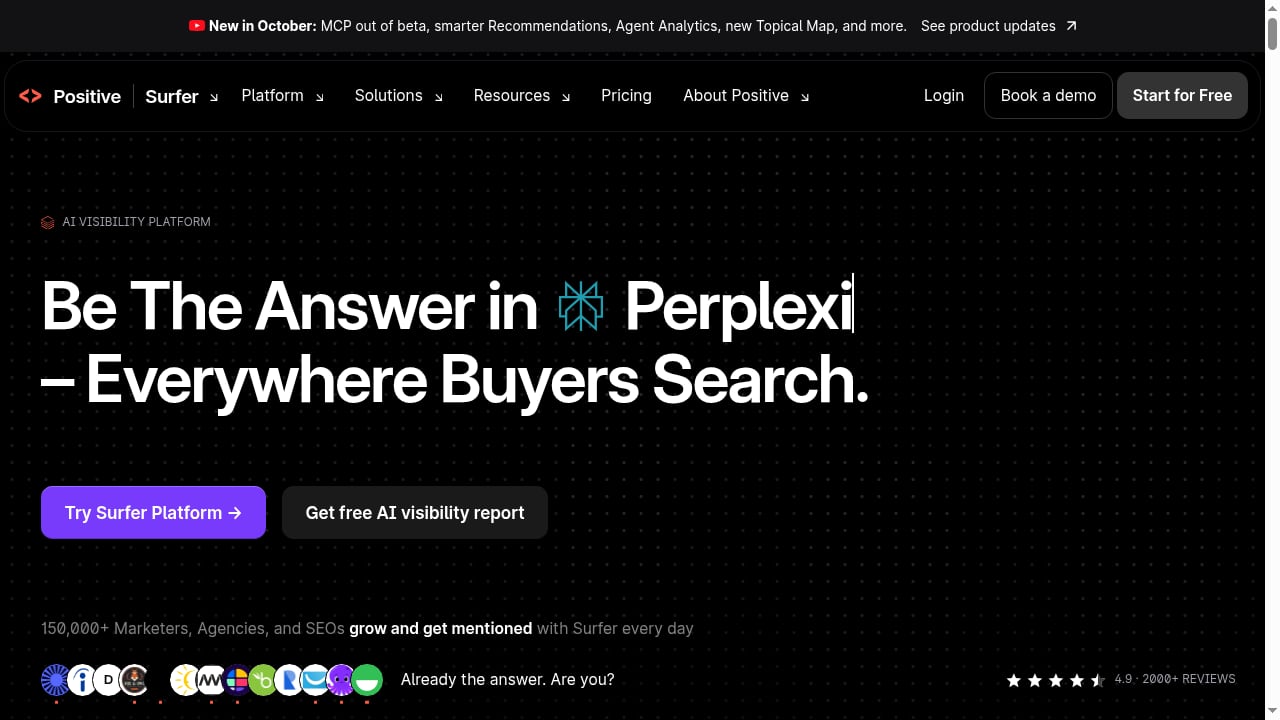
First viewport screenshot of Positive Surfer - AI Visibility Platform for maximum organic growth.
Surfer SEO positions itself as an AI Visibility Platform. Its goal is to help marketing and SEO teams maximize organic growth across traditional Google search and emerging AI search engines such as ChatGPT, Gemini, Perplexity, and Google AI Overviews.
Key capabilities include:
- AI Tracker for monitoring brand mentions across AI models
- Content Editor with AI Search Guidelines for real-time citation-optimized writing suggestions
- Agent Analytics for analyzing server logs to see which pages AI crawlers visit
- A unified AI SEO Content Score that combines traditional SEO and AI search performance
Surfer reports serving over 2,800 companies and holds a 4.8/5 rating. It supports agencies and multi-domain teams with view-only report sharing, data export, activity logs, and extended reporting history up to 16 months. Its positioning is about being "The Answer in Google – Everywhere Buyers Search," with an emphasis on automation, actionable insights, and staying ahead in the AI era of search.
The core difference: engine vs layer
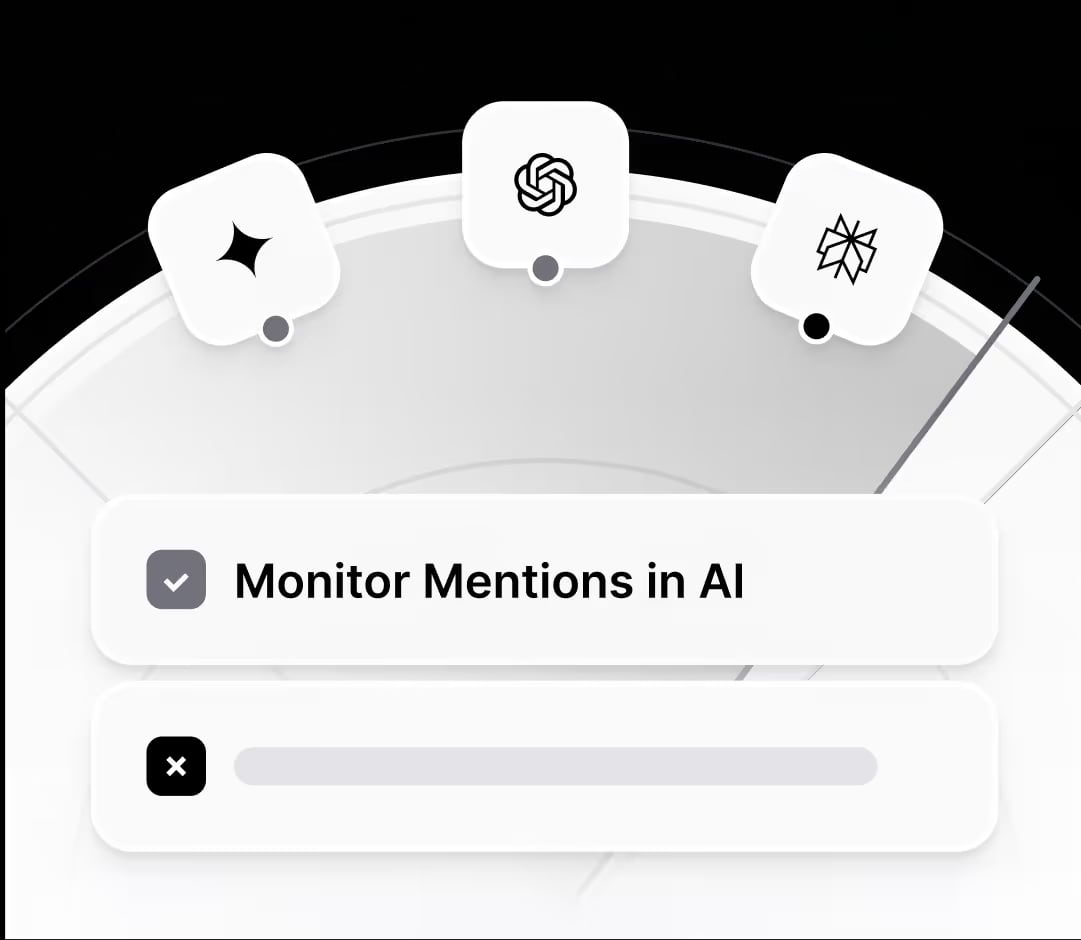
Surfer SEO product interface.
AgentBooks is a content engine. It starts with real product data rather than blank prompts. It plans topics, researches organic results, writes articles, prepares SEO elements, and publishes on a schedule. The output is a running content operation.
Surfer SEO is an optimization and visibility layer. It helps you write better content for both Google and AI search engines, and it tracks how your brand appears in AI-generated answers. The output is better-optimized content and clearer visibility data.
Neither approach is wrong. They solve different problems at different stages.
| Dimension | AgentBooks | Surfer SEO |
|---|---|---|
| Primary job | Automate content planning, creation, and publishing | Optimize content and track AI visibility |
| Starting point | Your website and product data | A draft, a keyword, or a visibility report |
| Content workflow | Approval-first, scheduled generation | Real-time writing suggestions in an editor |
| AI search tracking | Not a core advertised feature | AI Tracker across ChatGPT, Gemini, Perplexity, and AI Overviews |
| Publishing | Built-in, including custom domain and multilingual | Not the primary focus |
| Pricing signal | Free plan; Business $30/month; Enterprise $100/month | Not specified in the provided product context |
| Best for | Teams that need consistent output | Teams that need optimization and visibility data |
Where AgentBooks has an advantage
AgentBooks is strongest when the bottleneck is production. If your team knows what it wants to say but cannot publish consistently, AgentBooks removes that friction.
- It starts from your website, so content reflects the actual product instead of generic prompts.
- It plans topics and keywords in a categorized structure, which makes the content roadmap easier to manage.
- It handles publishing, including custom domains and multilingual output, so you are not stitching together five tools.
- It supports multiple brands in one workspace, which matters for agencies and portfolio owners.
- It offers a free plan and a $30/month Business plan, which lowers the barrier for small teams and solo founders.
For a solo operator, the workflow comparison in AgentBooks vs The AI Content Team for Solo Founders is a useful next read.
Where Surfer SEO has an advantage
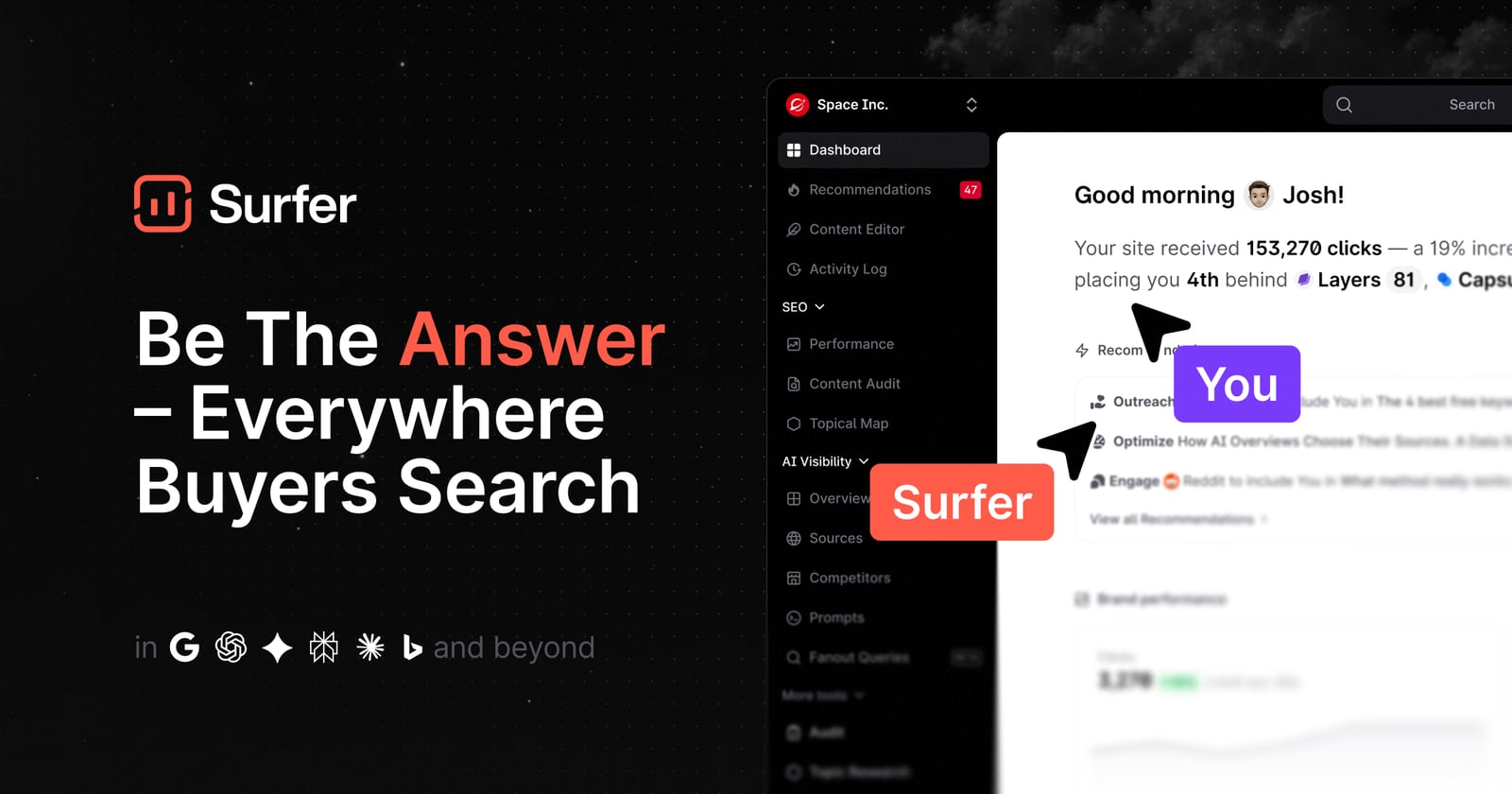
Surfer SEO product interface.
Surfer is strongest when the bottleneck is optimization and visibility. If you already produce content and need to improve how it performs in Google and AI answers, Surfer's feature set is more directly relevant.
- AI Tracker monitors brand mentions across multiple AI models, which is valuable if AI search visibility is a board-level metric.
- Content Editor with AI Search Guidelines gives real-time suggestions aimed at citation optimization.
- Agent Analytics uses server logs to show which pages AI crawlers visit, which is a different kind of data than rank tracking.
- The unified AI SEO Content Score combines traditional SEO and AI search performance in one number.
- Agency-friendly features include view-only report sharing, data export, activity logs, and reporting history up to 16 months.
Surfer's scale signal is also notable: over 2,800 companies and a 4.8/5 rating. That is meaningful social proof for teams that want a widely adopted platform.
Where each tool has limits
AgentBooks does not guarantee rankings or traffic. It optimizes the content process and measurable inputs. If your goal is a guaranteed page-one position, no tool can promise that, and AgentBooks is explicit about it.
Surfer's product context does not specify pricing in the provided material, so budget planning requires a direct check. Its core strength is optimization and visibility, not end-to-end publishing. If you need a system that plans, writes, and publishes on a schedule, Surfer is not positioned as that system.
The broader category context matters here too. The Top 10 AI Content Creation & Predictive Audience Intelligence Platforms 2026 review shows how different platforms specialize, and why picking one tool for every job often leads to gaps.
How AI search changes the comparison
AI search engines do not simply match a query to a list of documents. They decompose a query into multiple sub-queries, retrieve information in parallel, and synthesize an answer. This technique is often called query fan-out, and it changes what content needs to do to be cited.
As Hobo Web's explanation of query fan-out describes, a single prompt can be expanded into dozens of related sub-queries covering different intents, synonyms, and entity variations. The system then pulls from the live web, knowledge graphs, product feeds, and structured databases before generating a synthesized response.
That has two implications for this comparison:
- Content needs to cover multiple facets of a topic, not just one keyword.
- Visibility tracking needs to look at AI answers, not only ranked links.
AgentBooks addresses the first implication by planning topics and researching organic results before writing. Surfer addresses the second by tracking brand mentions across AI models. Teams that care about both may need both.
Decision guide: which one fits your situation?
First viewport screenshot of Positive Surfer - Updates.
Use this as a starting filter.
Choose AgentBooks if:
- You need a consistent publishing cadence and cannot hire enough writers.
- You want content grounded in your actual product and website.
- You want planning, writing, SEO preparation, and publishing in one workspace.
- You manage multiple brands or clients.
- You want a low-cost entry point with a free plan and a $30/month Business tier.
Choose Surfer SEO if:
- You already publish content and need to optimize it for Google and AI search.
- AI visibility tracking across ChatGPT, Gemini, Perplexity, and AI Overviews is a priority.
- You want real-time writing suggestions aimed at citation optimization.
- You need agency reporting features such as view-only sharing, data export, and activity logs.
- You want a platform with a large user base and a high rating.
Consider both if:
- You need production volume and optimization depth.
- You want to publish consistently and then measure AI citation performance.
- You have separate budgets for content operations and SEO visibility.
For a deeper look at how AI content platforms are evaluated, the AI SEO Writer That Ranks on Google & ChatGPT: 2026 Review breaks down ideal users, use cases, strengths, limits, and pricing signals.
Practical example: a SaaS team with one writer
Imagine a SaaS company with one content marketer and a product that solves a niche problem.
The content marketer can produce two articles per week at best. That is roughly 100 articles per year, minus holidays and launch weeks. The bottleneck is not ideas. It is production.
With AgentBooks, the team shares the website, gets a categorized keyword plan, approves article outlines, and schedules generation. The marketer shifts from writing every draft to editing and approving. Output rises without adding headcount.
With Surfer, the same team would still need to produce drafts. Surfer would help optimize those drafts and track AI visibility. That is valuable, but it does not solve the production bottleneck.
If the team already had five writers and strong output, the calculus flips. Surfer's optimization and tracking would matter more than another content engine.
Related reading
- Keyword Research and Planning: A Practical 2026 Workflow - A practical keyword research and planning workflow: seed ideas, demand data, intent mapping, clustering, prioritization, and a content plan you can ship.
- How to Use AgentBooks with BrandWell Growth Automation - Learn how to connect AgentBooks with BrandWell's growth automation software to align inbound content and outbound intent data in one repeatable workflow.
Sources and further reading
- Top 18 AI B2B Lead Generation Solutions to Scale Your Pipeline | AI Acquisition - We help Entrepreneurs Build & Grow Successful AI-Powered Businesses.
- AgentsTide – AI Agents Directory 2026 - 57+ curated autonomous AI agents. Verified pricing, honest descriptions, use cases, and comparisons.
FAQ
Is AgentBooks a replacement for Surfer SEO?
Not exactly. AgentBooks automates content planning, creation, and publishing. Surfer SEO optimizes content and tracks AI visibility. They can overlap in SEO preparation, but their primary jobs differ.
Does AgentBooks track AI search visibility?
AI search visibility tracking is not listed among AgentBooks' core features. Surfer SEO explicitly offers AI Tracker for monitoring brand mentions across AI models.
Does Surfer SEO publish content?
Publishing is not Surfer's primary focus. AgentBooks includes publishing with custom domain and site identity, multilingual output, and scheduled generation.
How much does AgentBooks cost?
AgentBooks offers a free plan in public beta, a Business plan at $30/month, and an Enterprise plan at $100/month.
How much does Surfer SEO cost?
Pricing is not specified in the provided product context. Check Surfer's site directly for current plans.
Can I use both tools together?
Yes. A common pattern is to use AgentBooks for production and Surfer for optimization and AI visibility tracking. The two workflows are complementary rather than mutually exclusive.
Which is better for agencies?
AgentBooks supports multi-brand workspaces, which helps agencies manage multiple clients. Surfer supports multi-domain teams with view-only report sharing, data export, activity logs, and extended reporting history. Both have agency-relevant features, but they serve different stages of the workflow.
Conclusion
AgentBooks and Surfer SEO are not direct substitutes in every scenario. AgentBooks is a content engine that starts with your website and runs an always-on publishing operation. Surfer SEO is an optimization and visibility layer that helps you improve content and track how your brand appears in AI answers.
If your bottleneck is production, AgentBooks addresses it with brand intelligence, keyword planning, approval-first workflows, scheduled generation, and publishing. If your bottleneck is optimization and AI visibility, Surfer addresses it with AI Tracker, citation-optimized writing suggestions, crawler analytics, and a unified content score.
Many teams will eventually want both. The practical first step is to identify which problem costs you more right now: not publishing enough, or not optimizing and measuring enough. That answer points to the right tool.