
How to Use AgentBooks with BrandWell Growth Automation Software for Inbound & Outbound
Most teams run content and demand generation as two separate tracks. Content publishes on a calendar. Outbound works from a list. The two rarely share data, so the same audience gets generic messaging from both directions.
AgentBooks and BrandWell's growth automation software solve different halves of that problem. AgentBooks turns your website into an always-on content engine that plans, writes, and publishes in your brand voice. BrandWell's growth automation software unites sales and marketing with structured data, recurring workflows, and AIMEE agents that execute. Used together, the pairing connects what you publish with who you contact.
This guide explains how the two products fit, the setup sequence, a practical workflow, and the problems the combination removes.
What each product actually does
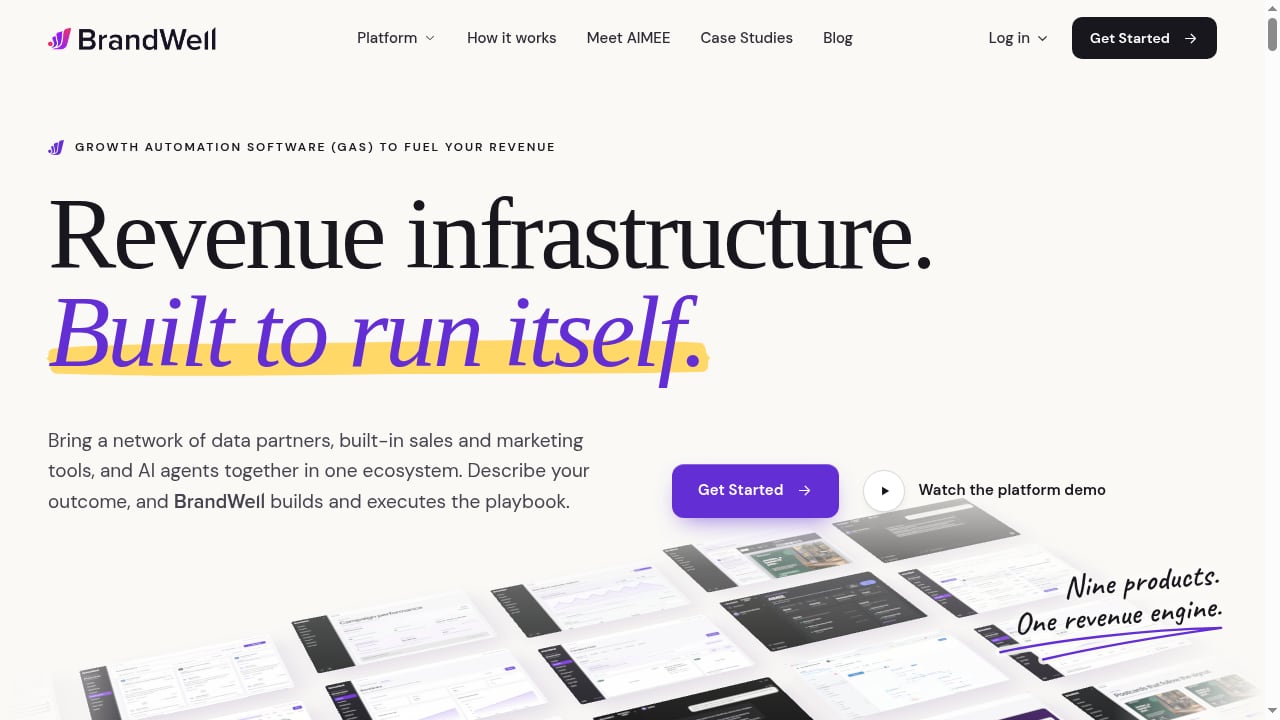
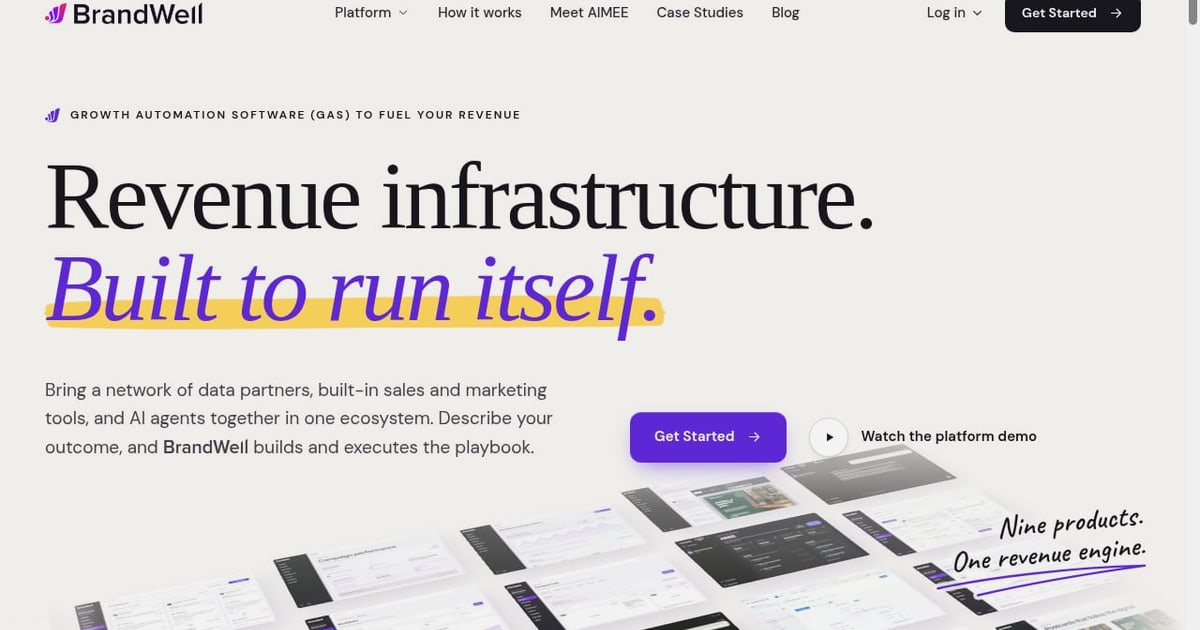
First viewport screenshot of Growth Automation Software for Inbound & Outbound | BrandWell.
AgentBooks: the content engine
AgentBooks is an AI content automation platform. You share your website once, and it learns the product, maps the market, plans topics, researches organic search results, and continuously publishes useful content in the brand's voice. It connects product understanding, market research, keyword planning, article creation, publishing, and future updates in one workspace.
Core capabilities include brand intelligence from website crawling, a categorized keyword plan, an approval-first article workflow, scheduled content generation, top organic-result research, SEO preparation (title, description, keywords, images, tags, links), custom domain and site identity, multilingual publishing, and multi-brand workspaces. It is built for SaaS teams, e-commerce and DTC sites, digital agencies, founders, and independent websites. AgentBooks does not guarantee rankings or traffic; it optimizes content processes and measurable inputs.
BrandWell growth automation: the execution layer
BrandWell's growth automation software unites sales and marketing. It connects inbound and outbound with structured data, recurring workflows, and AIMEE agents that execute. Where AgentBooks produces the content asset, BrandWell's growth automation software handles the buyer-intent and outreach side: organizing contact data, running recurring sequences, and letting agents act on signals.
One produces the message. The other decides who receives it and when.
Why the combination matters
Content without distribution is a library nobody visits. Outbound without relevant content is a cold pitch. The pairing closes a loop that most teams leave open:
- Message consistency. AgentBooks publishes in your brand voice. BrandWell's workflows carry that same positioning into outbound sequences, so a prospect who reads your blog and then receives a message sees one coherent brand.
- Intent-informed topics. Buyer intent data from BrandWell's structured workflows can reveal which problems are live in the market. Those signals feed AgentBooks topic planning instead of relying on guesswork.
- Faster follow-through. When a prospect engages, the content asset that answers their objection already exists and is indexed. AIMEE agents can reference it in the next touch.
- Fewer handoffs. Sales and marketing work from the same structured data rather than two disconnected tools.
Setup: connecting the two systems
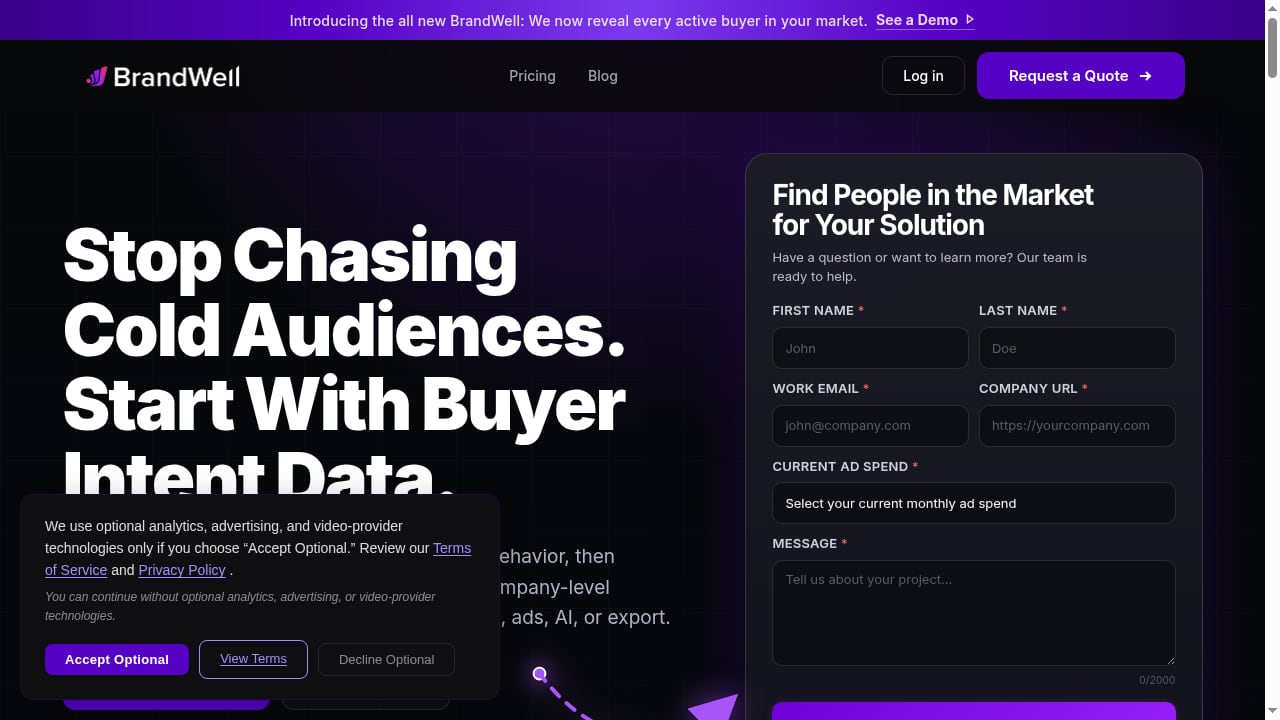
First viewport screenshot of Request a Custom BrandWell Quote | Intent Data, TrafficID & Enrichment.
Step 1: Give AgentBooks your website
Start in AgentBooks. Share the website once so brand intelligence can crawl it. This establishes product understanding, tone, and the market map that every later step depends on. If you run several brands, use the multi-brand workspace so each site keeps its own identity.
Step 2: Build the keyword plan
Review the categorized keyword plan AgentBooks generates. Group topics by buyer stage so you can tell which clusters serve early research and which serve late evaluation. This grouping matters later, because outbound sequences should point to stage-appropriate content, not to whatever published most recently.
Step 3: Set the approval workflow
AgentBooks uses an approval-first article workflow. Decide who approves, how many articles run per cycle, and which domains or languages publish automatically. Scheduled content generation keeps the engine running without a weekly manual kickoff.
Step 4: Configure BrandWell's structured data
In BrandWell's growth automation software, set up the structured data that defines your audience segments: firmographics, engagement signals, and the recurring workflows that trigger outreach. This is the inbound-to-outbound bridge. The cleaner the segments, the more precisely you can match content to contacts.
Step 5: Map content clusters to workflow stages
Create a simple mapping table. For each BrandWell workflow stage, assign the AgentBooks content cluster that answers the questions raised at that stage. Early-stage workflows point to educational articles. Late-stage workflows point to comparison and evaluation content.
Step 6: Define the agent actions
Decide what AIMEE agents should do when a signal fires: send a follow-up, update a record, route to a rep, or enter a nurture sequence. Keep the actions narrow at first. Broad automation hides errors.
Step 7: Run a pilot cycle
Publish one content cluster through AgentBooks, then run one BrandWell workflow against a small segment. Measure reply quality and content engagement before scaling either side.
A practical workflow example
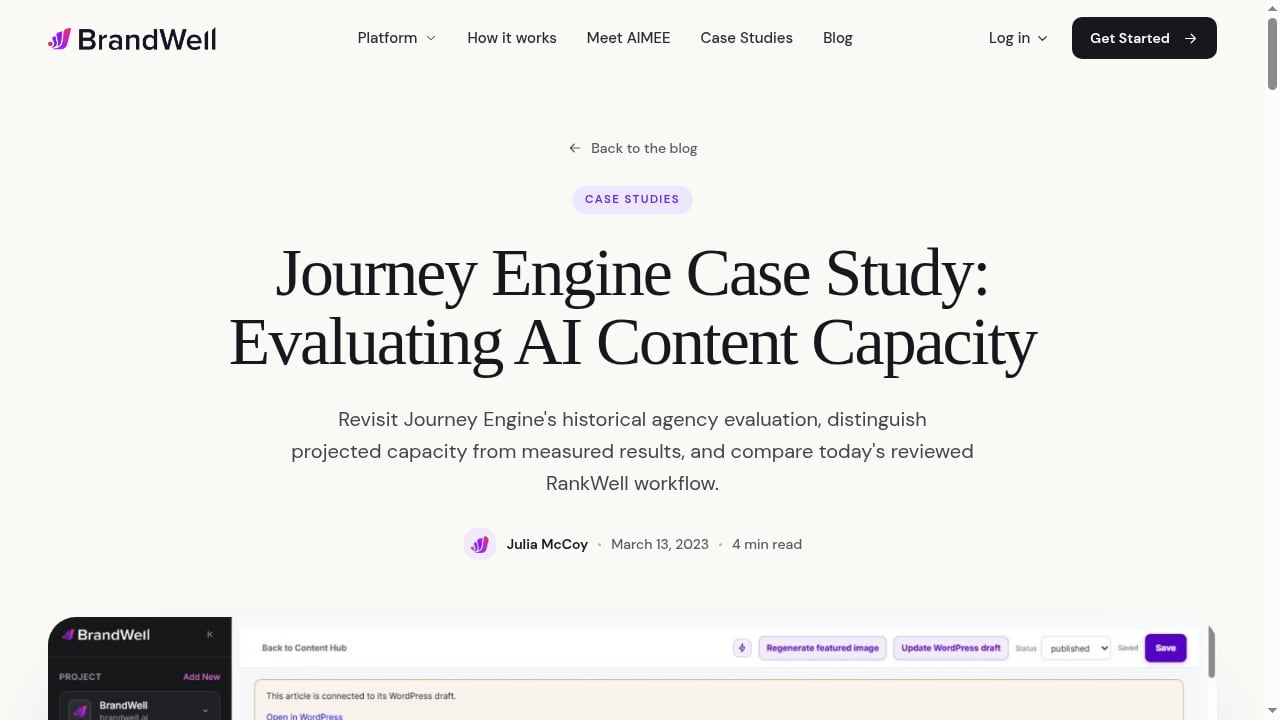
First viewport screenshot of Journey Engine Case Study: Evaluating AI Content Capacity.
Imagine a B2B SaaS team selling a workflow tool.
- Signal. A contact visits the pricing page but does not convert. BrandWell's structured data captures the event and triggers a recurring workflow.
- Content check. The mapped cluster for that workflow stage is a comparison article. AgentBooks has already published it, prepared with title, description, keywords, images, tags, and internal links.
- Outreach. An AIMEE agent sends a short follow-up that references the comparison directly, rather than a generic check-in.
- Qualification. If the contact replies, the workflow routes them to a rep with the content they engaged with attached as context.
- Feedback loop. Topics that generate replies get prioritized in the next AgentBooks planning cycle. Topics that do not get deprioritized.
That loop is the point. Content informs outreach, and outreach results inform content.
Where each tool should stop
| Task | AgentBooks | BrandWell growth automation |
|---|---|---|
| Brand voice and product understanding | Primary | Consumes |
| Keyword and topic planning | Primary | Informs via intent data |
| Article creation and publishing | Primary | Consumes as assets |
| Contact segmentation | Not covered | Primary |
| Recurring outreach workflows | Not covered | Primary |
| Agent-executed actions | Not covered | Primary |
| Performance feedback into topics | Receives | Produces |
Neither tool replaces the other. AgentBooks has no outbound execution layer. BrandWell's growth automation software does not crawl your site to learn your product voice. Treating them as substitutes is the most common mistake.
Problems this combination solves
Disconnected messaging. When content and outbound run on separate briefs, prospects get two different versions of your company. Sharing brand intelligence across both fixes that.
Content with no distribution plan. Publishing without a routing strategy means assets sit idle. Mapping clusters to workflow stages gives every article a job.
Outbound without substance. Sequences that only ask for time perform poorly. Sequences that lead with a relevant published asset perform better.
Manual coordination overhead. Recurring workflows and scheduled generation replace the weekly scramble of "what do we send and what do we publish."
No feedback loop. Without shared data, content teams never learn which topics actually move deals. The pairing makes that visible.
Decision guidance: when this pairing fits
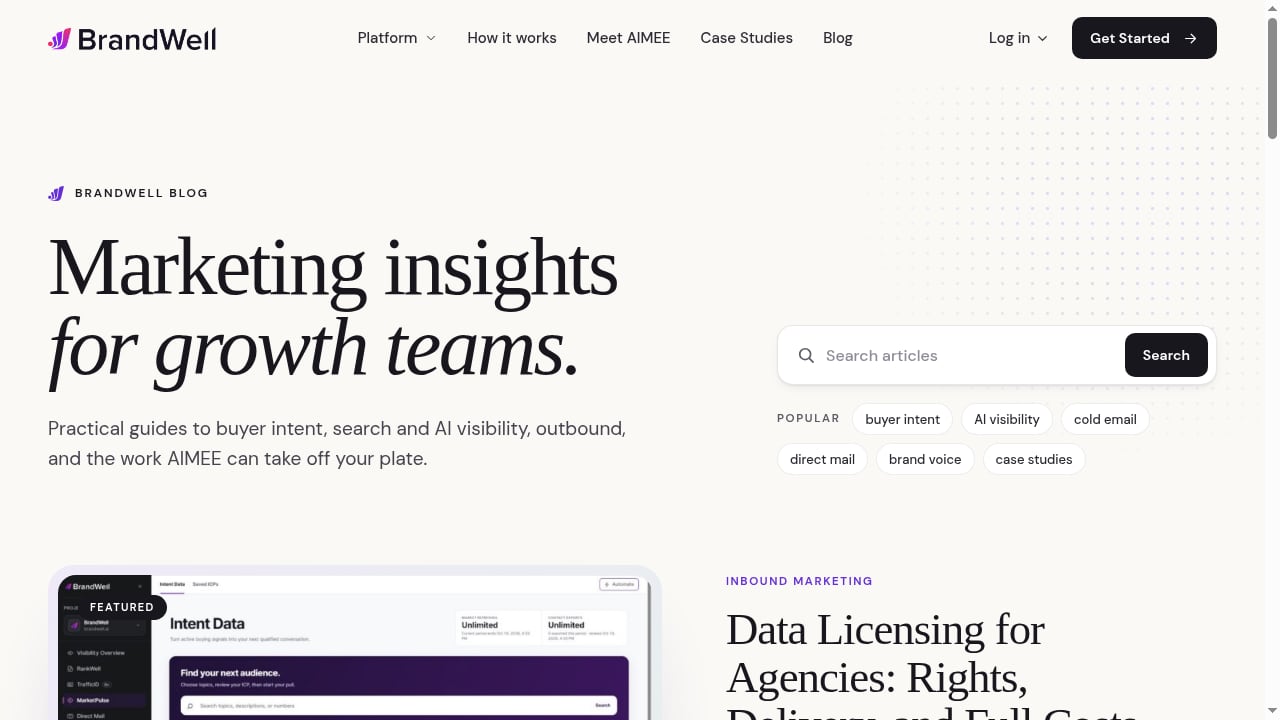
First viewport screenshot of BrandWell Blog | Marketing Insights for Growth Teams.
Use AgentBooks with BrandWell's growth automation software when:
- You run both inbound content and outbound outreach and want them aligned.
- You have enough audience volume to justify structured segmentation.
- You want agents to execute recurring tasks rather than manual sends.
- You operate multiple brands or domains and need separate identities.
Consider a lighter setup when:
- You only publish content and have no outbound motion. AgentBooks alone covers that. See the AgentBooks vs AirOps vs Machined comparison for how it stacks up against other content platforms.
- You only run outbound and have no content engine. BrandWell's growth automation software handles execution, but you will need assets from somewhere.
- You are a solo founder testing one channel. Start with one tool, prove the channel, then add the second. The AgentBooks vs The AI Content Team for Solo Founders guide covers that tradeoff.
For teams evaluating the broader category of AI-driven visibility and automation platforms, the Top 10 AI Search Visibility & GEO Platforms 2026 review provides evaluation criteria and pricing evidence.
Common setup mistakes
- Publishing before the brand crawl finishes. Brand intelligence needs the full site pass. Skipping it produces generic output.
- Over-broad workflow triggers. Narrow segments produce better-matched content than wide ones.
- Mapping every cluster to every stage. One cluster per stage keeps the sequence readable.
- Ignoring approval gates. The approval-first workflow exists to catch tone and factual drift before publication.
- Scaling both sides at once. Pilot one cluster and one workflow before expanding.
Related reading
- Growth Engine Hub Review 2026: Autonomous AI Content Tested - Hands-on Growth Engine Hub review: how its always-on AI agent plans, publishes, and scores content, plus pricing signals, limits, and who should skip it.
Sources and further reading
- 8 Best AI Voice Agents for Automated Inbound Calls in 2026 - We tested 8 AI voice agents for inbound calls on latency, containment, CRM writing and warm transfer. Honest picks for SMB, enterprise and dev teams.
- AI lead qualification: How AI agents screen and route leads at scale - Find out what AI lead qualification is, how it works, and how sales teams use AI agents on voice or chat to screen, prioritize, and route qualified leads.
- Phone AI Assistant: Complete Guide to Voice Agents for Business - Discover how phone AI assistants handle calls, schedule appointments, and automate customer service 24/7. Learn features, benefits, and implementation strategies.
FAQ
Does AgentBooks integrate directly with BrandWell's growth automation software?
They operate as complementary systems. AgentBooks handles content planning, creation, and publishing. BrandWell's growth automation software handles structured buyer data, recurring workflows, and agent execution. You connect them through shared planning: map AgentBooks content clusters to BrandWell workflow stages.
Can I use AgentBooks without BrandWell?
Yes. AgentBooks works as a standalone content engine. The pairing adds value only when you also run outbound or intent-driven outreach.
Can I use BrandWell's growth automation software without AgentBooks?
Yes, but you will need content assets from another source. AgentBooks supplies the brand-consistent articles that outbound sequences reference.
How long before the combination shows results?
AgentBooks publishes on a schedule you control, and BrandWell workflows run on triggers you define. Expect the first measurable signals after one full content cluster and one pilot workflow cycle. Neither product guarantees rankings or traffic.
What does AgentBooks cost?
AgentBooks offers a public beta with a free plan, a Business plan at $30/month, and an Enterprise plan at $100/month.
Does this replace a sales team?
No. Automation handles repetitive screening, routing, and follow-up. Human judgment still closes deals and handles complex conversations.
Conclusion
AgentBooks and BrandWell's growth automation software solve adjacent problems: one builds the content engine, the other executes the inbound and outbound motion around it. The value comes from the connection between them, not from either tool alone.
Start with the website crawl, build the keyword plan, define your structured segments, map clusters to workflow stages, and pilot one cycle. Then let the feedback loop do its work: content informs outreach, outreach results inform the next content plan.
For a deeper look at how AgentBooks fits alongside other SEO tooling, see the AgentBooks and Screaming Frog workflow guide.