

Growth Engine Hub Review 2026: Autonomous AI Content Tested
Most AI writing tools stop the moment a draft appears. Growth Engine Hub makes a bigger claim: that its always-on agent can plan, publish, measure, and repair your content without a full-time team. This review breaks down what the platform actually does, where it fits, and what it costs you in money and attention.
What Growth Engine Hub Is (and Is Not)
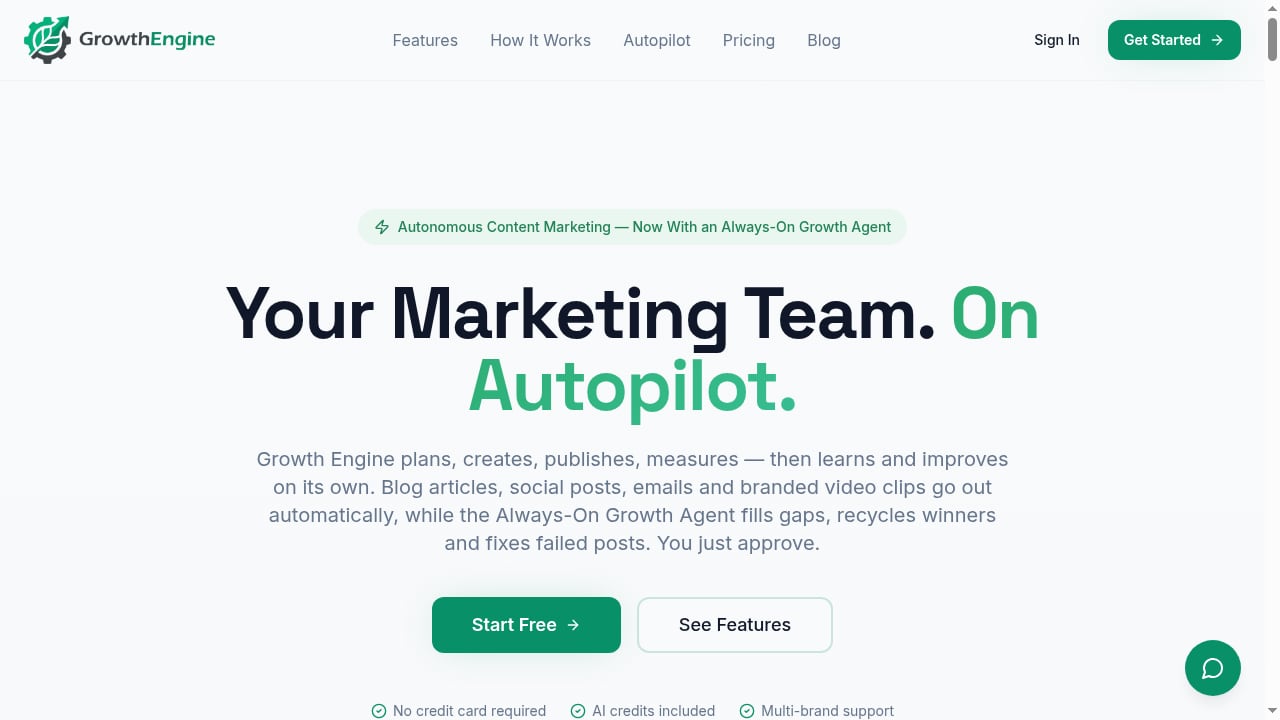
First viewport screenshot of Growth Engine Hub — Autonomous AI Content Marketing.
Growth Engine Hub is an autonomous AI content marketing platform. It positions itself as a single system that replaces a writer, a scheduler, an SEO tool, an email platform, and an analytics dashboard. The core loop is simple to describe: plan and create, publish, measure, then learn and act.
The flagship feature is the AI Growth Autopilot. A Smart Guided Wizard walks you through four setup steps:
- Brand context — voice, audience, industry, visual style, and reference images (the platform calls this Brand DNA).
- Competitor selection — the AI scrapes competitor content to find topic strengths, weaknesses, and gaps.
- Keyword selection — high-impact opportunities are surfaced and turned into content briefs.
- Goal definition — what you want the content to achieve.
From there, the system generates a strategic content plan and produces blog articles, social posts for four platforms (Twitter/X, LinkedIn, Facebook, Instagram), email newsletters and drip sequences, and branded video clips up to 40 seconds.
What it is not: a human strategist, a guarantee of rankings, or a tool that removes the need to review anything. The platform itself keeps a Review Queue, which tells you the honest truth — nothing ships without approval unless you deliberately switch on auto-approve.
The Always-On Growth Agent, Explained
First viewport screenshot of Growth Engine Hub — Autonomous AI Content Marketing.
The differentiator worth testing first is the Always-On Growth Agent. It runs in the background and does four jobs:
- Fills content gaps — spots topics or channels missing from your calendar.
- Recycles winners — turns a strong blog post into social threads or email campaigns.
- Fixes failed posts — surfaces failed publishing attempts with one-click retry, including self-healing retries when an OAuth token expires.
- Sends a weekly growth report — a summary of what happened and what the agent did about it.
This is the part that separates Growth Engine Hub from a standard AI writer. A drafting tool waits for you. An agent acts on a schedule and reports back. Whether that is valuable depends entirely on how much you trust an automated system to touch your brand's public channels.
Performance IQ: One Score, Real Data
Performance IQ compresses blog views, social engagement, and email opens into a single 0–100 score per brand. The AI then explains what is working and feeds those learnings back into the next round of generation.
Two things stand out here. First, the closed feedback loop is the actual mechanism behind the "learns and improves" claim — without it, autonomy is just scheduling. Second, the platform is unusually candid about early-stage data: it explicitly avoids "vanity zeros" and tells you when your audience is still building, rather than pretending a low score means bad content.
A single composite score is useful for scanning, but it can hide channel-level detail. If you need to know whether LinkedIn or email is carrying your results, check the underlying social analytics rather than the headline number alone.
Setup: What the First Week Looks Like
First viewport screenshot of Growth Engine Hub — Autonomous AI Content Marketing.
Setup is guided, not technical. Expect this sequence:
- Connect accounts. Link Twitter/X, LinkedIn, Facebook, and Instagram via OAuth. Credentials are encrypted; the platform states it never stores passwords.
- Define Brand DNA. Upload brand facts, tone, visual style, and reference images.
- Add competitors. The AI analyzes their content strategy and surfaces exploitable gaps.
- Pick keywords and goals. The wizard generates briefs from high-impact keyword opportunities.
- Generate or autopilot. Create content manually or let Autopilot produce a full week of blog posts, social content, and email campaigns in one click.
- Review and approve. Everything lands in one queue. Edit, schedule, publish, or delete — or enable auto-approve.
The platform also handles the unglamorous plumbing: published blog posts are added to a live sitemap and submitted to Google Search Console, with structured data, RSS, llms.txt, and instant index pings so both search engines and AI assistants can find and cite you. Existing content can be imported from any RSS feed or URL.
If you already run a keyword and crawling workflow, this is the stage where you should decide what stays manual. Our guide to using AgentBooks with Screaming Frog covers how to keep technical and content workflows connected rather than duplicated.
Strengths
- True end-to-end coverage. Strategy, creation, publishing, and measurement live in one system instead of five disconnected subscriptions.
- A real approval layer. The Review Queue and role-based access (Admin, Editor, Viewer) make it usable by teams, not just solo operators.
- Self-healing publishing. Failed posts surface with one-click retry, and metrics sync back automatically from all four social platforms.
- Multi-brand support. One dashboard, instant brand switching, unified analytics and pipelines.
- Built-in discoverability. Sitemap submission, structured data, and AI-crawler signals are handled without manual SEO work.
- Low-friction entry. A free tier with AI credits and no credit card required.
Limitations and Honest Trade-offs
- Autonomy requires trust. The value of an always-on agent is proportional to how much you let it act. Teams that review every item manually get less leverage from the feature they are paying for.
- Composite scoring flattens detail. Performance IQ is a fast signal, not a diagnostic. Deep channel analysis still requires reading the underlying analytics.
- Video is short-form only. Clips run 8 to 40 seconds — useful for Reels, Facebook, and LinkedIn, but not a replacement for long-form video production.
- Credit-based pricing needs modeling. Plans are metered in AI credits, so heavy multi-brand usage can push you past the entry tier faster than a flat-rate tool would.
- Brand voice still needs auditing. The AI humanizer and Brand Voice Polish reduce generic output, but nobody should publish unreviewed content under a premium brand without sampling it first.
- Some features sit outside the core loop. Backlink intelligence and B2B lead generation are useful add-ons, but they are adjacent to content automation rather than central to it.
Pricing Signals
Growth Engine Hub publishes a transparent, credit-based structure with no per-seat charges and no hidden fees. Based on the vendor's own pricing page (prices shown as approximate and billed in EUR):
| Tier | Indicative price | Credits | Brands | Notable inclusions |
|---|---|---|---|---|
| Free | $0 forever | 50 AI credits/month | 1 | Blog, social, and email generation, public blog hosting, content scoring, basic analytics |
| Solo (most popular) | ~$20.52/mo | 500 AI credits/month | 3 | AI Growth Autopilot, competitor intelligence, keyword gap detection, backlink discovery, drip sequences, content recycling, content calendar, social publishing |
| Team | ~$52.92/mo | 2,000 credits | More brands | Everything above plus team collaboration and lead generation |
The vendor also frames the product against a "$200+/mo tool stack" it claims to replace. Treat that as positioning, not a benchmark — your real comparison is your current invoice total for writing, scheduling, email, and analytics.
For a broader view of how credit-based AI content platforms compare on workflow and price, see our comparison of AgentBooks, Clearscope, and GravityWrite.
Who Should Use Growth Engine Hub

First viewport screenshot of Growth Engine Hub — Autonomous AI Content Marketing.
Strong fit:
- Solopreneurs and small business owners who need a consistent presence but cannot justify a content hire.
- Lean marketing teams managing several brands from one dashboard.
- Agencies that want a repeatable content pipeline with client approval workflows.
- Teams already publishing on all four social platforms who are tired of copy-pasting between apps.
Weak fit:
- Brands with strict editorial governance that require human-written long-form content.
- Teams needing deep, channel-level attribution rather than a composite score.
- Businesses whose growth depends on long-form video or complex paid media.
How to Evaluate It in a Trial
Do not judge an autonomous platform by its interface. Judge it by what it ships. A practical two-week test:
- Run the wizard fully. Incomplete Brand DNA produces generic output — that is a setup failure, not a product failure.
- Sample 10 generated items across blog, social, email, and video. Score brand fit yourself before enabling auto-approve.
- Watch the Review Queue for a week. Count how many items you approve unchanged. That ratio is your real automation rate.
- Check the closed loop. After publishing, confirm that Performance IQ insights actually change the next batch of content.
- Break something on purpose. Disconnect and reconnect a social account to see how self-healing retries behave.
- Model credits against your calendar. Estimate monthly output per brand, then compare it to the credit allowance.
If you are still deciding between an autonomous engine and a planning suite, our marketing manager software evaluation guide and the top AI content planning and optimization tools both lay out criteria you can reuse here.
Related reading
- Top 10 AI Search Visibility & GEO Platforms 2026 - A ranked review of the 10 best AI search visibility and GEO platforms in 2026, with evaluation criteria, pricing evidence, and fit guidance.
- AgentBooks vs SEO WRITING: AI SEO Article Tools Compared - AgentBooks vs SEO WRITING compared: brand intelligence, keyword planning, bulk generation, publishing, pricing, and which AI SEO article tool fits your workflow.
Sources and further reading
- Growth Engine Hub — Autonomous AI Content Marketing - Autonomous content marketing: an always-on AI growth agent plans, writes, publishes and measures your blog, social, email and video — you just approve.
- Growth Hub (formerly Horizon Marketing) - Your Strategic Partner for Predictable Revenue Growth. We build scalable Growth Engines for B2B & E-commerce. Stop guessing. Start growing. We
- Are you ready to transform your content marketing from a time sink into a growth engine? - Are you ready to transform your content marketing from a time sink into a growth engine? 📈 For small business owners, marketers, and agencies, the challenge of consistent, high-performing content is immense. Spending 10+ hours a week on content creation, scheduling, and optimization is simply unsustainable. Generic AI writers fall short, and most tools stop at drafting.
Growth Engine Hub redefines the landscape with "Automate 2026: Predictive AI for Hyper-Personalized Content Growth." Our always-on AI content engine is designed to replace five essential marketing tools – your writer, scheduler, SEO tool, email platform, and analytics – with one seamless, intelligent solution. Imagine a Growth Agent that autonomously fills your content calendar, rewrites underperforming posts, generates images and video, tracks SEO and social performance, and delivers a weekly growth report, all while strictly adhering to your Brand DNA.
This isn't just automation; it's content marketing on autopilot, driven by predictive AI to ensure hyper-personalized, high-impact content. Outrank competitors and automate growth, allowing you to focus on strategic initiatives.
Discover how Growth Engine Hub can empower your content strategy and drive unparalleled growth. Visit https://growthenginehub.ai to learn more about our AI content engine today.
##AIContentMarketing ##AutomatedMarketing ##SmallBusinessGrowth ##ContentStrategy
FAQ
Is Growth Engine Hub free to try?
Yes. The free tier includes 50 AI credits per month, one brand, blog and social generation, email campaigns, public blog hosting, and content scoring. No credit card is required.
Does content publish without my approval?
No, not by default. Every item the agent creates lands in a Review Queue where you can edit, publish, schedule, or delete it. Auto-approve is an optional setting you switch on yourself.
Which platforms does it publish to?
Twitter/X, LinkedIn, Facebook, and Instagram, plus a hosted blog and email campaigns. Accounts are connected once via OAuth.
What is Performance IQ?
A 0–100 score per brand that combines blog views, social engagement, and email opens into one number, with AI explanations that feed back into future content generation.
Does it replace an SEO tool?
It covers a meaningful slice: keyword gap detection, competitor analysis, content scoring, sitemap submission, structured data, and AI-crawler signals. It does not replace a full technical SEO audit or backlink analysis suite, though it does include backlink discovery and monitoring on paid tiers.
Can I manage more than one brand?
Yes. Multi-brand management is built in, with a unified dashboard and instant brand switching. The free tier is limited to one brand.
Conclusion
Growth Engine Hub is one of the more complete attempts at closing the loop between content creation and content performance. The Always-On Growth Agent, the Review Queue, and Performance IQ form a coherent system: generate, publish, measure, learn, repeat. The free tier makes it cheap to test, and the credit-based pricing keeps entry costs low for solo operators.
It is not a hands-off miracle. Its value scales with how much you let the agent act and how well you set up Brand DNA in the first place. If you want consistent multi-channel output without hiring a team — and you are willing to review the queue — it is worth a serious trial. If you need human-grade long-form editorial or deep channel attribution, keep it as a supplement rather than a replacement.
Start with the free tier, run the two-week test above, and let the approval ratio tell you whether the autopilot has earned your trust.