
Marketing Manager Software: What to Evaluate in 2026
A marketing manager rarely has one problem. There is a campaign to plan, a content calendar to fill, a budget to defend, and a team that needs clear ownership of every task. Marketing manager software is the category that promises to hold all of it together. In practice, that promise splits into three very different tool types, and choosing the wrong one is how teams end up with overlapping subscriptions and half-used dashboards.
This guide breaks the category down by job to be done, shows where each type of platform earns its cost, and gives you a short evaluation checklist you can run before your next renewal cycle.
What "marketing manager software" actually covers
Search results for this term mix at least three product families:
- Broad marketing suites that combine CRM, email, automation, and analytics in one platform, such as HubSpot's marketing software.
- Project and campaign management tools built for marketing teams, including the options reviewed in this marketing project management software roundup.
- Channel-specific platforms for email, SEO, social, or content, such as the tools catalogued in Salesforce's digital marketing software list.
A marketing manager usually needs one tool from each family, not one tool that claims to be all three. The decision is about which layer deserves to be the system of record and which layers can stay narrow and cheap.
Start with the job, not the feature list
First viewport screenshot of Create useful discovery content beyond the product grid. | AgentBooks.
Before comparing vendors, write down the single output your team is judged on. Common answers:
- Pipeline and lead volume — the suite layer matters most, because CRM data has to connect to campaigns.
- Campaign delivery on time — the project layer matters most, because ownership and deadlines are the bottleneck.
- Organic visibility and content output — the channel layer matters most, because publishing cadence and search intent drive results.
If your bottleneck is content production, a CRM-heavy suite will not fix it. If your bottleneck is attribution, a content tool will not fix it either. Naming the bottleneck first prevents you from buying a platform that is excellent at the wrong job.
How the three layers compare
| Layer | Primary job | Strong when | Weak when |
|---|---|---|---|
| Marketing suite | Unify contacts, campaigns, and reporting | You need one view of the customer across channels | You mainly need publishing speed or editorial depth |
| Project management | Plan, assign, and track campaign work | Multiple stakeholders and deadlines must stay visible | Content creation itself is the constraint |
| Content engine | Research, plan, write, and publish at cadence | Organic content volume and consistency are the goal | You need deep CRM segmentation or sales workflows |
Most mature teams run all three, but they sequence them. The suite usually comes first because it holds customer data. Project management follows once coordination breaks down. The content engine is often added last, and it is usually the layer with the fastest measurable change in output.
Where AI content engines fit
First viewport screenshot of Content operations shaped around the way your product grows. | AgentBooks.
AI content automation platforms sit in the third layer. They take a website, learn the product and positioning from it, build a keyword plan, research the organic results already ranking, and then produce articles in the brand's voice on a schedule. AgentBooks is built around exactly this sequence: brand intelligence from crawling the site, a categorized keyword plan, an approval-first article workflow, scheduled generation, and SEO preparation covering titles, descriptions, images, tags, and links.
That matters for a marketing manager because the content layer is where most teams lose time to blank-page work. A tool that starts from real product data instead of a generic prompt changes the review burden. Instead of briefing every article from scratch, the manager reviews drafts that already reflect the product and the target query.
AgentBooks runs a public beta with a free plan, a Business plan at $30/month, and an Enterprise plan at $100/month, and it supports custom domains, multilingual publishing, and multi-brand workspaces. It does not guarantee rankings or traffic. What it does is make the content process measurable and repeatable, which is the part a marketing manager can actually control.
If you are comparing this layer against alternatives, the AgentBooks vs The SEO Agent comparison and the AgentBooks vs Brafton vs QuickCreator breakdown for solo founders walk through brand intelligence, keyword planning, publishing, and pricing side by side.
A practical evaluation checklist
First viewport screenshot of Turn expertise into content that keeps teaching. | AgentBooks.
Run these questions against any marketing manager software before you commit:
- What is the system of record? Decide which tool owns customer data and which tools read from it. Duplicated contact records are the most common integration failure.
- How does work enter the tool? Briefs, requests, and ideas should have one intake path. If intake is scattered across email and chat, adoption will collapse within a quarter.
- What does the approval step look like? For content, an approval-first workflow keeps a human in the loop before publishing. For campaigns, approval gates should route automatically once sign-off lands.
- What is the real cost at your team size? Per-seat pricing punishes growing teams. Flat pricing rewards them. Model both at your headcount twelve months from now, not today.
- What happens when the tool is wrong? Ask how you correct brand voice, keyword targets, or audience assumptions. Tools that cannot be corrected become abandoned tools.
- What can you measure in 30 days? Pick one input metric — articles published, campaigns shipped, response time — and confirm the tool reports on it without custom work.
A worked example for a lean team
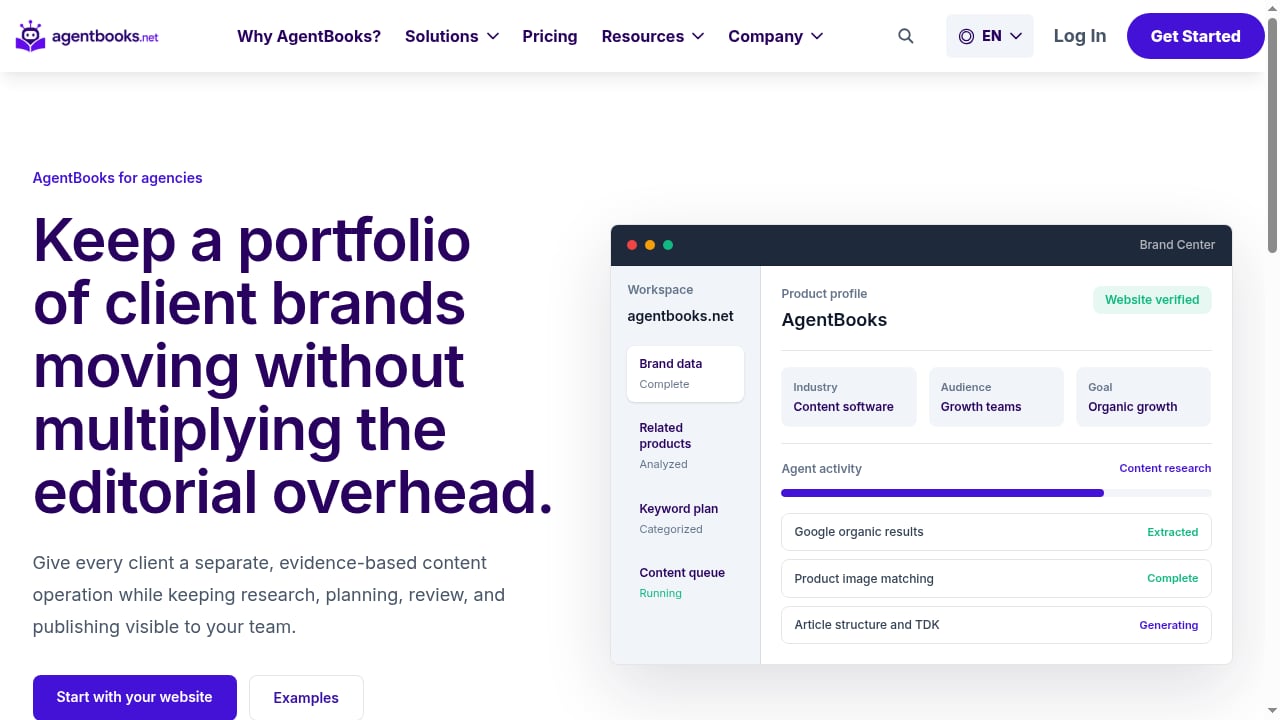
First viewport screenshot of Keep a portfolio of client brands moving without multiplying the editorial overhead. | AgentBooks.
Imagine a five-person SaaS marketing team with a CRM suite already in place and a project board that mostly works. Their bottleneck is organic content: two blog posts a month, no consistent keyword plan, and no clear owner for SEO preparation.
The sensible move is not to replace the suite or the project board. It is to add a content engine, connect it to the existing keyword and analytics data, and keep the project board as the place where review tasks live. A workflow like the one described in How to Use AgentBooks with SE Ranking shows how planning data and publishing automation can sit on either side of the same process without duplicating effort.
Within a month, the measurable change is not rankings. It is cadence: more drafts reaching review, each one already mapped to a query and prepared with metadata. That is the input a marketing manager can report upward while the compounding effects play out.
Common mistakes to avoid
- Buying the suite to solve a content problem. Suites are strong at orchestration and weak at editorial depth.
- Adding a content tool with no keyword plan. Volume without intent mapping produces pages nobody searches for.
- Skipping the approval step. Fully automated publishing without review is how brand voice drifts.
- Ignoring multilingual and multi-brand needs until later. If you run more than one brand or market, confirm workspace separation before you buy.
- Judging the tool in week one. Content systems show their value in cadence and consistency, not in a single launch.
Related reading
- How to Use AgentBooks with Fountain City: AI Content Workflow - Learn how AgentBooks and Fountain City work together: setup steps, a practical content workflow, real examples, and the problems this AI pairing solves.
FAQ
Is marketing manager software the same as a CRM?
No. A CRM manages customer records and interactions. Marketing manager software is a broader label that can include CRM, campaign automation, project management, and content production. Many teams run a CRM as the system of record and add specialist tools around it.
Do I need project management software if I already use a marketing suite?
Only if coordination is your bottleneck. Suites handle campaign execution but are usually weaker at workload visibility, brief intake, and cross-team deadlines. If those are not problems yet, skip the extra layer.
Where does AI content automation fit in the stack?
It belongs in the content layer. These platforms handle research, keyword planning, drafting, and publishing preparation. They complement a suite rather than replacing it, because they do not manage customer data or sales workflows.
How should I measure whether a content engine is working?
Track inputs you control: drafts produced, articles published on schedule, percentage of pieces with complete metadata, and review turnaround time. Ranking and traffic changes take longer and depend on factors outside any single tool.
What pricing model should I expect?
Project tools typically charge per user per month, suites bundle pricing by contact volume or seats, and content engines often use flat monthly tiers. AgentBooks, for example, lists a free plan, a Business plan at $30/month, and an Enterprise plan at $100/month.
Can one platform cover planning, writing, and publishing?
Increasingly, yes — within the content layer. AgentBooks connects product understanding, market research, keyword planning, article creation, publishing, and future updates in one workspace. It still leaves CRM, sales, and paid media to other tools.
Conclusion
Marketing manager software is not one purchase. It is a stack decision: a system of record, a coordination layer, and a production layer. Get the order right and each addition compounds. Get it wrong and you pay for overlap.
Start by naming your bottleneck. If it is content cadence, evaluate the content layer first and hold it to input metrics you can measure in a month. If it is coordination, fix intake and ownership before adding anything new. For a broader view of how the content layer compares across vendors, the top AI content planning and optimization tools for 2026 puts the leading options side by side with pricing evidence.