

AgentBooks vs The SEO Agent: Which AI Content Engine Fits?
If you are choosing between AgentBooks and The SEO Agent, you are comparing two different theories of AI content production. AgentBooks starts from your website and builds a brand-aware content engine around it. The SEO Agent starts from a keyword and pushes a fact-checked article out the other end, every day.
Both can publish useful content without a human writing every draft. The difference is where the intelligence comes from, how much editorial control you keep, and what you pay as you add sites or brands.
This comparison uses the product context and public evidence available for each platform. It does not claim either tool guarantees rankings or traffic.
Quick comparison: AgentBooks vs The SEO Agent
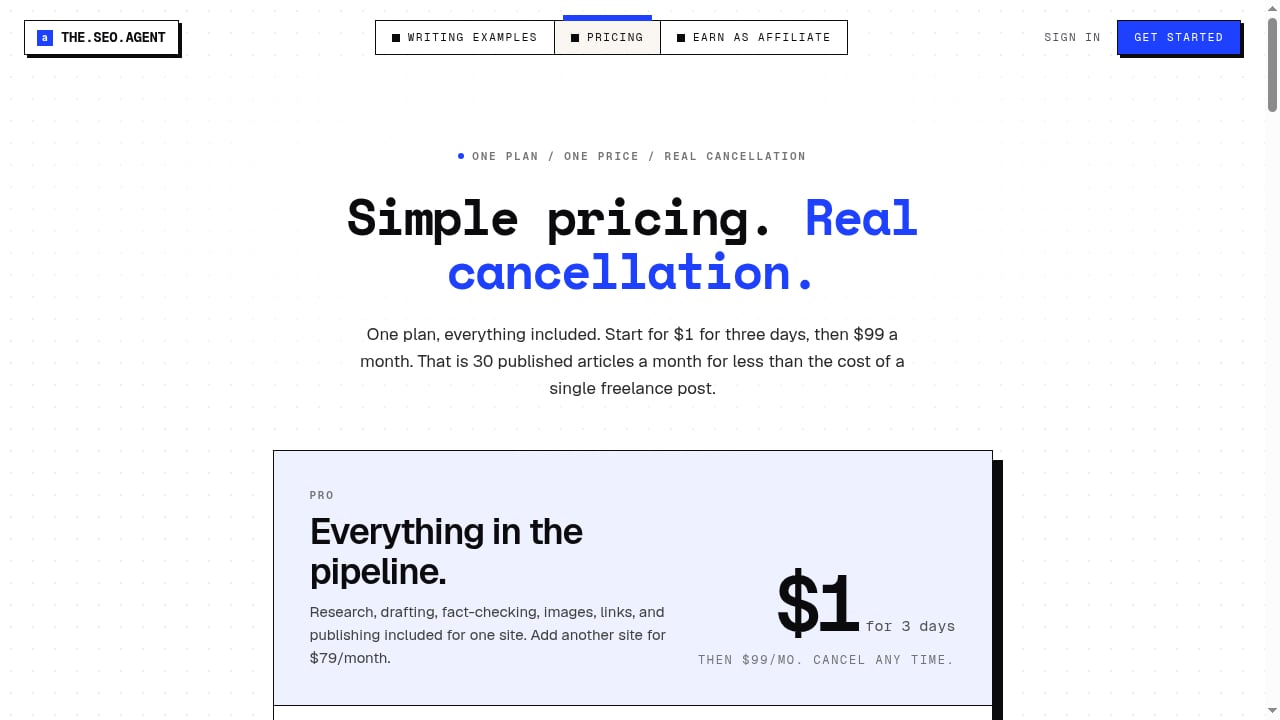
First viewport screenshot of The SEO Agent — AI SEO content automation.
| Dimension | AgentBooks | The SEO Agent |
|---|---|---|
| Starting point | A website shared once; the platform learns the product and brand voice | A keyword entered into the pipeline |
| Core promise | An always-on content engine connected to real product data | One keyword in, one researched article out, daily |
| Keyword planning | Categorized keyword plan built from market research | Real search-demand keyword research |
| Editorial control | Approval-first article workflow | Optional outline approval gate |
| Fact handling | SEO preparation and organic-result research; no claim-level fact-checking gate described | Every claim checked against saved sources; articles with unfixed fact problems are held |
| Publishing | Custom domain and site identity, multilingual publishing, scheduled generation | Native publishing to WordPress, Webflow, Shopify, Ghost, Wix, Framer, and webhooks |
| Scale model | Multi-brand workspaces | One site per plan; additional sites at a lower monthly rate |
| Pricing | Free plan in public beta; Business $30/month; Enterprise $100/month | $99/month for one site and 30 articles/month after a $1 three-day trial; extra sites $79/month |
| GEO/AI search formatting | Not specified in the available product context | GEO formatting for AI Overviews, ChatGPT, and Perplexity |
| API access | Not specified in the available product context | REST API for audits, keyword research, article generation, and CMS publishing |
Where AgentBooks is stronger
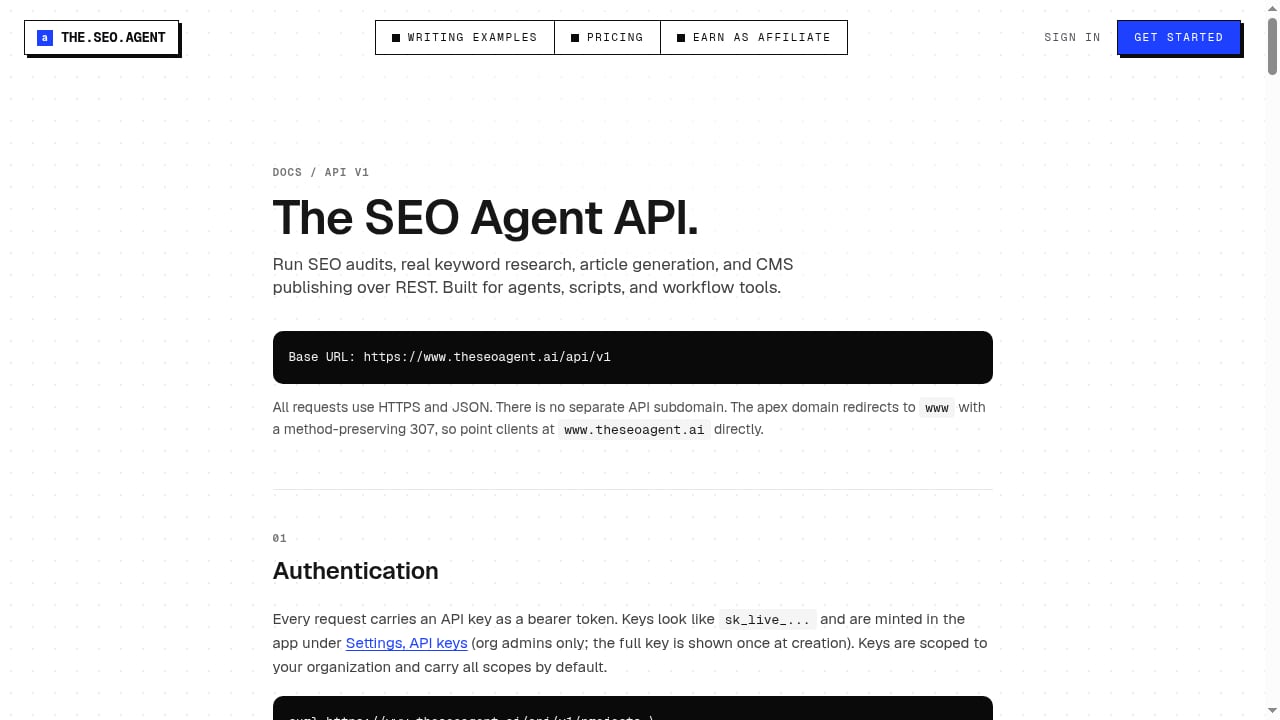
First viewport screenshot of The SEO Agent API.
It starts with your product, not a blank prompt
The most common failure mode in AI content is generic output. A model that only sees a keyword writes something that could belong to any company in the category.
AgentBooks is positioned around the opposite approach: share your website once, and the platform crawls it to learn the product, map the market, and plan topics. That brand intelligence layer feeds the article workflow, so drafts are written in the brand's voice rather than in a neutral assistant voice.
For SaaS teams and DTC sites with a distinct point of view, that difference shows up in the first paragraph of every draft.
Keyword planning is part of the workspace, not a separate step
AgentBooks connects product understanding, market research, keyword planning, article creation, publishing, and future updates in one workspace. The keyword plan is categorized, which makes it easier to see how topics cluster before you approve a batch.
The SEO Agent also does real search-demand keyword research, so this is not a capability gap. The difference is packaging: AgentBooks treats planning as a visible layer you can inspect and steer, while The SEO Agent treats it as the first stage of a pipeline that ends in a published article.
Approval-first workflow with scheduled generation
AgentBooks uses an approval-first article workflow and scheduled content generation. You can review drafts before they go live, and you can let the engine keep producing on a cadence.
The SEO Agent offers an optional outline approval gate and holds articles that have unfixed fact problems. That is a meaningful safety feature, but it is a different kind of control: it gates on factual integrity, while AgentBooks gates on editorial approval.
Multi-brand workspaces and multilingual publishing
If you run more than one site or brand, AgentBooks supports multi-brand workspaces and multilingual publishing. That matters for agencies and founders managing several properties under one login.
The SEO Agent handles multiple sites too, but through a per-site pricing model rather than a shared workspace concept. If you manage five client sites, the cost structure and the organizational structure both look different.
Pricing is dramatically lower at entry
AgentBooks offers a free plan in public beta, a Business plan at $30/month, and an Enterprise plan at $100/month. The SEO Agent costs $99/month for one site and 30 articles per month after a $1 three-day trial, with additional sites at $79/month.
For a solo founder or a small team testing AI content for the first time, the entry cost difference is large enough to change the decision on its own. You can read a broader set of options in our roundup of top AI marketing automation software for 2026.
Where The SEO Agent is stronger
First viewport screenshot of The SEO Agent — AI SEO content automation.
Claim-level fact-checking is built into the pipeline
The SEO Agent checks every claim in a draft against saved sources and automatically holds articles that have unfixed fact problems. That is a specific, verifiable workflow feature, and it addresses a real risk: Google's own guidance on generative AI content calls manual fact-checking and review critical because these models predict words rather than retrieve facts.
AgentBooks does research top organic results and prepares SEO elements, but the available product context does not describe a claim-by-claim verification gate. If your niche is regulated, medical, financial, or otherwise fact-sensitive, this is the single most important difference in the comparison.
Native publishing across more CMS platforms
The SEO Agent publishes natively to WordPress, Webflow, Shopify, Ghost, Wix, Framer, and webhooks. That is a wide integration surface, and webhooks cover the long tail of custom stacks.
AgentBooks supports custom domain and site identity plus multilingual publishing, but the available context does not enumerate native CMS connectors. If your site runs on Framer or Wix and you want zero-friction publishing, verify the integration before committing.
GEO formatting for AI Overviews, ChatGPT, and Perplexity
The SEO Agent formats content for GEO, targeting AI Overviews, ChatGPT, and Perplexity. As AI assistants become a real discovery channel, that formatting is increasingly part of the job.
AgentBooks prepares TDK, images, tags, and links for SEO, but the product context does not describe GEO-specific formatting. If being cited by AI assistants is a primary goal, this is a capability to test directly.
REST API for agent and script workflows
The SEO Agent offers a REST API for running SEO audits, keyword research, article generation, and CMS publishing from agents, scripts, or workflow tools, with bearer authentication, JSON envelopes, and signed webhooks.
That makes it composable. You can wire it into an existing automation stack instead of adopting a new dashboard as the center of your workflow. AgentBooks is positioned as a workspace, not an API-first building block, based on the available context.
Published proof point
The SEO Agent cites a case study showing growth from 66,632 impressions and 36 clicks to 165,283 impressions and 384 clicks after publishing 61 new pages in four months. That is a concrete before-and-after, and it is the kind of evidence buyers should ask both vendors for.
AgentBooks does not guarantee rankings or traffic and positions itself around optimizing content processes and measurable inputs. That is an honest framing, but it means you will need to build your own measurement loop. Our guide on using AgentBooks with SE Ranking walks through how to plan, publish, and measure in one workflow.
Pricing and scale: the math that actually decides it
First viewport screenshot of Blog | TheSEOAgent.
Run the numbers for your specific situation before you read another feature list.
Scenario 1: One site, testing AI content for the first time. AgentBooks free plan or $30/month Business plan versus The SEO Agent at $99/month after a $1 trial. AgentBooks is cheaper to start. The SEO Agent gives you 30 articles a month and claim-level fact-checking for that price.
Scenario 2: One site, 30 articles a month, fact-sensitive niche. The SEO Agent's $99/month includes the volume and the verification gate. AgentBooks Enterprise at $100/month is comparable in price, but the fact-checking workflow is the deciding factor, not the price.
Scenario 3: Five client sites. The SEO Agent: $99 + (4 x $79) = $415/month. AgentBooks: multi-brand workspaces on a Business or Enterprise plan, depending on volume. The workspace model is usually easier to operate at agency scale, but confirm article limits per brand.
Scenario 4: You already have an automation stack. The SEO Agent's REST API lets you plug content generation into tools you already run. AgentBooks expects you to work inside its workspace. Neither is wrong; they suit different operating styles.
Which should you choose?
Choose AgentBooks if:
- You want content that sounds like your brand from the first draft, built from your actual website and product data.
- You manage multiple brands or sites and want one workspace.
- You want a low-cost entry point, including a free beta plan.
- You value an approval-first editorial workflow over pipeline automation.
- You are comfortable building your own measurement and fact-verification layer.
Choose The SEO Agent if:
- Fact-checking every claim against saved sources is non-negotiable for your niche.
- You need native publishing to WordPress, Webflow, Shopify, Ghost, Wix, or Framer.
- GEO formatting for AI Overviews, ChatGPT, and Perplexity is a priority.
- You want a REST API to embed content generation into existing agent or script workflows.
- You want a published case study with impression and click data before you commit.
If you are still mapping the category, our comparison of AgentBooks vs Growth Engine Hub covers a third approach to the same problem.
Related reading
- BrightEdge Review 2026: Enterprise SEO & AI Search Fit - Evidence-based BrightEdge review: enterprise SEO and AI search features, pricing signals, setup effort, limitations, and who should choose or skip it.
- AgentBooks vs QuickCreator vs GTM AI for Solo Founders - Compare AgentBooks, QuickCreator's AI content team, and GTM AI for solo founders. See which fits content automation, publishing, and go-to-market tasks.
Sources and further reading
- AgentBook | Websites, SEO and automation for local businesses - AgentBook builds websites, local SEO and automation systems that turn searches and conversations into qualified enquiries.
- What is an AI agent that changed your life for real? : r/AI_Agents - Sep 30, 2026 ... ... SEO blog, and optimizes your visibility in Google and AI search like ChatGPT. ... agent vs. claude code you need to attach and MCP server ...
- Our Next Guest Might Be an AI Agent. Market to Both. - AI agents now shortlist hotels before guests ever see them. Here's how to market to the traveler and the machine at the same time.
FAQ
Is AgentBooks cheaper than The SEO Agent?
At entry, yes. AgentBooks has a free plan in public beta, a Business plan at $30/month, and an Enterprise plan at $100/month. The SEO Agent costs $99/month for one site and 30 articles per month after a $1 three-day trial, with additional sites at $79/month. At the Enterprise tier the two are close in price, so features matter more than cost.
Does AgentBooks fact-check articles?
The available product context describes researching top organic results and preparing SEO elements such as TDK, images, tags, and links. It does not describe a claim-by-claim verification gate against saved sources. The SEO Agent explicitly does this and holds articles with unfixed fact problems.
Which tool publishes to more CMS platforms?
The SEO Agent lists native publishing to WordPress, Webflow, Shopify, Ghost, Wix, Framer, and webhooks. AgentBooks supports custom domain and site identity plus multilingual publishing, but native CMS connectors are not enumerated in the available context. Verify before you commit.
Can I run multiple sites on one plan?
AgentBooks supports multi-brand workspaces. The SEO Agent serves one site per plan, with additional sites at $79/month each. For agencies, the workspace model is usually simpler to operate; the per-site model is usually simpler to predict.
Does either tool guarantee rankings or traffic?
No. AgentBooks explicitly does not guarantee rankings or traffic and positions itself around optimizing content processes and measurable inputs. The SEO Agent publishes a case study with impression and click growth, which is evidence of results in one case, not a guarantee.
Which is better for GEO and AI search visibility?
The SEO Agent explicitly formats content for GEO, targeting AI Overviews, ChatGPT, and Perplexity. AgentBooks focuses on SEO preparation. If AI assistant citations are a primary goal, test both and measure citations directly.
Conclusion
AgentBooks and The SEO Agent solve the same broad problem with different centers of gravity. AgentBooks is a brand-aware content engine: share your website, get a keyword plan, approve drafts, and publish on a schedule across multiple brands at a low entry price. The SEO Agent is a verification-first pipeline: one keyword in, one fact-checked article out, published natively to your CMS, with GEO formatting and a REST API for automation.
The deciding questions are simple. Do you need claim-level fact-checking and native CMS publishing? The SEO Agent is built around those. Do you need brand intelligence from your own site, multi-brand workspaces, and a cheaper starting point? AgentBooks is built around those.
Neither replaces editorial judgment. Google's guidance on generative AI content is explicit that manual fact-checking and review remain critical, so whichever engine you pick, keep a human in the loop before anything goes live.