
BrightEdge Review 2026: Enterprise SEO and AI Search Fit
BrightEdge is one of the longest-running names in enterprise SEO, and in 2026 it is repositioning around a newer problem: visibility inside AI-generated answers. This review breaks down what the platform actually does, who gets value from it, where it falls short, and how to decide whether it belongs in your stack.
What BrightEdge is
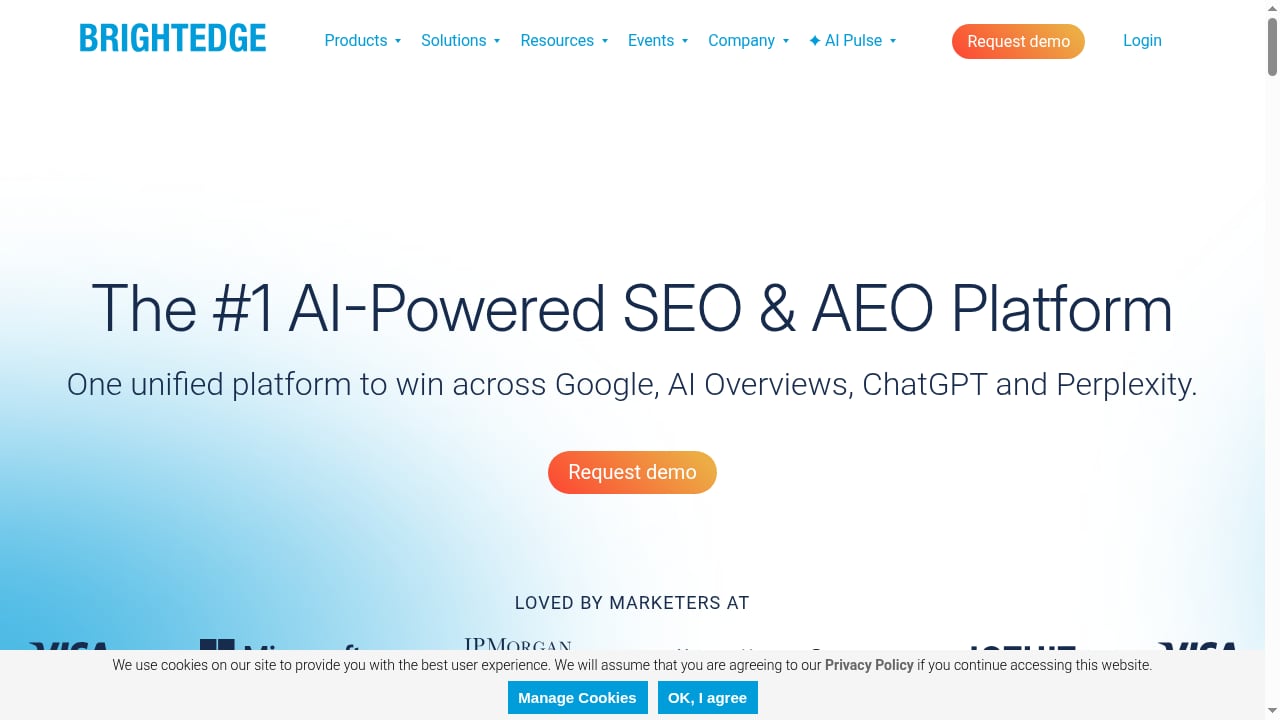
First viewport screenshot of Enterprise SEO Platform | Visibility in AI Search | BrightEdge.
BrightEdge is an enterprise SEO and AI search optimization platform sold primarily through a sales-led process. It centralizes keyword research, content optimization, technical auditing, competitive analysis, and reporting for organizations that manage many domains, brands, or regional teams at once.
Its core engine, DataMind, applies AI and deep learning to surface findings and recommendations. The platform's stated goal is to connect SEO work to measurable business outcomes across large digital portfolios, not just track rankings for a single site.
Who BrightEdge is built for

First viewport screenshot of B2B Solutions.
BrightEdge fits organizations where SEO decisions already involve multiple stakeholders.
- Enterprise SEO teams managing dozens or hundreds of properties across regions and business units.
- B2B marketers who need keyword prioritization tied to pipeline rather than raw traffic.
- Content and technical teams that need a shared system for audits, recommendations, and reporting.
- Large agencies running SEO programs for enterprise clients with dedicated onboarding budgets.
Typical buyers include SEO directors, VPs of digital marketing, and content strategists. The sales and onboarding process assumes a buying committee, which mirrors how large organizations actually run SEO.
Who should skip it
BrightEdge is a poor fit for several common profiles:
- Solo consultants or freelancers managing one or two client sites.
- Small agencies with fewer than five active client domains.
- In-house teams of one or two people without a customer success relationship to lean on.
- Anyone who needs month-to-month billing rather than a multi-year contract.
- Teams that want to trial a platform before committing, since BrightEdge does not offer a free trial.
If you recognize yourself in that list, a lighter self-serve platform will usually deliver more value per dollar. Our ranking of the top enterprise SEO and AI search platforms is a useful starting point for comparing options by scalability and pricing evidence.
Core features and use cases
First viewport screenshot of SEO & AI Search Case Studies.
Keyword research and prioritization
Data Cube X is BrightEdge's flagship research module. It lets teams analyze entire domains, specific URLs, or individual keywords to find ranking opportunities, monitor SERP features, and identify keyword gaps. Domain-level reports break visibility down by keyword group and separate branded from non-branded demand, which helps teams see how much of their visibility depends on brand searches versus category terms.
Use case: A retailer discovers that most of its organic traffic comes from branded queries and uses non-branded gap analysis to build a content roadmap.
AI search and AI visibility tracking
BrightEdge's newer modules address how brands appear inside AI-generated answers rather than traditional search results. AI Hyper Cube analyzes large volumes of AI queries across engines such as ChatGPT and Gemini to surface which prompts mention a brand, what sources those systems cite, how competitors are positioned, and the sentiment of the AI narrative. AI Agent Insights tracks which AI systems visit a site and where they hit technical friction.
Use case: A B2B software company audits which AI answers cite its documentation versus a competitor's, then adjusts content structure to earn more mentions.
Content optimization and on-page execution
Copilot analyzes pages in real time and suggests optimized titles and meta descriptions with character counts, reducing the need to export tasks into separate tools. Autopilot takes a more automated approach, adjusting page elements continuously without developer support once deployed.
Use case: A content team managing thousands of pages uses Copilot to standardize metadata at scale instead of editing pages one by one.
Technical auditing and reporting
ContentIQ covers technical site auditing, BrightEdge Instant monitors real-time search trends, and StoryBuilder builds custom reporting dashboards. Together they cover the loop a large SEO team needs: find an opportunity, ship a fix, prove impact to leadership.
Documented results
BrightEdge publishes case studies that give a sense of the outcomes enterprises pursue with the platform:
- 3M reported 20% organic traffic growth year over year for three consecutive years.
- Adobe reported winning 66% share of SEO voice and over 5,900 Quick Answers.
- Advanced Recovery Systems reported an 87% increase in SEO revenue and 441% organic traffic growth.
- NinjaOne reported winning 61% share of AI mentions.
These are vendor-published figures, so treat them as directional rather than independently verified. They are most useful for understanding the types of outcomes the platform is designed to produce.
Pricing signals
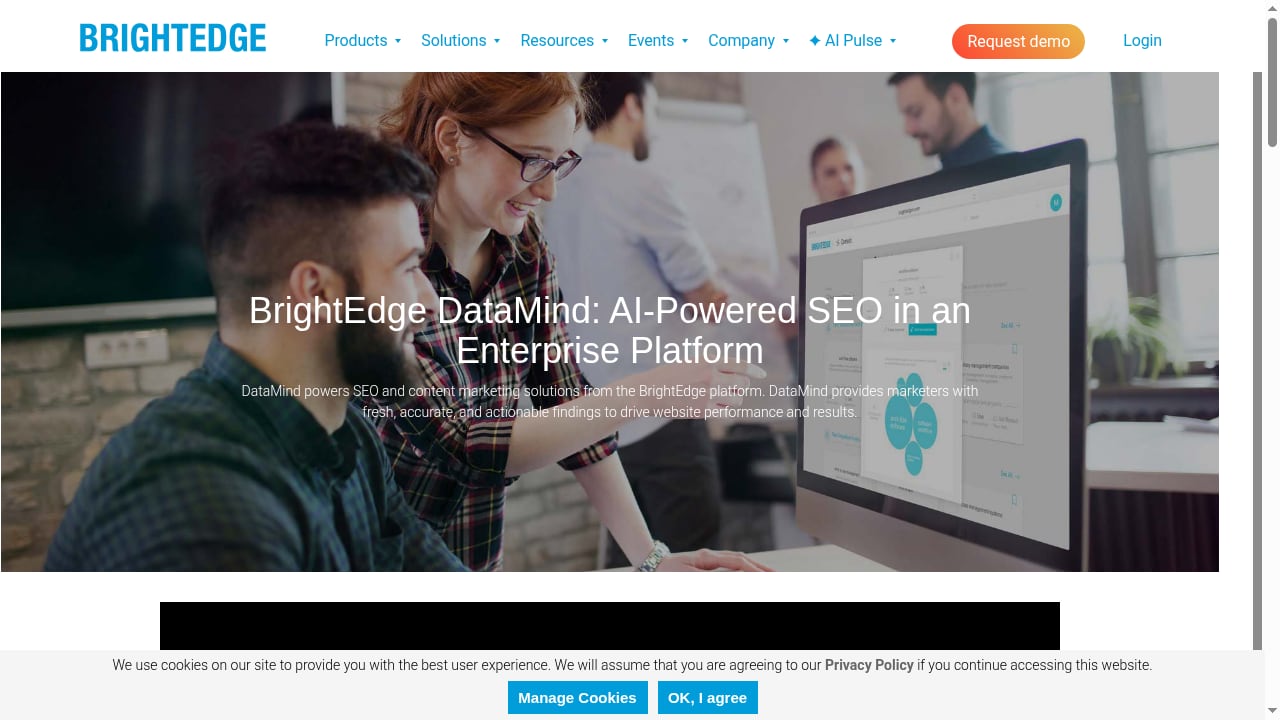
First viewport screenshot of DataMind.
BrightEdge does not publish pricing on its website. Based on third-party deal data, contracts commonly land near a median of roughly $50,000 per year, with pricing structured around domain count, seat count, and custom modules. Contracts typically favor annual or multi-year commitments, and there is no free trial.
That structure has practical consequences:
- Budget approval usually requires executive sign-off.
- Total cost rises with the number of domains and seats you add.
- Negotiating leverage improves when you have clear volume commitments and competing quotes.
- The absence of a trial means your evaluation depends on demos and reference calls.
If you are comparing enterprise contracts, our breakdown of AI marketing automation software includes pricing evidence and decision criteria for both lean teams and enterprises.
Setup and onboarding
BrightEdge is not a plug-and-play tool. Expect a structured onboarding process that involves:
- Scoping — defining domains, business units, and regions to track.
- Technical integration — connecting analytics platforms and crawl access.
- Configuration — setting up keyword groups, dashboards, and reporting views.
- Training — enabling SEO, content, and technical users across teams.
Organizations with a dedicated onboarding budget and a customer success contact get through this faster. Teams without those resources often find the ramp-up slow.
Strengths and limitations
Strengths
- Deep keyword and competitive data across many domains and regions.
- AI search visibility tracking that addresses a real 2026 shift.
- Automation for repetitive on-page work through Copilot and Autopilot.
- Reporting built for executive stakeholders, not just practitioners.
- Established enterprise customer base and long operating history.
Limitations
- No public pricing and no free trial, which raises evaluation risk.
- High cost threshold that excludes small teams and solo practitioners.
- Long setup and onboarding relative to self-serve tools.
- Rigid contract terms that favor annual commitments.
- Public sentiment is mixed: employee reviews on Glassdoor are notably critical, and practitioner discussion on r/SEO includes complaints about aggressive sales outreach and perceived value relative to price.
Those sentiment signals do not determine whether the product works for your use case, but they are worth weighing during procurement, especially if internal stakeholder patience is limited.
How to decide: a practical framework
Score yourself against these criteria before requesting a demo.
| Question | Lean toward BrightEdge | Lean elsewhere |
|---|---|---|
| How many domains do you manage? | 10+ | 1–5 |
| Is there a dedicated SEO owner? | Yes, plus supporting teams | One generalist |
| Can you commit to an annual contract? | Yes | No |
| Do you need AI answer visibility tracking? | Yes, as a priority | Not yet |
| Is there budget for onboarding? | Yes | No |
| Do you need a trial before buying? | No | Yes |
If you answer "lean elsewhere" on three or more rows, a self-serve platform is likely the better first purchase. If you answer "lean toward BrightEdge" on most rows, the platform's depth is worth the procurement effort.
For teams evaluating adjacent workflow tools, our comparison of AgentBooks, AirOps, and Averi covers how content engines differ on brand intelligence, AI search visibility, and publishing workflow.
Related reading
- How to Use AgentBooks with SE Ranking: AI SEO Workflow - Combine AgentBooks content automation with SE Ranking SEO data to plan, publish, and measure content. Step-by-step workflow, examples, and FAQs.
- AgentBooks vs QuickCreator vs GTM AI for Solo Founders - Compare AgentBooks, QuickCreator's AI content team, and GTM AI for solo founders. See which fits content automation, publishing, and go-to-market tasks.
- AgentBooks vs Growth Engine Hub: Which AI Content Engine Wins? - AgentBooks vs Growth Engine Hub compared: brand intelligence, keyword planning, publishing workflow, channels, and pricing to pick the right AI content engine.
Sources and further reading
- BrightEdge Review (2026): Features, Pricing, and Pros & Cons - BrightEdge review 2026: no public pricing page, Vendr deal data near $50k median, G2 4.4/5 rating, and why small teams should skip this platform.
FAQ
Does BrightEdge offer a free trial?
No. BrightEdge does not publish a free trial. Evaluation happens through demos, sales conversations, and reference calls with existing customers.
How much does BrightEdge cost?
BrightEdge does not publish pricing. Third-party deal data suggests contracts commonly land near a median of roughly $50,000 per year, with final pricing depending on domain count, seat count, and selected modules.
Is BrightEdge good for small businesses?
Generally no. The platform is priced and structured for enterprise teams managing multiple domains. Small businesses and solo consultants are usually better served by lighter, self-serve tools.
What is DataMind in BrightEdge?
DataMind is BrightEdge's AI and deep learning engine. It powers recommendations, forecasting, and findings across modules such as Data Cube X and Copilot.
Can BrightEdge track visibility in AI search engines?
Yes. Modules such as AI Hyper Cube and AI Agent Insights are built to show how brands appear in AI-generated answers, which sources those systems cite, and where competitors are positioned.
What is the biggest drawback of BrightEdge?
For most evaluators, the biggest drawback is the combination of no public pricing, no free trial, and rigid multi-year contracts. That makes it hard to assess fit before committing significant budget.
Conclusion
BrightEdge remains a capable enterprise SEO platform with genuine depth in keyword research, competitive analysis, and now AI search visibility. Its case studies show the scale of outcomes large organizations pursue with it, and its newer AI modules address a shift that most SEO teams can no longer ignore.
The trade-offs are equally clear: no public pricing, no trial, high cost, and a setup process that assumes dedicated resources. If you manage a large portfolio and can commit to the procurement cycle, BrightEdge deserves a serious look. If you are a small team or solo practitioner, the honest answer is that you will likely get more value from a lighter platform — and you can start by comparing options in our enterprise SEO and AI search platform ranking.