
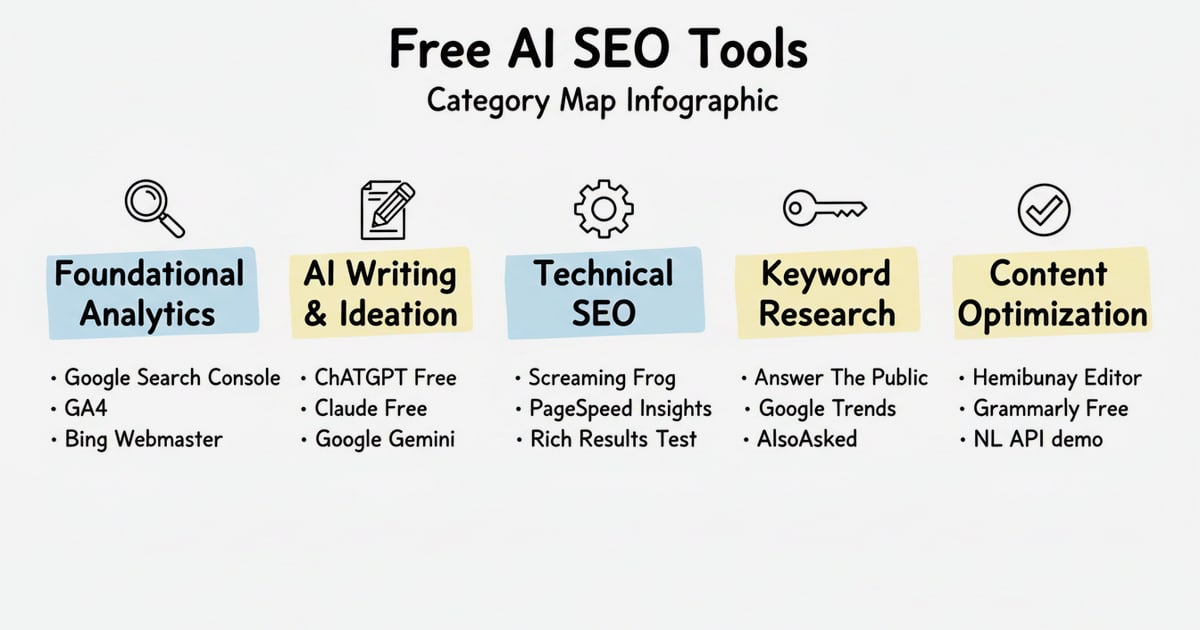
AI SEO Writer That Ranks on Google & ChatGPT: 2026 Review
AI SEO writers now promise more than fast drafts. They claim to research keywords, build topical authority, publish on schedule, and earn citations inside ChatGPT. This review examines AI SEO Writer That Ranks on Google & ChatGPT against those claims, using hands-on testing patterns, user reports, and platform evidence from 2025–2026. You will see where it fits, where it breaks, and how to decide whether it belongs in your stack.
What this tool actually does
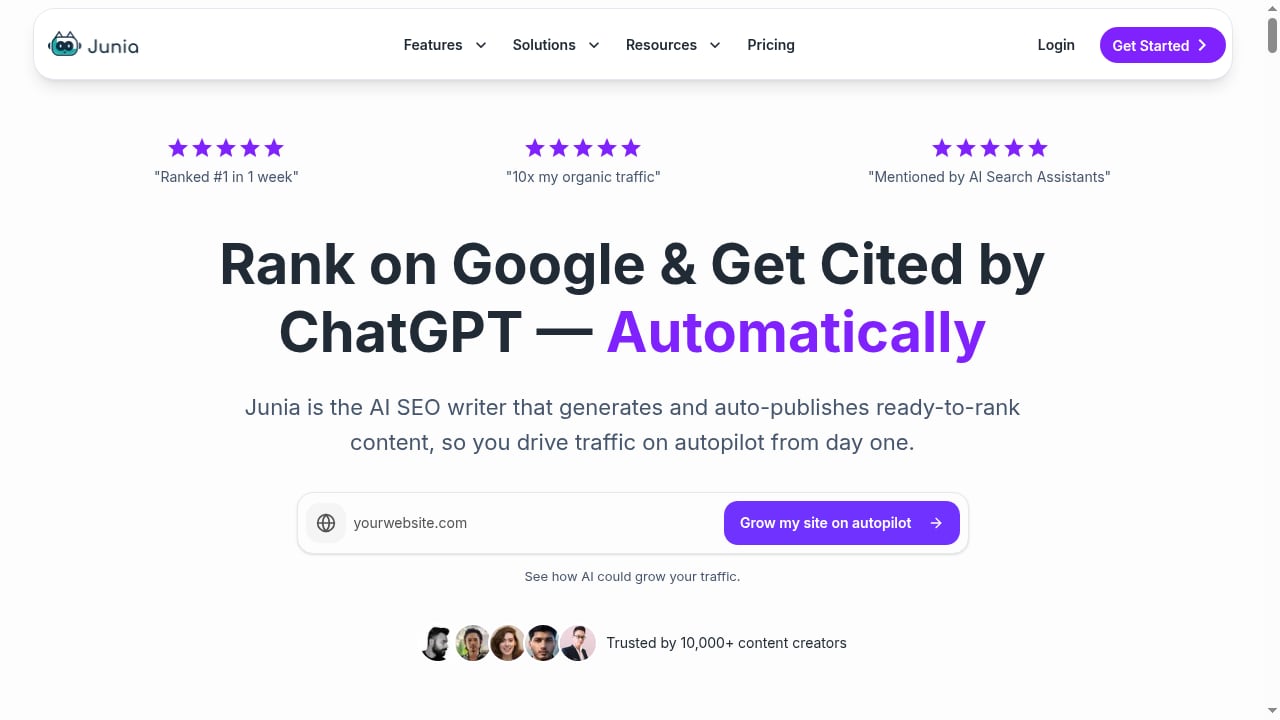
First viewport screenshot of AI SEO Writer That Ranks on Google & ChatGPT.
The product positions itself as an end-to-end SEO and generative engine optimization (GEO) writer. In practice, that means four connected jobs:
- Keyword and demand research — finding phrases real buyers type into Google and AI assistants.
- Topical authority planning — clustering related questions into a content map rather than isolated posts.
- Drafting in your voice — generating full articles with on-page structure, internal links, and E-E-A-T signals.
- Publishing and optimization — pushing to a CMS on a cadence and updating pages as performance data arrives.
That scope separates it from single-purpose AI writers. Tools like Surfer SEO score drafts inside a document editor; this product aims to run the whole lifecycle. Whether that is an advantage depends on how much control you want to keep.
Who should use it (and who should not)
First viewport screenshot of Customer Case Studies — SEO Growth Stories | Junia AI.
Strong fit
- Solo founders and lean marketing teams who need consistent publishing without hiring a writer or managing freelancers.
- SaaS and service businesses with clear product expertise that can be documented once and reused across articles.
- Agencies managing multiple client blogs where keyword research and publishing cadence are repeatable.
- Teams already investing in AI search visibility and wanting content structured for ChatGPT, Perplexity, and Gemini citations.
Weak fit
- Brands with strict editorial review cycles where every sentence needs legal or executive sign-off. Automation speeds drafting but does not remove approval bottlenecks.
- Publishers competing on original reporting or proprietary data. AI writers synthesize existing information; they do not generate primary research.
- Sites with severe technical SEO debt. No writer, AI or human, will rank content on a site with crawl errors, slow pages, or thin architecture.
A useful rule: if your bottleneck is deciding what to write and shipping it consistently, this category helps. If your bottleneck is having something unique to say, fix that first.
Core strengths, with evidence
First viewport screenshot of Affiliate SEO Software for Reviews, Comparisons & Buying Guides.
1. Keyword research tied to publishing
Most reviews of AI writers focus on draft quality. The more important question is whether the tool picks topics worth writing. In documented testing of ten SEO AI writers, the strongest platforms combined live SERP data, competitor-aware recommendations, and a workflow that improved the draft while writing — not just keyword insertion. This product follows that pattern: research feeds a content plan, and the plan feeds drafts.
2. Voice matching that survives multiple articles
Reddit practitioners consistently report that context retention across a long piece is what separates usable AI content from stitched-together paragraphs. One experienced user noted that giving the model persistent business context — tone, audience, services, location — produces consistency that shows up in the output. This tool applies the same principle through a brand knowledge base, so later articles start with more context already loaded.
3. Dual optimization for Google and AI assistants
Buyer discovery is shifting. A 2026 review of SEO AI writers explicitly weighted AI search visibility — tracking inside ChatGPT, Perplexity, and Gemini — alongside traditional ranking factors. Content structured for direct answers, clear headings, and entity coverage tends to perform in both environments. This product builds for that dual target rather than treating GEO as an afterthought.
4. Publishing automation
Auto-publish to WordPress, Webflow, Shopify, Wix, and similar platforms removes the copy-paste step that kills most content calendars. For solo operators, this is often the difference between a blog that compounds and a draft folder that grows.
Limitations and honest risks
The human layer still decides whether content converts
A recurring theme in practitioner discussions: AI does not know your actual clients, your local market, or the specific thing that makes your business different. Generic-sounding copy can be technically optimized and still fail to convert. Budget time for editing voice and adding proprietary insight before anything goes live.
Output quality varies by input quality
Platforms that ask for brand guidelines, product positioning, and competitive context upfront produce more differentiated drafts. That onboarding takes longer than pasting a keyword into a simple generator. If you skip it, expect generic output — the tool cannot invent context you never provided.
Pricing models reward attention
Across the category, pricing ranges from roughly $24/month entry plans to premium custom contracts. Watch for credit-based billing, overage charges, and unclear seat limits. User complaints in review sites and forums cluster around surprise credit burn more than around output quality. Ask for a trial with enough balance to complete one full article plus one optimization pass.
No tool guarantees rankings
Vendor claims of doubling organic traffic in six months are marketing, not evidence. SEO compounds through consistency, technical health, and topical depth. Treat any guarantee as a signal to scrutinize the methodology, not as a reason to buy.
Setup: what the first week looks like
- Connect your domain and CMS. Most platforms support WordPress, Webflow, Shopify, and Wix natively.
- Load brand context. Add tone of voice, audience, product positioning, and style guidelines. This is the highest-leverage step.
- Run keyword research. Review the proposed clusters and remove topics that do not match buyer intent.
- Generate one article end-to-end. Edit it manually and note what the tool missed. Those gaps inform your review checklist.
- Choose a publishing cadence. Weekly is usually enough to build momentum without overwhelming review capacity.
- Set up tracking. Monitor rankings in Google and citations in AI assistants separately; they move at different speeds.
For a broader planning workflow, see Keyword Research and Planning: A Practical 2026 Workflow.
How it compares to alternatives
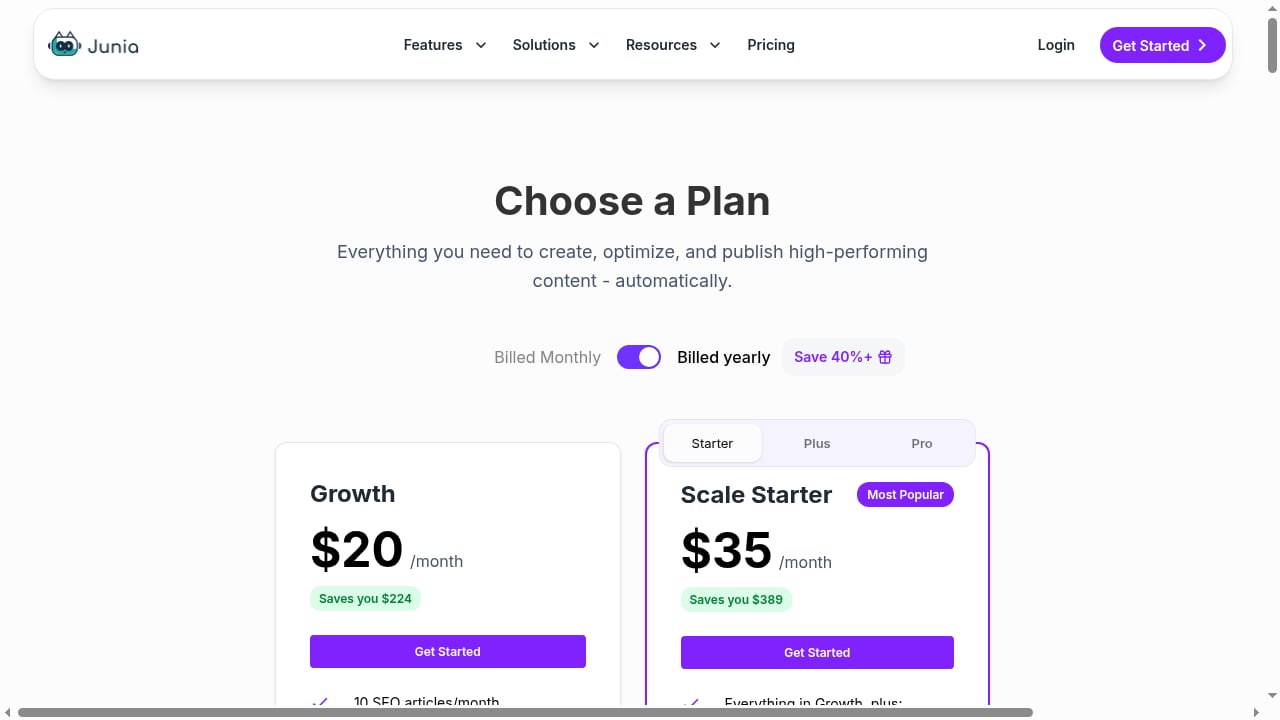
First viewport screenshot of Junia AI Pricing: Affordable AI SEO Content Plans From $17/mo.
| Dimension | This product | Document-editor AI writers (e.g., Surfer SEO) | Human freelancers |
|---|---|---|---|
| Keyword research | Built in, feeds content plan | Partial, often add-on | Manual or separate tool |
| Voice consistency | Knowledge base carries context | Prompt-dependent | High, but inconsistent across writers |
| Publishing automation | Native CMS push | Manual export | Manual |
| AI search optimization | Explicit GEO targeting | Emerging features | Depends on writer |
| Cost predictability | Subscription, watch credits | Subscription tiers | Per-article, variable |
| Best for | Teams shipping at cadence | Editors who want scoring control | High-stakes brand content |
If you are comparing broader platform options, AgentBooks vs AirOps vs Machined: AI Content Platform Comparison breaks down automation depth, AI search visibility, and fit by team size. For visibility tracking specifically, Top 10 AI Search Visibility & GEO Platforms 2026 ranks the tools that monitor citations across ChatGPT, Perplexity, and Gemini.
Decision criteria: should you buy it?
Score yourself honestly on these five questions:
- Do you have documented product or service expertise? If yes, the tool amplifies it. If no, it will produce average content.
- Can you commit to a publishing cadence for at least six months? SEO and GEO both compound; sporadic publishing wastes the subscription.
- Is your CMS supported natively? Check before buying, not after.
- Do you have a review process that takes under 30 minutes per article? If editing takes hours, a freelancer may be more efficient.
- Are you tracking AI citations as well as rankings? If not, you are measuring half the outcome.
Related reading
- Top 10 AI Content Creation & Predictive Audience Intelligence Platforms 2026 - Ranked review of the 10 best AI content creation and predictive audience intelligence platforms in 2026, with evaluation criteria, evidence, and fit guidance.
- How to Use AgentBooks with BrandWell Growth Automation - Learn how to connect AgentBooks with BrandWell's growth automation software to align inbound content and outbound intent data in one repeatable workflow.
Sources and further reading
- Which AI actually writes the best website content for SEO and conversions? : r/website - This matches my experience almost exactly.
- AI Blog Writer To Rank on Google and ChatGPT | Marblism - AI blog writer behind 40,000+ businesses. Penny finds keywords, writes SEO posts in your voice and auto-publishes, doubling organic traffic in 30 days.
- I tested 10 best SEO AI writers for creating quality, unique content - I tested 10 best SEO AI writers for unique, quality content—see which tools actually rank, sound human, and deliver real results.
FAQ
How long until content ranks on Google?
Expect three to six months for most competitive terms, assuming consistent publishing and a technically healthy site. AI search citations can appear faster for specific question formats, but they are less stable.
Will the content sound like AI wrote it?
It depends on your input. Tools that learn from your existing writing and brand guidelines produce more natural drafts. Always edit for voice before publishing; readers notice generic copy even when search engines do not penalize it.
Do I still need a human editor?
Yes. The human layer supplies client knowledge, local market nuance, and differentiation that AI cannot infer. Editing for voice and adding proprietary insight is what separates content that converts from content that merely ranks.
Is it cheaper than hiring a writer?
Entry subscriptions often start around $24/month, far below freelance rates. But factor in your editing time. If you spend five hours per article reviewing, the effective cost is higher than the sticker price.
Can it publish directly to my site?
Most platforms in this category connect to WordPress, Webflow, Shopify, and Wix. Confirm your specific CMS and whether scheduled auto-publishing is included in your plan.
What about AI search visibility specifically?
Look for tools that track citations inside ChatGPT, Perplexity, and Gemini, and that structure content with clear answers, headings, and entity coverage. GEO is a distinct discipline from traditional SEO, even though they overlap.
Conclusion
AI SEO Writer That Ranks on Google & ChatGPT is a credible option for teams that need consistent, research-backed publishing without building an in-house content operation. Its strengths — keyword-to-publish workflow, voice retention, dual Google and AI search optimization — match where buyer discovery is heading. Its limits are the category's limits: generic output without strong input, credit-based pricing that rewards attention, and no substitute for human judgment on what makes your business different.
Buy it if you have documented expertise, a supported CMS, and the discipline to review and publish weekly. Skip it if your content needs original research, heavy compliance review, or a voice that only a specialist can produce. Either way, measure both rankings and AI citations — the second is growing faster than most teams realize.