
AI Visibility: How to Get Cited by AI Search Engines
AI visibility is how often and how prominently your brand, content, or website appears in answers generated by AI search engines and assistants such as ChatGPT, Perplexity, Google AI Overviews, Gemini, and Copilot. It is not a ranking position. It is a citation decision: either the model names you as a source, or it does not.
That shift changes what marketing teams need to measure and produce. This guide explains how AI engines choose sources, how to track your presence, and how to build a repeatable workflow that improves your odds of being cited.
What AI visibility actually means
AI Visibility: How to Get Cited by AI Search Engines - What AI visibility actually means.
Traditional SEO visibility measures where a page ranks in a list of links. AI visibility measures whether your content is synthesized into a generated answer. There is no "position 7" in an AI response. You are either included or invisible.
A complete view of AI visibility covers five dimensions:
- Platform breadth: your presence across ChatGPT, Perplexity, Google AI Overviews, Gemini, Claude, Copilot, and Grok.
- Query depth: the range of relevant prompts where you appear, from broad category questions to specific comparisons.
- Citation quality: whether you are treated as a primary authority, a supporting source, or a passing mention.
- Competitive positioning: how your citation frequency and sentiment compare with direct competitors.
- Temporal consistency: whether your visibility holds steady or fluctuates with model updates and content changes.
Treating AI visibility as a one-time audit misses the point. The brands that benefit most run it as an ongoing program.
Why AI visibility matters now

AI Visibility: How to Get Cited by AI Search Engines - Why AI visibility matters now.
The way people find information is changing faster than most teams realize. Three trends make this a strategic priority.
The zero-click trend is accelerating
A large share of search sessions now end without a click to any website. When AI answers appear, organic click-through rates drop significantly. Gartner has predicted that traditional search volume will decline 25% by 2026 and that organic search traffic could fall more than 50% by 2028. These are not speculative figures; they reflect a structural change in user behavior.
Publishers are blocking AI crawlers, creating scarcity
Many major news sites now block at least one AI bot, with GPTBot among the most commonly blocked. This creates a content scarcity problem for AI engines. Brands that allow AI crawling and publish high-quality, well-structured content have an outsized opportunity to be cited.
Citations create measurable business value
Being cited by AI engines is not just a vanity metric. Brands that appear in AI Overviews see higher click-through rates than brands that are not cited. Even in a zero-click environment, the exposure from an AI citation drives awareness, consideration, and downstream conversions.
How AI engines decide what to cite
AI Visibility: How to Get Cited by AI Search Engines - How AI engines decide what to cite.
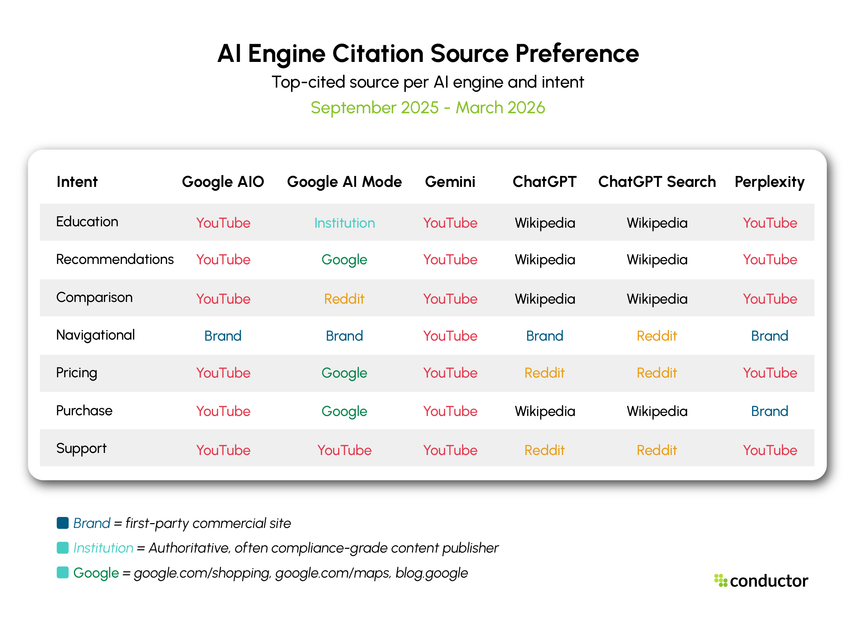
Each platform uses different methods, but several common patterns emerge from studying citation behavior across ChatGPT, Perplexity, Google AI Overviews, and other engines.
Source authority signals
AI engines prioritize content that demonstrates expertise and trustworthiness. The signals they evaluate include:
- Domain authority and reputation: established domains with strong backlink profiles and long publication histories receive more citations.
- Content freshness: recently published or updated content is favored over older material covering the same topic.
- Factual density: content with specific statistics, data points, and cited research is more likely to be referenced than vague claims.
- Structured formatting: clear headings, bullet lists, tables, and FAQ sections make it easier for models to parse and extract citations.
- Author expertise signals: clear authorship, author bios, and credentials receive a trust boost, especially for sensitive topics.
Content structure preferences
AI engines do not read content the way humans do. They extract discrete pieces of information and synthesize them into answers. This means your structure directly affects whether your content is usable as a citation. Pages that answer a specific question in a self-contained section are easier to quote than pages that bury the answer in long narrative passages.
How to measure AI visibility
AI Visibility: How to Get Cited by AI Search Engines - How to measure AI visibility.
You cannot improve what you do not measure. A practical measurement program combines manual checks, dedicated tools, and analytics.
Manual prompt tracking
Start by listing the prompts your customers actually ask. Include broad category questions, comparison queries, and problem-specific questions. Run them across ChatGPT, Perplexity, Google AI Overviews, and Gemini. Record whether your brand is mentioned, which competitors appear, and which sources are cited.
Dedicated AI visibility tools
A growing category of tools tracks brand mentions across AI engines. Options range from affordable entry-level platforms to enterprise suites. When evaluating them, look for:
- Tracking across multiple AI engines, not just one.
- Citation source detection so you know which pages are being referenced.
- Brand visibility scoring and share of voice against competitors.
- Sentiment analysis to catch negative or inaccurate mentions.
- Trend tracking over time, not just a single snapshot.
- AI crawler visibility checks to confirm your pages are accessible.
Tools such as OtterlyAI, Peec AI, ZipTie, Semrush, and Ahrefs Brand Radar each approach this differently. Zapier's roundup of the best AI visibility tools is a useful starting point for comparing features and pricing.
Connect visibility to outcomes
AI visibility data becomes more valuable when tied to business results. If you can connect citation trends to traffic, signups, or pipeline, you can justify investment and prioritize the prompts that matter most.
A practical workflow to improve AI visibility
Improving AI visibility is not a single tactic. It is a content operation. Here is a workflow that works for SaaS teams, e-commerce stores, independent sites, and agencies.
1. Build a source of truth about your product
AI engines cite content that is specific, accurate, and consistent. Start by documenting what your product does, who it is for, and how it differs from alternatives. A reusable brand data platform or knowledge base keeps this consistent across every page you publish.
2. Map topics to real prompts
Move beyond keyword lists. Map topics to the questions your customers ask AI assistants. Group them into categories: category education, comparison, problem-solving, and implementation. This becomes your prompt coverage plan.
3. Research what already ranks and gets cited
Before writing, study the organic results and the sources AI engines currently cite for your target prompts. This shows you the format, depth, and evidence level required to compete. It also reveals gaps where no strong source exists yet.
4. Produce structured, evidence-based content
Write content that is easy to extract. Use clear headings, short paragraphs, bullet lists, and tables. Include specific data, examples, and citations. Answer the core question early in the section, then add depth. For a repeatable framework, see this guide to SEO content optimization.
5. Publish consistently and update
AI engines favor freshness. A steady publishing cadence signals that your site is active and authoritative. Updating existing pages with new data and examples is often more effective than publishing new pages on the same topic.
6. Track, analyze, and iterate
After publishing, monitor whether your pages are being cited. If a competitor is cited instead, study their content structure and evidence. If your page is cited but sentiment is negative, investigate the source of the claim. Use these signals to refine your next batch of content.
Where AI content automation fits
Scaling this workflow manually is difficult. Research, writing, publishing, and monitoring all take time, and consistency is what drives AI visibility.
This is where an AI content marketing automation platform can help. AgentBooks, for example, is designed to turn a company's website into an always-on content engine. It starts by crawling your site to build a reusable source of truth, then builds a categorized keyword plan, generates articles with approval workflows, and publishes to a hosted content site with custom domain support. The platform connects product understanding, market research, keyword planning, article creation, publishing, and future updates in one workspace.
That kind of system is useful when you need to produce content at a pace that keeps up with AI engine freshness signals. It is not a replacement for strategy. You still need to decide which prompts matter, what evidence to include, and how to measure results. But it removes the bottleneck between planning and publishing.
If you are comparing tools, this ContentBot.ai review covers one alternative and where it fits in a broader content workflow.
Common mistakes that hurt AI visibility
- Publishing thin content: pages without specific data or examples rarely get cited.
- Ignoring structure: long, unbroken text is harder for models to extract.
- Chasing keywords instead of prompts: AI engines respond to questions, not just keyword strings.
- Blocking AI crawlers unintentionally: check your robots.txt and server settings.
- Treating it as a one-time project: AI visibility fluctuates with model updates and competitor moves.
- Neglecting sentiment: a mention is not always a positive mention.
Related reading
- CRM QuickCreator: How AI Content Connects to Your CRM - See how QuickCreator's Conversion Agent turns articles into CRM-ready leads, what it does well, where it stops, and how AgentBooks fits the workflow.
- Machined Meaning: Definition, Synonyms, and AI Content Use - Machined means made or finished by machine, or cut and shaped with precision. Learn the definition, synonyms, and why the word now describes AI content workflows.
- QuickCreator Review: AI Content Team for Solo Founders - QuickCreator review: how its AI content agents handle brand voice, E-E-A-T, and publishing for solo founders. Compare features, pricing, and alternatives.
Sources and further reading
- Get Your Free AI Visibility Report - See where you stand and start optimizing your AI search performance, all for free, inside Amplitude.
- What Is AI Visibility? The Complete Guide to Getting Cited by AI Search Engines (2026) - AI visibility is how brands get cited in ChatGPT, Perplexity, and Google AI Overviews. Learn how to measure, track, and improve your AI search presence.
FAQ
What is AI visibility in simple terms?
AI visibility is whether AI search engines and assistants mention or cite your brand when users ask relevant questions. It is measured by citation presence, not search ranking position.
How is AI visibility different from SEO?
SEO visibility measures where you rank in a list of links. AI visibility measures whether your content is synthesized into a generated answer. The success signal is a citation, not a click.
Which AI platforms should I track?
At minimum, track ChatGPT, Perplexity, Google AI Overviews, and Gemini. Depending on your audience, add Claude, Copilot, and Grok. Platform usage varies by region and industry.
How long does it take to improve AI visibility?
It depends on your starting point and publishing cadence. Some pages get cited within weeks; broader category visibility often takes several months of consistent, structured publishing and updates.
Do I need special tools to measure AI visibility?
You can start with manual prompt tracking. Dedicated tools make it easier to track multiple engines, detect citation sources, score share of voice, and monitor sentiment over time.
Can AI content automation help with AI visibility?
It can help with the production and consistency side. Platforms like AgentBooks handle research, planning, generation, and publishing in one workspace, which makes it easier to maintain the freshness and coverage that AI engines reward. Strategy and measurement still require human judgment.
Conclusion
AI visibility is becoming as important as traditional search visibility. The brands that win will be the ones that treat it as an ongoing program: understand how AI engines choose sources, measure citations across platforms, produce structured and evidence-based content, and iterate based on what gets cited.
Start with a small set of high-value prompts. Track them manually. Study the sources AI engines currently cite. Then build a publishing workflow that keeps your content fresh and specific. Whether you scale that with an automation platform or a manual process, the principle is the same: be the source that AI engines can trust and easily extract.