
Clearscope Review 2026: AI Search Visibility, Pricing, and Who It Fits
Clearscope has repositioned itself from a content optimization tool into what it calls a discoverability platform for Google, ChatGPT, Gemini, and Claude. That shift matters if you are evaluating it in 2026, because the product now spans three jobs: finding queries worth targeting, drafting and optimizing content against them, and monitoring whether your brand actually shows up in AI answers. This review breaks down what Clearscope does well, where it strains, what it costs in practice, and how to decide whether it belongs in your stack.
What Clearscope actually does
Clearscope | Get Discovered on Google & AI Search product interface.
Clearscope's core loop has three stages, and each maps to a distinct workflow.
1. Query discovery and intent analysis
You enter a topic or a competitor URL, and Clearscope surfaces the queries driving traffic and attention across Google and AI platforms. The intent analysis layer goes beyond keyword lists to explain why a query is being asked, which is the part most keyword tools skip. In practice this is useful for building a topic cluster rather than a pile of disconnected posts.
2. Drafting and optimization
Clearscope's editor scores your draft against a set of term suggestions drawn from top-ranking content. The AI drafting workflow is designed to get you past the blank page, and the optimization layer then tells you which terms, entities, and subtopics are missing. Teams report meaningful time savings here. One published customer quote cites a reduction of 1.5 to 3 hours per article, roughly 10 to 20 percent of total production time.
3. Visibility monitoring
Query Tracking monitors how your brand is mentioned across ChatGPT, Gemini, and Claude, and shows where competitors get recommended instead. This is the newest and most differentiated piece, because it addresses a real gap: there is no native analytics console for AI recommendations, so most teams are still testing manually.
Who Clearscope is built for
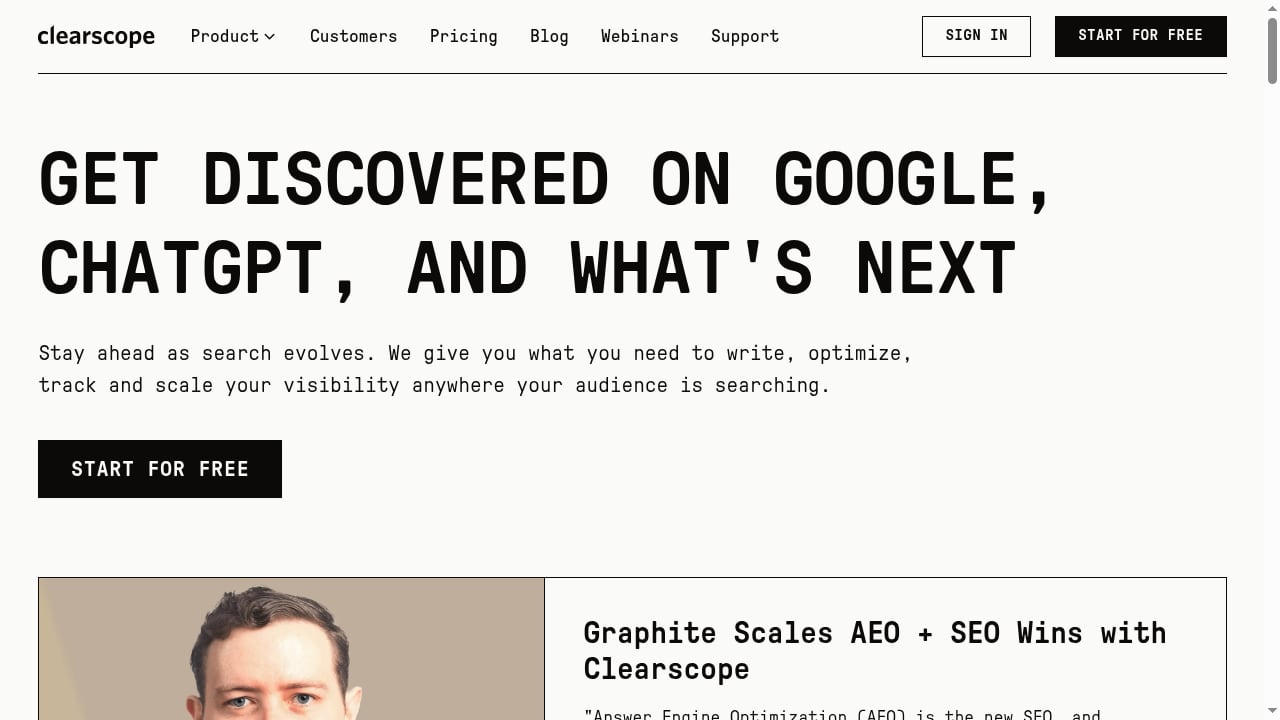
First viewport screenshot of Clearscope | Get Discovered on Google & AI Search.
Clearscope's own positioning spans solo creators through Fortune 500 content teams. In practice, the fit is narrower than that.
Strong fit:
- Content teams producing 8 or more optimized articles per month who need a consistent scoring standard across writers
- SEO managers who need to justify content investment with visibility data across both Google and AI surfaces
- Agencies managing multiple client domains where per-seat collaboration and shared views reduce review friction
Weak fit:
- Solo founders publishing 1 to 2 posts a month, where the subscription cost per article becomes hard to defend
- Teams whose bottleneck is publishing and distribution rather than research and optimization
- Anyone expecting AI visibility tracking to be a precise, auditable measurement rather than a directional signal
Strengths worth paying for
The optimization scoring is genuinely best-in-class. The term suggestion engine is the feature Clearscope built its reputation on, and it remains the reason most teams stay. It is prescriptive without being rigid, which makes it usable across writers with different skill levels.
AI visibility tracking closes a real blind spot. If your buyers start research in ChatGPT or Claude, you currently have no dashboard telling you whether you appear. Clearscope's Query Tracking gives you a repeatable view of that, plus competitor displacement data. That alone justifies a trial for brands with meaningful AI-referred pipeline.
Collaboration is built for teams, not individuals. Shared content views, pre-built and custom analytics views, and multi-user editing reduce the back-and-forth that plagues single-player SEO tools.
Documented outcome claims exist. Clearscope publishes specific customer results, including a 52 percent organic traffic increase on optimized content and a 130 percent growth in non-branded keyword traffic on one customer's blog. These are vendor-published and should be treated as directional, but they are specific rather than vague.
Limitations and honest trade-offs
AI visibility measurement is inherently imprecise. LLM outputs vary by session, model version, and prompt phrasing. Any tool claiming to track AI mentions is giving you a sampled signal, not a census. Clearscope is not exempt from this. Treat Query Tracking as a trend indicator, not a scoreboard.
Pricing is not published transparently. Clearscope does not list public pricing tiers on its site, which means you cannot evaluate cost-per-seat without a sales conversation. Budget accordingly and expect annual commitment structures typical of this category. If you need published, comparable pricing before you can get internal approval, this is friction.
Optimization scores can encourage padding. Term-suggestion tools reward coverage. Writers who chase a score rather than answer a question produce content that reads as complete but says little. The tool does not prevent this; editorial judgment still has to.
It is not a publishing or distribution engine. Clearscope helps you research, write, and measure. It does not automate publishing, manage your CMS workflow end to end, or run distribution. If that is your gap, you need a different layer.
How Clearscope compares to adjacent options

Clearscope customer Graphite.
| Need | Clearscope | Typical alternative |
|---|---|---|
| Content optimization scoring | Strong, category benchmark | Surfer SEO, Frase |
| AI visibility tracking | Included | Often a separate point tool |
| Drafting from scratch | AI drafting workflow | Dedicated AI writing engines |
| Publishing automation | Not a focus | Workflow automation platforms |
| Published pricing | Not listed | Varies widely |
If your primary need is content optimization with a team standard, Clearscope competes directly with other AI content planning and optimization tools. If your primary need is turning research into published output at volume, Clearscope is one input into a larger pipeline rather than the pipeline itself.
Setup and time-to-value
Clearscope is a browser-based SaaS tool with no installation. Realistic onboarding looks like this:
- Day one: Connect your domain, run Query Discovery on two or three core topics, and review the intent analysis output.
- Week one: Optimize one existing high-traffic page to calibrate how your team reads the scoring. Compare before-and-after visibility.
- Weeks two to four: Set up Query Tracking for your brand and two or three competitors. This is where you learn whether AI visibility is a real channel for you or a curiosity.
- Month two onward: Standardize the workflow across writers and start using content analytics views to protect rankings on published pages.
Time-to-value is fast for optimization and slower for AI visibility, because you need enough tracking history before the data means anything.
Decision criteria: should you buy it?
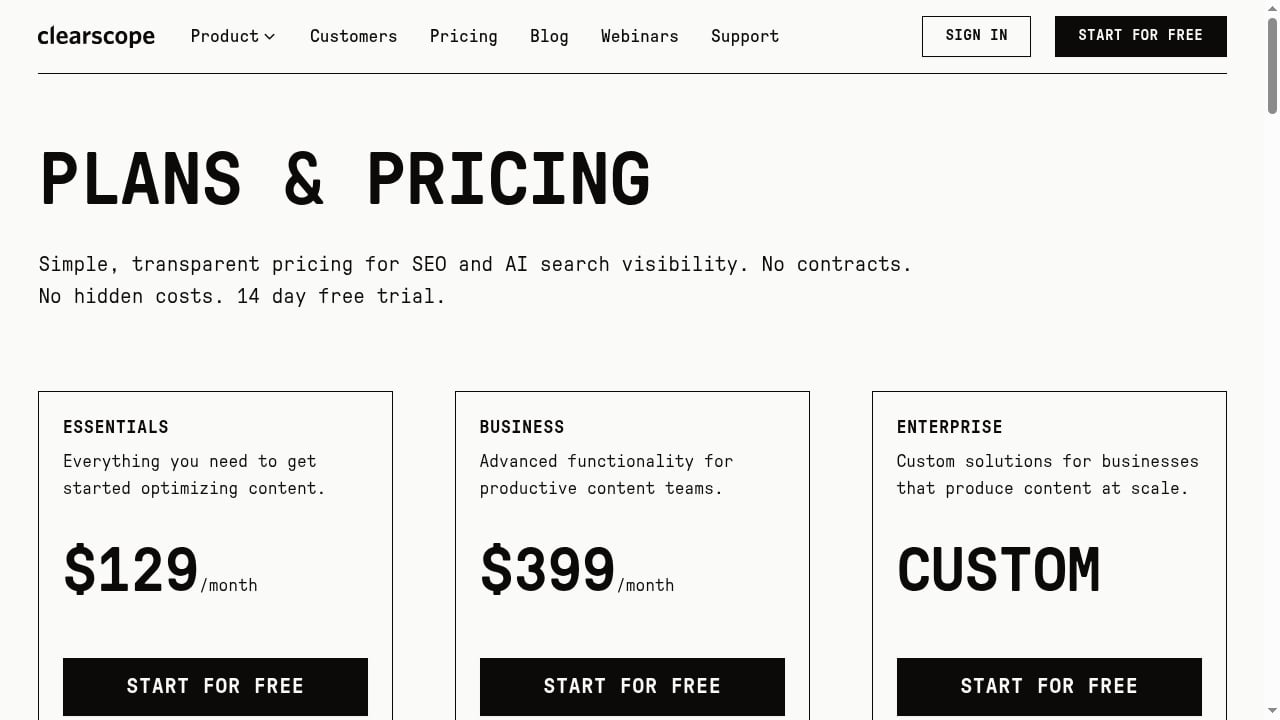
First viewport screenshot of Plans & Pricing | Clearscope.
Run through these questions before you commit.
- Do you publish enough to amortize the cost? Under roughly 5 optimized pieces a month, the math gets uncomfortable.
- Is AI search a real acquisition channel for you? Check your analytics for AI referrers and branded mentions in LLM answers. If it is negligible, the tracking feature is a nice-to-have.
- Do you need a team-wide scoring standard? This is Clearscope's strongest argument. If writers currently disagree about what "optimized" means, the tool solves that.
- Can you tolerate opaque pricing? If procurement requires published tiers, plan for a longer evaluation cycle.
- What is your actual bottleneck? If it is publishing and distribution, fix that first. Optimization tools amplify output; they do not create it.
For teams comparing broader platform choices, a structured evaluation framework helps — see this guide to marketing manager software for how to weigh suites against point tools. If you are pairing Clearscope-style research with a separate SEO data source, a combined content and SEO workflow is a useful reference for how the handoffs work.
Related reading
- How to Use AgentBooks with Fountain City: AI Content Workflow - Learn how AgentBooks and Fountain City work together: setup steps, a practical content workflow, real examples, and the problems this AI pairing solves.
- AgentBooks vs Brafton vs QuickCreator for Solo Founders - Compare AgentBooks, Brafton, and QuickCreator's AI content team for solo founders. See pricing, voice, automation, and which fits your workflow.
Sources and further reading
- Clearscope | Get Discovered on Google & AI Search - Clearscope is the discoverability platform for a new era in search. Improve and monitor your discoverability in Google, ChatGPT & beyond. Own your topical authority in your space and break through the blank page with best-in-class AI drafts.
- SEO for AI Startups — How to Get Discovered on Google and AI Search - An AI developer shares what a conversation with SEO Circular taught him about how AI startups get discovered on Google and AI-powered search in 2026.
- How are you even being discovered if AI assistants are the new search engine? : r/GrowthHacking - AI discovery and brand visibility in LLM responses isn't really my area since our clients focus on email deliverability, not search or AI recommendation optimization.
FAQ
Is Clearscope worth it in 2026? It depends on volume and whether AI visibility matters to you. For teams publishing regularly that need a shared optimization standard plus AI mention tracking, the value is defensible. For low-volume publishers, the cost per article is hard to justify.
Does Clearscope actually track ChatGPT and Gemini mentions? Yes, through Query Tracking. The caveat is that LLM outputs are non-deterministic, so results are sampled and directional rather than exact. Use it to spot trends and competitor displacement, not to report precise share of voice.
How much does Clearscope cost? Clearscope does not publish public pricing tiers. You need a sales conversation to get numbers. Expect annual commitment structures common in this category, and budget for a per-seat model.
How long does setup take? The tool itself is browser-based with no installation. You can run your first query discovery in under an hour. Meaningful AI visibility data takes several weeks of tracking history.
What is the biggest limitation? Two things: opaque pricing and the inherent imprecision of AI visibility measurement. Neither is disqualifying, but both should shape how you evaluate the tool.
Who should skip Clearscope? Solo publishers with low output, teams whose bottleneck is distribution rather than optimization, and buyers who require published pricing before they can proceed.
Conclusion
Clearscope has made a credible transition from content optimization tool to discoverability platform, and the AI visibility tracking is a genuine differentiator rather than a marketing label. The optimization engine remains the strongest reason to buy, and the Query Tracking feature is the strongest reason to re-evaluate it if you dismissed Clearscope years ago.
The honest caveats are pricing opacity and measurement imprecision. Neither makes the product bad; both mean you should trial it against your actual workflow before committing. If you publish at volume, need a team-wide quality standard, and want visibility data across Google and AI surfaces in one place, Clearscope earns a serious look. If your constraint is output volume or distribution, solve that first.