On-Page SEO: 11 Techniques That Still Work in 2026
On-page SEO is the practice of optimizing the visible content and underlying HTML of a webpage so search engines can understand it and match it to relevant queries. It covers everything from title tags and headings to internal links, image alt text, and the depth of the information itself.
In 2026, on-page SEO matters for two audiences at once: traditional search engines like Google and AI systems such as ChatGPT, Perplexity, and Google AI Overviews. Both pull from the same underlying signals—clear structure, accurate metadata, trustworthy content, and strong topical relevance. If a page is well optimized for one, it tends to perform better in the other.
This guide breaks down the core on-page techniques, explains why each one matters, and gives you a practical checklist you can apply to any page.
What Is On-Page SEO?
On-Page SEO: 11 Techniques That Still Work in 2026 - What Is On-Page SEO?.
On-page SEO is the process of improving individual webpages—their content, HTML source code, and structure—to rank higher and earn more relevant organic traffic. Unlike off-page SEO, which involves external signals such as backlinks and brand mentions, on-page SEO focuses entirely on elements you control directly.
Common on-page tasks include:
- Placing target keywords in strategic locations
- Writing accurate title tags and meta descriptions
- Structuring content with a logical heading hierarchy
- Optimizing URL slugs
- Adding descriptive image alt text
- Building internal links with meaningful anchor text
- Improving page speed and mobile usability
- Adding schema markup
These elements help search engines interpret what a page is about and whether it satisfies a searcher's intent. They also improve the experience for human visitors, which is increasingly the same thing.
Why On-Page SEO Still Matters
Search engines have become much better at understanding synonyms, context, and natural language. That does not make on-page optimization obsolete—it changes the emphasis. Keyword stuffing no longer works, but relevance, clarity, and structure matter more than ever.
A well-optimized page does three things:
- Helps search engines classify the page. Clear titles, headings, and structured content make it easier for crawlers and language models to extract meaning.
- Matches user intent. Pages that deliver the format and depth searchers expect are more likely to rank and get clicked.
- Improves the user experience. Readable headings, fast load times, and helpful internal links keep visitors engaged and reduce bounce rates.
On-page SEO also compounds. Small improvements across many pages can lift an entire site's visibility, especially when paired with a consistent publishing cadence.
On-Page SEO vs. Off-Page SEO

On-Page SEO: 11 Techniques That Still Work in 2026 - On-Page SEO vs. Off-Page SEO.
On-page and off-page SEO are complementary, but they operate in different spheres.
| On-Page SEO | Off-Page SEO |
|---|---|
| Title tags and meta descriptions | Link building |
| Keyword placement and content quality | Guest posting |
| URL slug optimization | Brand mentions |
| Internal linking | Social media signals |
| Image alt text and file names | Digital PR |
| Schema markup | Influencer outreach |
| Page speed and mobile usability | Local citations |
On-page SEO is the foundation. You control it fully, and it is the best starting point for any SEO strategy. Off-page signals amplify that foundation, but they are harder to earn without strong pages to link to.
11 On-Page SEO Techniques: A Practical Checklist
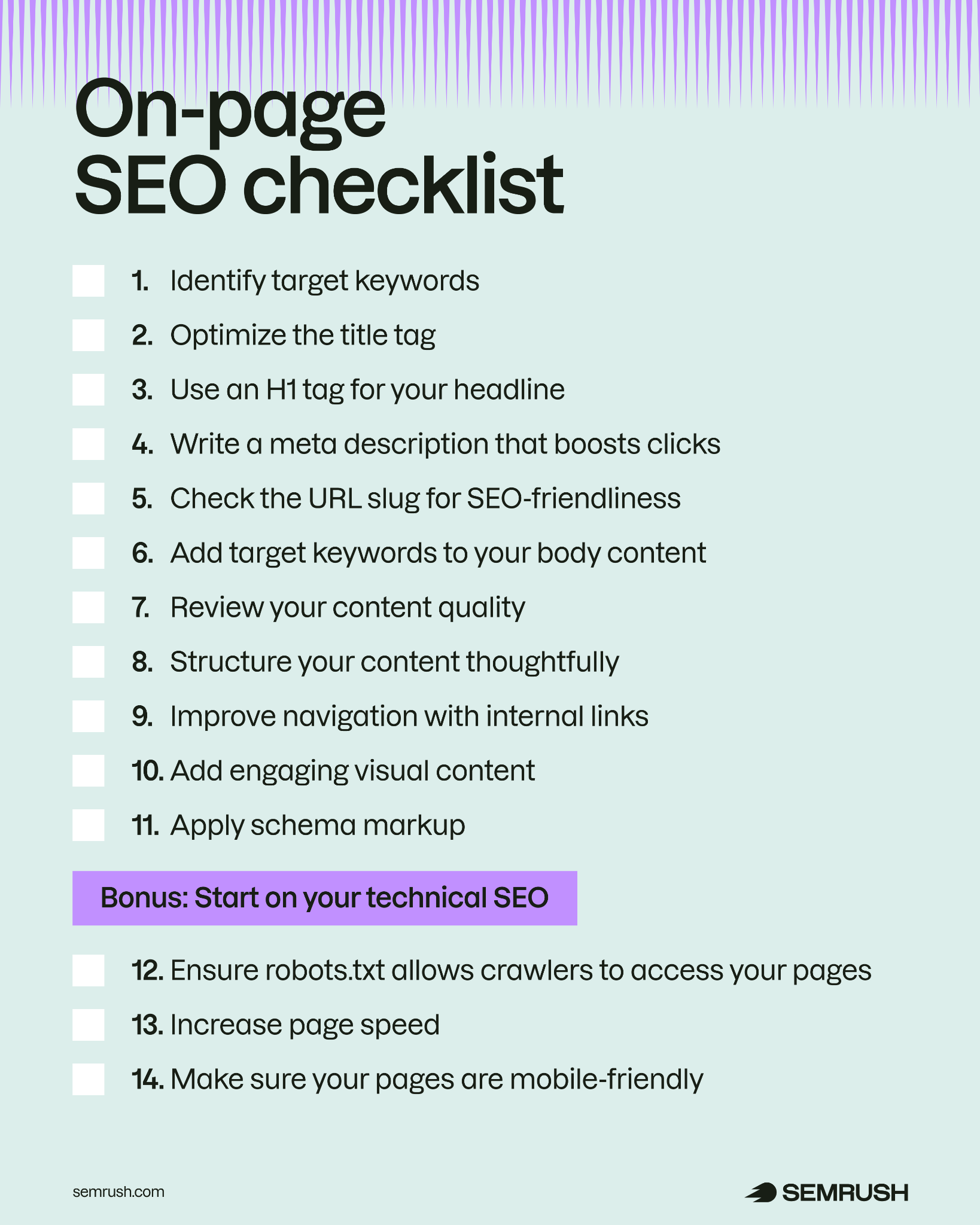
On-Page SEO: 11 Techniques That Still Work in 2026 - 11 On-Page SEO Techniques: A Practical Checklist.
1. Match Content to Search Intent
Before optimizing anything, understand what the searcher actually wants. Intent generally falls into four categories:
- Informational: The user wants to learn something ("what is on-page SEO")
- Navigational: The user wants to find a specific site or page
- Commercial: The user is comparing options ("best SEO tools")
- Transactional: The user is ready to act ("buy SEO software")
The fastest way to check intent is to look at the current search results for your target keyword. If the top results are all how-to guides, a product page is unlikely to rank. Match the format, depth, and angle of the content to what already performs.
2. Place Keywords Strategically—Not Mechanically
Keywords still signal relevance, but placement matters more than frequency. Include your primary keyword naturally in:
- The H1 heading
- The first paragraph
- At least one H2 subheading
- The URL slug
- Image alt text where relevant
- The meta description
Use secondary keywords and semantically related terms throughout the body. The goal is topical depth, not repetition. If a sentence reads awkwardly because you forced a keyword into it, rewrite it.
3. Write Title Tags That Earn Clicks
The title tag is often the first thing a searcher sees. It appears in browser tabs and can show in both traditional and AI-generated search results.
Best practices:
- Keep titles between 50 and 60 characters to avoid truncation
- Include the primary keyword near the beginning
- Make the title match or closely mirror the H1
- Use unique titles for every page
- Add a compelling element—a number, benefit, or differentiator—when it fits naturally
A strong title tells the searcher exactly what they will get and why it is worth clicking.
4. Write Meta Descriptions That Support the Click
Meta descriptions do not directly influence rankings, but they influence click-through rates, which can indirectly affect performance. A good meta description summarizes the page and gives the searcher a reason to choose it over competing results.
Aim for around 150 to 155 characters. Include the primary keyword naturally, use active voice, and add a light call to action when appropriate. For example: "Learn the 11 on-page SEO techniques that still work in 2026, from title tags to internal links. Compare examples and start optimizing today."
5. Optimize URL Slugs
A clean URL slug helps both users and search engines understand the page before they even open it.
Follow these rules:
- Include the primary keyword
- Keep it to three to five words
- Use hyphens between words, not underscores
- Avoid dates, random numbers, and unnecessary parameters
- Make it readable:
/on-page-seois better than/page?id=48291
6. Structure Content with a Logical Heading Hierarchy
Headings organize content into scannable sections. They help readers navigate long pages and help search engines and AI systems extract clear answers.
Use one H1 for the visible page title. Break the body into H2s for main topics and H3s for subtopics. Each heading should be descriptive and preview what follows. Avoid vague labels like "More Information" in favor of specific ones like "How to Optimize Title Tags."
For AI search optimization, answer the question posed by each heading in the first sentence of that section. This makes it easier for language models to pull concise, self-contained answers from your page.
7. Create Content That Is Deep, Unique, and Useful
Content quality is the backbone of on-page SEO. Search engines evaluate whether a page is:
- In-depth: Does it cover the topic comprehensively?
- Unique: Does it offer something the top-ranking pages do not?
- Trustworthy: Does it demonstrate expertise and cite credible sources?
- User-friendly: Is it readable, well organized, and free of excessive ads?
Avoid thin content that rehashes what already exists. Add original examples, data, comparisons, or actionable steps that make your page the best answer to the query.
8. Optimize Images with Descriptive File Names and Alt Text
Images contribute to on-page SEO in two ways: they improve the user experience and they give search engines additional context.
- Use descriptive file names like
on-page-seo-checklist.pnginstead ofIMG_4821.png - Write alt text that describes the image content and includes a keyword only when it is accurate
- Compress images to keep page load times fast
- Use modern formats like WebP where supported
Alt text also improves accessibility, which is a ranking-adjacent signal and a genuine user benefit.
9. Build a Strategic Internal Linking Structure
Internal links distribute authority across your site, help crawlers discover pages, and guide users to related content. They are one of the most underused on-page levers.
Best practices:
- Link from high-authority pages to pages you want to rank
- Use descriptive anchor text that tells users what to expect
- Avoid generic phrases like "click here" or "read more"
- Create hub-and-spoke structures: pillar pages that link out to detailed subpages, and subpages that link back
For example, if you are optimizing content across multiple languages, a guide to multilingual content strategy and localization workflows can support your international SEO efforts. Similarly, teams managing large content operations may benefit from a framework for enterprise content governance to keep AI-generated pages consistent and on-brand.
10. Add Schema Markup
Schema markup is structured data that helps search engines understand specific elements of a page—such as articles, FAQs, products, reviews, and breadcrumbs. It can enable rich results and improve the way your page appears in SERPs.
Common schema types for content sites include:
- Article
- FAQPage
- BreadcrumbList
- Product
- Review
Adding FAQ schema to a page with a well-structured FAQ section can increase the chance of earning an expanded result, which takes up more SERP real estate.
11. Optimize for AI Search and AI Overviews
AI systems pull answers from pages that are clear, structured, and authoritative. To increase your chances of being cited:
- Answer common questions directly and early in each section
- Use natural language and avoid jargon
- Break complex topics into small, well-labeled sections
- Cite reputable external sources where relevant
- Keep content accurate and up to date
Pages that already follow strong on-page fundamentals—clear headings, direct answers, trustworthy content—tend to perform better in AI-generated search experiences as well.
Common On-Page SEO Mistakes to Avoid
Even experienced teams make these mistakes:
- Keyword stuffing: Repeating a keyword until the copy reads unnaturally
- Duplicate title tags: Using the same title across multiple pages
- Vague headings: Labels like "Details" or "More" that provide no context
- Missing alt text: Images that contribute nothing to search understanding
- Orphan pages: Pages with no internal links pointing to them
- Ignoring search intent: Writing a blog post when searchers want a product comparison
- Thin content: Publishing 400-word pages that add nothing new
Fixing these issues often produces faster wins than chasing new tactics.
How to Audit Your On-Page SEO
Run a simple audit on any page using this sequence:
- Check the search results for your target keyword and confirm the page matches intent
- Review the title tag, meta description, and URL slug for accuracy and keyword inclusion
- Scan the heading structure for logical hierarchy and descriptive labels
- Read the first paragraph—does it answer the core question?
- Check images for descriptive file names and alt text
- Verify that the page has at least three to five internal links pointing to it
- Test page speed on mobile
- Confirm schema markup is present and valid
Repeat this process for your highest-value pages first, then work through the rest of the site.
Scaling On-Page SEO Without Losing Quality
On-page SEO becomes harder to maintain as a site grows. Manual audits take time, and content teams often stall when they run out of topics or struggle to keep brand voice consistent across dozens of pages.
Some teams address this with an autonomous content platform like AgentBooks, which learns a website's product and market, researches organic search results, and publishes useful content in the brand voice. The platform handles topic planning, keyword research, and publishing workflows, which frees teams to focus on strategy and review. For sites publishing at scale, this kind of system can keep on-page fundamentals—clear structure, keyword placement, internal linking—consistent across every new page without manual oversight.
The key is to treat automation as an assistant, not a replacement. Human review of titles, intent matching, and factual accuracy still matters, especially for pages targeting high-value commercial keywords.
Related reading
- Surfer Demo: Try the SEO Tool Before You Commit - Explore your Surfer demo options: the 14-day Golden Software trial, live SEO webinars, and beginner tutorials. Learn what each demo includes and how to choose.
- ContentBot.ai Features: Full 2026 Breakdown & Workflows - A practical breakdown of ContentBot.ai features: AI Flows, Importer, Blog Writer, Humanizer, multilingual output, pricing, and where the platform fits.
Sources and further reading
- On-page SEO techniques for measurable growth - Learn proven on-page SEO techniques to boost traffic, engagement, and conversions. Get actionable strategies and avoid common mistakes.
Frequently Asked Questions
What is the difference between on-page and off-page SEO?
On-page SEO covers everything you can control directly on a webpage: content, title tags, headings, URL slugs, internal links, images, and schema markup. Off-page SEO covers external signals such as backlinks, brand mentions, and social media presence.
How long should a title tag be?
Aim for 50 to 60 characters. This range keeps titles from being truncated in search results while leaving enough room to include the primary keyword and a compelling element.
Do meta descriptions affect rankings?
Meta descriptions are not a direct ranking factor, but they influence click-through rates. A clear, keyword-relevant description can improve CTR, which may indirectly support rankings over time.
How many times should I use my target keyword on a page?
There is no fixed number. Include the primary keyword naturally in the H1, first paragraph, URL slug, and at least one subheading. Use secondary keywords and related terms throughout the body without forcing them.
Does on-page SEO help with AI search results?
Yes. AI systems such as ChatGPT, Perplexity, and Google AI Overviews pull from pages that are clear, well-structured, and authoritative. Direct answers, logical headings, and trustworthy content all improve the likelihood of being cited.
What is the most important on-page SEO factor?
Content quality and search intent alignment are the most important factors. A page that thoroughly answers the searcher's question in the expected format will outperform one that is technically optimized but shallow or irrelevant.
Conclusion
On-page SEO is not a one-time task. It is a continuous process of matching content to intent, refining structure, and keeping pages useful for both human readers and AI systems. The techniques in this checklist—from title tags and headings to internal links and schema markup—work together to make every page easier to understand, rank, and click.
Start with your highest-value pages. Fix the fundamentals first, then build a repeatable process so every new page launches with strong on-page optimization already in place.
For further reading on how AI fits into modern search workflows, see this guide to on-page SEO from Semrush and Moz's overview of on-site SEO.