
SEO Training That Actually Works: A 2026 Guide
SEO training is everywhere, but most courses leave you with notes and no rankings. The real goal is to build judgment: knowing which keyword to target, which page to fix, and which tactic to ignore. This guide shows you how to choose training that sticks, practice it on a real site, and use AI tools to scale what you learn.
What SEO training should actually teach you
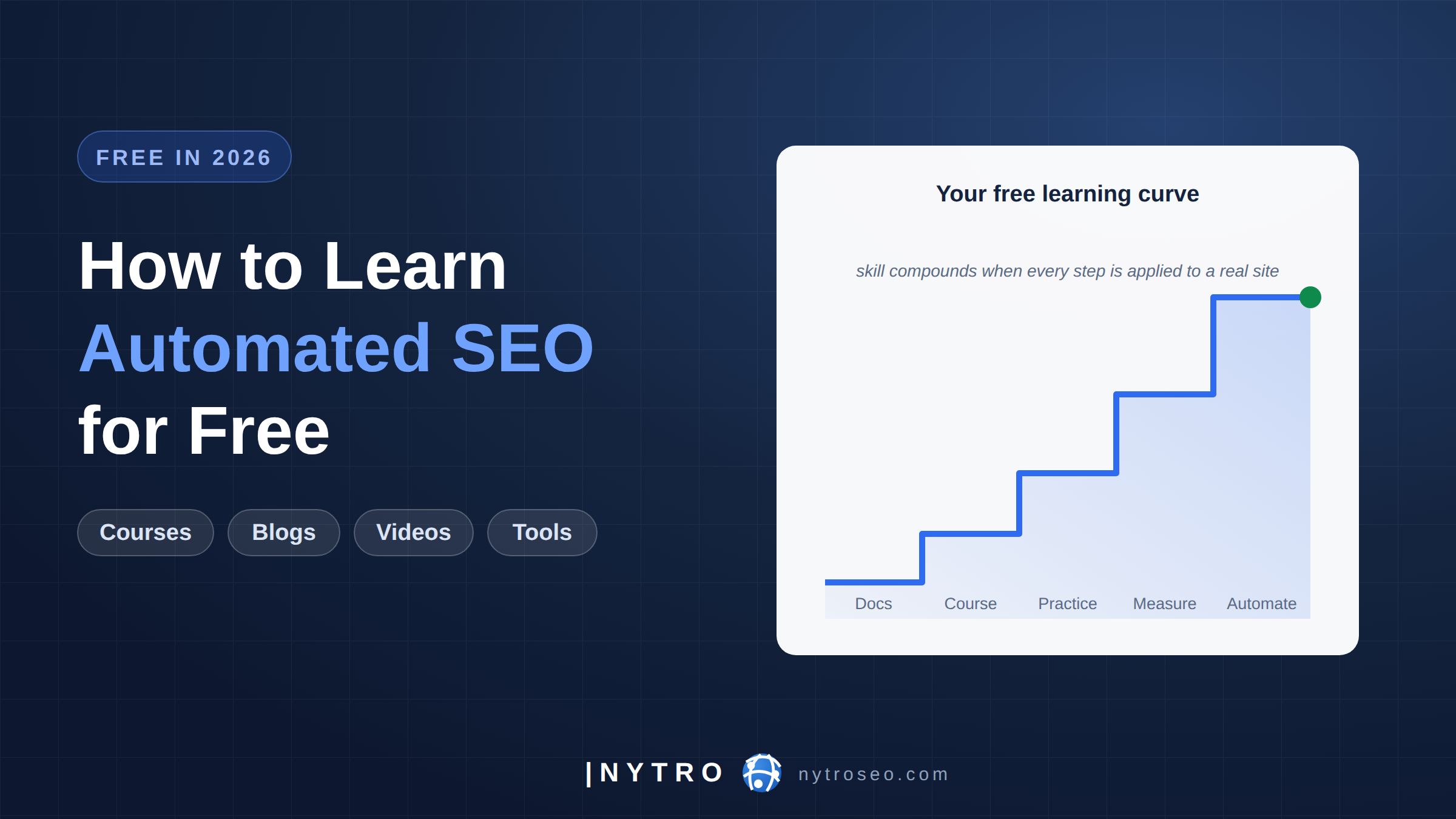
SEO Training That Actually Works: A 2026 Guide - What SEO training should actually teach you.
Good SEO training covers four skill layers. If a course skips one, you will feel it later.
1. How search engines find and rank pages
You need a working model of crawling, indexing, and ranking. Not academic depth, but enough to debug why a page is not showing up. This layer includes robots.txt, sitemaps, canonical tags, and how Google evaluates content quality.
2. Keyword and intent research
This is where most beginners stall. Training should teach you to move from a broad topic to specific queries, then classify each query by intent: informational, commercial, transactional, or navigational. You should practice building a keyword map that assigns one primary query per page.
3. On-page and technical execution
This covers title tags, headings, internal links, image alt text, page speed, mobile usability, and structured data. Technical SEO training should include hands-on audits, not just slide decks. You should be able to open a site, find three fixable issues, and explain the impact.
4. Measurement and iteration
Training should end with reporting. Learn to read Google Search Console impressions, clicks, average position, and CTR. Learn to separate ranking problems from click-through problems. Then learn to update old content instead of only publishing new pages.
How to choose an SEO course or certification
SEO Training That Actually Works: A 2026 Guide - How to choose an SEO course or certification.
Use these criteria to filter options quickly.
- Practice over theory. A 2-hour course with a real audit exercise beats a 20-hour video library with no assignments.
- Current material. SEO changes fast. Check whether the course covers AI overviews, generative engine optimization, and content quality signals.
- Tool access. Courses that include Semrush, Ahrefs, or Google Search Console walkthroughs are more useful than tool-agnostic theory.
- Certificate value. Certifications help with hiring, but a portfolio of ranked pages helps more. Look for courses that require a capstone project.
- Language and format. Video, text, and live cohorts suit different learners. Pick the format you will actually finish.
For a broader view of the tools you will use during and after training, see this guide to the best SEO tools in 2026. It covers audits, keyword research, rank tracking, and content optimization.
Free vs. paid SEO training
Free courses from major platforms are excellent for fundamentals. They typically run 1–4 hours and cover keyword research, on-page basics, and link building. Paid programs add depth, feedback, and capstone projects. University-style specializations span months and suit career changers.
A practical approach: start free, then pay only when you hit a specific wall, such as technical audits or content strategy at scale.
A 30-day SEO training plan you can run yourself

SEO Training That Actually Works: A 2026 Guide - A 30-day SEO training plan you can run yourself.
You do not need a course to start. Use this plan on a real site.
Week 1: Foundations and audit
- Read Google's official guidance on how Search works.
- Run a crawl of your site. List every page with a missing or duplicate title tag.
- Set up Google Search Console and submit your sitemap.
Week 2: Keyword research
- Pick one topic cluster. Find 20 queries using free tools and autocomplete.
- Classify each query by intent. Group them into 3–5 pages.
- Assign one primary keyword per page and note secondary terms.
Week 3: On-page execution
- Rewrite titles and meta descriptions for five pages.
- Add internal links from related pages to your target pages.
- Compress images and check mobile rendering.
Week 4: Measure and iterate
- Compare impressions and clicks week over week.
- Identify pages ranking on page two and update them with missing subtopics.
- Document what changed and what you will test next.
This loop is the core of SEO training. Courses accelerate it, but the loop is what builds skill.
Where AI fits into SEO training and daily work
SEO Training That Actually Works: A 2026 Guide - Where AI fits into SEO training and daily work.
AI tools are now part of the SEO workflow, but they do not replace judgment. Use them for research summaries, outline generation, and drafting. Keep human review for accuracy, brand voice, and editorial decisions.
If you are evaluating AI writing tools, this guide on AI writing assistants explains the difference between editing assistants and full content automation platforms.
For teams that need to publish consistently, platforms like AgentBooks connect keyword planning, article creation, approval workflows, and publishing in one workspace. It starts by crawling your website to build a reusable source of truth, then generates content in your brand voice. This is useful after training, when you understand the strategy and need to scale execution without losing quality.
A sensible rule: learn the fundamentals first, then automate the parts you already understand. Automation without training just produces more content that does not rank.
Common SEO training mistakes to avoid
- Collecting certificates instead of results. One ranked page teaches more than three certificates.
- Ignoring technical SEO. Content alone cannot fix crawl errors or slow pages.
- Chasing every algorithm update. Focus on user intent and content quality; those signals are stable.
- Skipping measurement. If you do not track impressions, clicks, and positions, you are guessing.
- Over-automating early. Use AI after you can evaluate its output.
Related reading
- How to Use ContentBot.ai: A Practical Setup Guide - Learn how to use ContentBot.ai step by step: account setup, AI workflows, bulk imports, SEO blog generation, and where it fits in a content stack.
- SEO Content Strategy: How to Create Content That Ranks - Learn how to plan, write, and scale SEO content that ranks. Covers search intent, keyword research, on-page optimization, and AI-assisted workflows.
Sources and further reading
- SEO - This comprehensive SEO course provides you with the foundational knowledge and practical skills needed to optimize your website and drive organic traffic. You will explore how search engines discover, index, and rank content, allowing you to align your strategy with their algorithms. Throughout the training, you will learn how to conduct effective keyword research and build topical relevance through content clusters. The content also covers how to implement crucial on-page and technical SEO elements that improve user experience. You will discover actionable techniques for building high-quality backlinks and establishing your website's search authority. By the end of this learning experience, you will be able to measure your SEO performance, set realistic goals, and continuously improve your strategy for long-term growth.
- 11 Best SEO Courses of 2026 to Become an SEO Pro - Looking for the best SEO courses to learn how to optimize for search engines? Check out this list of 11 SEO classes you can take!
- Best SEO Courses & Certificates [2026] | Coursera - SEO courses can help you learn keyword research, on-page optimization, link building, and content strategy. Compare course options to find what fits your goals. Enroll for free.
FAQ
How long does SEO training take?
Fundamentals take 2–4 hours. Practical competence takes 30–90 days of consistent work on a real site. Advanced technical and strategy skills take longer and usually require ongoing practice.
Is SEO certification worth it?
It helps for job applications and client trust. It is not a substitute for a portfolio. Pair any certification with two or three pages you have optimized and can explain.
Can I learn SEO for free?
Yes. Free courses from major platforms, Google's documentation, and your own site are enough to start. Paid training becomes worth it when you need feedback, advanced technical depth, or structured accountability.
Do I need to learn AI tools to do SEO?
Not to start. But AI-assisted research and drafting are increasingly standard. Learn the fundamentals first, then add AI tools to speed up execution.
What should I practice first?
Start with keyword research and on-page optimization. They produce visible results fastest and teach you how search intent connects to rankings.
Conclusion
The best SEO training is not the longest course. It is the one that makes you practice on a real site, measure results, and iterate. Choose training that covers crawling, keyword research, on-page execution, and reporting. Then build a 30-day loop and run it. Add AI tools like AgentBooks when you are ready to scale content without sacrificing the judgment you worked to build.