
The SEO Agent Review: AI SEO Content Automation Tested
The SEO Agent promises a simple loop: one keyword in, one researched article out, every day, published to your blog. At $99/month for one site and 30 articles, it sits in a crowded market of AI SEO content automation tools. This review breaks down what the product actually does, where it works well, where it falls short, and how to decide whether it belongs in your stack.
What The SEO Agent Does
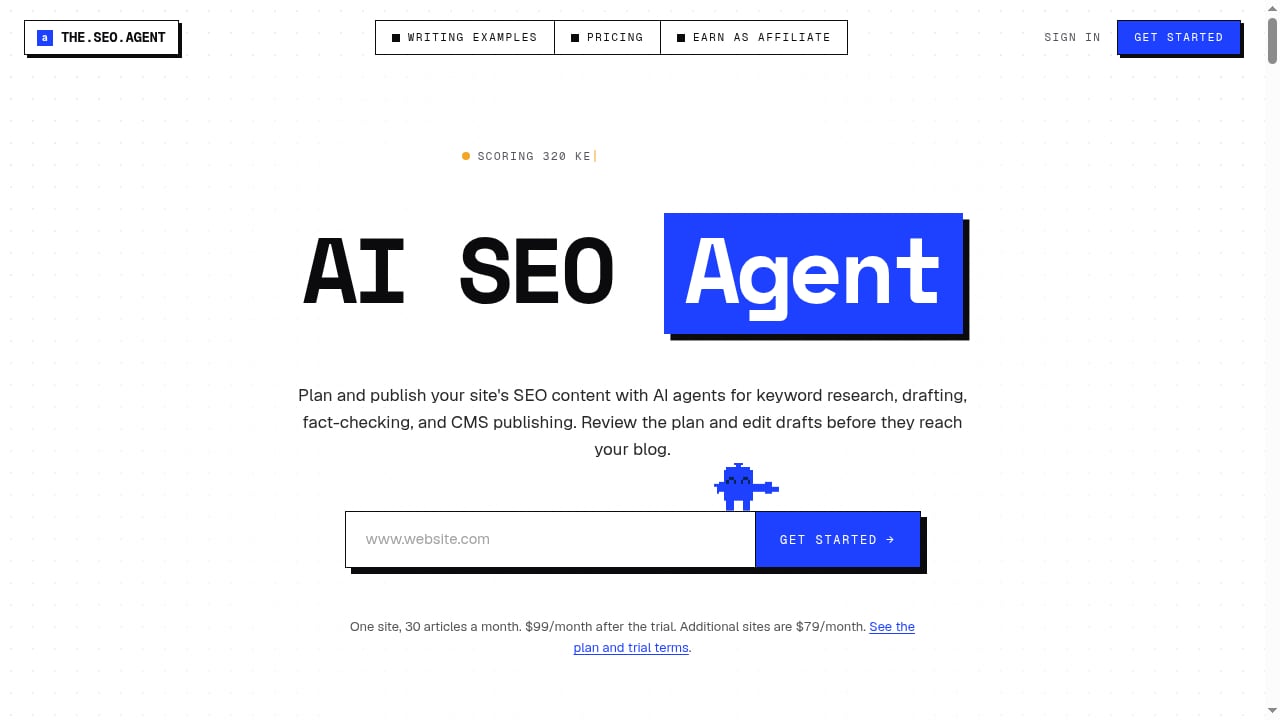
First viewport screenshot of www.theseoagent.ai.
The SEO Agent is an AI SEO agent that runs a multi-step content pipeline. According to its own product page, it researches keywords, plans articles, drafts them with citations, checks every claim against saved sources, adds internal links and images, and publishes to a CMS. Supported destinations include WordPress, Webflow, Shopify, Ghost, Wix, and webhooks.
The workflow is organized around three agents:
- Research agent: scans your site, pulls search-demand data, filters out keywords you already rank for, and proposes a 30-day content plan.
- Article agent: turns approved keywords into structured drafts with comparison tables, FAQs, internal links, and metadata.
- Publishing agent: handles the last mile — featured image, slug, canonical, internal links, and CMS delivery.
The product emphasizes an approval step. Nothing publishes until you approve the plan, and auto-publish stays off until you enable it.
Setup and Onboarding
Onboarding is one of the strongest parts of the product. You enter your domain, and the tool scans your site to pre-fill a business profile, target audience segments, and a brand voice. A hands-on test published by AI Tools Bakery found the onboarding ran in five short steps and took a couple of minutes, with the auto-generated business description accurate enough that no changes were needed.
Two caveats from that same test are worth noting. Competitor auto-detection was hit or miss in a niche site, and there is no free exploration — you need to start a trial before you see the dashboard. The trial is listed at $1 for three days.
A practical tip: connect Google Search Console early. Without it, the tool works from limited data and under-counts what your site already ranks for, which weakens the gap analysis.
How a Post Comes Together
A single article moves through a predictable sequence:
- The research agent places a keyword on a planner card with volume and difficulty.
- You approve or edit the plan.
- The article agent drafts the full piece — introduction, methodology, summary list, comparison table, sections, how-to-choose block, FAQ, and verdict.
- The publishing agent wires internal links, sets metadata, and schedules the post.
That structure is deliberately aligned with how strong SEO articles are built, and it arrives without prompting. The trade-off is sameness: if every post follows the same skeleton, your blog can start to feel formulaic. Plan for occasional manual restructuring of your highest-value pages.
Content Quality and Fact-Checking
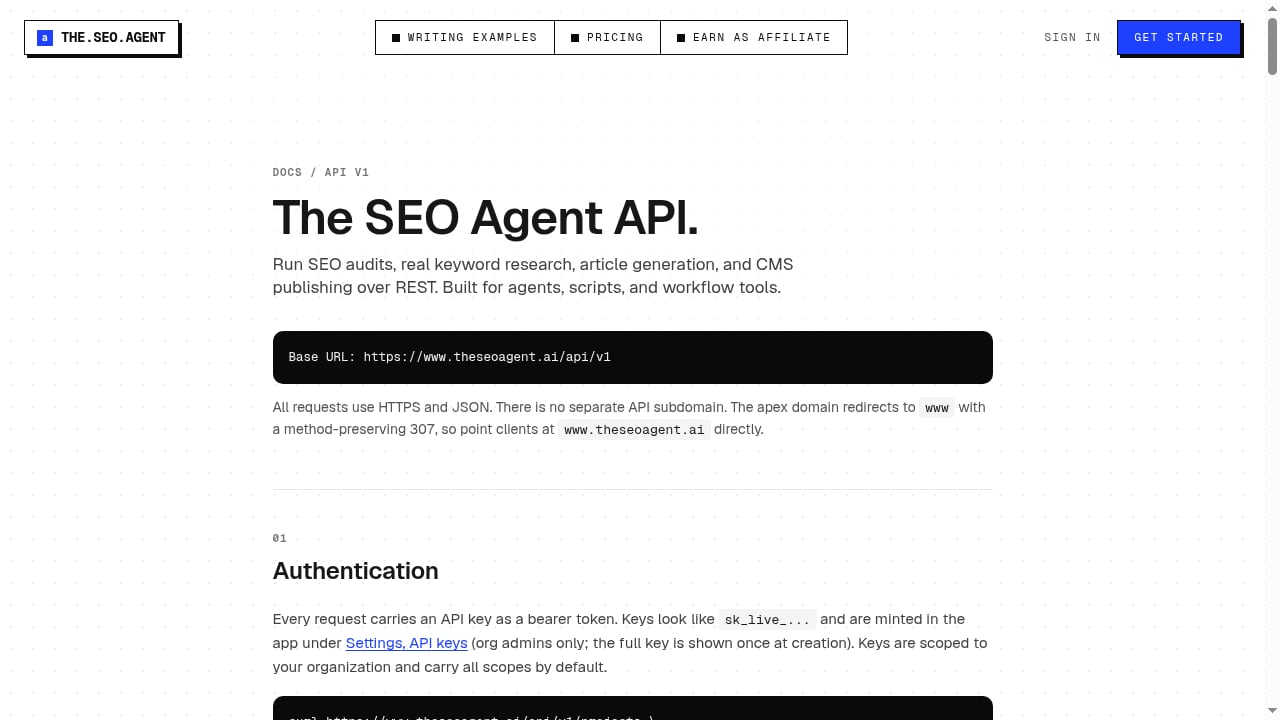
First viewport screenshot of www.theseoagent.ai.
The SEO Agent's differentiator is its claim checker. Every claim is read against the sources saved during research, and unsupported claims are kept, softened, or cut. An article with a fact problem it cannot fix waits for review instead of publishing.
That is a meaningful safeguard, but it is not a substitute for editorial review. The AI Tools Bakery test found the writing well-structured and on-brand, but also flagged confident first-person testing language ("we tested," "we put every tool through the same five tests") describing work the tool had not actually done. It also caught a roundup that listed the reviewer's own site among the products. These are normal AI-writing failure modes, and a quick human read catches them.
For a deeper look at how AI drafting fits into a broader quality workflow, see our guide to using AgentBooks with Claude for research, drafting, and quality control.
Publishing and Integrations
Native publishing is a real advantage over tools that stop at a Google Doc. The SEO Agent ships the article, sources, links, images, and metadata together, and its WordPress integration runs through a WordPress.org plugin. If WordPress is your CMS, our practical guide to auto-publishing to WordPress covers the safety checks worth putting in place before you hand over the keys.
For other CMSs, publishing goes through Webflow, Shopify, Ghost, Wix, or a webhook. Webhook delivery is the most flexible option but also the one that requires the most setup on your side.
Pricing Signals
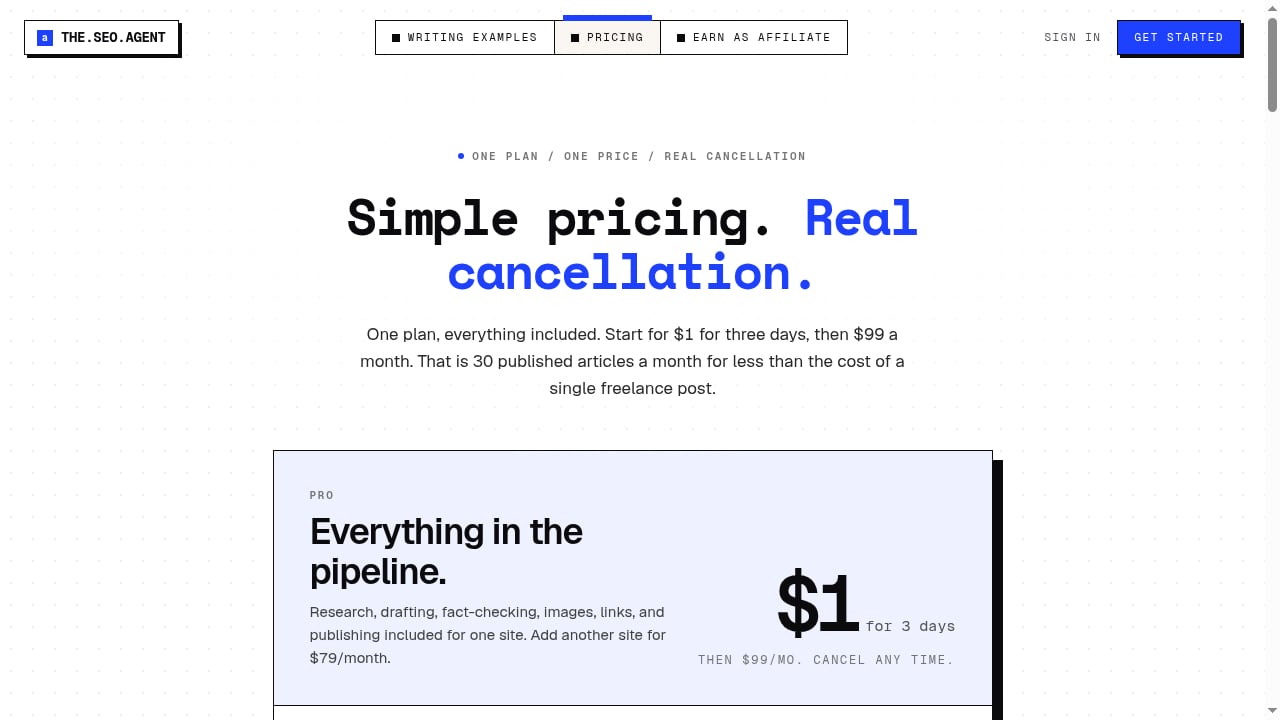
First viewport screenshot of www.theseoagent.ai.
The published plan is straightforward: one site, 30 articles a month, $99/month after the trial. Additional sites are $79/month each. The trial is listed at $1 for three days, and cancellation is handled inside the app with no support ticket.
At 30 articles for $99, the per-article cost is roughly $3.30 before any editing time. That is cheap compared with freelance rates, but the real comparison is cost per published, ranking article. Factor in your review time, the occasional rewrite, and the fact that not every post will earn traffic.
A simple ROI check before you commit:
- Baseline: record current clicks, impressions, and ranking keywords before you start.
- Round trips: count how many edits each draft needs before it is publishable.
- Quality drift: review output monthly, not just in week one.
- Total bill: subscription plus your hours plus any tooling you add for tracking.
Strengths and Limitations
Strengths
- Fast, polished onboarding that learns brand voice from your existing site.
- Real keyword data with volume and difficulty on each planner card.
- Claim-level fact-checking against saved sources.
- Native CMS publishing with metadata and internal links included.
- Transparent single-plan pricing and in-app cancellation.
Limitations
- Output is a strong first draft, not a finished article; human review is still required.
- Formulaic article structure across posts.
- Competitor detection can miss in narrow niches.
- No free tier to explore before starting a trial.
- Weaker fit if you already rely on Surfer or Clearscope for optimization workflows.
Who Should Use It
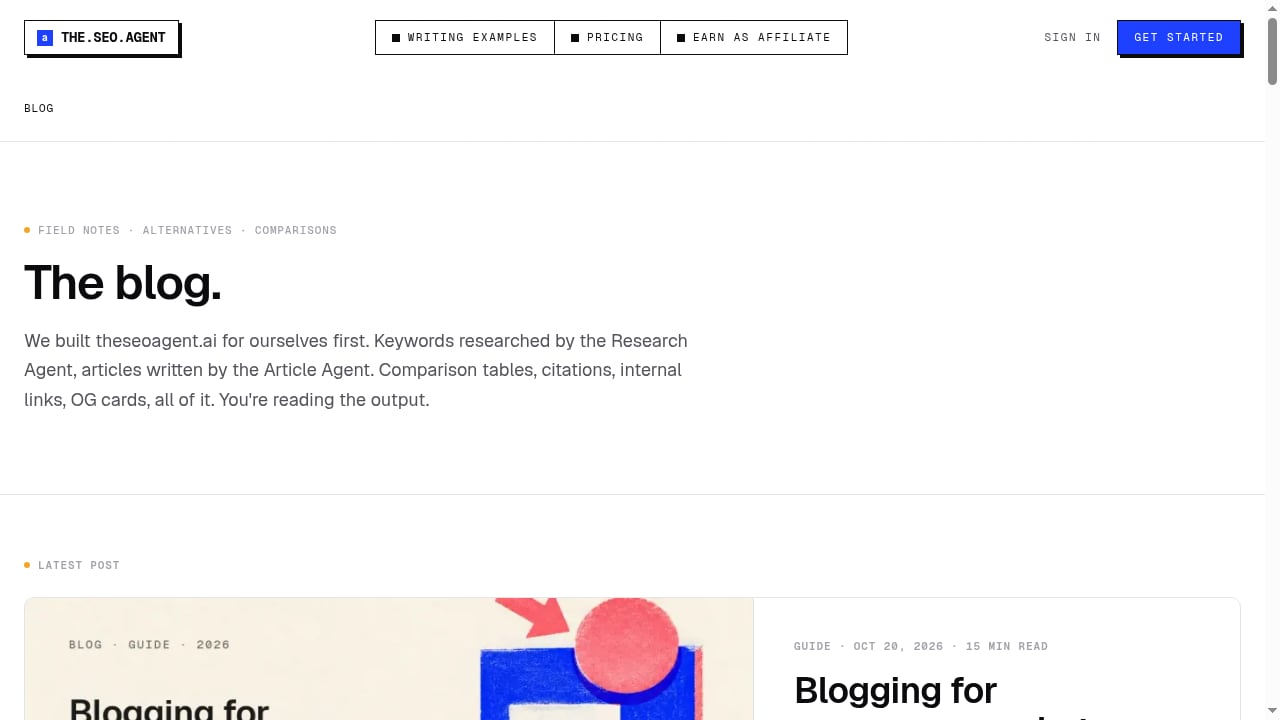
First viewport screenshot of www.theseoagent.ai.
The SEO Agent fits solo founders, small content teams, and agencies running multiple small sites that need consistent publishing volume without hiring writers. It is a poor fit for teams with an established editorial process, strict compliance review, or a strong preference for deep subject-matter expertise in every post.
If you are comparing options across the category, our roundup of the top 10 AI content generation software products compares output quality, workflow, and pricing. For a head-to-head view against a broader content engine, see AgentBooks vs GTM AI.
Decision Criteria
Use these questions to decide:
- Do you have review capacity? If nobody can read drafts weekly, quality will drift.
- Is your CMS supported natively? WordPress users get the smoothest path.
- Is your niche narrow? Check that the research agent finds sensible competitors and keywords.
- Do you need optimization depth? If you already run Surfer or Clearscope, the marginal value drops.
- Can you measure results? Connect Search Console before the first post goes live.
Related reading
- AgentBooks vs Writesonic vs Averi: 2026 Comparison - Compare AgentBooks, Writesonic, and Averi on content automation, AI visibility, brand voice, and pricing to find the right fit for your team.
Sources and further reading
- The SEO Agent — AI SEO content automation - One keyword in, one researched article out, every day. The SEO Agent researches keywords, drafts articles, checks every claim against its sources, and publishes to your blog.
- The heart of the internet - I've been automating SEO tasks like data analysis and content optimization for over a year now, and it's working quite well. The data analysis, in particular, works like a charm because I incorporate my own logic into SQL queries and then pass the results to my AI Agents. This approach has significantly improved my results.
Frequently Asked Questions
Is The SEO Agent good for beginners?
Yes, for site owners who can review drafts. Onboarding requires no prompt writing, and the planner shows volume and difficulty so you can sanity-check targets. Beginners should keep auto-publish off at first.
Does The SEO Agent publish without approval?
By default it leans toward automation, but auto-publish and per-article approval are toggles you control. The product states that nothing publishes until you approve the plan.
How much does The SEO Agent cost?
$99/month for one site and 30 articles after a $1 three-day trial. Additional sites are $79/month each.
Will Google penalize AI-generated content?
Google rewards useful content regardless of how it is produced. The risk comes from low-value, unsourced pages published at spam volume, not from AI use itself. Citations, internal links, and a sane cadence reduce that risk.
Can I use my own brand voice?
The tool builds a brand profile from your site during onboarding, and you can edit drafts and adjust publishing cadence.
What is the biggest limitation?
The output is a first draft. Confident phrasing and occasional factual slips mean a human review step is still necessary, especially on pages that represent your brand.
Conclusion
The SEO Agent is a credible AI SEO content automation platform for small sites that need steady publishing volume at a low flat price. Its onboarding, claim checking, and native CMS publishing are genuine strengths. Its limits — formulaic structure, first-draft quality, and niche-detection gaps — are manageable if you keep a human in the loop. Start with Search Console connected, auto-publish off, and a baseline recorded. If the drafts need fewer edits each month and rankings move, the subscription is earning its place.