
Top 10 AI Content Generation Software Products 2026
AI content generation software has moved past the novelty stage. In 2026, the question is no longer whether a tool can produce a paragraph—it is whether that paragraph survives an editor, a fact-check, and a search results page. This review ranks ten products that genuinely belong to the AI content generation category, explains how each was evaluated, and shows where each fits in a real content operation.
One boundary up front: AgentBooks is a content automation platform rather than a writing product, so it is not ranked here. It appears later only where an adjacent workflow makes it relevant to a buying decision.
How These Ten Products Were Evaluated
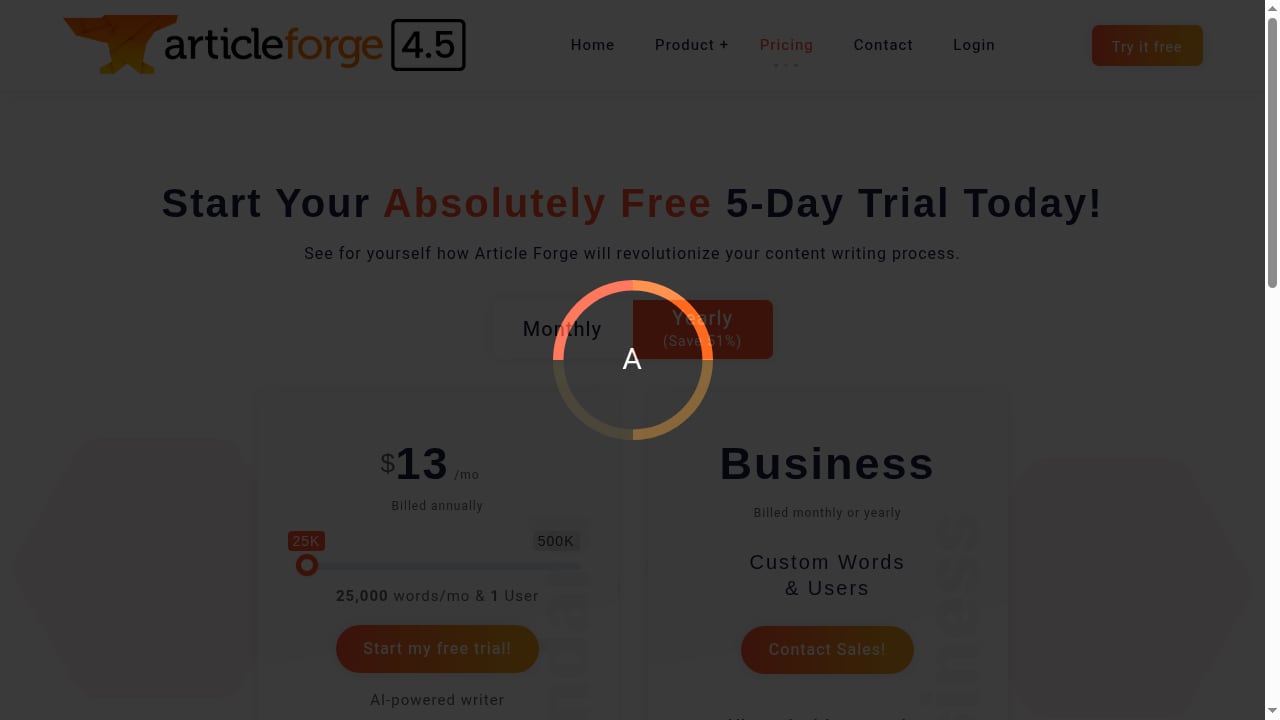
First viewport screenshot of www.articleforge.com.
Every product below was assessed against the same five criteria. No single criterion decides the ranking; the weighting favors tools that hold up under repeated, real-world use.
- Output quality and originality. Does the draft read like a human wrote it, stay on topic, and avoid the telltale patterns of generic AI text?
- Workflow depth. Can the tool handle research, planning, drafting, and publishing—or does it stop at a single generation step?
- Control and editing. Are there brand voice settings, outline controls, fact-checking aids, and revision tools, or is the output take-it-or-leave-it?
- Pricing transparency. Are plans, word limits, and overage costs published clearly, and is there a trial or refund path?
- Evidence of real use. Public case studies, review-platform recognition, and documented feature behavior carry more weight than marketing claims.
Pricing figures reflect published plans at the time of writing and should be re-checked before purchase.
The Top 10 AI Content Generation Software Products for 2026
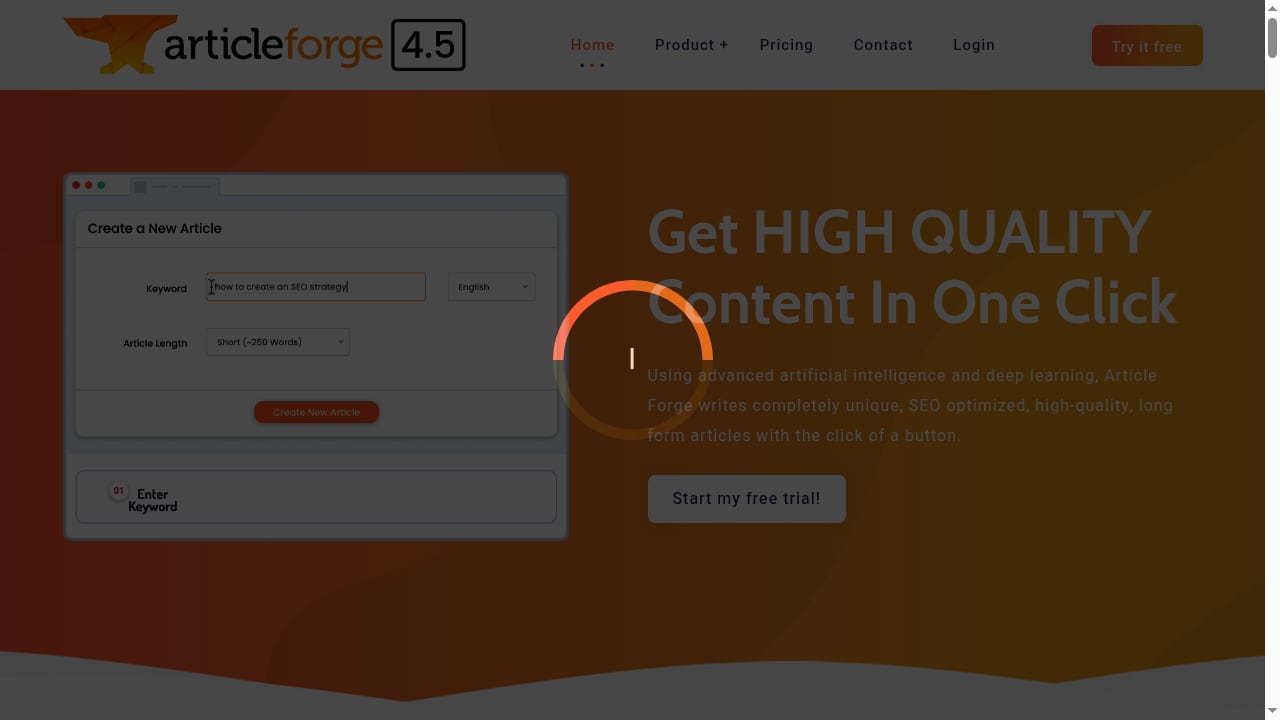
First viewport screenshot of www.articleforge.com.
1. Article Forge — Best for Fully Automated Long-Form Articles
Article Forge is built around a single promise: submit a keyword, receive a complete article. It generates 1,500+ word long-form pieces in one click, with bulk generation, automatic posting to blogs, API access, and an "Avoid AI Detection" toggle aimed at helping output pass AI detectors.
The tool is backed by more than ten years of AI research and positions itself as the first and only product that can research, plan, and write long-form content automatically. That automation depth is why it tops this list for teams whose bottleneck is volume rather than editorial craft. Case studies cited by the vendor show generated content ranking on Google and passing AI detection tools, and the product has been recognized as a High Performer by G2 in the Content Creation category.
Pricing: Standard plan at $27/month, or $13/month billed annually for 25,000 words; custom Business plans available. A 5-day free trial and a 30-day money-back guarantee lower the risk of testing it.
Best for: Content creators, marketers, SEO professionals, and businesses that need large volumes of SEO-friendly articles with minimal hands-on time. Watch out for: fully automated output still needs a human review pass for accuracy and brand fit.
2. Jasper — Best for Brand-Consistent Marketing Content
Jasper is one of the most established names in AI marketing content, and its strength is consistency across channels. Brand voice training, campaign workflows, and templates for ads, emails, landing pages, and social posts make it a natural fit for marketing teams that publish under a strict style guide.
Independent tool roundups consistently place Jasper in the marketing content category for exactly this reason: it is designed to hold a voice you train it on rather than to churn out anonymous blog posts. That makes it a strong second pick—excellent for brand-led content, less specialized for high-volume long-form SEO production.
Best for: Marketing teams producing multi-channel campaigns. Watch out for: per-seat pricing adds up quickly for larger teams.
3. Writesonic — Best All-Round AI Writing Suite
Writesonic covers a broad surface: article writing, SEO-focused briefs, landing page copy, and a chat-style assistant for ad hoc drafting. Its article workflow includes research assistance and structured outlines, which puts it closer to a full content tool than a simple generator.
It earns a top-three spot because it balances breadth with usable output quality. Teams that want one subscription for blog posts, product copy, and quick marketing assets will find fewer gaps here than in narrower tools.
Best for: Small teams and solo marketers who want one tool for many content types. Watch out for: output quality varies by template, so test the specific formats you rely on.
4. Copy.ai — Best for Go-to-Market and Sales Content
Copy.ai has shifted its center of gravity toward go-to-market workflows: sales emails, prospecting sequences, and structured content operations alongside standard copywriting. For content teams that sit close to revenue, that positioning is genuinely useful.
Its workflow builder lets teams chain prompts and data into repeatable processes, which is more than most copywriting tools offer. The trade-off is that long-form editorial content is not its strongest suit.
Best for: Sales and marketing operations teams producing structured, repeatable copy. Watch out for: editorial teams may find the workflow model heavier than they need.
5. Surfer — Best for SEO-Led Content Briefs and Optimization
Surfer is best known for content optimization, but its AI writing features—briefs, outlines, and draft generation grounded in search data—place it firmly in the content generation category. The difference is that generation starts from data rather than a blank prompt.
For teams whose content strategy is search-driven, that grounding reduces the revision cycle. If you want a deeper look at how this class of tool performs, see this SEO Writing AI review for a feature-and-pricing breakdown.
Best for: SEO teams that want drafts tied to real search intent. Watch out for: the AI writing is a companion to the optimization product, not a standalone volume engine.
6. Frase — Best for Research-First Article Drafts
Frase combines SERP research, topic modeling, and AI drafting in one workspace. Its core value is the research layer: it surfaces what top-ranking pages cover, then helps you build an outline and draft that addresses the same questions.
That research-first approach produces drafts that need less structural rework than raw generators. It suits writers who want assistance with the analytical part of content creation rather than a fully hands-off tool.
Best for: Writers and content strategists who want research and drafting in one place. Watch out for: the interface has a learning curve compared with single-purpose generators.
7. Rytr — Best Budget Option for Short-Form Content
Rytr is a low-cost AI writing assistant with a large template library covering emails, product descriptions, social captions, and short blog sections. It is not built for long-form depth, but for high-volume short-form output it is one of the most affordable credible options.
For freelancers and small businesses testing AI content generation for the first time, the low entry price makes experimentation easy.
Best for: Budget-conscious users producing short-form copy. Watch out for: long-form output tends to require substantial editing.
8. Anyword — Best for Performance-Driven Copy Testing
Anyword's differentiator is predictive performance scoring: it estimates how well a piece of copy will perform before you publish it. For conversion-focused content—ads, landing pages, email subject lines—that feedback loop is a meaningful advantage over tools that only generate text.
It is a narrower fit than general writing suites, but within its lane it offers something most competitors do not.
Best for: Performance marketers who test copy against conversion goals. Watch out for: less suited to long-form editorial or SEO article production.
9. ContentShake AI — Best for Small-Business Blog Automation
ContentShake AI, from Semrush, is aimed at small businesses that need a steady blog without a dedicated content team. It combines keyword input, AI drafting, and publishing to a connected site, with a workflow simple enough for non-specialists.
It sits in the same broad territory as full automation platforms but at a smaller scale. Teams that outgrow it often move toward dedicated automation systems—the AgentBooks vs Writesonic vs Averi comparison covers how those approaches differ.
Best for: Small businesses that want a guided blog workflow. Watch out for: customization and brand-voice control are limited compared with enterprise tools.
10. Grammarly — Best for AI-Assisted Editing and Rewriting
Grammarly earns the final spot because generation and editing are converging. Its AI features now draft, rewrite, and adjust tone inside the tools people already write in, which makes it the most widely adopted AI writing assistance in most workflows.
It is not a content production engine, and it should not be ranked as one. But as the quality-control layer at the end of an AI content pipeline, it is hard to replace.
Best for: Every team that generates AI drafts and needs a fast editing pass. Watch out for: it will not plan, research, or produce long-form articles on its own.
Quick Comparison: Which Tool Fits Which Job?

Article Forge product interface.
| Job to be done | Strongest fit |
|---|---|
| High-volume long-form articles | Article Forge |
| Brand-consistent campaigns | Jasper |
| One suite for many content types | Writesonic |
| SEO briefs and optimization | Surfer, Frase |
| Short-form copy on a budget | Rytr |
| Conversion copy testing | Anyword |
| Guided small-business blogging | ContentShake AI |
| Editing and quality control | Grammarly |
Where Content Automation Fits Alongside These Tools

Article Forge product interface.
Most of the products above generate content. Fewer handle the full loop of planning topics, researching search results, drafting, and publishing on a schedule. That gap is where content automation platforms enter the picture.
AgentBooks, for example, crawls a website once to build a reusable brand dataset, then plans keywords, researches top organic results, and publishes articles on a schedule with approval steps. It is a different category from the writing tools ranked here—its free public beta covers one brand, with a Business plan at $30/month and an Enterprise plan at $100/month—but teams that have outgrown manual generation often evaluate it next. The AgentBooks vs GTM AI comparison is useful if that decision is on your table.
A practical pattern many teams adopt: use a generator like Article Forge for volume, an optimizer like Surfer for search alignment, Grammarly for the final edit, and an automation layer only when the manual workflow becomes the bottleneck.
How to Choose in 2026
Start with the job, not the tool. If you need volume, prioritize automation depth and word-based pricing. If you need brand consistency, prioritize voice training and template coverage. If you need search performance, prioritize research and optimization features. Then test with your own briefs—not the vendor's demo—before committing to an annual plan.
Related reading
- How to Use AgentBooks with Claude: Workflow & Setup - Learn how to combine AgentBooks' AI content automation with Claude for research, drafting, and quality control. Step-by-step workflow and examples.
Sources and further reading
- The 18+ Best AI Tools & Platforms 2026 (I Tested 30+) - More than 18+ AI platforms went through my workflow, and only 21 made the cut. Here's what each does best, where it falls short, and who it's for.
- The 12 Best AI Tools for 2026 (That People Actually Use) - A guide to the 12 best AI tools that people are actually using, including the best AI assistants, video generators, automation tools, app builders, and more.
- Best Creative AI Software (2026): CapCut Recognized for Bringing Video, Image, and Content Creation Into One Platform by Software Experts - Software Experts has named CapCut in its 2026 creative AI software coverage for its range of tools spanning video, images, music, and content preparation. Th...
Frequently Asked Questions
What is the best AI content generation software in 2026?
There is no universal best. Article Forge leads for fully automated long-form articles, Jasper for brand-consistent marketing content, and Surfer or Frase for SEO-grounded drafting. The right choice depends on whether your bottleneck is volume, brand voice, or search performance.
Can AI-generated content rank on Google?
Yes, when it is accurate, useful, and edited. Vendor case studies for Article Forge show generated content ranking, but ranking depends on content quality and search intent matching, not on the generation method alone.
Is AI content detection reliable?
Not fully. Detectors produce false positives and false negatives, and tools like Article Forge offer an "Avoid AI Detection" toggle to reduce flags. Editorial review remains the most reliable quality signal.
How much does AI content generation software cost?
Entry plans range from roughly $9 to $30 per month, with word-based limits. Article Forge's Standard plan is $27/month or $13/month billed annually for 25,000 words; enterprise and custom plans cost more.
Should I use a writing tool or a content automation platform?
Use a writing tool when you want control over each piece. Consider an automation platform when planning, research, and publishing overhead—not drafting—is what limits your output.
Conclusion
The 2026 market rewards specificity. Article Forge wins this ranking because it does one job—automated long-form article generation—more completely than the alternatives, while Jasper, Writesonic, and Surfer each own a distinct slice of the workflow. Pick the tool that removes your actual bottleneck, test it against your own standards, and keep a human editor in the loop. That combination, not the software alone, is what produces content worth publishing.