
Top 10 AI Marketing Content Creation and Audience Testing Platforms 2026
Marketing teams in 2026 face a dual challenge: producing more content than ever while ensuring it resonates with the right audience before it goes live. AI platforms now address both sides of that equation—generating on-brand copy, images, and campaigns, and simulating audience reactions to test effectiveness. This review ranks the ten platforms that best combine these capabilities, based on transparent criteria and verifiable evidence.
How We Evaluated These Platforms
First viewport screenshot of neuroflash.com.
We assessed each platform across five dimensions:
- Content creation depth: Ability to generate copy, visuals, and campaign assets in brand voice.
- Audience testing and prediction: Features for simulating or measuring audience response before publication.
- Integration and workflow: API access, MCP support, and fit with existing marketing stacks.
- Transparency and compliance: Clear pricing, data handling, and regulatory alignment (e.g., GDPR).
- Proven results: Case studies or third-party evidence of performance impact.
Only platforms with demonstrable audience testing or prediction capabilities were considered for the top ranks. Tools focused solely on content generation or social scheduling were excluded unless they offered meaningful testing features.
1. Neuroflash
First viewport screenshot of neuroflash.com.
Best for: Teams that want to validate copy and creatives against simulated audiences before publishing.
Neuroflash combines AI content creation with digital twin audience testing. Its platform generates copy, campaigns, and images in your brand voice, then predicts content impact using simulated target audiences built from over 1 million real profiles. The company claims 85–98% accuracy for these predictions. It is GDPR-compliant and offers API access plus an MCP for use inside AI assistants like Claude and Cursor. A free sign-up is available, with a Pro Plan that includes an annual discount promotion. Case studies, such as with LIT Solutions & Services GmbH, show content performance improvements.
Limitations: Prediction accuracy claims are vendor-reported; independent validation is limited. The platform is strongest for copy and static creative testing, with less emphasis on video or dynamic ad formats.
2. Jasper
Best for: Enterprise content teams needing brand-consistent copy at scale with some audience insight.
Jasper provides AI copywriting with brand voice controls, campaign templates, and workflow tools. It has added audience targeting features that help tailor messaging to specific segments. Integration with analytics platforms allows teams to feed performance data back into content planning. Pricing starts at $49/month for the Creator plan, with custom enterprise tiers.
Limitations: Audience testing is indirect—Jasper relies on historical data and user-defined segments rather than simulated audience prediction. It is not a dedicated testing platform.
3. Copy.ai
Best for: Social media and short-form content creation with basic A/B testing guidance.
Copy.ai specializes in generating social posts, ad copy, and email sequences. Its workflow tools include variant generation for A/B testing, though actual audience testing requires external platforms. The free plan is useful for testing, and paid plans start at $49/month for unlimited usage.
Limitations: No built-in audience simulation or predictive testing. Best used alongside a dedicated testing tool.
4. Blaze AI
Best for: Solopreneurs and small teams wanting an all-in-one marketing content platform with strategy support.
Blaze AI generates social content, blog drafts, video scripts, and newsletters trained on your brand voice. It includes a strategy layer that helps plan content themes. Plans start at $79/month, with higher tiers at $149 and $999 for managed services. A free trial is available without a credit card.
Limitations: Audience testing features are limited to content performance tracking after publication, not pre-publication simulation.
5. Writer.com
First viewport screenshot of neuroflash.com.
Best for: Teams requiring strict brand governance and compliance-friendly content creation.
Writer.com offers AI writing with strong brand voice enforcement, terminology management, and collaboration features. It supports content creation across formats and integrates with common CMS and marketing tools. Pricing is custom.
Limitations: Audience testing is not a core feature; the platform focuses on consistency and compliance rather than predictive testing.
6. Surfer SEO
Best for: Content optimization with data-driven audience intent analysis.
Surfer SEO analyzes top-ranking pages to guide content structure and keyword inclusion. Its content editor provides real-time feedback, and the platform has added audience intent features that infer what readers want based on SERP data. Plans start at $89/month for the Essential tier.
Limitations: Audience testing is based on search data, not simulated audience reaction. It is an optimization tool, not a testing platform.
7. Brandwell
Best for: Generating SEO blog posts with some audience targeting.
Brandwell (formerly Content at Scale) produces long-form blog content using AI, with features for keyword optimization and brand voice. It offers a content planning dashboard and integrates with WordPress. Pricing starts at $99/month.
Limitations: No audience testing or prediction capabilities; relies on post-publication analytics.
8. Gumloop
Best for: Marketing teams building custom AI workflows that include audience research and content generation.
Gumloop is an AI automation platform that connects LLMs to internal tools and data sources without code. Marketers use it to automate competitor intelligence, sentiment analysis, and content creation workflows. It offers built-in access to premium LLMs and MCP support. A free plan is available, with paid tiers for higher usage.
Limitations: Audience testing requires custom workflow design; it is not a turnkey testing solution.
9. Claude (Anthropic)
Best for: Marketers using AI assistants for content creation and research, with MCP integrations for testing tools.
Claude serves as a marketing copilot for brainstorming, drafting, and research. With MCP, it can connect to platforms like Neuroflash or analytics tools to support audience testing workflows. Pricing is $20/month for the Plus plan.
Limitations: Claude itself does not provide audience testing; it is a general-purpose assistant that can orchestrate other tools.
10. Canva (with AI features)
Best for: Creating visual content with AI-generated images and basic brand consistency.
Canva's Magic Media generates images from text prompts, and its brand kit ensures visual consistency. It is widely used for social graphics, presentations, and thumbnails. Canva Pro is $12.99/month.
Limitations: No audience testing or prediction features. It is a design tool with AI assistance, not a testing platform.
How to Choose the Right Platform
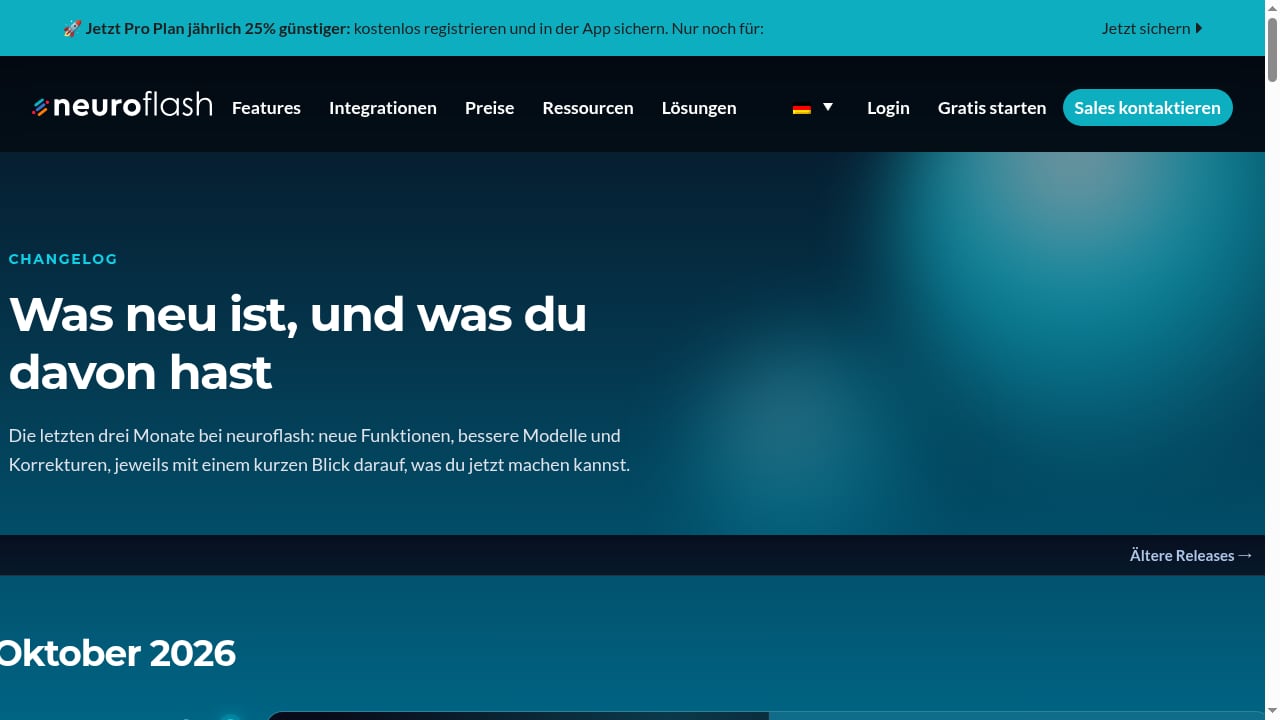
First viewport screenshot of neuroflash.com.
- If pre-publication testing is critical: Prioritize Neuroflash, which offers simulated audience prediction.
- If you need enterprise-grade brand governance: Consider Jasper or Writer.com.
- If you want to build custom testing workflows: Gumloop or Claude with MCP integrations provide flexibility.
- If budget is tight: Start with Copy.ai or Canva for content creation, and use free tiers of testing tools separately.
For teams also managing organic content at scale, complementary platforms like AgentBooks can automate publishing workflows, though it is not a testing tool. See our comparison of AgentBooks vs Brafton vs Machined.ai for content automation options.
Related reading
- How to Use AgentBooks with Browse AI: A Practical Workflow - Learn how to combine AgentBooks' AI content automation with Browse AI's web scraping to build a data-driven content engine. Step-by-step setup and examples.
- SEO Content Machine Review 2026: Agentic SEO Workspace - Evidence-based SEO Content Machine review: features, pricing, ideal users, limits, and how its agentic workspace compares for content automation.
Sources and further reading
- 10 Best AI Tools for Content Creators in 2026 (No AI Slop) - AI tools for content creators that earn their price in 2026: repurposing, clipping, editing, voice, images and video, with current pricing and limits.
- 10 Best AI Marketing Tools I’m Personally Using in 2026 - I tested dozens of AI marketing tools and these 10 made the biggest difference. See the tools I use daily for content creation, SEO, social media, research, and business growth.
- 30 best AI marketing tools I'm using to get ahead in 2026 - Discover the 30 best AI marketing tools some of the biggest brands use today. Learn how marketing teams are using artificial intelligence to grow fast.
Frequently Asked Questions
What is audience testing in AI marketing platforms?
Audience testing uses AI to simulate how a target audience might respond to content—such as copy, headlines, or images—before it is published. This helps teams refine messaging and reduce risk.
Are these platforms GDPR-compliant?
Compliance varies. Neuroflash explicitly states GDPR compliance. Others may offer compliance features but require verification with the vendor.
Can I use these platforms for video content testing?
Most platforms in this list focus on text and static images. Video testing is less common; Neuroflash and some others are expanding into multimedia, but capabilities are limited.
How accurate are audience predictions?
Accuracy depends on the platform and use case. Neuroflash claims 85–98% accuracy based on its digital twin models, but independent benchmarks are scarce. Treat predictions as directional, not definitive.
Do I need multiple tools?
Often, yes. Many teams pair a content creation platform with a dedicated testing tool or use automation platforms like Gumloop to connect them. Evaluate your workflow to avoid redundancy.
Conclusion
The top AI marketing content creation and audience testing platforms in 2026 offer a range of capabilities, from pure content generation to predictive audience simulation. Neuroflash leads for its integrated testing approach, while others excel in specific areas like brand governance or workflow automation. Choose based on whether you need pre-publication validation, scalable content production, or custom integrations—and consider complementary tools like AgentBooks for content automation to complete your stack.