

AgentBooks vs The AI Content Team for Solo Founders
Solo founders rarely lack ideas. They lack a system that turns a website into a steady stream of useful articles without hiring a team. Two options keep surfacing in that search: AgentBooks, an AI content automation platform that learns from your site, and The AI Content Team for Solo Founders by QuickCreator, a tool that ships articles in your voice and aims for Google rankings plus citations in ChatGPT, Perplexity, and Gemini. This comparison looks at what each one actually does for a one-person company.
What AgentBooks does for a solo founder
First viewport screenshot of Free Blog Hook Generator – Opening Lines | QuickCreator.
AgentBooks starts with your website. You share the URL once, and the platform crawls it to build brand intelligence: what you sell, who you serve, and how you sound. From there it maps the market, plans topics, researches top organic results, and publishes scheduled articles in your brand voice. The workflow is approval-first, so you review before anything goes live.
Core capabilities include:
- Brand intelligence from website crawling
- A categorized keyword plan
- An approval-first article workflow
- Scheduled content generation
- Top organic-result research
- SEO preparation such as TDK, images, tags, and links
- Custom domain and site identity
- Multilingual publishing
- Multi-brand workspaces
The platform is in public beta with a free plan, a Business plan at $30/month, and an Enterprise plan at $100/month. AgentBooks does not promise rankings or traffic. It promises to improve the content process and the measurable inputs that feed it.
What The AI Content Team for Solo Founders does
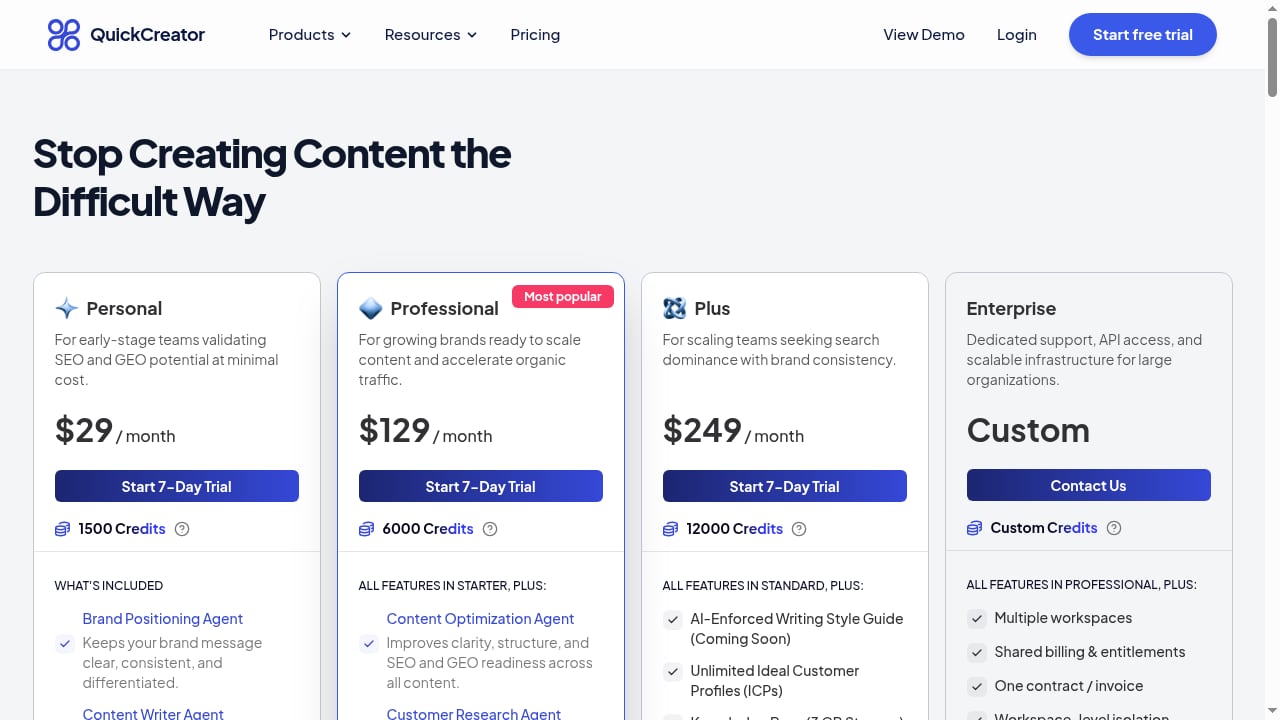
First viewport screenshot of Pricing — Agentic Marketing Platform | QuickCreator.
QuickCreator's offer is narrower and more direct: an AI content team for one person. It ships articles in your voice, targets Google rankings, and positions the output to be cited by ChatGPT, Perplexity, and Gemini. Pricing starts at $29/mo.
That is a clear pitch. The trade-off is that the public description focuses on article output and AI citation, not on the surrounding system. There is no stated website-crawl brand intelligence, no categorized keyword plan, no approval-first workflow, no multi-brand workspace, and no multilingual publishing in the available product context. If your need is simply "publish articles that rank and get cited," that may be enough. If your need is a repeatable engine that starts from real product data, the gap matters.
Head-to-head comparison
First viewport screenshot of Free AI Idea Generator | QuickCreator.
| Dimension | AgentBooks | The AI Content Team for Solo Founders |
|---|---|---|
| Starting point | Website crawl and brand intelligence | Article briefs in your voice |
| Keyword planning | Categorized keyword plan | Not described in available context |
| Workflow | Approval-first, scheduled generation | Article shipping |
| Publishing | Custom domain, site identity, multilingual | Article delivery |
| AI citation goal | Not guaranteed | Explicit goal for ChatGPT, Perplexity, Gemini |
| Multi-brand | Yes | Not described in available context |
| Pricing | Free plan, $30/mo Business, $100/mo Enterprise | From $29/mo |
Where AgentBooks fits better
AgentBooks is the stronger choice when the founder wants a content engine rather than a content vendor. Three scenarios stand out:
- You run more than one brand. Multi-brand workspaces let you keep separate voices and keyword plans without rebuilding the setup each time.
- You want to approve before publishing. The approval-first workflow keeps a human in the loop, which matters when your name is on the byline.
- You need the plan, not just the posts. A categorized keyword plan and top organic-result research give you a reason for every article, not just a queue of drafts.
For a deeper look at how AgentBooks handles planning and optimization against other tools, see the AgentBooks vs Clearscope vs GravityWrite comparison and the Top 10 AI Content Planning & Optimization Tools.
Where The AI Content Team fits better

Footer Background.
QuickCreator's tool wins on simplicity and on a specific promise. If you already know your topics and just want articles written in your voice that are built to rank and to be cited by AI assistants, the lower starting price and narrower scope can be attractive. It is also a reasonable first paid tool if you are testing whether AI-assisted publishing moves any needle at all before committing to a full engine.
The honest caveat: the available product context does not describe website-crawl brand intelligence, keyword planning, approval workflows, multi-brand support, or multilingual publishing. Treat those as unknowns and ask before you buy.
A practical decision path
Ask yourself three questions:
- Does my content need to start from what my product actually is, or can I supply the briefs myself?
- Do I need a keyword plan and organic-result research, or just finished articles?
- Will I run one brand or several over the next year?
If you answered "from the product," "plan included," and "several," AgentBooks is the better fit. If you answered "I supply the briefs," "just articles," and "one brand," QuickCreator's tool may be enough at a slightly lower entry price.
For founders who want to see how an always-on agent behaves in practice, the Growth Engine Hub review is a useful reference point on what autonomous content actually looks like when tested.
Related reading
- How to Use AgentBooks with Screaming Frog: SEO Workflow - Learn how to use AgentBooks with Screaming Frog: setup steps, a practical SEO workflow, real examples, and the problems this pairing solves.
Sources and further reading
- AgentBooks Blog - 238 articles
- AgentsBooks — Run an AI-Native Agency or Service Firm - The operating system for AI-native agencies and service firms. Deploy autonomous agents that handle content, sales, support and client ops — fewer hires.
- How This 5x Founder Runs His Startup Solo With AI Agents (OpenClaw, Codex, Devin) | Ryan Carson - Watch Ryan demo his exact OpenClaw, Codex, and Devin setup that books meetings,runs ads, and ships features while he sleeps
FAQ
Is AgentBooks cheaper than The AI Content Team for Solo Founders?
AgentBooks has a free plan and paid tiers at $30/month and $100/month. QuickCreator's tool starts at $29/mo. The entry prices are close, so the deciding factor is scope, not the first dollar.
Does AgentBooks guarantee Google rankings?
No. AgentBooks explicitly does not guarantee rankings or traffic. It optimizes the content process and the measurable inputs behind it.
Can The AI Content Team get my articles cited by ChatGPT and Perplexity?
That is the stated goal of the product. No tool can guarantee citation, but the positioning is explicit about targeting AI assistants.
Which one is better for a solo founder with one product?
If you want a full engine with brand intelligence, keyword planning, and approval-first publishing, AgentBooks. If you want article output in your voice at a slightly lower entry price, QuickCreator's tool is the simpler path.
Does AgentBooks support multiple brands?
Yes. Multi-brand workspaces are part of the platform, along with multilingual publishing and custom domain identity.
Conclusion
Both tools target the same person: a solo founder who needs content without a content team. The difference is what they start from. AgentBooks begins with your website, builds brand intelligence, plans keywords, researches organic results, and publishes on a schedule with approval in the loop. The AI Content Team for Solo Founders by QuickCreator begins with article output and a clear goal of ranking and AI citation.
If your bottleneck is writing, either tool helps. If your bottleneck is the system that decides what to write and why, AgentBooks covers more of that ground. For a wider view of how these platforms are evaluated, the Top 10 AI Search Visibility & GEO Platforms is a useful next read.