AgentBooks vs Machined vs Copy.ai: Which AI Platform Fits Your Workflow?
Choosing between AgentBooks, Machined, and Copy.ai is less about finding a single "best" tool and more about matching the right engine to the problem you are actually trying to solve. One is built to run an always-on content engine for organic search. Another automates the full SEO content pipeline from keyword clusters to publishing. The third extends AI across your entire go-to-market operation, from prospecting to deal coaching.
This comparison breaks down what each platform does well, where it falls short, and which use cases justify the investment.
How the Three Platforms Differ at a Glance
Automated Keyword Research & Discovery.
The core distinction comes down to scope and autonomy.
- AgentBooks positions itself as an autonomous content growth platform. You share your website once, and it learns your product, maps your market, plans topics, researches top-ranking pages, and publishes useful content in your brand voice on an ongoing basis.
- Machined is an AI SEO content generation platform. It automates the entire content workflow from keyword research and clustering to bulk article generation and one-click publishing to WordPress or Webflow.
- Copy.ai is a GTM AI platform. It replaces disconnected AI copilots across sales, marketing, and operations with workflows, agents, and a shared intelligence layer.
If you need a narrow, content-only solution, the first two are direct competitors. Copy.ai competes on a much broader playing field.
AgentBooks: The Autonomous Content Engine
AgentBooks is designed for teams that want organic content growth without manually managing every step of the editorial calendar. The platform's core promise is that you share your website once and it handles the rest: learning the product, mapping the market, planning topics, researching organic search results, and continuously publishing useful content.
Where AgentBooks Has a Supported Advantage
Brand intelligence that persists across every article. AgentBooks extracts product knowledge from your website and applies it consistently across all generated content. This matters when you are publishing dozens of educational articles, comparison pages, or buying guides and cannot afford to re-brief a writer or AI tool every time.
Organic research built into the workflow. The platform incorporates top-ranking pages into its research process, which helps generated content align with what search engines and readers already find useful. This is a meaningful advantage over generic AI writers that draft from model knowledge alone.
Approval-first or autopilot publishing. AgentBooks gives teams a choice: review every draft before it goes live, or let the platform publish continuously. That flexibility is useful for agencies and in-house teams with different risk tolerances.
Custom domain hosting and multilingual output. The platform hosts your content site on a custom domain and supports publishing in multiple languages, which removes a common technical hurdle for teams expanding into new markets.
Adaptive content operations by business model. AgentBooks shapes its output around the type of business you run. SaaS companies get feature guides and comparison pages. E-commerce stores get buying guides and audience-specific FAQs. Independent websites and digital products get formats suited to their own funnels.
Pricing Signals
AgentBooks starts with a free beta tier that includes brand research, keyword planning, and a hosted content site. The Pro plan is $29 per month and adds advanced SEO optimization and multilingual publishing. The Team plan is $99 per month with multiple workspaces and priority support.
Machined: The SEO Content Automation Workhorse
Machined product interface.
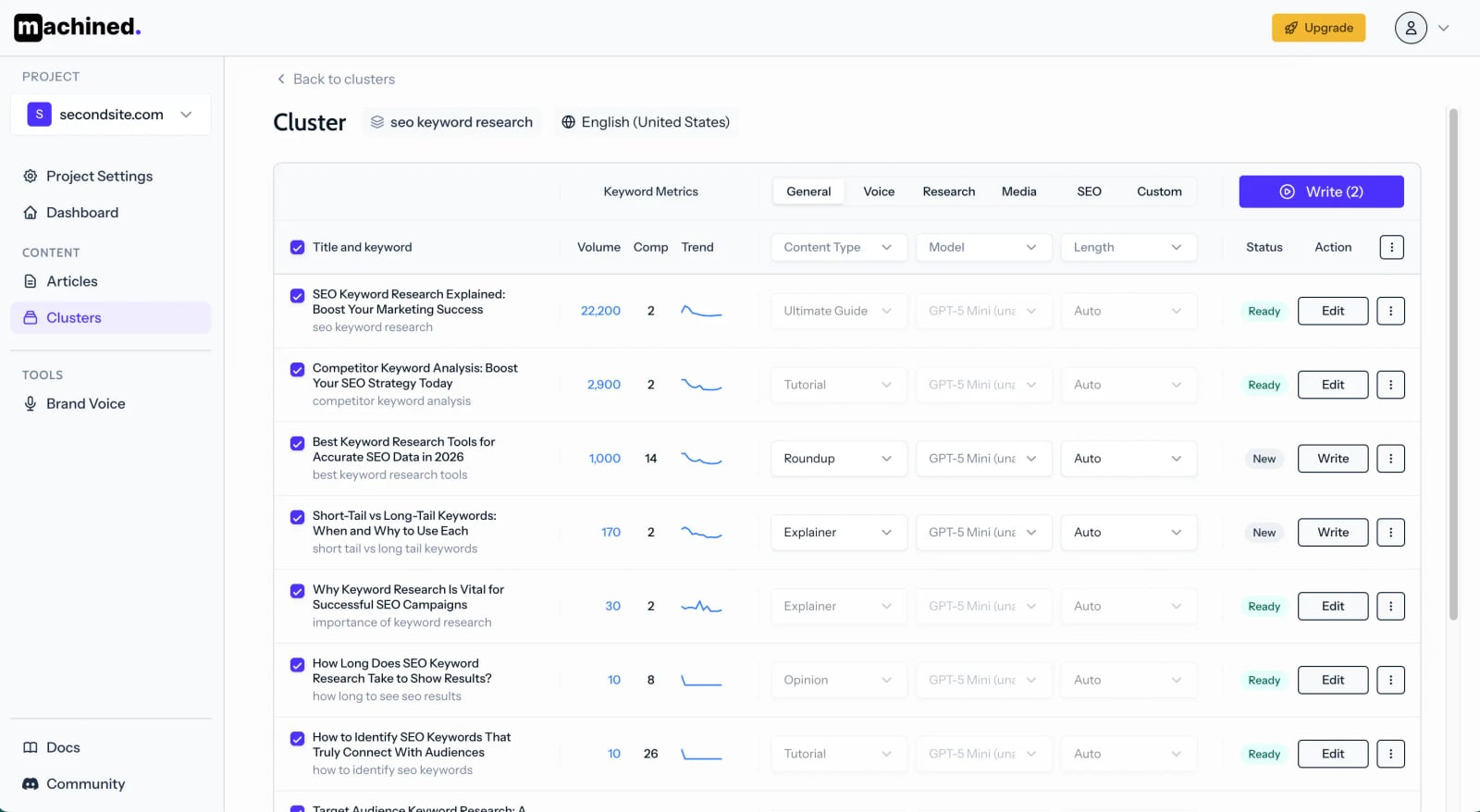
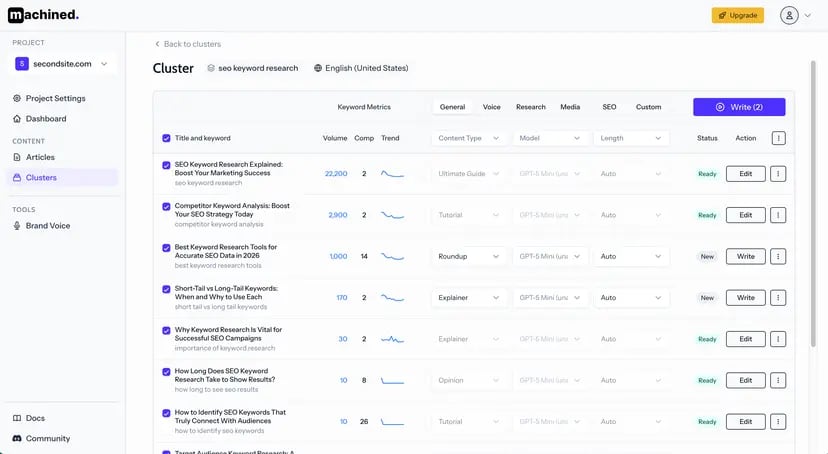
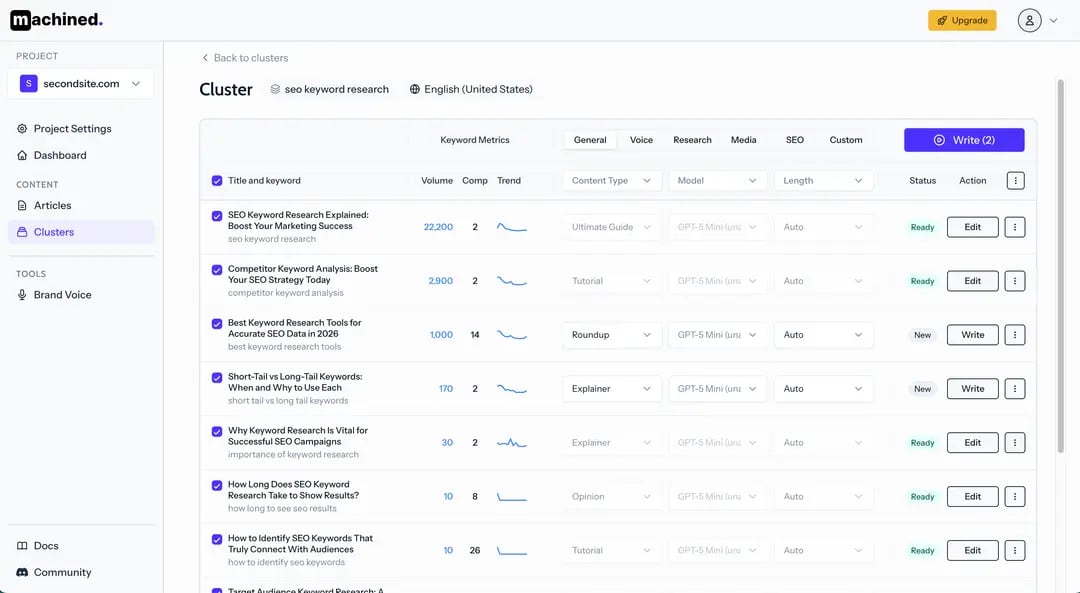
Machined is built for one job: producing large volumes of SEO-optimized content quickly. It automates keyword research, clustering, writing, internal linking, and publishing, which makes it a strong fit for teams that need to scale output without scaling headcount.
Where Machined Has a Supported Advantage
End-to-end keyword research and clustering. Machined automatically groups related keywords into content clusters, which helps you build topical authority instead of publishing isolated articles. This is a core SEO discipline that many tools leave to separate platforms.
Multi-provider AI writing with citations. Machined pulls from multiple AI providers, including OpenAI, Anthropic, Google, Perplexity, and OpenRouter. The citation feature is notable because it gives generated articles a factual anchor, which is increasingly important for trust and AI-assisted search visibility.
Bulk article generation. If you need 50 or 100 articles produced in a batch, Machined is designed for that. This is a different operating model from tools that generate one article at a time.
Automated internal linking and one-click publishing. Machined handles internal links automatically and publishes directly to WordPress and Webflow. For content teams already using those CMS platforms, this removes a significant manual step.
AI image generation and brand voice customization. The platform generates images alongside text and lets you tune the writing style to match your brand, which reduces the "generic AI" feel that plagues bulk content.
Proof Points
Machined's public case study with Engineer Seal Stamps reports 4x keyword growth to more than 200 top-ranking keywords, over 100 hours saved per month, and citations by five AI platforms. Those are directional signals, not guarantees, but they illustrate the intended use case: aggressive, measurable SEO expansion.
Pricing Signals
Machined offers a free starting tier, with paid plans ranging from $29 to $99 per month. That pricing is competitive for teams that need high-volume content generation.
Copy.ai: The GTM AI Platform
Machined product interface.
Copy.ai has evolved well beyond its early days as an AI copywriting tool. It now positions itself as the first AI-native GTM platform, replacing dozens of disconnected copilots with a single system that spans sales, marketing, and operations.
Where Copy.ai Has a Supported Advantage
AI across the entire go-to-market engine. Copy.ai automates prospecting research, sales outreach, content creation, inbound lead processing, account-based marketing, translation, and deal coaching. That breadth is unmatched by content-only tools.
Workflows and Copy Agents. The platform's Workflows let you chain multi-step processes, while Copy Agents handle specific tasks autonomously. This is the closest thing in this comparison to true multi-agent orchestration, where specialized agents collaborate and hand off tasks rather than operating in isolation.
Content Agent Studio for marketing teams. Copy.ai can spin up a content engine from just three sample inputs. For marketing teams that want a faster path to consistent content without building a full editorial operation, this is a practical entry point.
Translation and localization at native quality. The platform offers real-time, native-level translations, which is valuable for global teams that need to localize campaigns, landing pages, and outreach without a separate translation vendor.
Deal coaching and forecasting. Copy.ai analyzes sales transcripts, scores deals, and predicts close dates. This is a sales operations capability that neither AgentBooks nor Machined attempts to provide.
Scale and Trust Signals
Copy.ai reports 17 million users and claims to generate 5x more meetings for customers. Those numbers reflect a broad adoption base, though they span many use cases beyond content.
Head-to-Head Comparison
Machined product interface.
Content Automation Depth
Machined is the most aggressive content automation tool in this group when measured by volume and SEO-specific features. AgentBooks is more autonomous in the strategic sense: it plans, researches, and publishes continuously without requiring you to manage keyword clusters manually. Copy.ai can produce content, but content is one module inside a much larger GTM platform.
SEO Focus
Machined and AgentBooks are both SEO-native. Machined gives you explicit control over keyword clusters, internal links, and bulk publishing. AgentBooks handles organic research and topic planning behind the scenes. Copy.ai supports SEO content creation but does not position itself as an SEO platform first.
Brand Voice and Consistency
AgentBooks builds brand intelligence from your website and applies it across every piece of content. Machined offers brand voice customization as a configurable setting. Copy.ai includes Brand Voice as a technical component within its broader platform. All three address brand consistency, but AgentBooks makes it a foundational layer rather than a toggle.
Go-to-Market Breadth
Copy.ai is the clear winner here. Prospecting, lead enrichment, account-based marketing, deal scoring, and forecasting are entirely outside the scope of AgentBooks and Machined. If your primary bottleneck is sales pipeline rather than organic traffic, Copy.ai is the only tool in this comparison that addresses it directly.
Pricing Accessibility
All three platforms offer a free tier, and paid plans start at $29 per month for AgentBooks and Machined. Copy.ai's pricing is not publicly detailed in the same way, but its enterprise-oriented GTM features typically command higher tiers. For pure content use cases, AgentBooks and Machined are the more predictable budget options.
How to Choose
Choose AgentBooks if:
- You want a content engine that runs continuously with minimal manual oversight.
- Your primary goal is organic search growth and reducing reliance on paid acquisition.
- You need brand-consistent, educational content across multiple languages.
- You run a SaaS, e-commerce, independent website, or digital product business and want content shaped around your specific model.
Choose Machined if:
- You need to publish large volumes of SEO content quickly.
- You already use WordPress or Webflow and want one-click publishing.
- You want explicit control over keyword clusters and internal linking.
- You value multi-provider AI writing with citations for factual grounding.
Choose Copy.ai if:
- Your bottleneck spans sales, marketing, and operations, not just content.
- You want workflows and agents that automate prospecting, lead processing, and deal coaching.
- You need native-level translation and localization across your GTM stack.
- You are consolidating multiple disconnected AI copilots into one platform.
A Practical Decision Framework
Start by identifying the single biggest constraint in your growth engine.
- If organic traffic is flat because you cannot produce enough useful content, test Machined or AgentBooks. Machined is better for volume and explicit SEO control. AgentBooks is better for hands-off, brand-consistent publishing.
- If content exists but does not rank or convert, look at the research layer. AgentBooks incorporates top-ranking pages into its planning. Machined gives you keyword clusters and internal linking. Both address ranking, but through different mechanisms.
- If the pipeline is the problem, not the content, Copy.ai is the only tool in this comparison that automates prospecting, enrichment, and outreach.
- If you are already using several disconnected AI tools, consider the orchestration angle. Copy.ai's Workflows and Agents are built for that. Machined's multi-provider approach also reduces tool sprawl within the content domain.
For teams evaluating broader AI orchestration patterns, it is worth understanding how multi-provider AI gateways unify routing, failover, and governance across models. That architectural decision affects how tools like Machined and Copy.ai perform in production. See the multi-provider AI guide for a deeper look.
What the Comparison Does Not Tell You
None of these platforms can fix a broken content or GTM strategy on its own. If your positioning is unclear, your target audience is undefined, or your product value is not articulated, AI will amplify the confusion rather than resolve it.
Machined can publish 100 articles, but if those articles target keywords your buyers never search, the volume is wasted. AgentBooks can run on autopilot, but if your website does not clearly explain what you sell, the brand intelligence it extracts will be fuzzy. Copy.ai can automate outreach, but if the underlying offer is weak, more meetings will not close more deals.
Before committing to any platform, document your ideal customer, your core value proposition, and the specific metrics you want to move. Then choose the tool that attacks the constraint closest to revenue.
Related reading
- AI Copywriting in 2026: Tools, Workflows & Realistic Results - Learn what AI copywriting actually does well, where it fails, and how to build a workflow that produces useful, brand-consistent copy without losing quality.
- SEO Writing Review 2026: Features, Pricing & Real Test - An evidence-based SEO Writing review covering real workflows, SERP analysis, pricing signals, ideal users, and limitations before you buy.
Sources and further reading
- AgentBooks Blog | AgentBooks - AgentBooks vs Copy.ai: Compare an autonomous content engine with a GTM AI platform. See features, pricing, and which tool solves your organic growth or sales ...
- How Australian Businesses Are Moving from Single AI Tools to Multi-Agent Orchestration in 2026 (And Why It Matters) - For the past two years, Australian businesses have been experimenting with AI tools one at a time. ChatGPT for emails. A chatbot for customer service. Predictive analytics for sales forecasting. Each tool working in isolation, delivering modest wins but never quite transforming the business.
- AI in Manufacturing & Delivery: Smarter Operations with Tencys - 🚀 From Data to Decisions: AI in Manufacturing & Delivery Manufacturing and delivery businesses generate massive amounts of data every day. The real challenge is turning that data into faster, smarter decisions.
At Tencys, we help organizations leverage AI & Agentic AI to transform operations:
🏭 Manufacturing • Predict equipment issues • Improve quality & production • Optimize inventory and supply • Get real-time operational insights
🚚 Delivery & Logistics • Optimize routes and resources • Predict delays • Improve fleet utilization • Automate repetitive workflows
With Agentic AI, systems can go beyond providing insights; they can analyze, decide, and initiate actions with the right human oversight.
Data → Intelligence → Action
The future of operations isn
FAQ
Is AgentBooks better than Machined for SEO?
It depends on your operating style. Machined gives you explicit control over keyword clusters, internal linking, and bulk publishing, which suits teams that want hands-on SEO management. AgentBooks automates organic research and topic planning behind the scenes, which suits teams that want an autonomous engine. Both are SEO-native; neither is objectively better for every team.
Can Copy.ai replace Machined or AgentBooks for content?
Copy.ai can produce SEO content, thought leadership, and social posts, but it is not a dedicated SEO content platform. If content is your only need, Machined or AgentBooks will likely offer deeper SEO-specific features. If you also need sales and operations automation, Copy.ai's breadth becomes an advantage.
Which tool is best for a small team on a budget?
All three offer free tiers. AgentBooks and Machined both start paid plans at $29 per month, making them accessible for small teams focused on content. Copy.ai's broader GTM features may require higher-tier pricing, so evaluate whether you will actually use the sales and operations modules before paying for them.
Do these tools work with WordPress?
Machined offers one-click publishing to WordPress and Webflow. AgentBooks hosts content on a custom domain through its own platform. Copy.ai integrates with broader GTM stacks but does not position itself as a CMS publishing tool.
Which platform is best for multilingual content?
AgentBooks supports multilingual publishing as part of its Pro plan. Copy.ai offers real-time, native-level translations across its GTM workflows. Machined's multilingual capabilities are less prominent in its core positioning.
Conclusion
AgentBooks, Machined, and Copy.ai solve different problems. AgentBooks is an autonomous content engine for teams that want organic growth without manual editorial overhead. Machined is an SEO content automation workhorse for teams that need volume, clusters, and publishing speed. Copy.ai is a GTM AI platform for teams whose bottleneck spans sales, marketing, and operations.
The right choice depends on where your growth is stalling. If content volume and SEO control are the issue, start with Machined. If you want a hands-off, brand-consistent content engine, test AgentBooks. If your pipeline needs automation across the entire go-to-market function, Copy.ai is the broader bet. For a practical look at what AI SEO actually delivers in 2026, see the AI SEO guide before committing to any platform.