

ContentBot AI Logo: Brand Assets, Usage Rules & Alternatives
If you searched for the ContentBot AI logo, you probably need one of three things: the official brand mark for a review, a comparison page, or a slide deck; a clear idea of what the product actually does before you commit; or a realistic alternative when a flow-based writer is not enough for your publishing pipeline. This guide covers all three, with practical notes on where the logo lives, how to reference the brand correctly, and how to decide whether ContentBot.ai fits your workflow.
What the ContentBot.ai brand actually represents

ContentBot AI Logo: Brand Assets, Usage Rules & Alternatives - What the ContentBot.ai brand actually represents.
ContentBot.ai is an AI content generation tool built around AI Flows — visual sequences of triggers, actions, and filters that automate content production. The product markets itself to digital marketers, content marketers, founders, copywriters, and SEO specialists, and its feature set includes an AI Blog Writer, an Importer for bulk generation, a Humanizer, and multilingual output across more than 110 languages.
That positioning matters when you use the logo. The mark is not just a decorative icon; it signals a specific category of tool: a prompt-and-flow content generator, not a full content operations platform. If you are writing about the brand, describe it accurately rather than treating it as a generic "AI writer."
Where the logo appears
The brand mark is most commonly seen in three places:
- The homepage and login screen at contentbot.ai, where the logo anchors the navigation and sign-in flow.
- The about page, which introduces the team behind the product and their background building WordPress tools.
- Third-party review and comparison sites, where the logo is usually pulled from the official site or a press kit rather than supplied directly.
Because there is no widely published, standalone brand asset page, most people end up cropping a screenshot or requesting the mark from the company directly. If you need a clean vector file, the safest route is to contact the team through the official site rather than upscaling a low-resolution image.
How to use the ContentBot AI logo correctly

ContentBot AI Logo: Brand Assets, Usage Rules & Alternatives - How to use the ContentBot AI logo correctly.
Brand marks carry legal and editorial weight, so a few simple rules keep you out of trouble.
Do
- Use the logo to identify the product in reviews, tutorials, comparisons, and news coverage.
- Keep the mark unaltered — no recoloring, stretching, or adding effects.
- Link the image back to the official site when you publish it on the web.
- Add a short attribution such as "ContentBot.ai logo, used for identification purposes."
Don't
- Imply sponsorship, partnership, or endorsement unless you have written permission.
- Use the logo as your own product icon, favicon, or app store image.
- Place the mark inside a design that suggests it is part of your own brand system.
If you are building a comparison table or a roundup, a text mention with a link is often safer and more useful than embedding the image at all.
What ContentBot.ai does well — and where it stops
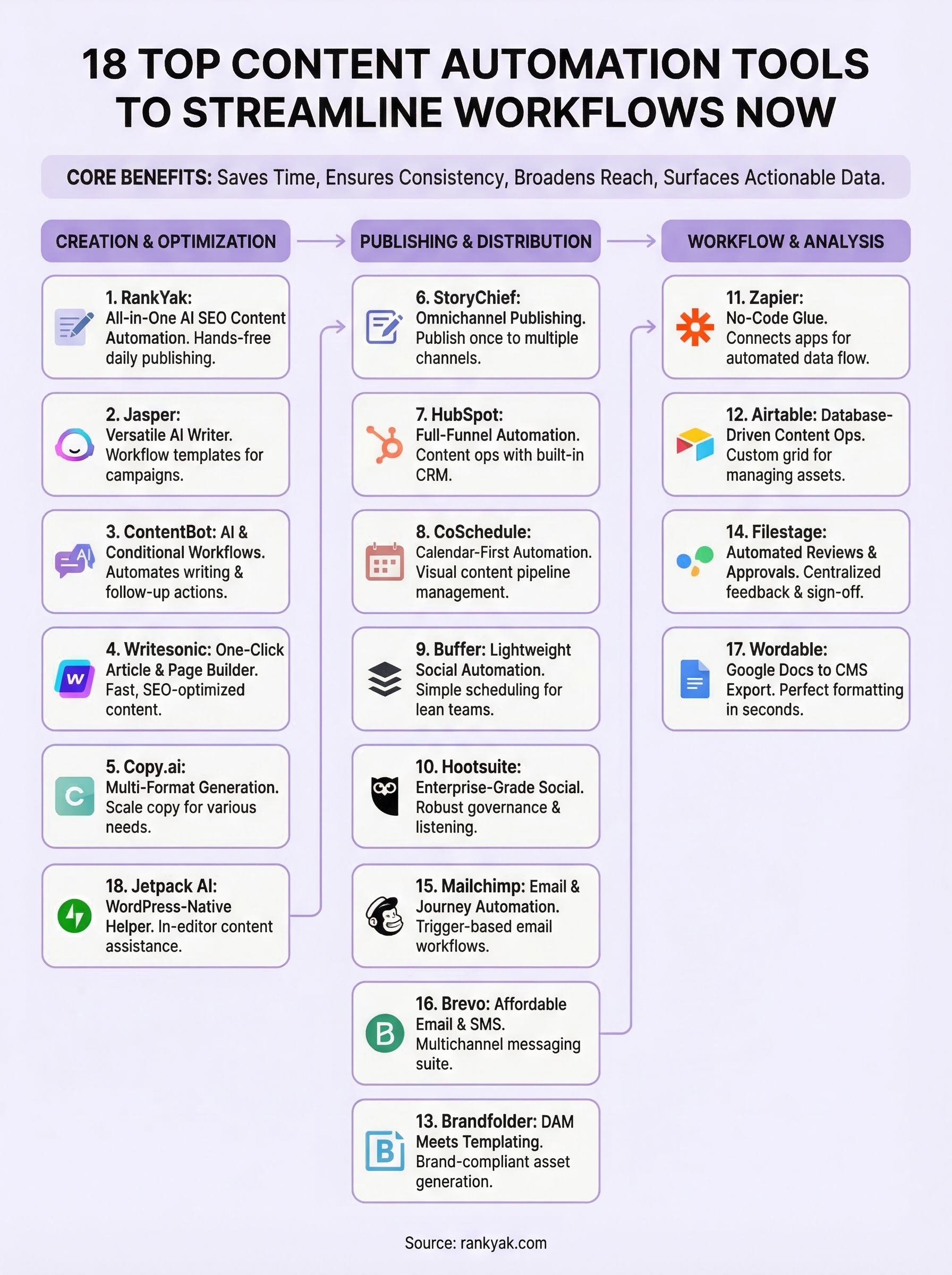
ContentBot AI Logo: Brand Assets, Usage Rules & Alternatives - What ContentBot.ai does well — and where it stops.
Before you feature the logo in a buying guide, it helps to understand the product's real strengths and limits.
Strengths
- Flow automation. Flows let you chain triggers and actions to produce content on a schedule, which is genuinely useful for high-volume, repeatable tasks.
- Bulk imports. The Importer accepts a file of topics or variables and returns output in bulk, which suits e-commerce product descriptions and large keyword lists.
- Multilingual output. Support for 110+ languages makes it viable for teams testing new markets.
- Humanizer. A dedicated feature aimed at making AI output read more naturally.
Limits
- It is primarily a generation tool, not a publishing and governance system. You still need to handle approvals, internal linking strategy, and post-publish updates elsewhere.
- Brand voice consistency depends heavily on how well you write prompts; there is no persistent source of truth about your product.
- SEO structure — topic clusters, keyword mapping, and content refresh cycles — is largely your responsibility, not the tool's.
If you want a deeper look at how this category of tool fits into a broader stack, our guide to the AI writing agent workflow explains how planning, drafting, and publishing connect.
When a flow-based writer is not enough

ContentBot AI Logo: Brand Assets, Usage Rules & Alternatives - When a flow-based writer is not enough.
ContentBot.ai is a good fit if you need fast, templated output: ad copy, product descriptions, topic ideas, or bulk blog drafts. It becomes a bottleneck when your goal shifts from producing more content to running a content engine.
That shift usually shows up in three symptoms:
- Inconsistent voice. Different writers and prompts produce different tones, and nothing enforces a single brand standard.
- Weak topical authority. You publish articles, but they do not form a connected cluster that search engines can recognize.
- Manual refresh work. Old posts go stale and nobody owns the update cycle.
At that point, teams typically look for a platform that connects product understanding, keyword planning, article creation, approval, publishing, and future updates in one workspace. AgentBooks is built for exactly that: it crawls your website to create a reusable source of truth, builds a categorized keyword plan, generates articles in your brand voice with approval workflows, and publishes to a hosted content site with custom domain support. It is not a replacement for a flow builder — it is the layer above it that keeps content consistent and current.
If you are still evaluating the free tier of the tool in question, our breakdown of the ContentBot.ai free trial covers what the demo editor and AI flows actually include, plus word limits and when to move on.
ContentBot.ai vs. a full content engine: a quick comparison
| Dimension | ContentBot.ai | Full content engine (e.g., AgentBooks) |
|---|---|---|
| Primary job | Generate copy and drafts via flows | Plan, create, approve, publish, and update content |
| Brand voice | Prompt-dependent | Learned from your website as a source of truth |
| Keyword strategy | Manual | Categorized keyword plan built in |
| Publishing | Export or integrate | Hosted content site with custom domain |
| Content refresh | Manual | Continuous updates as part of the workflow |
| Best for | High-volume, templated output | SaaS teams, agencies, founders scaling organic content |
Neither column is universally better. If your bottleneck is volume, a flow tool wins. If your bottleneck is consistency and compounding organic growth, a content engine wins.
Practical example: using the logo in a comparison post
Suppose you are writing a roundup of AI writing tools. A clean approach looks like this:
- Header image: your own branded graphic, not a collage of competitor logos.
- Body: mention ContentBot.ai by name with a link to its homepage, and describe its flow and import features accurately.
- Comparison table: use text names in the column headers rather than logos, which avoids licensing ambiguity and renders more reliably on mobile.
- Footer note: if you do include the mark, add "Logos are property of their respective owners and used for identification only."
This structure keeps your article legally clean and more useful to readers, who care about capabilities far more than iconography.
Related reading
- Yoast SEO WordPress Plugin: Features, Pricing & Fit - A practical guide to the Yoast SEO WordPress plugin: free vs Premium features, AI tools, schema, pricing, and when to add a content automation platform.
- Enterprise SEO: Strategy, Workflows & Scaling Content - Enterprise SEO requires templated fixes, cross-team workflows, and scalable content. Learn how to prioritize, automate, and prove ROI at scale.
- How to Use Surfer: A Beginner's Guide to Mapping Data - Learn how to use Surfer by Golden Software: import data, create contour maps, customize layers, and export results. A practical tutorial for beginners.
Sources and further reading
- Login to ContentBot.ai | AI Assistant for Copywriters and Marketers - Log in to ContentBot.ai and start generating amazing content ideas and marketing copy. Generate anything from blog topic ideas to marketing ideas, ...
- The Future of Writing is Here - Get to know the team behind ContentBot. We're passionate about innovation and helping copywriters, marketers and founders with all their copy needs.
FAQ
Is there an official ContentBot.ai logo download page?
There is no widely advertised standalone brand asset page. The mark appears on the official site and login screen. For a high-resolution or vector version, contact the team through the official website.
Can I use the ContentBot AI logo in my own article or video?
Yes, for identification and editorial coverage, provided you do not imply endorsement and do not alter the mark. When in doubt, ask for written permission.
What does ContentBot.ai actually do?
It is an AI content generation tool centered on AI Flows, with an AI Blog Writer, an Importer for bulk content, a Humanizer, and support for more than 110 languages.
Is ContentBot.ai good for SEO content?
It can produce SEO-oriented drafts, but it does not manage keyword mapping, internal linking strategy, or content refreshes. Those remain your responsibility or require a dedicated content engine.
What is the best alternative if I need end-to-end publishing?
Look for a platform that connects product understanding, keyword planning, generation, approval, and publishing. AgentBooks is one example, with a free Starter plan during public beta, a Pro plan at $29/month, and a Team plan at $99/month.
Does the logo matter for search rankings?
No. Logos have no direct SEO value. What matters is accurate, useful content that matches search intent — which is why describing the product correctly is more valuable than embedding its mark.
Conclusion
The ContentBot AI logo is easy to find on the official site but not formally packaged as a downloadable asset, so treat it as an identification mark rather than a design element you can repurpose freely. More importantly, use the logo as a prompt to get the description right: ContentBot.ai is a flow-driven generation tool that excels at volume and multilingual output, but it stops short of the planning, governance, and refresh cycles that compound organic growth. If your needs have outgrown flow-based drafting, explore a platform that owns the full pipeline — and if you are still comparing tools, start with a structured keyword research process so your content decisions are grounded in demand rather than guesswork.