
Keyword Research and Planning: A Practical 2026 Workflow
Keyword research and planning is not a list-building exercise. It is a decision process: you gather demand evidence, interpret intent, group related queries, rank the opportunities, and commit to a publishing plan you can actually execute. Teams that skip the planning half end up with spreadsheets full of keywords and no content calendar.
This guide walks through a repeatable workflow you can run for a single page, a client site, or an entire content program.
What keyword research and planning actually includes
First viewport screenshot of Keep publishing without building a full content team. | AgentBooks.
Most people conflate two different jobs:
- Keyword research is discovery and measurement. You find the queries people use, then attach data such as search volume, competition, cost-per-click, and trend history.
- Keyword planning is selection and sequencing. You decide which queries matter for your business, which page should target each one, and when it should be published.
Research without planning produces a long list. Planning without research produces guesses. You need both.
A useful working definition: keyword research and planning is the process of matching real search demand to your business model, then converting that match into a prioritized content roadmap.
Step 1: Start with the business, not the keyword tool
Before you open any tool, write down four things:
- Who you serve — the audience and their level of awareness.
- What you sell — products, services, or monetization model.
- Where you compete — target countries, languages, and regions.
- What a qualified visitor does next — sign up, book a demo, buy, subscribe.
This context changes which keywords are worth pursuing. A high-volume informational term is valuable to a media site and nearly worthless to a company selling enterprise software with a six-month sales cycle.
If you are running research across multiple brands or clients, keep this context attached to each project rather than in your head. Tools that store audience, offer, and market alongside the keyword list make handoffs far cleaner.
Step 2: Build a seed list from multiple angles
First viewport screenshot of Create useful discovery content beyond the product grid. | AgentBooks.
Seeds are starting points, not targets. Generate them from:
- Product and category terms — how customers describe what you sell.
- Problem language — what people type when something is broken, slow, or confusing.
- Comparison queries — "X vs Y", "X alternatives", "best X for Y".
- Jobs to be done — "how to", "template", "checklist", "calculator".
- Your own site — page titles, internal search logs, and support tickets.
- Competitor pages — the topics they rank for and the gaps they ignore.
Aim for 50 to 200 seeds. You will expand them in the next step, so breadth matters more than precision here.
Step 3: Expand seeds into measurable keyword candidates
This is where data enters the process. You need, at minimum:
| Signal | Why it matters |
|---|---|
| Monthly search volume | Sizes the opportunity |
| Competition or difficulty | Estimates how hard ranking will be |
| Cost-per-click | A proxy for commercial value |
| 12-month trend | Reveals seasonality and direction |
| SERP composition | Shows what type of page can win |
Different tools expose these signals differently. Some charge per keyword researched, which suits project-based and agency work. Others bundle research credits into monthly plans with discovery and brief generation. Microsoft's own Keyword Planner provides volume trends and performance forecasts for advertisers, and is free with a Microsoft Advertising account.
A practical tip: research in batches by theme, not alphabetically. Grouping seeds before you pull data makes the next step much faster.
Step 4: Read the SERP before you commit
Volume and difficulty numbers are estimates. The search engine results page is evidence.
For each candidate keyword, check:
- What page types rank — product pages, listicles, tutorials, forums, videos?
- Whether the intent is commercial or informational — a page selling a product will not rank for a purely educational query.
- Whether there is a featured snippet or AI overview — this can reduce click-through even when you rank.
- Whether the top results are fresh — if every result was updated this year, the topic rewards maintenance.
This step is where most keyword plans break. A keyword can look perfect in a spreadsheet and be unwinnable in practice because the SERP is dominated by a page type you cannot produce.
Step 5: Map intent to page type
Intent mapping is the bridge between research and planning. A simple four-bucket model works well:
- Informational — "what is", "how to", "why does". Target with guides, explainers, and tutorials.
- Commercial investigation — "best", "vs", "alternatives", "review". Target with comparisons and evaluations.
- Transactional — "buy", "pricing", "demo", "near me". Target with product and landing pages.
- Navigational — brand and product names. Target with homepage, docs, or support pages.
For each keyword in your shortlist, write the intended page type next to it. If you cannot name the page type, the keyword is not ready for the plan.
Step 6: Cluster keywords into topics, not lists
Clustering means grouping keywords that should be served by the same page. Search engines rank pages, not keywords, so targeting five near-identical queries with five thin pages usually cannibalizes your own results.
A workable clustering rule:
- Group keywords that share the same intent.
- Group keywords whose SERPs overlap significantly.
- Name the cluster after the highest-volume representative query.
- Assign one URL per cluster.
If you are comparing tools that automate this, AgentBooks vs AirOps vs Machined breaks down how different platforms handle cluster generation and publishing workflows.
Step 7: Prioritize with a scoring model
You cannot publish everything. Score each cluster on four dimensions, each rated 1 to 5:
- Business value — how close is this to revenue?
- Demand — combined volume across the cluster.
- Achievability — how realistic is ranking given your authority and the SERP?
- Effort — research, writing, design, and maintenance cost.
A simple weighted score: (Business value × 2) + Demand + Achievability − Effort.
The weighting is arbitrary on purpose. The value is in forcing an explicit trade-off instead of defaulting to the highest-volume keyword every time.
Step 8: Turn the plan into a calendar
First viewport screenshot of Build organic discovery without making content your second job. | AgentBooks.
A keyword plan becomes real when it has dates, owners, and URLs. Each row should include:
- Target cluster and representative keyword
- Assigned URL (existing or planned)
- Page type and word-count range
- Internal links to add
- Publish date and review date
Review dates matter more than publish dates. Search demand shifts, competitors publish, and AI-generated answers reshape SERPs. A quarterly refresh cycle keeps the plan honest.
If your team already runs technical audits alongside content work, How to Use AgentBooks with Screaming Frog shows how crawl data and content planning can feed each other.
Common mistakes in keyword research and planning
- Chasing volume over fit. A 50,000-volume keyword that attracts unqualified traffic costs more than it returns.
- Skipping SERP analysis. Data alone does not tell you what page type wins.
- One keyword, one page. This creates thin content and cannibalization.
- No owner or date. Plans without accountability stall after week two.
- Treating difficulty as a guarantee. Difficulty scores are heuristics, not predictions.
Where automation fits
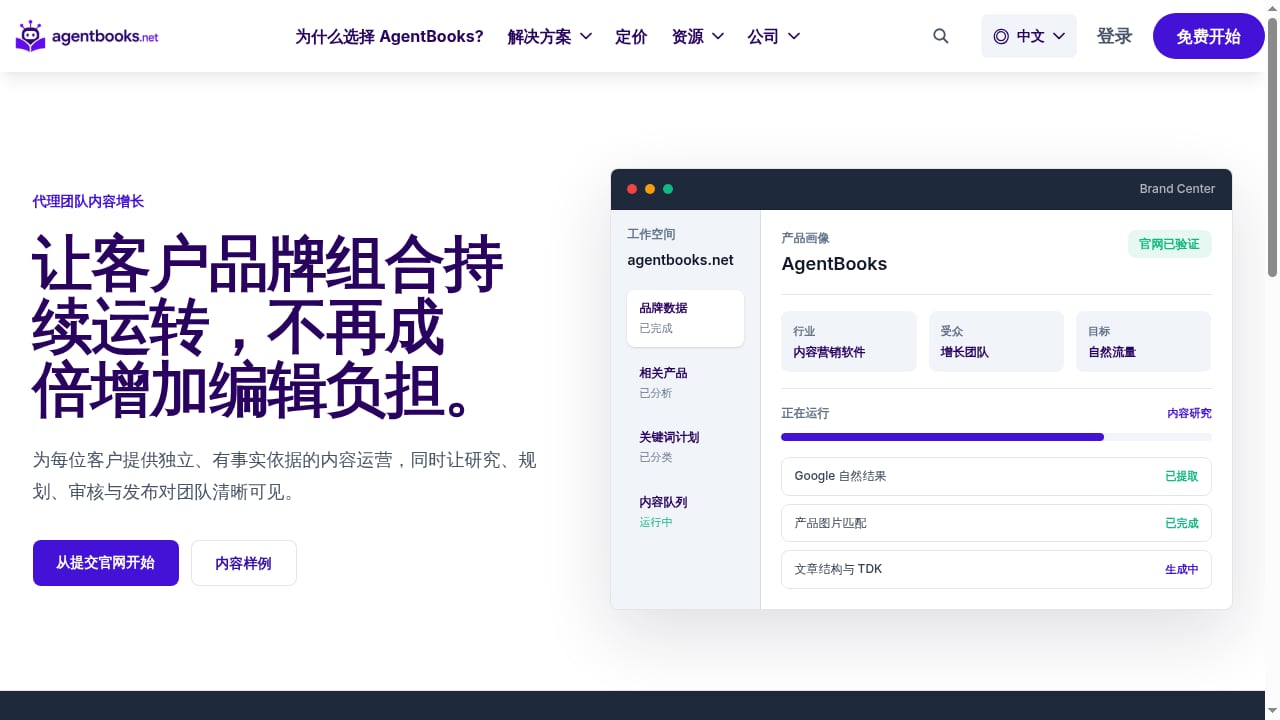
First viewport screenshot of Keep client brand portfolios running without multiplying editorial workload. | AgentBooks.
Automation helps most in the repetitive middle of the workflow: expanding seeds, pulling demand data, grouping clusters, drafting briefs, and keeping the calendar current. It helps least at the edges — deciding what the business should prioritize and judging whether a SERP is winnable.
Platforms like AgentBooks approach this by learning from a website first, then generating a categorized keyword plan and an approval-first article workflow from that context. The value is not in replacing judgment; it is in keeping research, planning, and publishing in one place so the plan does not go stale. For a broader view of how these platforms compare, see Top 10 AI Content Creation & Predictive Audience Intelligence Platforms 2026.
Related reading
- How to Use AgentBooks with BrandWell Growth Automation - Learn how to connect AgentBooks with BrandWell's growth automation software to align inbound content and outbound intent data in one repeatable workflow.
- AgentBooks vs The AI Content Team for Solo Founders - AgentBooks vs The AI Content Team for Solo Founders: compare brand intelligence, keyword planning, publishing, pricing, and fit for one-person teams.
Sources and further reading
- KWScanner | Keyword Research Tool & Campaign Planner - Keyword research tool and Keywords Everywhere alternative. Check search volume, CPC, competition, and keyword ideas in bulk. Pay as you go, no subscription.
- TheKeyword — Know what to publish next - Find relevant keywords, choose your priorities and build a content plan for your website or client.
FAQ
How often should I redo keyword research?
Run a full refresh quarterly and a light check monthly. Update any cluster where the SERP has changed, a competitor has published, or your own rankings have shifted meaningfully.
How many keywords should one page target?
One primary keyword and a handful of close variants. If you find yourself listing ten unrelated keywords for a single URL, you probably have two or three clusters that deserve separate pages.
Is search volume still reliable?
It is directional, not precise. Use it to compare opportunities within the same market and tool, not as an absolute traffic forecast. Coverage varies by keyword, market, and data provider.
Do I need paid tools?
Not necessarily. Free planners such as Microsoft's Keyword Planner cover volume and forecasting. Paid tools add bulk research, clustering, trend history, and API access, which matter more as your program scales.
How do I handle keyword research for multiple languages?
Treat each language as a separate market with its own demand data and SERP. Do not translate a keyword list and assume the volumes carry over — they rarely do.
What is the biggest mistake beginners make?
Building the list before defining the business context. Without a clear audience, offer, and conversion goal, every prioritization decision becomes arbitrary.
Conclusion
Keyword research and planning works when it is treated as one continuous process: gather demand evidence, read the SERP, map intent, cluster, prioritize, and schedule. The tools you use matter less than the discipline of connecting each keyword to a page, a purpose, and a date. Start with your business context, keep the plan visible, and review it on a schedule — that is what separates a keyword list from a content engine.