

SEO Writing AI Review: A Practical Look at AI SEO Content Generation
SEO Writing AI (also known as SEOWriting.ai) promises to turn a keyword into a publish-ready article in about 15 minutes, complete with SERP-informed structure, internal and external links, and WordPress or Shopify publishing. That pitch is appealing if you run a blog, an affiliate site, or an agency content desk. But does the tool hold up under real editorial pressure? This review examines its features, pricing signals, setup process, strengths, limitations, and the types of users who will get the most from it.
What SEO Writing AI actually does
First viewport screenshot of seowriting.ai.
At its core, SEO Writing AI is an AI content generation platform built around search intent. You enter a keyword, and the tool analyzes competing pages in the SERP to build an outline, then drafts long-form content around that structure. The output is formatted with headings, lists, and tables, and can include AI-generated images and citations.
The platform also markets itself as optimizing for AI answers from ChatGPT, Perplexity, and Google AI, not just traditional search results. That positioning matters because more buyers now start research inside an AI assistant. Whether the tool's AI-answer optimization is measurable is a fair question, but the underlying approach—clear structure, direct answers, and cited sources—is consistent with what AI systems tend to quote.
Key capabilities include:
- 1-click article generation for blog posts, product roundups, reviews, and how-to guides
- Bulk generation for producing many articles from a keyword list
- Real-time SERP analysis to shape outlines around what already ranks
- Brand voice customization to keep tone consistent across a site
- Internal and external linking with placement controls
- AI editor and content score for readability and on-page checks
- WordPress and Shopify integration for direct publishing and scheduling
- A rewriter tool for refreshing existing pages
Who SEO Writing AI is best for
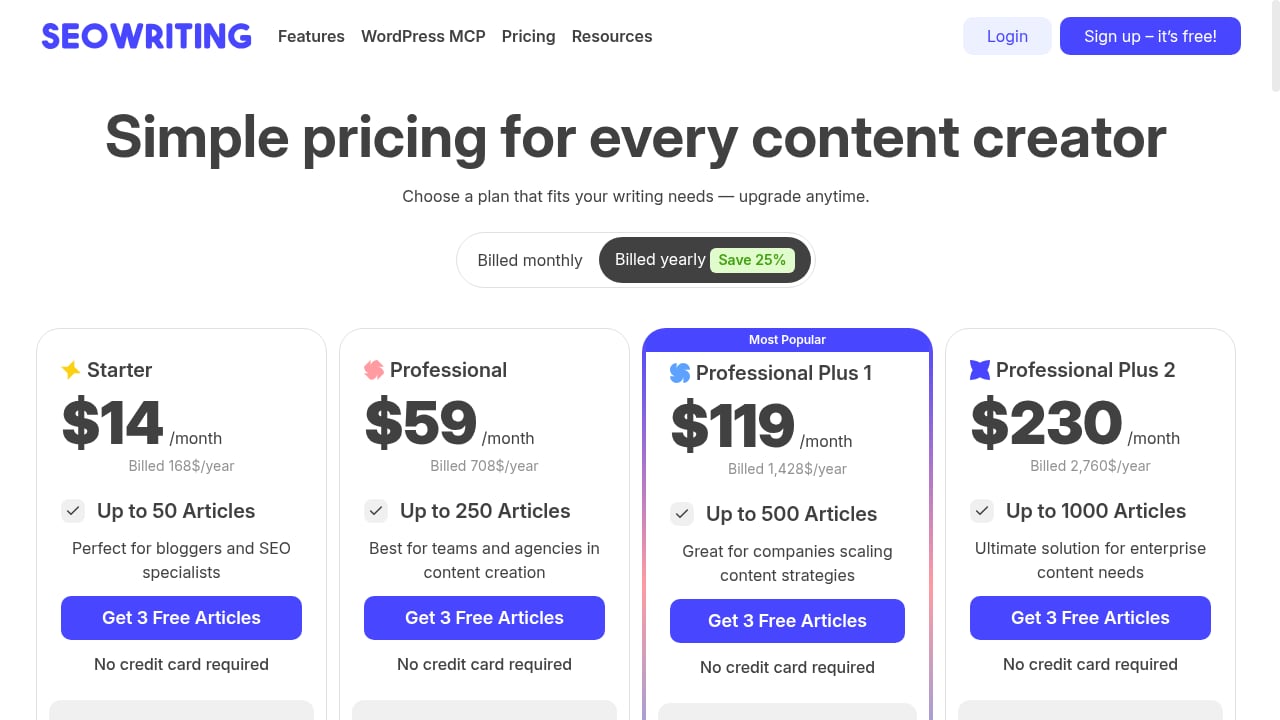
First viewport screenshot of seowriting.ai.
The tool fits best where speed and volume matter more than bespoke editorial craft.
Affiliate and niche site publishers
Affiliate marketers need product roundups, comparisons, and reviews at scale. SEO Writing AI's templates for product listings and roundups, plus bulk mode, make it possible to launch dozens of pages quickly. One long-term reviewer noted using the tool to launch sites in competitive niches at a fraction of the usual cost, with formatting and on-page SEO handled automatically.
Agencies producing content at volume
Agencies juggling multiple clients can use brand voice settings and bulk generation to standardize output. The WordPress integration reduces the handoff friction between writing and publishing, though client approval workflows still need a human layer.
Bloggers and small teams without a dedicated writer
If you are a solo operator who understands your topic but not the mechanics of on-page SEO, the tool's outline and linking automation remove a lot of busywork. The free tier and low entry price lower the risk of trying it.
Who should look elsewhere
If you need deep keyword research, complex content briefs with entity coverage scoring, or maximum control over every sentence, SEO Writing AI will feel limited. Reviewers have pointed out that it is not a keyword research suite and does not offer the widest range of language models. Teams that need heavy customization or multi-step editorial workflows may prefer a broader content operations platform. For a wider field, see this comparison of AI marketing content creation and audience testing platforms.
Strengths: where the tool earns its keep
Speed from keyword to draft
The 1-click workflow is genuinely fast. You choose a topic, set language, tone, article size, AI model, and point of view, then let the tool generate a title and outline from the SERP. In a typical session, you can go from keyword to a formatted draft in well under an hour, and the vendor claims as little as 15 minutes for a complete article.
SERP-informed structure
Because the outline is built from competing pages, the draft usually covers the subtopics a searcher expects. That reduces the risk of missing a key section—a common failure mode with generic AI writers that invent structure from scratch.
Linking and publishing automation
Internal and external linking can be configured by quantity and placement, with contextual enrichment. WordPress auto-posting and scheduling mean you can move from draft to live page without copy-pasting. Shopify integration serves ecommerce teams producing product-led content.
Bulk mode for scaled production
Bulk mode accepts a list of keywords—typed, pasted, or uploaded from a spreadsheet—and generates articles with titles, meta descriptions, and images. For affiliate sites or content-heavy projects, this is the feature that changes the economics of publishing.
A free entry point
The free tier lets you test the workflow before committing. That is a low-risk way to judge output quality against your own standards.
Limitations and risks to weigh
Output quality still needs an editor
AI drafts from any tool can be generic, repetitive, or factually shaky. SEO Writing AI is no exception. The content score and readability checks help, but they do not replace subject-matter review. Budget time for editing, especially on YMYL topics.
API key and cost management
One Trustpilot reviewer described connecting an OpenAI API key and later forgetting to revoke it, which led to unexpected costs. If you use bring-your-own-key options, set spending limits and rotate keys when you stop using a tool. This is a user-side risk, but it is worth planning for.
Feature depth versus specialists
Reviewers note the tool lacks built-in keyword research and does not offer the widest model selection. If your workflow depends on entity optimization, advanced briefs, or granular control over prompts, you may find yourself supplementing with other tools.
AI-answer optimization is hard to verify
Claims about getting cited in ChatGPT or Perplexity are difficult to measure directly. Treat them as a directional benefit rather than a guaranteed outcome, and track AI referrals in your analytics.
Pricing signals: what to expect
SEO Writing AI uses a tiered subscription model with monthly and yearly billing; the annual option is advertised with a 25% discount. Based on published plan information, the structure looks like this:
| Plan | Approximate price | What it signals |
|---|---|---|
| Free | $0 | Trial access with limited article generation and word count |
| Starter | Around $14/month | Entry-level volume, readability mode, bulk generation, premium AI models |
| Professional | Around $49/month | Higher article limits, unlimited words, external linking, brand voice, deep web research, citations |
| Professional Plus | Higher tier | For heavier production and team needs |
Prices and limits change, so confirm current details on the vendor's site before buying. The key signal is that the entry price is low relative to the volume, which makes it attractive for testing. The Professional tier is where linking, brand voice, and research depth become available—features most serious publishers will want.
Setup: a realistic walkthrough
First viewport screenshot of seowriting.ai.
Setting up SEO Writing AI is straightforward, but a few choices affect output quality more than others.
- Connect your site. Link WordPress or Shopify so the tool can pull internal link candidates and publish directly.
- Configure brand voice. Add tone guidance and examples of your best content. This is the single biggest lever for making drafts sound like you.
- Choose your research depth. Basic web crawling uses real-time results; deeper crawling scrapes more sources and adds citations. Use deeper research for competitive topics.
- Set readability and formatting. Grade 8–9 readability works well for consumer content. Enable lists and tables where they help scanning.
- Define linking rules. Set internal and external link quantities and placement. Review the links before publishing—automated links can miss context.
- Generate and edit. Use the outline editor to adjust headings before drafting. After generation, run a fact-check and tighten the intro.
- Publish and monitor. Schedule through the integration, then track rankings and AI referrals.
If you want to see how this kind of automation fits into a larger workflow, this guide on using AgentBooks with Browse AI shows how scraping and content automation can be combined. For a direct tool comparison, see AgentBooks vs AI SEO Writer.
How SEO Writing AI compares to alternatives
First viewport screenshot of seowriting.ai.
Reviewers have compared SEO Writing AI with Agility Writer and Perplexity AI. The general pattern: SEO Writing AI wins on price and bulk output, Agility Writer offers more advanced editing and integrations, and Perplexity AI is strong on factual, cited answers but is not a full content production workflow.
Against broader content operations platforms, SEO Writing AI is narrower. It does one job—generating SEO-oriented articles—and does it affordably. If you need brand intelligence, multi-step approvals, or localization at scale, a platform like those covered in the AgentBooks vs Brafton vs Machined.ai comparison may be a better fit.
Decision criteria: is it right for you?
Use these questions to decide:
- Do you publish more than 10 articles a month? If yes, bulk mode and the Professional tier likely pay for themselves.
- Is your bottleneck drafting or strategy? SEO Writing AI solves drafting. It does not replace keyword strategy or editorial judgment.
- Do you need citations and brand voice? These sit on higher tiers; factor that into the real cost.
- Can you commit to editing? If you cannot review output, the tool will produce volume without quality.
- Do you need AI-answer visibility? The tool's structure helps, but track results rather than assuming them.
FAQ
Is SEO Writing AI good for beginners?
Yes, for beginners who need a guided workflow. The 1-click mode and SERP-based outlines reduce the blank-page problem, and the free tier lets you test before paying. Just plan to edit the output.
Can SEO Writing AI generate content in bulk?
Yes. Bulk mode accepts keyword lists and can generate many articles with titles, meta descriptions, and images, then publish to WordPress.
Does SEO Writing AI integrate with WordPress and Shopify?
Yes, both integrations are part of the platform's publishing workflow, including scheduling and featured image handling.
How much does SEO Writing AI cost?
Published plans range from a free tier to paid Starter and Professional tiers, with annual billing advertised at a 25% discount. Check the vendor site for current limits.
Is SEO Writing AI safe to use with an API key?
If you connect a third-party API key, set spending limits and revoke keys you no longer use. One public review describes unexpected costs from a key that was not revoked.
Does SEO Writing AI help with AI search visibility?
The platform markets optimization for AI answers, and its structured, cited output aligns with that goal. Results vary, so measure AI referral traffic in your analytics.
Conclusion
SEO Writing AI is a pragmatic choice for publishers who need SEO-oriented drafts at volume without a large budget. Its SERP analysis, linking automation, and bulk generation are real time-savers, and the free tier makes evaluation easy. The trade-offs are familiar: output needs editing, feature depth is narrower than specialist platforms, and AI-answer claims should be tracked rather than trusted. If your bottleneck is turning keywords into structured drafts, it is worth a trial. If your bottleneck is strategy, brand consistency, or complex workflows, pair it with a broader content operations platform—or choose one instead.
Sources: