
Top 10 AI Marketing Automation Software Products 2026
Marketing automation in 2026 looks different from the drip-sequence era. The strongest platforms now combine workflow builders, AI agents, and channel execution across email, social, ads, and content. This review ranks ten products that genuinely belong to the AI marketing automation category, explains how each was evaluated, and helps you match a platform to your team size and workflow.
How We Evaluated These Platforms
First viewport screenshot of Pricing.
Every product below was assessed against five criteria:
- Automation depth: Does it automate at least two marketing channels (email, SMS, social, ads, content) with branching logic or agentic steps?
- AI usefulness: Is AI applied to real marketing tasks such as campaign drafting, lead scoring, send-time optimization, or workflow generation, rather than surface-level copy suggestions?
- Integration and data flow: Can it connect to CRM, analytics, and content systems without heavy engineering work?
- Pricing transparency: Are entry prices and scaling costs publicly documented?
- Evidence: Does the vendor or credible third-party testing document measurable outcomes?
Products were excluded if they are primarily content-only tools, standalone chatbots, or general-purpose workflow builders with no marketing-specific execution layer.
The Top 10 AI Marketing Automation Software Products for 2026
First viewport screenshot of AI CMO for SEO, GEO and Multi-Channel Automation.
1. aiCMO
Best for: Brands and lean teams that want an AI agent to run daily marketing operations end to end.
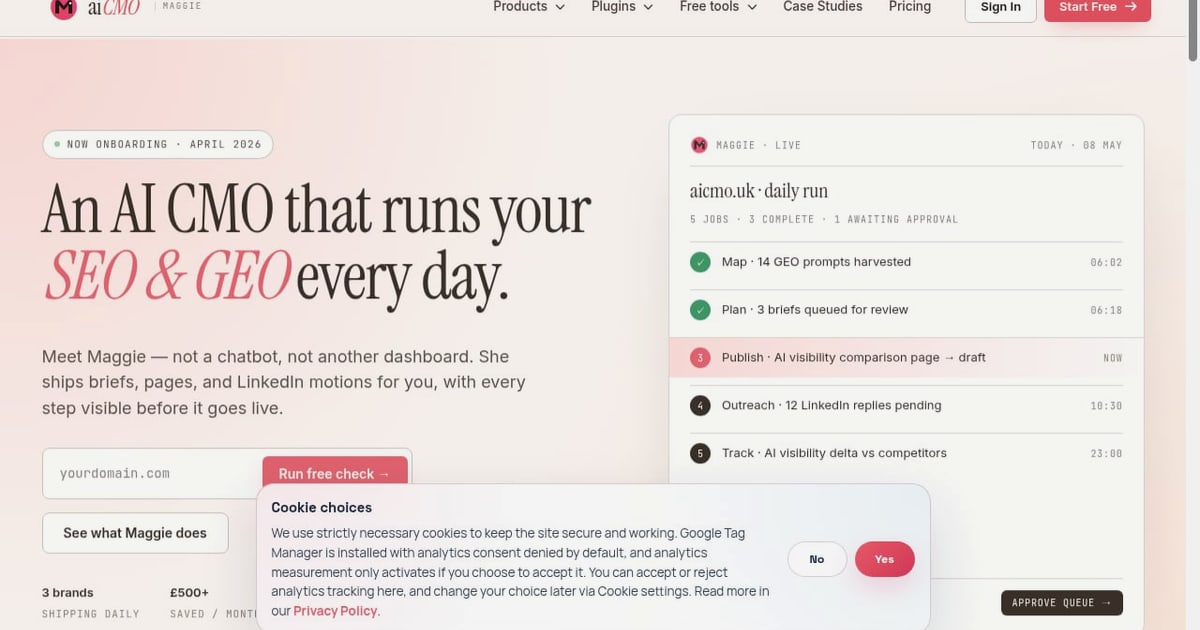
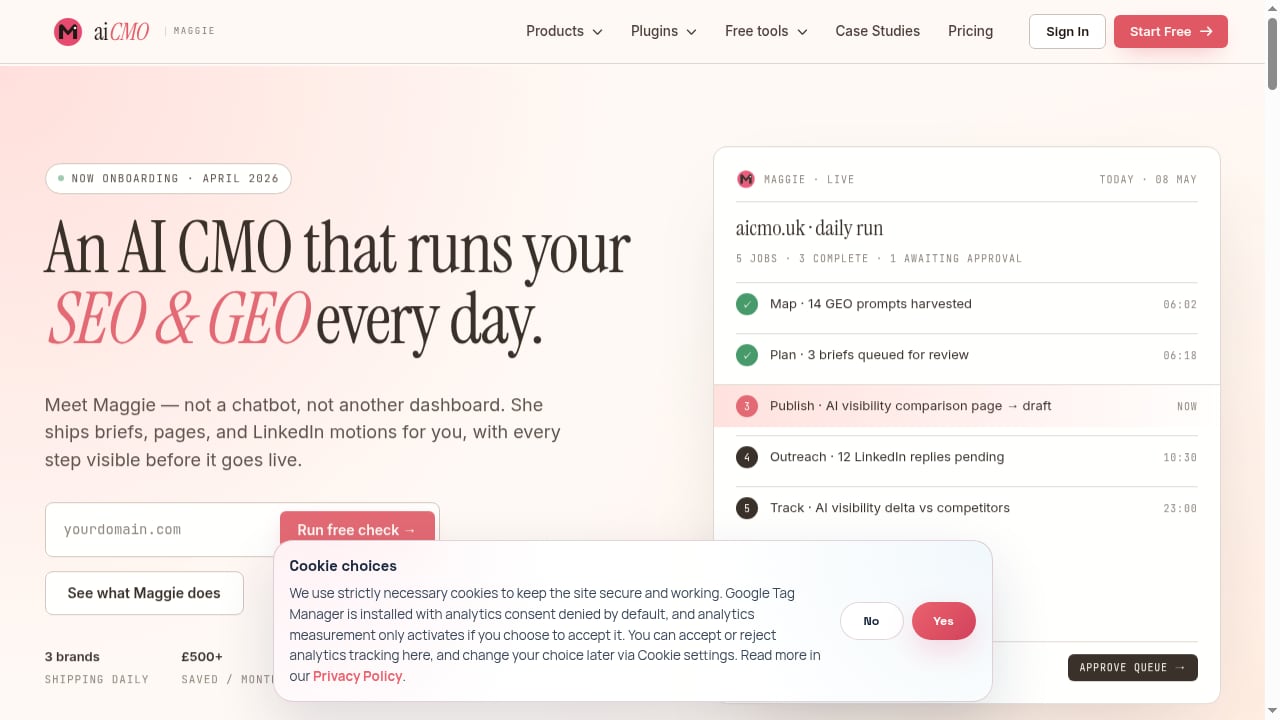
aiCMO is built around an AI agent named Maggie that ships briefs, pages, and LinkedIn motions, with each step visible before publishing. Its core modules include SEO and GEO Autopilot, an AI Visibility Tracker, a WordPress plugin, and a LinkedIn plugin. The platform targets brands, small businesses, creators, and marketing teams that want to reduce agency overhead without losing oversight.
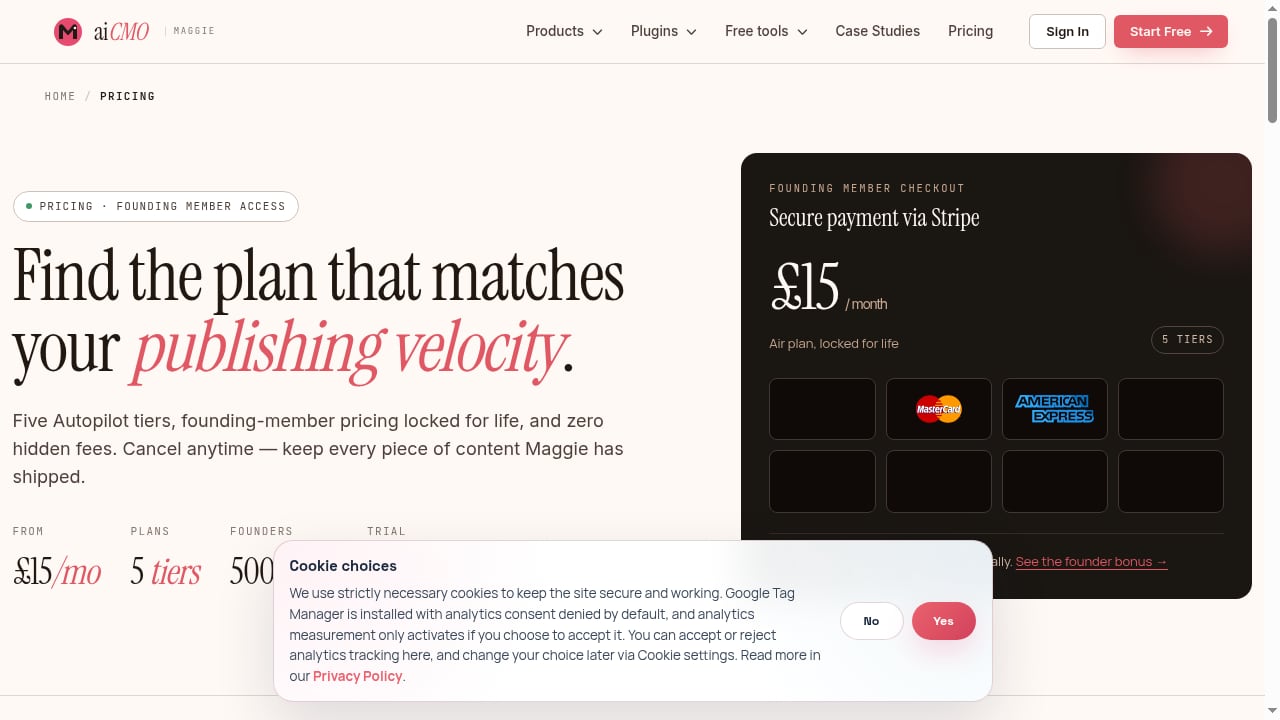
Pricing is published across five tiers (Air, Pro, Max, Ultra, Elite), with founding-member pricing starting at £15 per month, a 14-day trial, and a 500-seat founder limit. Users report saving £500+ per month and shipping campaigns in weeks rather than quarters. The positioning is explicit: not a chatbot and not another dashboard, but an agent that connects search, content, and outreach systems.
Standout strength: Visible, approval-first execution across SEO, GEO, and LinkedIn in one agent workflow.
2. HubSpot
Best for: Mid-market and enterprise teams that want marketing, sales, and CRM in one suite.
HubSpot's marketing automation covers email sequences, lead scoring, campaign reporting, and an AI content assistant, all tied to its CRM. The main trade-off is cost: entry pricing for the marketing hub starts around $890 per month, which puts it out of reach for solo operators. For teams already running sales on HubSpot, the unified data model reduces handoff friction between marketing and sales.
Standout strength: Deep CRM integration with mature reporting and attribution.
3. ActiveCampaign
Best for: Small and mid-sized businesses that want AI-assisted campaign building at a low entry price.
ActiveCampaign combines email automation, SMS, and a visual journey builder with AI tools for generating campaign copy and predicting send behavior. Pricing starts from $15 per month, making it one of the more accessible full automation platforms. Its multilingual workflow templates are useful for teams operating in more than one market.
Standout strength: Strong automation builder at a low starting price.
4. Klaviyo
Best for: E-commerce brands that need behavioral triggers and revenue attribution.
Klaviyo's drag-and-drop interface and deep Shopify integration make it a default choice for online stores. AI features include predictive analytics for customer lifetime value and churn risk, plus automated product recommendations inside email and SMS flows. It offers a free plan and paid tiers from $20 per month.
Standout strength: E-commerce-native data model with predictive segmentation.
5. Brevo
Best for: Budget-conscious teams that want email, SMS, and CRM in one place.
Brevo bundles email marketing, SMS, a lightweight CRM, and a meeting scheduler, with a free plan and paid tiers from $9 per month. Its AI features focus on send-time optimization and content assistance. For very small teams, the combination of CRM and automation in a single low-cost tool is the main draw.
Standout strength: Low-cost all-in-one stack with a usable free tier.
6. Customer.io
Best for: Product-led companies that need behavior-driven messaging across many channels.
Customer.io specializes in event-triggered workflows across email, push, SMS, and in-app messages. Pricing starts from $100 per month, which reflects its focus on data-rich, product-led use cases rather than simple newsletters. Its workflow builder handles complex branching that many email-first tools cannot.
Standout strength: Powerful event-based automation for product-led growth teams.
7. Omnisend
Best for: E-commerce teams that want a generous free plan and quick setup.
Omnisend focuses on email and SMS automation for online stores, with a free plan and paid tiers from $16 per month. Its automation presets cover cart abandonment, welcome series, and post-purchase follow-ups. AI features include subject line generation and audience segmentation suggestions.
Standout strength: Fast e-commerce setup with a strong free tier.
8. Mailchimp
Best for: Small businesses that want familiar email automation with AI assistance.
Mailchimp remains a common entry point for email marketing automation, with a free plan and paid tiers from $13 per month. Its AI features include content generation, send-time optimization, and audience insights. It also integrates with third-party acquisition channels, though its multi-channel automation is less advanced than Klaviyo or Customer.io.
Standout strength: Familiar interface and broad integration ecosystem.
9. Adobe Marketo Engage
Best for: Enterprises with complex, multi-touch attribution and governance needs.
Marketo Engage is built for large marketing organizations, with a conversational AI interface, advanced lead management, and extensive compliance controls. Pricing is available by request and typically exceeds $1,000 per month. It is not a fit for small teams, but for enterprises already inside the Adobe ecosystem, it offers deep orchestration and reporting.
Standout strength: Enterprise-grade governance and multi-touch attribution.
10. Blaze
Best for: Solo marketers and creators who want strategy, content, and publishing handled in one place.
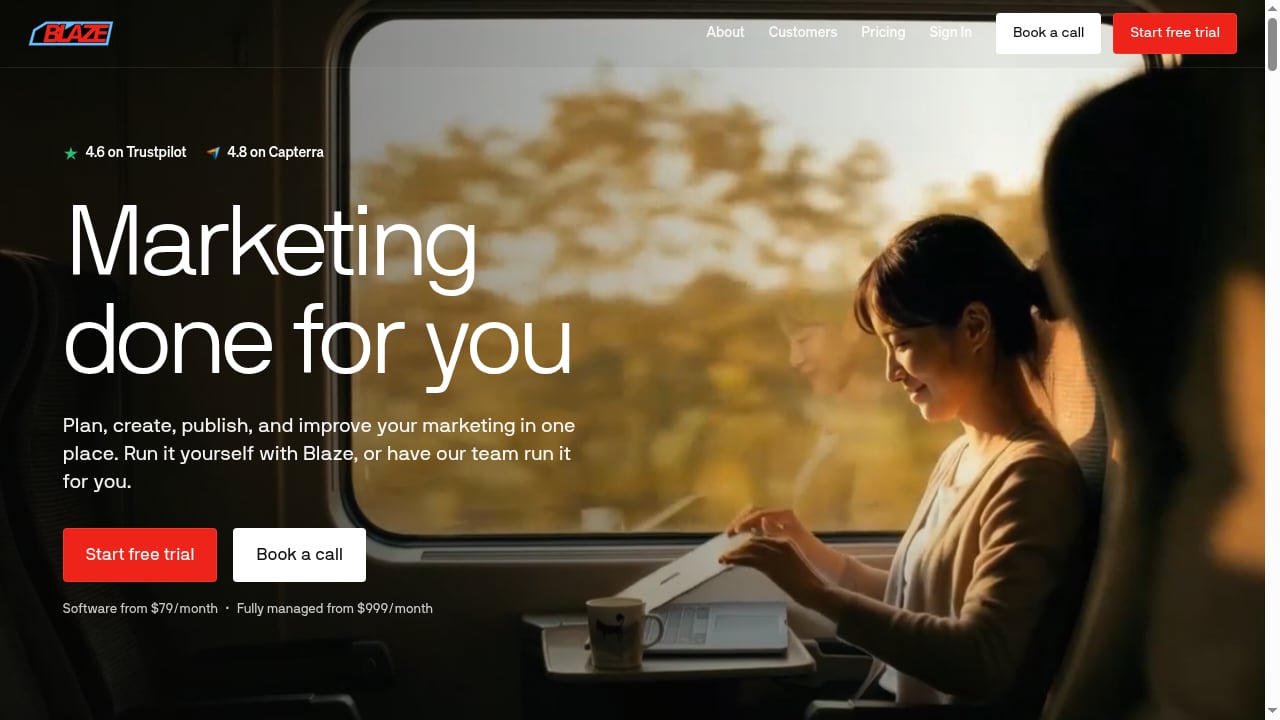
Blaze sets a marketing strategy, generates blog posts, social content, newsletters, and images, and publishes on a schedule. A Brand Kit captures voice and style, and the platform improves its output weekly based on performance data. Pricing starts at $79 per month with a free trial. It is a content-heavy automation tool rather than a full CRM-driven suite, which makes it a good fit for creators who need consistent output without a marketing team.
Standout strength: Brand-aware content generation with built-in scheduling and analytics.
How to Choose the Right Platform
First viewport screenshot of Blaze | Marketing Done For You.
Match the tool to the job you actually need done:
- If you need an agent to run search, content, and outreach together: aiCMO is the closest fit, especially for teams replacing agency retainers.
- If you need CRM plus marketing in one system: HubSpot or ActiveCampaign.
- If you run an e-commerce store: Klaviyo or Omnisend.
- If you are product-led and event-driven: Customer.io.
- If you are a creator or solo marketer: Blaze.
- If you are an enterprise with governance requirements: Adobe Marketo Engage.
A practical next step is to list the three marketing tasks that consume the most time each week, then check which platform automates at least two of them without custom development. For teams that also need a dedicated content engine feeding the automation stack, a tool like AgentBooks can handle continuous publishing while the automation platform manages distribution and follow-up. If your priority is search visibility alongside automation, the enterprise SEO and AI search platform ranking covers that adjacent category.
Related reading
- AgentBooks vs QuickCreator vs GTM AI for Solo Founders - Compare AgentBooks, QuickCreator's AI content team, and GTM AI for solo founders. See which fits content automation, publishing, and go-to-market tasks.
- AgentBooks vs Growth Engine Hub: Which AI Content Engine Wins? - AgentBooks vs Growth Engine Hub compared: brand intelligence, keyword planning, publishing workflow, channels, and pricing to pick the right AI content engine.
- Averi Review 2026: Honest Look at the AI Content Engine - Averi review for founders and lean teams: how the Brand Core and Strategy Map work, real pricing, SEO/GEO scoring, limitations, and who should buy.
Sources and further reading
- 11 best marketing automation platforms I’m using in 2026 - Looking for the best marketing automation platforms? After testing dozens of tools, here are the top 11 my clients and I use on a regular basis.
- The 9 best marketing automation software tools in 2026 - If your team needs a new solution for executing self-sufficient marketing campaigns, explore these best-in-class marketing automation software.
- Best AI tools for Marketing Automation in 2026 - Explore the top AI tools for Marketing Automation in 2026. Enhance your digital marketing strategy with tools like involve.me, Jasper.ai, and more.
FAQ
What is the difference between AI marketing automation and traditional marketing automation?
Traditional automation follows fixed triggers and rules. AI marketing automation adds predictive scoring, content generation, send-time optimization, and agentic workflows that can adapt based on data rather than only executing predefined steps.
Which AI marketing automation tool is best for a small business?
For low-cost email and SMS automation, Brevo and ActiveCampaign offer the lowest entry prices. For an agent that runs SEO, GEO, and LinkedIn execution with visible approvals, aiCMO is designed specifically for lean teams.
Do these platforms replace a marketing agency?
They replace repetitive execution work, not strategy and judgment. Platforms like aiCMO and Blaze are built to reduce agency overhead for routine output, but most teams still need human review before publishing.
How much should I expect to pay in 2026?
Entry pricing ranges from free tiers to about $20 per month for email-first tools, $79 per month for content-focused platforms like Blaze, and $890 or more per month for full-suite systems like HubSpot. Enterprise platforms such as Marketo Engage are priced by request.
Can I combine a content automation tool with a marketing automation platform?
Yes. A common setup is a content engine for planning and publishing paired with an automation platform for email, SMS, and CRM follow-up. The AgentBooks and SE Ranking workflow is one example of connecting content automation to SEO data.
Conclusion
The best AI marketing automation software in 2026 depends on which part of marketing you need to run without constant manual effort. aiCMO leads this list for teams that want an agent to execute search, content, and outreach with full visibility. HubSpot and Marketo Engage serve enterprises, Klaviyo and Omnisend serve e-commerce, and Blaze serves creators who need content output. Start with the workflow that costs you the most time, verify pricing against your volume, and choose the platform that automates that workflow first.
For further reading on how automation platforms compare, see the AgentBooks, AirOps, and Averi comparison.