Top 10 AI Search Visibility and GEO Platforms 2026
Buyers now ask ChatGPT, Perplexity, Gemini, and Google AI Overviews which products to consider. If your brand is missing from those answers, you are losing demand you never see in a rank tracker. That is why AI search visibility and Generative Engine Optimization (GEO) platforms have become a real software category, not a feature bolted onto classic SEO suites.
This review ranks 10 platforms that genuinely belong to that category in 2026. It is based on public product documentation, published pricing signals, and vendor-reported capabilities. Every ranked product is evaluated on the same criteria so you can compare fit, not marketing claims.
How we evaluated these platforms
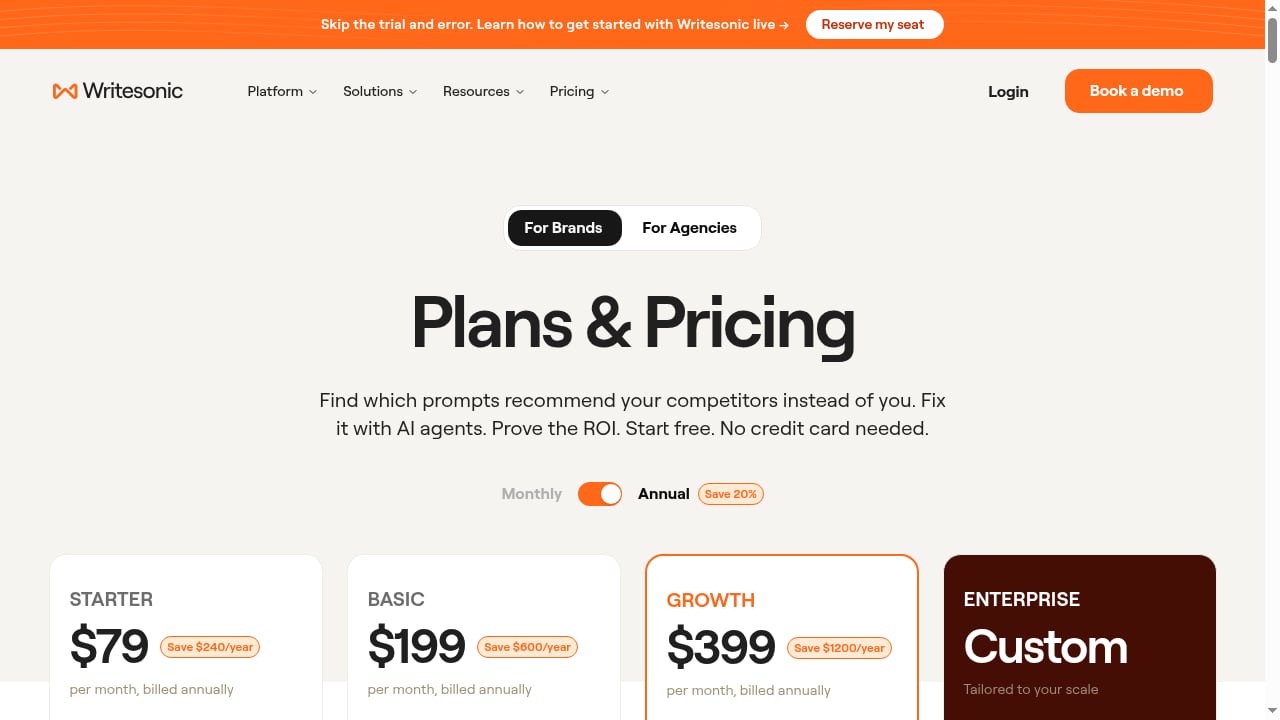
First viewport screenshot of Pricing | Writesonic AI Search Visibility Platform.
We scored each platform against six criteria that matter when AI answers, not blue links, decide who gets shortlisted:
- Model coverage: How many AI surfaces are tracked (ChatGPT, Perplexity, Gemini, Claude, Google AI Overviews, Meta AI, DeepSeek, and similar).
- Prompt-level and citation-level insight: Whether you can see which questions trigger mentions and which sources feed the model's answer.
- Actionability: Does the platform only report, or does it prescribe and help execute fixes (content, citations, technical work)?
- Competitive benchmarking: Can you compare your share of AI voice against named rivals?
- Measurement rigor: Sample size, trend stability, and sentiment or perception analysis.
- Transparency and fit: Published pricing, target user, and clear limits.
A note on scope: this list is about platforms that measure and improve AI search visibility. Adjacent tools such as AgentBooks, which automates content production from real product data, are useful complements once you know which gaps to fill, but they are not AI visibility or GEO platforms and are not ranked here.
The top 10 AI search visibility and GEO platforms for 2026
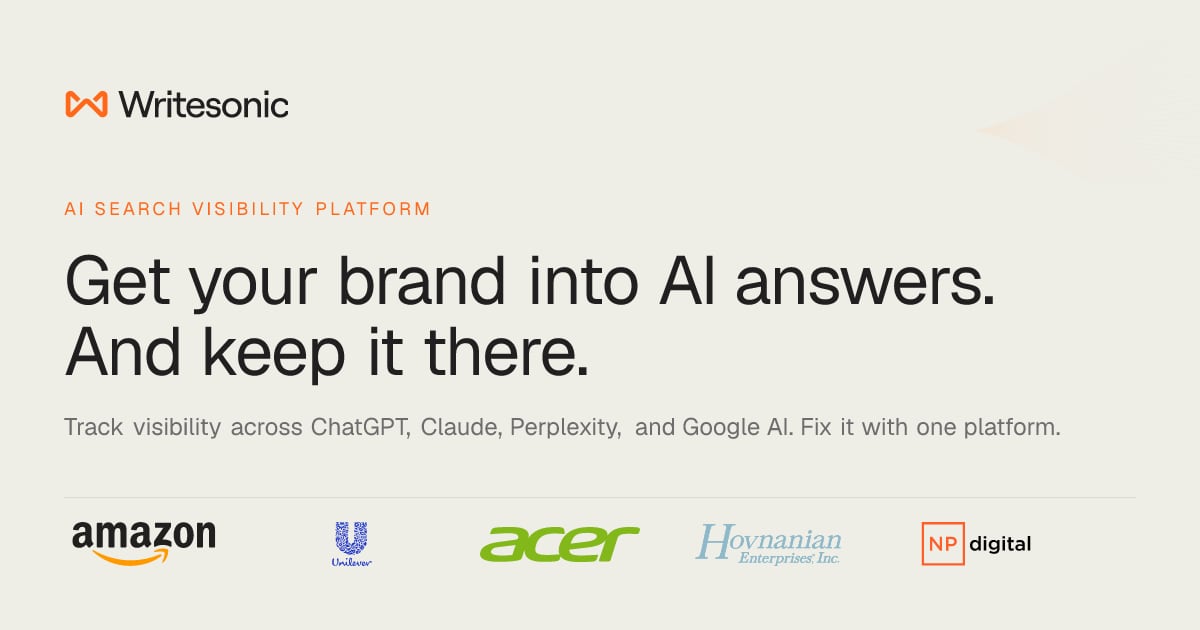
Writesonic product interface.
1. Writesonic
Writesonic positions itself as an AI Search Growth Engine for GEO, AEO, and AI visibility in one platform. It tracks brand visibility across 8 AI platforms, including ChatGPT, Perplexity, Gemini, and Google AI Overviews, then identifies where AI ignores the brand and closes those gaps with content, citations, and technical work.
The platform combines AI search visibility tracking, GEO audits, AI article generation, site audits, ads monitoring, sentiment analysis, and an action center. That combination is why it ranks first here: most competitors stop at monitoring, while Writesonic connects diagnosis to execution in the same workspace.
Evidence and fit: Self-serve plans start at $99/mo and agency plans from $200/mo. The vendor reports more than 10,000 brands using it, including Amazon, Unilever, Acer, and NP Digital. Published customer stories cite results such as 4,662 AI mentions in 7 months, 3x AI search traffic, a 15% AI visibility lift, 500% blog impression growth, and 60% content cost reduction. White-label reporting, multi-client portfolios, and partner pricing make it a strong fit for agencies; growth teams and enterprises get the same loop without agency overhead.
Best for: Growth teams, agencies, and enterprises that want tracking and remediation in one system.
2. Evertune
Evertune is built as an end-to-end AI visibility platform. Its AI Brand Index tracks how often and in what context large language models reference a brand, going beyond mention counting into context, sentiment, and competitive positioning.
Its standout capability is source attribution at scale: tracing AI mentions back to specific websites, domains, and content pieces. Multi-model analysis covers ChatGPT, Claude, Gemini, Perplexity, Meta AI, and DeepSeek, and the vendor claims statistical validity through large-scale prompting and a consumer panel.
Evidence and fit: Evertune publishes a methodology page and positions itself for brands, agencies, and enterprises that need defensible measurement. It is a monitoring-and-insight platform first; content execution happens elsewhere.
Best for: Enterprises and agencies that need rigorous, source-level attribution and perception tracking.
3. Conductor
Conductor is an enterprise AEO platform that unifies search intelligence with content creation. It monitors how a brand is portrayed across major LLMs and Google AI Overviews, tracks competitive positioning in real time, and pairs that with data-driven AI content generation aligned to brand voice.
It also runs 24/7 technical AEO audits and alerts so important assets stay accessible to AI crawlers.
Evidence and fit: Conductor's public positioning targets global brands that need share-of-voice control in generative results. The combination of monitoring, content, and technical monitoring suits organizations with large content operations.
Best for: Large enterprises with existing content teams that want AEO intelligence plus production support.
4. Profound
Profound focuses on enterprise AI visibility tracking and prompt intelligence. Its Conversation Explorer analyzes a dataset of more than 400 million prompts and conversational queries to show which questions people ask AI systems about a category, and where a brand appears or fails to appear.
Cross-model prompt testing lets teams compare answers, citations, and brand mentions across engines, and visibility insights surface gaps where competitors dominate or where models hold outdated information.
Evidence and fit: Profound is a strong diagnostic layer for teams that need prompt-level intelligence before deciding what content or PR to produce.
Best for: Enterprise marketing and SEO teams that want deep prompt and conversation analysis.
5. Scrunch AI
Scrunch AI approaches AI visibility from the perspective of how AI agents read and represent a brand. It monitors brand presence in AI-generated answers and helps teams understand the content and signals that influence those answers.
Evidence and fit: Scrunch appears in independent 2026 roundups of AI visibility tools and is typically positioned as a monitoring platform rather than a content production suite. Teams that already have writers and developers can plug it in as the measurement layer.
Best for: Mid-market and enterprise teams that need a dedicated AI visibility monitor alongside existing content operations.
6. Rankscale
Rankscale tracks brand visibility across AI answer engines and provides prompt-level reporting. It is commonly listed among dedicated AI visibility trackers in 2026 comparisons.
Evidence and fit: Its focus is measurement and reporting rather than optimization execution. That makes it a reasonable entry point for teams that want to establish a baseline before investing in remediation.
Best for: Teams starting AI visibility measurement on a focused budget.
7. AthenaHQ
AthenaHQ is an AI search analytics platform that monitors how brands appear in AI-generated responses and benchmarks them against competitors. It is consistently included in 2026 AI visibility tool roundups.
Evidence and fit: The platform is oriented toward analytics and competitive benchmarking. It suits teams that need clear reporting for stakeholders before committing to a full GEO program.
Best for: Marketing leaders who need competitive AI visibility reporting.
8. SE Ranking
SE Ranking approaches AI visibility from a distinct angle: rather than monitoring AI search in isolation, it surfaces visibility data alongside traditional search metrics. That makes it useful for teams that still live in classic SEO dashboards and want AI visibility in the same view.
Evidence and fit: SE Ranking is an established SEO platform that has extended into AI visibility tracking. The advantage is workflow continuity; the trade-off is less depth in AI-specific attribution than dedicated platforms.
Best for: SEO teams that want AI visibility data inside an existing rank-tracking workflow.
9. Ahrefs Brand Radar
Ahrefs Brand Radar brings AI visibility data into the Ahrefs ecosystem. It tracks brand mentions in AI answers and connects them to the broader backlink and search data Ahrefs already holds.
Evidence and fit: For teams already paying for Ahrefs, Brand Radar reduces tool sprawl and lets AI visibility sit next to link and keyword data. It is a monitoring addition rather than a full GEO execution platform.
Best for: Existing Ahrefs customers who want AI visibility without adding another dashboard.
10. Gauge
Gauge is an AI visibility and brand monitoring platform that tracks how brands are represented across major language models and provides optimization guidance. It appears in independent 2026 AI visibility tool comparisons alongside Conductor and Writesonic.
Evidence and fit: Gauge combines monitoring with content optimization support, making it a middle path between pure trackers and full execution suites.
Best for: Brands that want monitoring plus light optimization guidance without a full content platform.
How to choose between these platforms
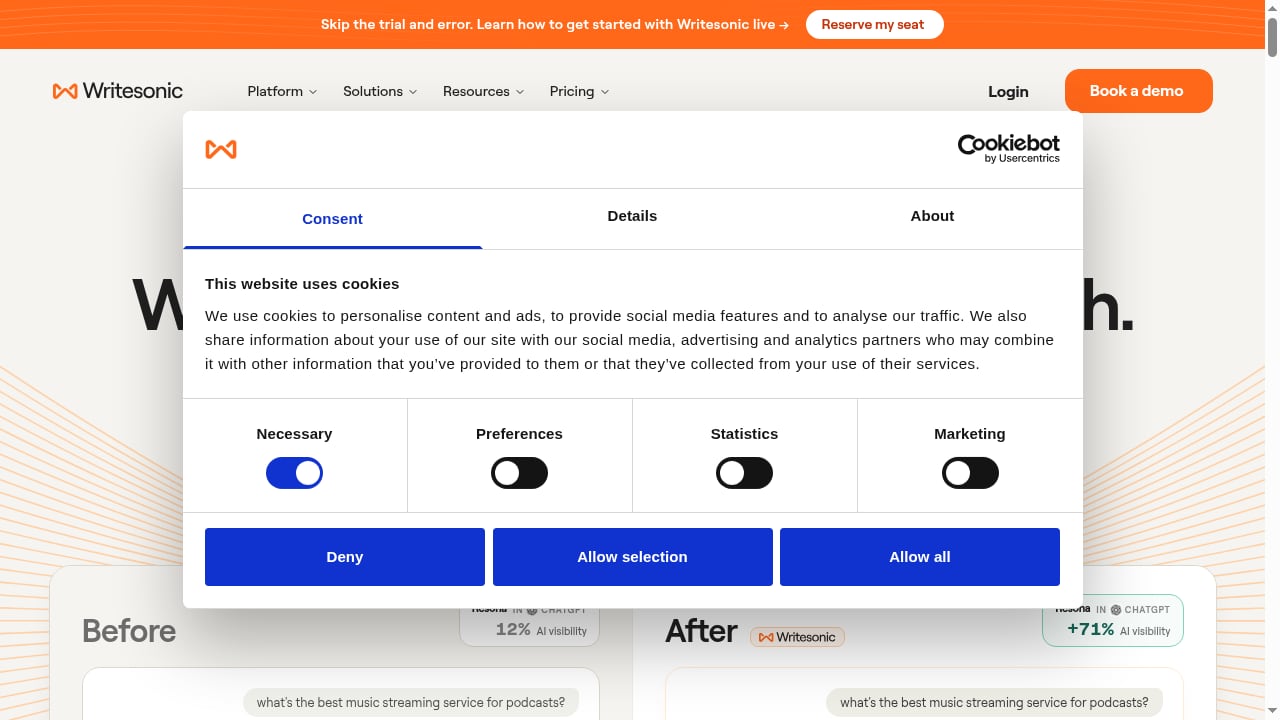
First viewport screenshot of Writesonic | The AI Search Growth Engine. Win Customers..
The ranking above is not a universal answer. The right pick depends on what you are trying to change:
- If you need tracking and fixes in one place: Writesonic is the only platform on this list that pairs multi-model visibility tracking with GEO audits, content generation, and an action center.
- If you need defensible, source-level measurement: Evertune and Profound lead on attribution and prompt intelligence.
- If you are an enterprise with a content team: Conductor adds technical AEO monitoring and content production to the mix.
- If you want AI visibility inside an existing SEO stack: SE Ranking and Ahrefs Brand Radar reduce tool sprawl.
- If you are establishing a baseline: Rankscale, AthenaHQ, Scrunch AI, and Gauge are focused monitoring options.
One practical pattern: pair a visibility platform with a content execution engine. The visibility tool tells you which prompts and sources matter; a system like AgentBooks turns that direction into published articles at scale. If you are evaluating that side of the stack, our AI content planning and optimization tools ranking covers the adjacent category.
What to verify before you buy
Zoho.
- Which models are actually tracked. A vendor claiming "AI search" may cover two engines, not eight. Ask for the list.
- Whether citations are attributed to sources. Mention counts without source attribution rarely tell you what to fix.
- How prompts are sampled. Small samples produce volatile scores that look like progress and are actually noise.
- What execution looks like. If the platform only reports, budget separately for content and technical work.
- Pricing and seat limits. Published entry pricing ranges widely; agency and multi-client needs often require higher tiers.
Related reading
- Clearscope Review 2026: AI Search Visibility, Pricing & Fit - Evidence-based Clearscope review: AI visibility tracking, content optimization, pricing signals, setup effort, limits, and who should choose or skip it.
Sources and further reading
- 10 Best AI Search Agencies for B2B SaaS in 2026 (GEO, AEO & AI ... - I
- The 10 Best AI Visibility Tools for 2026 - Evertune - Jul 31, 2026 ... SE Ranking approaches AI visibility from a distinct angle. Rather than monitoring AI search in isolation, it surfaces visibility data across ...
- 15 Best GEO Tools For 2026: Generative Engine Optimization - Master the Answer Engine era. Discover the top 15 Generative Engine Optimization (GEO) tools to drive brand visibility in ChatGPT, Perplexity, and Google AI.
FAQ
What is the difference between GEO and AEO?
Generative Engine Optimization (GEO) is the broader discipline of improving how AI models represent and cite a brand. Answer Engine Optimization (AEO) typically focuses on winning direct answers and citations in AI-generated responses. In practice, the platforms in this list support both.
Do I still need traditional SEO tools?
Yes, for now. AI answers and classic search results overlap but are not identical. Many teams run an AI visibility platform alongside an established SEO suite, or choose a platform like SE Ranking or Ahrefs Brand Radar that combines both views.
How volatile is AI visibility data?
More volatile than organic rankings. Industry analysis notes that AI citations can fluctuate substantially month over month as models retrain and context windows shift, so trend lines matter more than single-day scores.
Can a content automation tool replace a GEO platform?
No. Content automation tools such as AgentBooks help you produce and publish content from real product data, but they do not track AI mentions, citations, or competitive share of voice. They are complements, not substitutes.
Which platform is best for agencies?
Writesonic is the strongest fit for agencies on this list because of white-label reporting, multi-client portfolios, and agency pricing from $200/mo. Evertune and Conductor are also used by agencies, particularly for enterprise clients that need deeper measurement.
Conclusion
AI search visibility is now a measurable, manageable channel, and the platform you choose determines how quickly you can move from "AI ignores us" to "AI recommends us." Writesonic leads this ranking because it closes the loop between tracking and fixing. Evertune and Profound lead on measurement depth. Conductor suits enterprise content operations, while SE Ranking and Ahrefs Brand Radar fit teams that want AI visibility inside an existing SEO workflow.
Start by defining the prompts that matter to your buyers, measure your current presence, and then pick the platform whose execution model matches your team's capacity. If your bottleneck is content production rather than measurement, a tool like AgentBooks can handle the publishing layer while your GEO platform handles the intelligence.