Top 10 AI Visibility Platform Products 2026 (Ranked & Compared)
Your customers now ask ChatGPT, Gemini, and Perplexity which product to buy – often before they click a single search result. If your brand isn’t mentioned in those AI-generated answers, you’re invisible to more than half your market. Traditional SEO metrics don’t capture this shift; they track keyword positions and organic traffic, not whether a large language model recommends you. This is where AI visibility platforms come in. They monitor, measure, and help improve how often AI search engines cite your brand. But with dozens of tools claiming to boost Generative Engine Optimization (GEO), which one truly fits your team?
In this expert guide, we rank the top 10 AI visibility platform products of 2026 using a transparent, criteria-driven methodology. You’ll find detailed reviews of each platform, a quick comparison table, pricing insights, and practical advice on integrating visibility tools with a content engine for long-term growth.
How We Evaluated AI Visibility Platforms
Top 10 AI Visibility Platform Products 2026 (Ranked & Compared) product interface and feature overview.
We assessed every platform against seven real-world criteria, weighted by what matters most for teams who need more than a dashboard:
- AI engine coverage – Does it track mentions across ChatGPT, Google AI Overviews/AI Mode, Gemini, Perplexity, Claude, Microsoft Copilot, and others? Single-model tracking is insufficient.
- Citation depth & source attribution – Can you see exactly which URLs and domains the AI used when mentioning you (or a competitor)? Granular source attribution is essential for precise optimization.
- Actionable optimization features – Does the platform go beyond reporting to recommend specific content changes, new topics, or structural fixes that will increase AI visibility?
- Ease of use & workflow integration – Can non-technical marketing teams interpret the data and export insights to a content creation pipeline?
- Proven performance & evidence – Do independent studies, proprietary research, and verified user case studies back the tool’s claims? (Look for sample sizes, not marketing fluff.)
- Pricing transparency – Are the plans clear, and does the cost match the value for startups, scale-ups, and enterprises alike?
- Unique differentiator – What one thing makes this platform stand out from the crowd?
We also considered third-party data, including Profound’s 2026 analysis of 3.25 billion citations and Kevin Indig’s correlation research showing that classic SEO metrics like Domain Rating don’t directly drive AI chatbot mentions[^1].
AI Visibility Platform Comparison Table
Top 10 AI Visibility Platform Products 2026 (Ranked & Compared) product interface and feature overview.
| Platform | AI Engines Covered | Key Strength | Pricing (Starting) | Best For | Rating (by criteria) |
|---|---|---|---|---|---|
| Surfer | Google, ChatGPT, Gemini, Perplexity | Unified SEO + AI search content optimization | From $89/mo | In-house marketing & SEO teams | 9.5/10 |
| Profound | 10 engines | Largest verified prompt database (1.5B+) & enterprise security | Custom | Enterprise, regulated industries | 9.3/10 |
| Evertune | ChatGPT, Claude, Gemini, Perplexity, Meta AI, DeepSeek | Source-level attribution & AI Brand Index | Custom | Large agencies, enterprises | 9.1/10 |
| Omnia | 4+ core engines (ChatGPT, Perplexity, Gemini, Claude) | Turns monitoring into prescriptive content recommendations | €79/mo | VC-funded startups, scale-ups | 8.9/10 |
| Conductor | ChatGPT, Perplexity, Google AIO | Deep enterprise AEO with SEO intelligence | Custom | Global enterprise marketing teams | 8.7/10 |
| Gauge | ChatGPT, Claude, Gemini, Perplexity (multi-engine on higher plans) | Full-stack GEO toolkit including agentic content engine | From $99/mo | Mid-market SEO & content teams | 8.5/10 |
| Quattr | ChatGPT, Claude, Perplexity plus Google | Complete AI SEO suite with visibility tracking | Custom | Teams managing SEO + AI search together | 8.3/10 |
| AthenaHQ | Multiple LLMs | Fast onboarding, affordable prompt library | From $49/mo (estimated) | SMBs & first-time AI visibility explorers | 8.0/10 |
| Peec AI | Major LLMs | Budget-friendly competitor tracking & citation analysis | €89/mo | Cost-conscious teams | 7.8/10 |
| AirOps | AI engines + traditional search | Workflow-driven content & GEO templates | From $49/mo (Growth) | Marketing teams automating content pipelines | 7.6/10 |
The Top 10 AI Visibility Platforms in 2026
Top 10 AI Visibility Platform Products 2026 (Ranked & Compared) product interface and feature overview.
1. Surfer – Best All-in-One Content & AI Visibility Platform
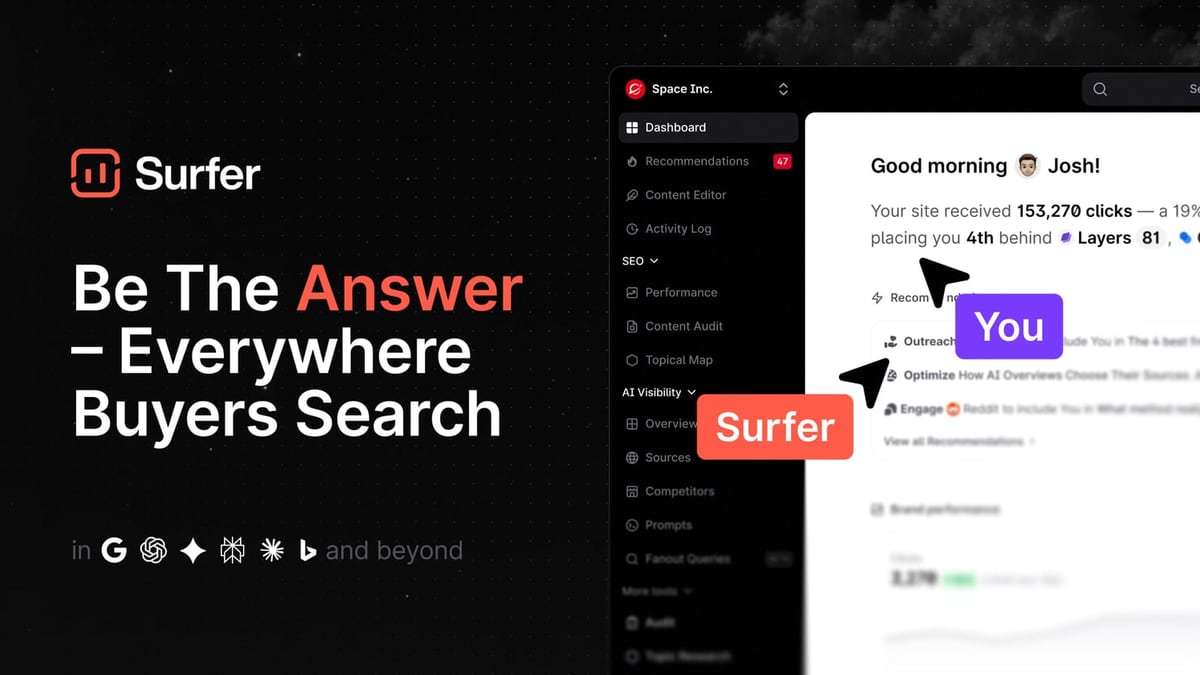
Surfer has evolved from a classic SEO content editor into a leader in AI visibility. It serves 150,000+ marketers and agencies, delivering a unified workspace to optimize for both Google and AI search engines like ChatGPT, Gemini, and Perplexity. Proof points are impressive: one user saw a 740% organic visibility increase in 90 days, while another grew organic leads by 340%.
Why Surfer earned the #1 spot
Unlike pure monitoring dashboards, Surfer bridges the gap between knowing where you stand and actively improving content. The Content Editor now includes AI Search Guidelines, giving real-time suggestions to make your page more likely to be cited by LLMs. The AI Tracker monitors brand mentions across multiple models and ties them back to the content changes you make. Add in Auto-Optimize for one-click improvements, an Activity Log for team productivity, and a Backlink Marketplace to secure AI-trusted sources, and you get a complete visibility engine.
Standout features
- Unified Content Score for both traditional SEO and AI search optimization
- AI mention monitoring with direct correlation to content updates
- Workflow for teams: Activity Log tracks who did what
- Extensive educational resources and a large community
Best for
In-house marketing and SEO teams, agencies, and any organization that wants to actively improve AI visibility through content, not just observe it.
2. Profound – Enterprise-Grade AI Citation Intelligence
Profound earned the highest AEO Score (92/100) in independent evaluations thanks to its massive proprietary dataset: 1.5 billion real user prompts and 3.25 billion citations analyzed. It offers deep source attribution, GA4 integration for attribution, and SOC 2 Type II security, making it the go-to for regulated industries and large enterprises.
What sets Profound apart
The research power is staggering. Profound’s 2026 analysis revealed that 97.4% of AI citations come from non-Tier-1 earned media – Reddit threads, niche YouTube videos, LinkedIn posts. That kind of insight only emerges when you query at scale. The platform also provides “Prompt Research Reports” that rank and cluster millions of conversations, so you know which topics truly drive visibility.
Key advantage
- Live snapshots of brand perception across 10 engines (including Google AI Mode)
- Attribution to exact URLs and domains
- First-party consumer panel of 25 million people for statistically significant trends
Best for
Enterprises that need a defensible, data-heavy view of AI visibility with compliance-grade security.
3. Evertune – The Actionable Visibility Platform with Source-Level Tracking
Evertune is purpose‑built for brands that want to trace every AI mention back to the specific web page that triggered it. Its AI Brand Index goes beyond simple mention counting to analyze context, sentiment, and competitive positioning across ChatGPT, Claude, Gemini, Perplexity, Meta AI, and DeepSeek.
Why Evertune is a top contender
Source attribution at scale is Evertune’s superpower. You see which of your articles, product pages, or third-party reviews are driving mentions – and which competitor assets are winning instead. The platform then suggests data-driven content changes prioritized by impact potential. This closes the loop between monitoring and action without requiring a separate content tool.
Standout features
- Multi-model analysis with sentiment and brand perception scores
- Recommendations for specific content and messaging adjustments
- Designed for both marketing teams and agencies
Best for
Mid‑market to enterprise brands and agencies that want to turn AI insights directly into editorial tasks.
4. Omnia – From Quick Wins to Long-Tail AI Content Opportunities
Omnia excels at helping startups and scale-ups find the AI prompts they can actually win – without needing a 10x marketing budget. It monitors core engines (ChatGPT, Perplexity, Gemini, Claude) daily, then serves AI-powered content recommendations that tell you exactly what to write next.
Why Omnia stands out
Instead of a three-month content roadmap, Omnia gives you one clear next action: “Competitor X gets cited 40 times for this query via their comparison guide – build a better one.” Or, “Perplexity is pulling from G2 reviews instead of your product pages – fix your review strategy.” It’s instantly actionable. One case study showed a brand jumping from position #11 to #2 in tracked AI prompts in under seven days.
Key features
- Citation analysis with exact source URLs
- Share of voice trends with competitive benchmarking
- Topic discovery for long-tail, winnable queries
- Unlimited countries and languages
Best for
VC-funded startups and scale-ups with active content programs that need a clear, execution-oriented AI visibility tool.
5. Conductor – Enterprise AEO for Global Brands
Conductor is a well-established SEO platform that now includes robust AI visibility intelligence. Its enterprise AEO module tracks brand portrayal across ChatGPT, Perplexity, and Google AIO while uniting search intelligence with Conductor Creator, its data-driven content generation tool.
Where Conductor shines
Large cross-functional marketing teams can manage all SEO and AEO efforts in one place. The platform includes 24/7 technical audits to ensure AI crawlers can access your most important assets, plus comprehensive ROI and performance measurement. If you already use Conductor for SEO, layering AI visibility on top is seamless.
Best for
Enterprise organizations that need to scale visibility across traditional search and AI search simultaneously.
6. Gauge – Full-Stack GEO with Agentic Content Features
Gauge offers a complete “Track, Understand, Act” workflow. It monitors brand mentions across major LLMs and then goes a step further with an agentic content engine that creates data-driven articles optimized for AI search.
Key differentiator
The platform bridges monitoring and content creation under one roof. Starting at $99/month for ChatGPT tracking, Gauge is accessible for smaller teams. Multi‑engine coverage is available on higher plans, with Claude and Grok reserved for enterprise customers. This pricing tier makes it a viable entry point for companies wanting a full-stack GEO toolkit.
Best for
Mid-market SEO and content teams that want an integrated monitoring-plus-content solution without third-party tools.
7. Quattr – AI SEO & Visibility Combined for Technical Teams
Quattr is best described as an AI SEO platform that now includes AI visibility tracking. It handles keyword research, content optimization, internal linking, technical audits, and AI mention monitoring across ChatGPT, Claude, and Perplexity.
Ideal scenario
If your team already invests heavily in SEO and needs to fold AI visibility into the same workflow, Quattr’s all-in-one approach makes sense. It uses predictive scoring to improve content and builds internal link networks based on performance and user data – a unique technical edge.
Best for
Teams that manage SEO and AI visibility together and prefer not to split tooling.
8. AthenaHQ – Quick Setup, AI Visibility for SMBs
AthenaHQ focuses on fast onboarding and a user-friendly experience. It offers a prompt library that helps SMBs get started with AI visibility monitoring without deep technical knowledge. While it lacks the advanced content creation features of higher-ranked tools, its pricing and simplicity make it a solid entry point.
Who should pick AthenaHQ
Small marketing teams or individual consultants who need to see brand mentions across multiple LLMs and benchmark against a few competitors – and want to be up and running in hours, not weeks.
Best for
SMBs, freelancers, and first-time AI visibility explorers.
9. Peec AI – Budget-Aware Competitor and Citation Tracking
Peec AI keeps things lean: at €89 per month you get core citation analysis and competitor tracking. It monitors major LLMs and highlights which competitor URLs are driving their mentions, giving you a focused view of the citation landscape.
Why it’s on the list
For teams that can’t justify a €200+ monthly commitment but still need reliable AI mention tracking, Peec AI fills the gap. The tool trades broad feature depth for affordability and ease of use – a fair trade for early-stage or bootstrapped startups.
Best for
Budget-conscious teams that need straightforward competitor citation intelligence.
10. AirOps – AI Visibility through Workflow Automation
AirOps blends GEO tracking with workflow automation. Its templates help marketing teams create AI-optimized content at scale by connecting the visibility data directly to content generation sequences. While its monitoring depth is lighter than dedicated platforms, the workflow angle is unique.
When AirOps makes sense
If your company already uses automated content pipelines and wants to layer AI visibility signals into those workflows, AirOps is a natural fit. It will not give you the deepest citation analysis, but it will help you turn data into published pages faster.
Best for
Marketing teams that prioritize content velocity and have established automation stacks.
Beyond Monitoring: Feeding Your Visibility Engine with an Autonomous Content Platform
Top 10 AI Visibility Platform Products 2026 (Ranked & Compared) product interface and feature overview.
Ranking brands inside AI responses is only half the battle. Even the best visibility tools can only tell you what to create and why – you still need to produce the authoritative, well-structured content that LLMs trust.
This is where complementary content engines earn their place. Instead of manually assembling every article, you can use a platform that learns your product’s brand, maps your market, and continuously publishes useful, on-brand content. One such option is AgentBooks – an autonomous content growth platform that turns your website into an always‑on content engine. It researches organic results, plans topics, and publishes SEO‑optimized articles with minimal editorial overhead.
When you pair a visibility tool like Surfer or Omnia with a content engine like AgentBooks, you create a closed loop:
- The visibility platform identifies the exact prompts, topics, and source pages that drive AI citations.
- AgentBooks produces the factual, long-form content needed to capture those citations – in your brand voice, and on a regular schedule.
If you’re weighing AI content platforms, our detailed comparison can help you choose the right one: see how AgentBooks stacks against Contentpen and Machined in this AI content platform showdown. And for a hands‑on workflow, learn how to integrate AgentBooks with Yoast SEO to ensure every piece meets both classic SEO standards and AI search expectations.
Related reading
- How to Use AgentBooks with Acquia: AI Content + DXP Workflow - Combine AgentBooks' autonomous content engine with Acquia's DXP to produce, manage, and publish brand-aligned SEO content. Step-by-step setup, workflow tips, and examples.
- AgentBooks vs Sprinklr: Which One Drives SEO Content Growth? - Compare AgentBooks and Sprinklr side by side: an autonomous content engine versus an enterprise CXM suite. Learn which platform fits growth teams, SaaS brands, and e‑commerce sites for SEO-driven content.
- Yoast SEO Review: Is Premium Worth $99? Honest Breakdown - Evidence-based Yoast SEO review covering free vs premium, real pros/cons, pricing, use cases, and when to choose alternatives. No hype, just actionable insight.
Sources and further reading
- The 10 Best AI Visibility Tools for 2026 - Compare the 15 best AI visibility tools for 2026, ranked by AI model coverage, monitoring depth, GEO features, and pricing. Updated May 2026.
FAQ: AI Visibility Platforms
What is the difference between an AI visibility platform and an SEO rank tracker?
SEO rank trackers monitor positions in Google’s traditional results, which are deterministic and relatively stable. AI visibility platforms track brand mentions inside generative AI answers – and those mentions can change with every query because LLMs synthesize responses differently each time. An AI visibility tool shows you the sources, prompts, and sentiment behind those mentions, not just a rank number[^2].
Can an AI visibility platform guarantee my brand will show up in ChatGPT?
No platform can promise a specific citation, because AI models generate responses probabilistically. What a good tool does is show you the content patterns and sources that correlate with mentions, then give you an optimization roadmap. Success depends on consistently creating the kind of authoritative, useful content that AIs choose to cite.
Which LLMs should my AI visibility tool cover at minimum?
At a minimum, it should cover ChatGPT, Google (AI Overviews and/or AI Mode), Gemini, and Perplexity. If your audience is global, Claude and DeepSeek are also important. Avoid tools that only monitor one engine – you will miss large parts of the picture.
How much does an AI visibility platform cost?
Entry-level tools start around $49–$99 per month (AthenaHQ, Gauge Starter). Mid‑range platforms with full features and multi‑engine coverage range from €79 to about $300/month (Omnia, Surfer). Enterprise solutions like Profound and Evertune have custom pricing that can exceed $1,000/month, justified by massive data sets and security requirements.
Does AI visibility require separate content creation, or is it all built in?
Some platforms (like Gauge and Quattr) include lightweight content generation. However, most high-end visibility tools focus on monitoring and optimization recommendations. For steady, high-volume content production that aligns with visibility insights, teams often add a dedicated AI content engine like AgentBooks.
Conclusion: Pick a Platform That Turns Data into Action
The AI visibility landscape has matured fast. Gone are the days when a simple screenshot tool could tell you enough. The best platforms in 2026 not only track whether you are mentioned but show you which content assets to build, which technical gaps to close, and how to outpace competitors across multiple AI search engines.
Quick decision guide:
- If you want the most complete content-driven visibility improvement workflow, Surfer is the top choice.
- If you need enterprise-grade scale and defensible citation analytics, go with Profound.
- If you are a startup that needs fast, winnable prompts without enterprise pricing, Omnia will serve you well.
- If you want to combine monitoring with an autonomous content engine, pair any of the top-ranked tools with AgentBooks to keep your site filled with the kind of fact-dense, well-structured articles that AI chatbots love to cite.
AI citations are now a critical brand marketing channel. Choose a platform that matches your team’s ability to act on the data, and you will build an AI presence that lasts.
[^1]: Kevin Indig’s correlation table and Profound’s citation source distribution analysis originally published in Nick Lafferty’s AEO score rankings.
[^2]: See the distinction between AI visibility and SEO rank tracking discussed in Omnia’s guide to AI visibility platforms.