AgentBooks vs Contentpen vs Autoblogging.ai Compared (2026)
Choosing between AgentBooks, Contentpen, and Autoblogging.ai can feel like picking a core operating system for your content machine. Each platform promises to eliminate bottlenecks, but they travel very different routes. One learns your brand like an in-house researcher, one wraps your entire content lifecycle in analytics, and one treats volume as its true north.
This comparison breaks down how they differ—not just who has more features—so you can match the right engine to your team’s real workflow.
Feature-by-Feature Comparison

AgentBooks vs Contentpen vs Autoblogging.ai Compared (2026) product interface and feature overview.
Brand Intelligence and Market Mapping
Where AgentBooks stands apart is in its ability to build a living model of your product’s brand and market landscape. It doesn’t just accept a keyword; it crawls your website to understand what you sell, who you serve, and which related products or service lines exist. That ground truth feeds into interrelated topic planning, so every article connects back to your actual offering—not generic SEO guesswork. A SaaS company with a complex feature suite, for instance, can let AgentBooks discover adjacent use cases and create content that moves prospects through a natural product journey.
Autoblogging.ai and Contentpen both maintain brand voice consistency tools, but they lack the same deep product-level intelligence. For a deeper dive into how AgentBooks compares on this autonomous brand layer, see our AgentBooks vs Contentpen head‑to‑head and our analysis on what makes a platform truly autonomous.
AI Generation Modes and Volume Scaling
Both substitutes excel when speed and scale are the top priority. Autoblogging.ai’s Godlike Mode runs SERP competitor analysis, extracts LSI keywords, and pulls knowledge‑graph entities, then turns a single keyword into a publish‑ready post—all inside the generation step. Its bulk generation can process up to 500 articles from one CSV upload, making it a natural fit for affiliate site owners or agencies managing dozens of client blogs.
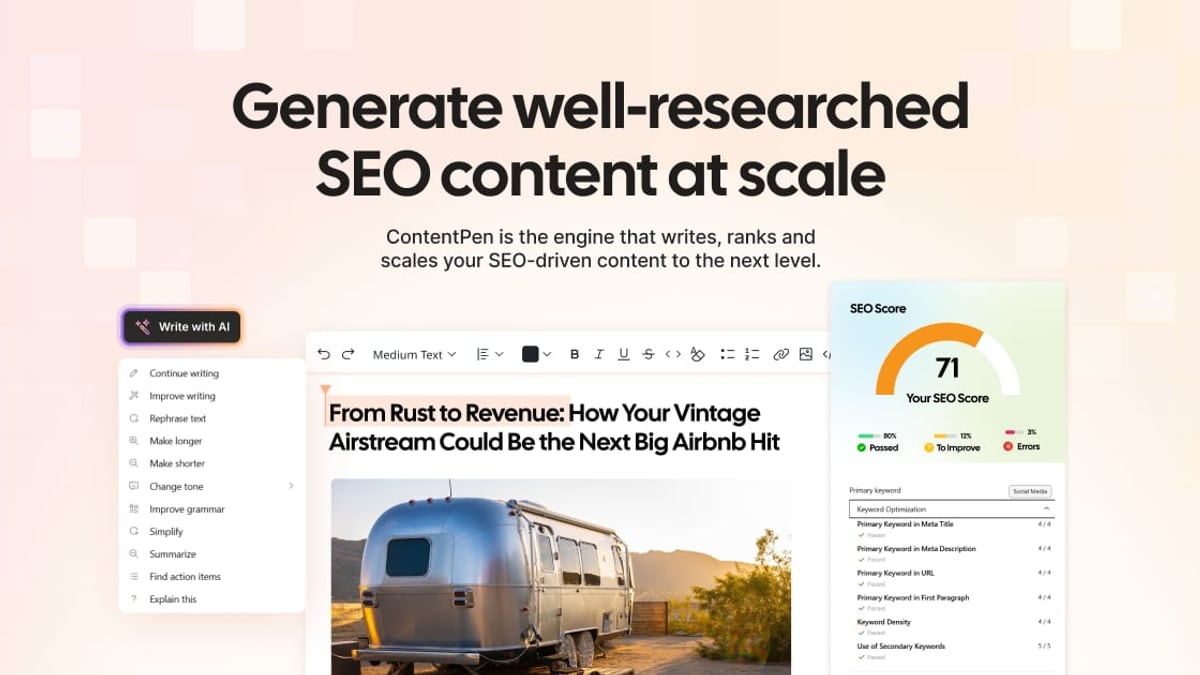
Contentpen takes a different scaling path. It offers bulk generation with SEO and AEO (Answer Engine Optimization) scoring baked in, plus automatic internal and external linking. The platform’s analytics dashboard then monitors content decay, CTR gaps, and AI visibility across seven major AI platforms—capabilities that Autoblogging.ai and AgentBooks don’t surface in the same way. According to its own feature roundup, Contentpen treats content as a continuous improvement loop rather than a one‑off publish.
AgentBooks focuses on continual, research‑backed output rather than maximum volume in a single batch. For teams that need hundreds of posts overnight, Autoblogging.ai’s credit‑based queues offer more immediate throughput.
Research and Factuality
AgentBooks explicitly prioritizes verifiable product facts and organic search result research. Before drafting, it mirrors real SERPs to ground articles in what users actually find useful. The result is content that ties back to your product pages and cited sources, reducing the risk of hallucinated claims—a critical advantage for regulated industries or complex B2B topics.
Autoblogging.ai’s Godlike Mode also incorporates SERP analysis, but its primary aim is on‑page SEO scoring (LSI placement, knowledge entity inclusion) rather than factual accuracy. Contentpen’s SEO optimizer suggests structure and keywords; the final fact‑check lands on the writer. Both can produce strong drafts, but AgentBooks’ research‑first pipeline is designed for teams that can’t afford post‑generation fact‑finding marathons.
Publishing and Approval Workflows
All three platforms offer one‑click publishing, but the path to “publish” looks different. Contentpen pushes to WordPress, Wix, Webflow, Shopify, and Ghost directly from its dashboard, and its multi‑client workspaces let agencies keep projects separate while running approval chains. Autoblogging.ai’s strength is its 35+ integrations and scheduled auto‑posting, saving agencies the daily login grind.
AgentBooks counters with a structured approval‑first workflow and custom‑domain multilingual publishing. Content goes live on your own subdomain or primary domain, which helps preserve site authority and gives complete architectural control. The API also allows development teams to embed the content pipeline into existing CI/CD or custom CMS setups—something not readily available in the other tools.
SEO and Analytics Capabilities
Contentpen stands out here with its AEO scoring and AI visibility monitoring. It tracks how your brand appears across ChatGPT, Grok, Claude, and other AI platforms, complete with sentiment analysis and share‑of‑voice metrics. For organizations that view generative‑engine optimization as the next frontier, this is a notable moat.
Autoblogging.ai automates LSI keyword and knowledge‑graph entity inclusion, which can lift on‑page scores right out of the gate. AgentBooks doesn’t replicate these analytics dashboards. However, it takes a transparent approach: it doesn’t promise rankings or traffic, instead delivering a steady stream of useful, brand‑aligned content that builds topical authority over time. That philosophy appeals to teams that prioritize editorial integrity over optimization gamification.
Pricing Overview
AgentBooks vs Contentpen vs Autoblogging.ai Compared (2026) product interface and feature overview.
Each platform tiers its access differently:
- AgentBooks offers a free Starter plan, then Pro at $29/mo and Team at $99/mo, with no credit counters on public plans.
- Autoblogging.ai starts at $19/mo for 40 credits (Starter) and scales to $999/mo for 5,000 credits; bulk‑focused agencies often land on the $249/mo 1,000‑credit tier. Credits roll over, and free monthly credits are available without a card.
- Contentpen begins at $27/mo for 10 articles (Starter), moves to $55/mo (Premium) and $139/mo (Agency), with enterprise plans custom‑quoted.
Solopreneurs testing the waters can start with AgentBooks’ free plan or Autoblogging.ai’s free credits. Teams that outgrow article caps will want to compare how each platform handles unlimited vs. metered usage.
Which Platform Fits Your Team?

AgentBooks vs Contentpen vs Autoblogging.ai Compared (2026) product interface and feature overview.
Choose AgentBooks if: you need a content operating system that deeply understands your product, continuously maps your market, and publishes fact‑checked, brand‑aligned articles on your own domain—without requiring a large editorial staff. It’s built for growth teams, SaaS companies, and digital product creators who value consistency and transparency over raw volume.
Choose Autoblogging.ai if: your primary metric is output. When you run dozens of sites or affiliate properties and need Godlike‑mode articles at scale with direct WordPress scheduling, Autoblogging.ai’s credit model and 35+ integrations cut the time from idea to live post.
Choose Contentpen if: you want an end‑to‑end platform that not only creates content but also actively tracks its performance. The AEO scoring, AI visibility monitoring, and content decay alerts make it a strong choice for marketers who treat content as a constantly optimised asset, not just a publishing event.
Related reading
- QuickCreator Review: Does Its AI Content Engine Pay Off? - Evidence-based QuickCreator review: how the 6-AI-agent platform creates brand-aligned SEO content, real pricing, user feedback gaps, and how it compares to AgentBooks.
- Top 10 Digital Experience Platforms (2026) Ranked & Reviewed - See the 10 best digital experience platforms for 2026 based on analyst data, user reviews, and real‑world results. Compare Adobe, Optimizely, Sitecore, and more.
- How to Use AgentBooks with Bynder for Automated Brand Content - Learn how to integrate AgentBooks' autonomous content engine with Bynder's enterprise DAM. Automate on-brand creation, asset retrieval, and multi-channel publishing in one workflow.
Sources and further reading
- Contentpen vs Autoblogging.ai - Bloggers and agencies trying to decide between Contentpen and Autoblogging.ai face two tools that promise to cut writing time but differ sharply in how much
- Contentpen vs. WPAutoBlog Comparison - Compare Contentpen vs. WPAutoBlog using this comparison chart. Compare price, features, and reviews of the software side-by-side to make the best choice for your business.
Frequently Asked Questions
Can AgentBooks produce the same volume of articles as Autoblogging.ai?
Not in a single batch. Autoblogging.ai can generate up to 500 articles from a CSV upload, while AgentBooks is built for steady, research‑grounded publishing. If your main need is immediate bulk, Autoblogging.ai has the edge.
Does Contentpen’s AEO scoring replace a dedicated SEO tool?
For many teams, yes. Contentpen’s AEO and SEO scoring, combined with its analytics, can replace a separate optimizer. However, if you also need deep brand intelligence and market mapping, you might still pair it with a platform like AgentBooks.
Which tool is best for preserving a unique brand voice?
AgentBooks learns voice by grounding itself in your website and product data, producing content that sounds like you rather than a generic AI writer. Contentpen and Autoblogging.ai also offer brand voice settings, but AgentBooks’ product‑aware approach adds an extra layer of authenticity.
Is there a completely free way to start?
Yes. AgentBooks’ free Starter plan gives you access to core publishing features without a credit card. Autoblogging.ai also provides 10 free credits monthly, though volume is limited.
Conclusion
AgentBooks, Contentpen, and Autoblogging.ai solve overlapping problems from very different angles. AgentBooks acts like an autonomous editorial researcher that never stops learning your product; Contentpen layers analytics and AI‑visibility intelligence across the full content lifecycle; and Autoblogging.ai pushes raw generation speed to the forefront. Your choice ultimately comes down to whether your team needs a brand‑first content engine, an optimization‑powered marketing dashboard, or a high‑volume article factory.