

AgentBooks vs Growth Engine Hub: Which AI Content Engine Wins?
Choosing between AgentBooks and Growth Engine Hub comes down to one question: do you want a deep content engine for owned channels, or a broad autonomous agent that also runs social, email, and video? Both platforms automate content, but they start from different places and optimize for different outcomes. This comparison breaks down how each works, where each is strong, and which type of team should pick which.
What AgentBooks Is Built to Do
AgentBooks is an AI-powered content automation platform that turns a website into an always-on content engine. You share your website once, and the system learns your product, maps your market, plans topics, researches top organic results, and continuously publishes useful content in your brand's voice.
The workflow is approval-first. AgentBooks generates a categorized keyword plan, drafts articles, prepares SEO elements (TDK, images, tags, links), and schedules publishing to a custom domain with its own site identity. It supports multilingual publishing and multi-brand workspaces, so agencies and portfolio owners can run several properties from one place.
AgentBooks is designed for SaaS teams, e-commerce and DTC sites, digital agencies, founders, and independent websites. It positions itself as a content engine that starts with real product data rather than blank prompts. Pricing is transparent: a public beta with a free plan, a Business plan at $30/month, and an Enterprise plan at $100/month. It does not guarantee rankings or traffic; it optimizes the content process and the measurable inputs that feed it.
What Growth Engine Hub Is Built to Do
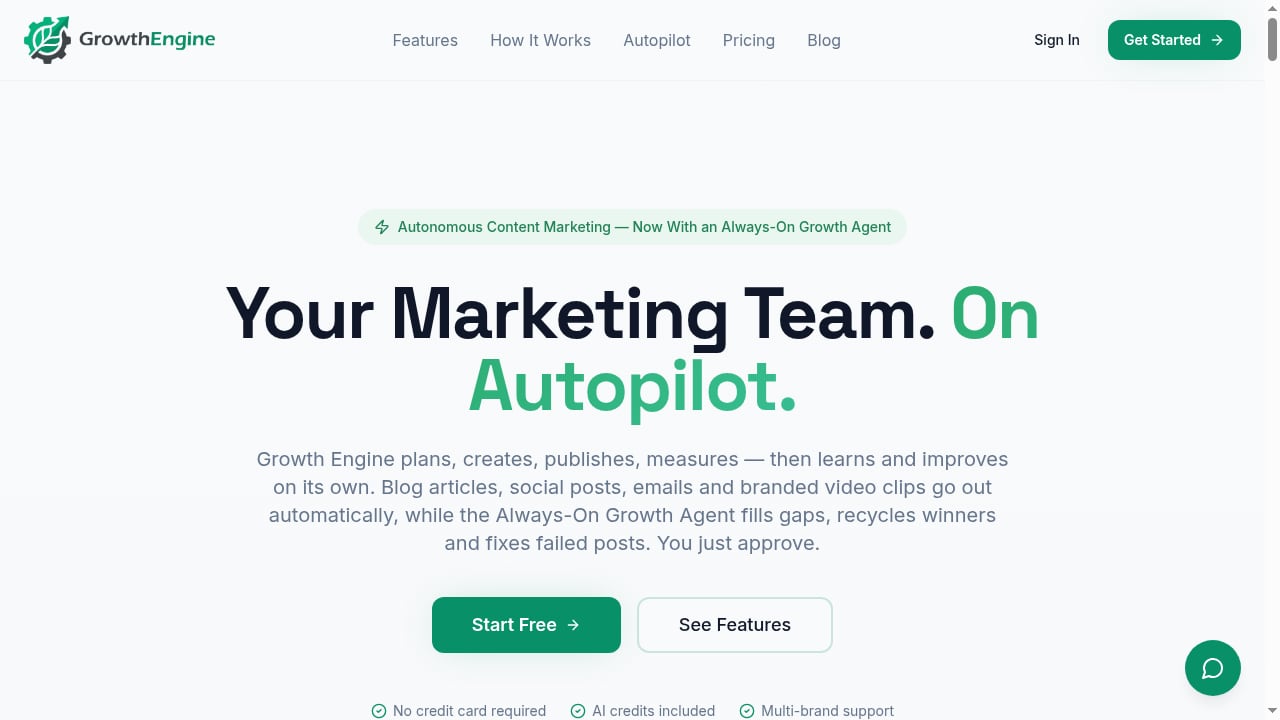
First viewport screenshot of Growth Engine Hub — Autonomous AI Content Marketing.
Growth Engine Hub is an autonomous AI content marketing platform that acts as an always-on growth agent. It plans, creates, publishes, and measures content across multiple channels: blog articles, social posts on four platforms, email newsletters, and branded video clips. It then learns and improves on its own.
Its flagship AI Growth Autopilot uses a Smart Guided Wizard with four steps: setting brand context, selecting competitors to outperform, choosing high-impact keywords, and defining goals. The AI then generates a strategic content plan and produces all content types, scheduling them automatically.
A key differentiator is the Always-On Growth Agent, which works 24/7 to fill content gaps, recycle winning content, and fix failed posts. Users keep control through a simple approval workflow. Performance IQ, a scoring system, uses real data to measure content performance. Growth Engine Hub supports multi-brand management and offers a free start with AI credits included, no credit card required. It positions itself as a complete solution for autonomous content marketing.
Head-to-Head Comparison
First viewport screenshot of Growth Engine Hub — Autonomous AI Content Marketing.
| Dimension | AgentBooks | Growth Engine Hub |
|---|---|---|
| Core approach | Website-to-content engine driven by product data | Autonomous growth agent across multiple channels |
| Setup | Share website once; system learns product and market | Smart Guided Wizard: brand context, competitors, keywords, goals |
| Planning | Categorized keyword plan from market research | Strategic content plan generated after wizard steps |
| Content types | Articles with SEO preparation (TDK, images, tags, links) | Blog articles, social posts on four platforms, email newsletters, branded video clips |
| Research | Top organic-result research baked into drafting | Competitor selection to outperform |
| Workflow | Approval-first article workflow with scheduled generation | Approval workflow with automatic scheduling |
| Optimization loop | Continuous publishing in brand voice; no ranking guarantees | Always-On Growth Agent fills gaps, recycles winners, fixes failed posts |
| Measurement | Focus on process and measurable inputs | Performance IQ scoring with real data |
| Publishing | Custom domain and site identity, multilingual | Multi-channel scheduling across blog, social, email, video |
| Multi-brand | Multi-brand workspaces | Multi-brand management |
| Pricing | Free beta plan; Business $30/month; Enterprise $100/month | Free start with AI credits; no credit card required |
Where AgentBooks Has the Edge
Product-grounded content instead of blank prompts
AgentBooks starts by crawling your website and learning the product. That means drafts reflect what you actually sell, not generic topic filler. For SaaS and DTC teams with complex offerings, this reduces the editing burden that comes with prompt-only tools.
A structured keyword plan you can inspect
Instead of a black-box plan, AgentBooks produces a categorized keyword plan. You can see which topics map to which clusters before a single article is written. That transparency matters for teams that need to align content with product launches or sales priorities.
SEO preparation built into every article
TDK, images, tags, and links are prepared as part of the article workflow. You are not stitching together a writer, an SEO plugin, and a spreadsheet. This is the kind of workflow depth covered in our comparison of AgentBooks vs MarketMuse, where planning tools and full engines diverge.
Transparent, low-cost pricing
A free beta plan, $30/month Business, and $100/month Enterprise make AgentBooks easy to trial without a sales call. For founders and lean teams, that predictability matters.
Multilingual and multi-brand from one workspace
Agencies and portfolio owners can run several brands and languages without separate accounts or duplicated setup.
Where Growth Engine Hub Has the Edge
First viewport screenshot of Growth Engine Hub — Autonomous AI Content Marketing.
True multi-channel output
Growth Engine Hub does not stop at blog articles. It produces social posts on four platforms, email newsletters, and branded video clips. If your bottleneck is channel coverage rather than article depth, that breadth is a real advantage.
A self-improving optimization loop
The Always-On Growth Agent works continuously to fill content gaps, recycle winning content, and fix failed posts. This is a more aggressive automation posture than a scheduled publishing queue.
Performance IQ scoring
Performance IQ uses real data to score content performance, giving marketers a feedback signal that pure publishing tools often lack.
Guided onboarding for non-specialists
The Smart Guided Wizard walks users through brand context, competitors, keywords, and goals. For solopreneurs and small business owners without a content strategist, that structure lowers the starting barrier.
Where Each Platform Has Limits
AgentBooks does not guarantee rankings or traffic, and it focuses on owned content rather than social, email, or video distribution. Teams that need a single tool to run every channel will find its scope narrower than Growth Engine Hub's.
Growth Engine Hub spreads across many formats, which can dilute depth per channel. A blog article, a social post, an email, and a video clip require different quality bars, and a single autonomous system may not match a dedicated article engine on long-form SEO depth. Its public pricing details are also less specific than AgentBooks' published tiers, so buyers should confirm costs against their expected credit usage.
Which Should You Choose?

First viewport screenshot of Growth Engine Hub — Autonomous AI Content Marketing.
Choose AgentBooks if:
- Your growth depends on organic search and owned content depth.
- You want content grounded in real product data, not generic prompts.
- You need a visible keyword plan and approval-first workflow.
- You run multiple brands or languages and want one workspace.
- You prefer transparent pricing at $30 or $100 per month.
Choose Growth Engine Hub if:
- You need blog, social, email, and video from one platform.
- You want an autonomous agent that continuously optimizes without manual prompts.
- You value performance scoring tied to real data.
- You are a solopreneur or small team that wants guided setup.
If you are still mapping the category, our roundup of AI search visibility and content operations platforms puts both approaches in context. And if you want to see how AgentBooks fits alongside measurement tooling, the AgentBooks and SEOcrawl AI workflow shows a practical setup.
How the Broader Market Is Moving
The shift toward autonomous agents is not limited to content marketing. In commerce, agentic systems are being measured against traditional conversational tools on autonomy, context retention, and cross-functional coordination. As KIBO's analysis of agentic commerce notes, true agentic platforms make independent decisions within defined bounds and maintain context across long interactions, while older conversational tools escalate and lose the thread. McKinsey's outlook on agentic commerce frames the same trajectory for retail: hyperpersonalized experiences and autonomous transactions. The lesson for content buyers is that "autonomous" is a spectrum, and the right question is which decisions you want the system to make on its own.
Related reading
- Averi Review 2026: Honest Look at the AI Content Engine - Averi review for founders and lean teams: how the Brand Core and Strategy Map work, real pricing, SEO/GEO scoring, limitations, and who should buy.
- Top 10 Enterprise SEO & AI Search Platforms 2026 - We ranked the 10 best enterprise SEO and AI search optimization platforms for 2026 by scalability, AEO coverage, actionability, and pricing evidence.
- AgentBooks vs AirOps vs Averi: Which AI Content Engine Fits? - Compare AgentBooks, AirOps, and Averi on brand intelligence, AI search visibility, publishing workflow, and pricing to pick the right content engine.
Sources and further reading
- Sourcing Leads: Complete Guide to Finding Quality Prospects - Master lead sourcing with proven strategies, essential tools, and best practices. Learn how to build a sustainable pipeline and convert prospects efficiently.
FAQ
Is AgentBooks a full replacement for Growth Engine Hub?
No. AgentBooks focuses on owned content: articles, keyword planning, SEO preparation, and publishing. Growth Engine Hub also covers social, email, and video. If you need multi-channel output, they are not direct substitutes.
Does AgentBooks guarantee rankings?
No. AgentBooks explicitly does not guarantee rankings or traffic. It optimizes the content process and the measurable inputs that support organic performance.
How much does each platform cost?
AgentBooks offers a free beta plan, a Business plan at $30/month, and an Enterprise plan at $100/month. Growth Engine Hub offers a free start with AI credits included and no credit card required; its paid tiers should be confirmed directly.
Can I run multiple brands on either platform?
Yes. AgentBooks supports multi-brand workspaces, and Growth Engine Hub supports multi-brand management.
Which is better for a solo founder?
If your priority is consistent blog content grounded in your product, AgentBooks is the leaner fit. If you want one system to also handle social, email, and video without hiring, Growth Engine Hub's guided wizard and autonomous agent are designed for that scenario.
Conclusion
AgentBooks and Growth Engine Hub solve adjacent problems. AgentBooks is a product-grounded content engine for teams that win through organic search and owned content depth. Growth Engine Hub is an autonomous multi-channel agent for teams that need broad coverage with minimal human input. Neither is universally better. Match the tool to your bottleneck: if it is article depth and SEO structure, start with AgentBooks. If it is channel coverage and hands-off optimization, Growth Engine Hub is the closer fit.